My highest objective is to help you reach your goals. Together, we create a plan for success specific to your needs. Coaching, Leadership Consulting, Author
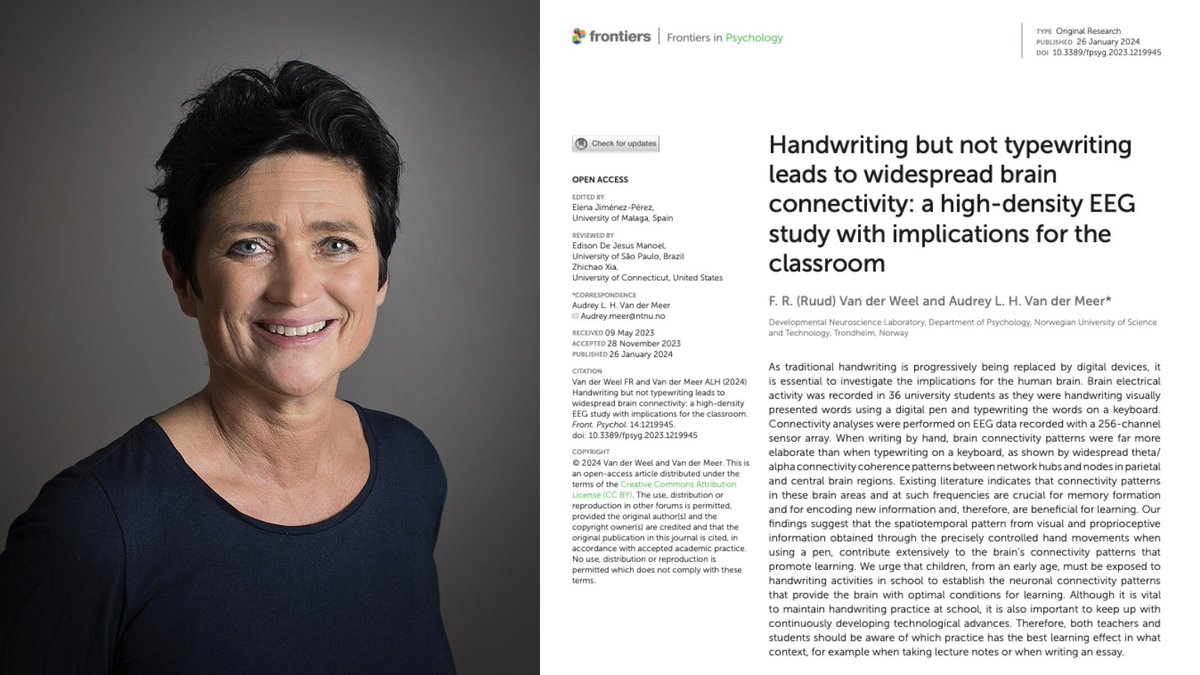
A Norwegian neuroscientist spent 20 years proving that the act of writing by hand changes the human brain in ways typing physically cannot, and almost nobody outside her field has read the paper.
Her name is Audrey van der Meer.
She runs a brain research lab in Trondheim, and the paper that closed the argument was published in 2024 in a journal called Frontiers in Psychology. The finding is brutal enough that it should have changed every classroom on Earth.
The experiment was simple. She recruited 36 university students and put each one in a cap with 256 sensors pressed against their scalp to record brain activity. Words flashed on a screen one at a time.
Sometimes the students wrote the word by hand on a touchscreen using a digital pen, and sometimes they typed the same word on a keyboard. Every neural response was recorded for the full five seconds the word stayed on screen.
Then her team looked at the part of the data most researchers had ignored for years, which is how different parts of the brain were communicating with each other during the task.
When the students wrote by hand, the brain lit up everywhere at once.
The regions responsible for memory, sensory integration, and the encoding of new information were all firing together in a coordinated pattern that spread across the entire cortex. The whole network was awake and connected.
When the same students typed the same word, that pattern collapsed almost completely.
Most of the brain went quiet, and the connections between regions that had been alive seconds earlier were nowhere to be found on the EEG.
Same word, same brain, same person, and two completely different neurological events.
The reason turned out to be something nobody had really paid attention to before her work. Writing by hand is not one motion but a sequence of thousands of tiny micro-movements coordinated with your eyes in real time, where each letter is a different shape that requires the brain to solve a slightly different spatial problem.
Your fingers, wrist, vision, and the parts of your brain that track position in space are all working together to produce one letter, then the next, then the next.
Typing throws all of that away. Every key on a keyboard requires the exact same finger motion regardless of which letter you are pressing, which means the brain has almost nothing to integrate and almost no problem to solve.
Van der Meer said it plainly in her interviews.
Pressing the same key with the same finger over and over does not stimulate the brain in any meaningful way, and she pointed out something that should scare every parent who handed their kid an iPad.
Children who learn to read and write on tablets often cannot tell letters like b and d apart, because they have never physically felt with their bodies what it takes to actually produce those letters on a page.
A decade before her, two researchers at Princeton ran the same fight using a completely different method and ended up at the same answer. Pam Mueller and Daniel Oppenheimer tested 327 students across three experiments, where half took notes on laptops with the internet disabled and half took notes by hand, before testing everyone on what they actually understood from the lectures they had watched.
The handwriting group won by a wide margin on every question that required real understanding rather than surface recall.
The reason was hiding in the transcripts of what the two groups had actually written down.
The laptop students typed almost word for word, capturing more total content but processing almost none of it as they went, while the handwriting students physically could not write fast enough to transcribe a lecture in real time, which forced them to listen carefully, decide what actually mattered, and put it in their own words on the page.
That single act of choosing what to keep was the learning itself, and the keyboard had quietly skipped the choosing and skipped the learning along with it.
Two studies. Two countries. Same answer.
Handwriting makes the brain work. Typing lets it coast.
Every note you have ever typed instead of written went into your brain through a thinner pipe. Every meeting, every book highlight, every idea you captured on your phone instead of on paper was processed at half depth.
You did not forget those things because your memory is bad. You forgot them because typing never woke the part of the brain that would have made them stick.
The fix is the thing your grandmother already knew.
Pick up a pen. Write the thing down. The slower road is the faster one.
Healing doesn’t happen in survival mode.
Sometimes the missing piece isn’t more restriction, harder workouts, or stricter routines; it’s sleep, nourishment, slowing down, stable blood sugar, deep breaths, sunlight, minerals, rest, and finally teaching your body that it’s safe again.
Your symptoms are not always a sign of laziness. Sometimes they’re a sign your body has been in fight-or-flight for far too long.
One of the hardest things to accept is that obedience to God will sometimes make you look strange to people who only understand comfort.
Noah looked ridiculous building the ark.
David looked underqualified.
The disciples looked uneducated.
Jesus Himself was misunderstood constantly.
Sometimes growth requires you to disappoint the version of you that wanted universal approval.
Not everybody will understand the assignment on your life.
And they don’t need to.
Being grateful for what you have does not mean you have to silence the part of you that knows you’re capable of more. Gratitude and growth can exist in the same heart.
The calmest person you know wasn't born that way. They trained it. Every time they paused instead of reacting, every time they chose silence over the last word, they were building a muscle. Emotional control is a skill, not a personality type. Some people decided to train it. Others decided their reactions are just who they are. One group has better outcomes.
Major cheat code in life: Decide what you won't tolerate before you're in the situation. In the moment, you'll talk yourself into staying. You'll rationalize. You'll lower the bar. Set your standards when you're calm and clear. When the moment comes, the decision is already made.
3 beliefs I will brainwash you into believing if you follow me:
1. Everything is 100% rigged in your favor.
Your brain is an evidence-seeking machine.
If you think the world is conspiring against you, you will certainly find evidence for that. So flip that belief on its head and start looking for ways the world is rigged *for you*.
You’ll quickly start to feel this is true.
2. Every outcome is 100% your responsibility.
Now, just because the world is rigged in your favor doesn’t mean the things you want are just going to “happen.”
It’s still on you to do them—and in fact, it’s 100% on you.
No one is coming to save you.
Not your parents, not the government, not your friends, nobody.
And this is the single most powerful belief you can have. Suddenly, the world becomes a massive playground for you to go and shape as you wish.
3. Every circumstance is an opportunity for growth.
Finally, you need to reframe your perspective on everything into a learning opportunity.
Not everything is going to work out how you want.
But there will be a chance to progress in some way, no matter what comes at you.
And this should make you extremely optimistic—no matter what you come across, you will emerge on the other side further along.
Jordan Peterson just said the one thing no university on Earth wants you to hear.
Peterson: “If you can think, and speak, and write, you are absolutely deadly. Nothing can get in your way.”
Twelve years of school. Four years of university. Not one teacher ever pulled you aside and said the thing that matters.
You were taught that writing is how you prove you followed the rules. Hit the word count. Match the rubric. Cite in APA. Pass the class.
Peterson: “No one ever tells students why they should write something.”
Because the real answer would dismantle the entire arrangement.
Writing is not a subject. It is the physical shape of a thought.
The words you can assemble are the only thoughts you get to think. Everything outside your vocabulary is a feeling you cannot name and a future you cannot plan.
Every empire in history knew this. Priests guarded the alphabet. Kings outlawed the printing press. Slave owners made reading a crime punishable by death.
They were not protecting paper. They were protecting obedience.
The modern version is gentler. They put the weapon in your hands at age five and called it homework. Graded your grammar and ignored your mind. Spent two decades convincing you the most dangerous tool a human can hold was just another assignment.
Peterson: “It’s the most powerful weapon you can possibly provide someone with.”
A person who can articulate their own reality cannot be sold a borrowed one. That is the version of you the system cannot afford to create.
You graduate able to write emails. Not your own life.
Most people will spend their entire existence renting their thoughts from the few who learned what a sentence actually does.
He said this from inside a University of Toronto lecture hall. Tenured professor. Twenty years. Nominated five consecutive years as one of Ontario’s best lecturers. Students called his courses life changing. The institution made him persona non grata and he walked away.
The one professor who actually told you what the weapon does got pushed out for using it himself.
That tells you everything about who the system was designed to protect. Not the students. Not the thinkers. The structure.
Twenty years of education and the most important thing you were ever told came from a man the university couldn’t get rid of fast enough.
The moment you force a true sentence out of yourself, unassigned and ungraded, you stop being written. You start being dangerous.