@ellegitimate @DodoNerd @objectiv_io I think it also depends on what you want to do with your data.
For rudimentary UX analysis it may be sufficient. It gets trickier when you want to do stuff like user clustering, churn prediction, attribution modeling etc.
@DodoNerd @objectiv_io I think it does mean front-end engineers spend less time on initial instrumentation, but at the expense of data quality.
As a result, instrumentation often gets revisited at a later stage when data teams find out their data is lacking.
It's convenient, but far from perfect.
@DodoNerd Autocapture is convenient to set up, but leads to data that needs a lot of cleaning & transformations. I think it's one of the biggest reasons companies struggle to use their data effectively, but I might be biased as I work at @objectiv_io
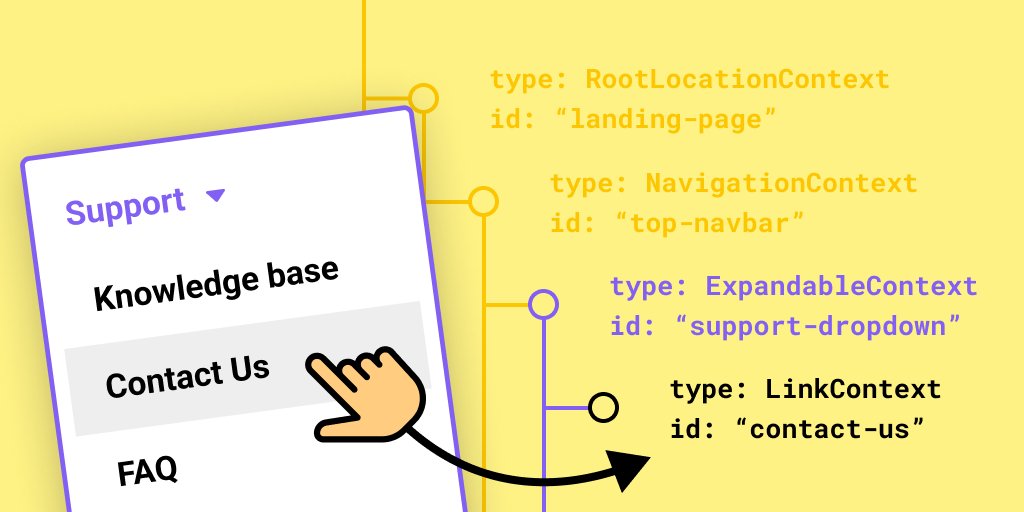
Our analytics tracker captures exactly where in the UI an event happens 🎬
This is stored in the event itself as a hierarchical stack of locations 🗃️
Use these locations to slice your data: no manual mapping required. 🔪
👉 https://t.co/cRhVxvAAA0
@__AlexMonahan__@ergestx That's pretty much what we're trying to do for product analytics with @objectiv_io . We've built an OSS tracker that validates all incoming events against an open analytics taxonomy designed for data science. Curious to hear what you think: https://t.co/CUSNHiqdVz
Excited to finally show you what we've silently been working on the last 12 months!
Say hello to the first release of Objectiv: open-source product analytics designed for data science.
https://t.co/O74pOueM4t
🧵Why are we building this? Thread below 👇