De-growth is the ultimate bourgeois ideology, dreamed up by spoiled kids in developed countries who would close the door behind them, oblivious to the fate of billions in the left tail of the global income distribution whose only hope to make it out of poverty is growth.
Nota técnica | Evolución reciente del tipo de cambio nominal en Paraguay: una visión macroeconómica integral
Acceder al análisis en https://t.co/7S5i8BpAec
One reason I started teaching my "progress" class is the vibes vs reality gap. Coming into the greatest decade in human history: basically solved metabolic syndrome, deaths from autos, huge progress in abundant green energy and cancer, going back to the moon, (and yeah, AI) 1/2
Every time I discuss the economic and social disruptions caused by the worldwide decline in fertility, I hear the same response: artificial intelligence (AI) and robots will make this issue irrelevant.
I find the answer deeply paradoxical because, despite being an economist, I am compelled to point out that the argument suffers from the mistake of “economism”: thinking that all social interactions in life are solely about productivity.
Most of the problems caused by declining fertility are largely unrelated to productivity: the depopulation of rural areas, the collapse of public services, and inverted family structures in which one child supports four grandparents. Reducing all of this to purely economic terms is an extremely narrow view of society and life. A robot cannot visit your grandmother in a nursing home in a depopulated town in Korea.
But there is an even more fundamental question: how do you know that societies will permit the deployment of artificial intelligence on a large enough scale? If we have learned anything from economic history, it is that societies repeatedly create barriers to wealth and hinder the adoption of new technologies.
The Roman Empire had a working steam device, the aeolipile, and never developed it beyond a toy. The Ming dynasty burned Zheng He’s fleet and turned inward. Spain expelled its Jewish and Moorish populations at the height of its imperial power, gutting its merchant and artisan classes. The Ottoman Empire resisted the printing press for nearly three centuries after Gutenberg. Tokugawa Japan had firearms in the 1500s but chose to abandon them. The Qing restricted all foreign trade to a single port in Canton for over a century. Argentina was one of the ten richest countries in the world in 1910 and spent a century in relative decline through self-inflicted policy choices. The Soviet Union had world-class mathematicians and physicists but could not produce a decent pair of shoes because the institutional framework would not allow it. India’s License Raj strangled industrial development for four decades after independence. Closer to our own time, much of Europe spent decades resisting genetically modified crops despite the technology being available. Right now, the EU is drafting some of the strictest AI regulations in the world.
And these problems will hit hardest where people least expect them. The conversation about aging and AI tends to focus on rich countries like the U.S. or Japan, but the most acute disruptions will come in emerging economies. Latin America and the Middle East have experienced some of the deepest and fastest declines in fertility on the planet. Colombia’s TFR is 1.06, Jamaica’s 1.20, Turkey’s 1.48, and Mexico’s 1.60. These countries are getting old before they get rich. On top of that, they face a double blow: not only are fewer children being born, but their most skilled and ambitious young workers are leaving. The doctors, engineers, and entrepreneurs who might drive AI adoption are moving to the US, Canada, or Europe.
And let’s be honest: these are not exactly countries known for getting out of the way of innovation. The political economies of Latin America and the Middle East are riddled with extractive institutions, captured regulators, powerful incumbents who block competition, and states that struggle to deliver basic public services, let alone manage an AI transition. If Argentina could not reform its economy in a hundred years of trying (perhaps it is doing it now, but the jury is still out on whether this reform will be sustainable), if Mexico cannot keep its own engineers from leaving, if Egypt cannot fix its educational system, I am not sure why we should expect them to seamlessly deploy the most disruptive technology in human history. The countries that most need technological dynamism to offset demographic decline are precisely the ones least equipped to make it happen.
There is nothing inevitable about adopting new technologies. It requires political will, institutional flexibility, and social acceptance. Aging, fiscally strained democracies dominated by elderly voters are not obviously the best candidates for any of those three.
So when someone tells me “don’t worry, AI will fix it,” I hear an argument that assumes the best possible technological outcome, assumes societies will actually adopt it, assumes it will be deployed fast enough, and assumes the only thing that matters is productivity. That is four enormous assumptions stacked on top of each other. And I am sorry, but since I teach global economic history for a living, I have learned that optimistic assumptions are rarely validated by the crooked timber of humanity.
En su reunión de la fecha, el Comité de Política Monetaria (#CPMpy) decidió, por unanimidad, reducir la tasa de interés de política monetaria (TPM) de 5,75% a 5,50% anual.
Comunicado: https://t.co/Vkl0W4kH0x
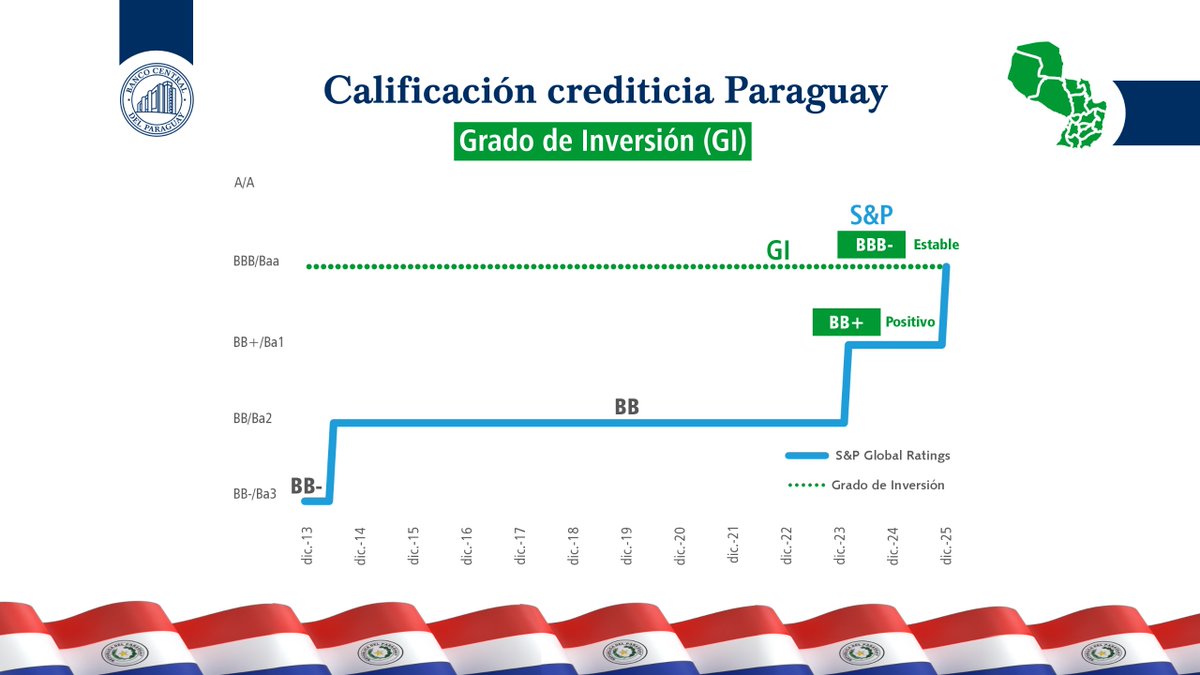
¡Otro paso histórico! Paraguay consolida su Grado de Inversión: S&P eleva la calificación a BBB-, destacando el fortalecimiento de la política monetaria, la credibilidad del BCP reflejada en la convergencia de las expectativas hacia la nueva meta de inflación, y la profundización del mercado financiero local.
Noticia completa: https://t.co/objnCQp0Hm
Qué locura!! A Norris le hicieron una parada lenta y fue superado por Piastri. Entonces, como fue "culpa" del equipo, Piastri le devolvió la posición.
No me parece que corresponda. No fue culpa de Óscar, no es cosa suya.
Max soltó una carcajada cuando se enteró. Momentazo.
The National Institute of Statistics of Paraguay estimates the country’s total fertility rate (TFR) at 1.95, already below replacement:
https://t.co/8SiEX9owc2
Now, you may be asking: Why should I care about Paraguay (unless, of course, you’re from Paraguay)?
Paraguay’s income per capita, around $6,500, is roughly one-fifth that of the U.S. in PPP terms. It ranks in the bottom quartile of Latin America, poor by most standards (although not as poor as Haiti).
Yet despite being a poor country, Paraguay’s TFR has already fallen below replacement and is declining fast. The official projection for 2050 is 1.72.
That seems overly optimistic. Based on regional trends, I’d expect something closer to 1.3 or lower. I could be wrong, of course, but it’s difficult to justify a rosier forecast given current data.
On top of that, Paraguay suffers from net emigration: many Paraguayans leave for Argentina, Brazil, or Spain in search of better opportunities. It’s not a country likely to attract large-scale immigration to offset fertility decline.
So here’s the real question: Have economists seriously started thinking about the long-run consequences of a sustained TFR well below replacement in a country with $6,500 per capita income, net outmigration, and limited state capacity?
Because this is no longer a hypothetical. It’s Paraguay in 2025.
Paraguay en las 6 primera fechas de las Eliminatorias (2 partidos con Barros Schelotto y 4 con Garnero)...
5 puntos de 18 posibles y 1 gol anotado.
Paraguay en las 6 últimas fechas de las Eliminatorias (con Gustavo Alfaro)...
12 puntos de 18 posibles, ninguna derrota y 7 goles anotados.
TIEMBLA EL CONTINENTE: LA GARRA GUARANÍ HA VUELTO.
PAR 1-1 VEN (59') - Jugada MÁGICA de Paraguay de principio a fin. Diego Gómez rompe líneas con un pase extraordinario, diablura de Almirón, gran asistencia de Junior Alonso y Sanabria no perdona. Lo merecía Paraguay,
El economista César Yunis Yuruhan, con más de 30 años de carrera en la institución, fue designado por el Directorio como economista jefe del Banco Central del Paraguay.
Norman Funk, Director de operaciones de Joshua Duerksen nos cuenta una anécdota de cómo casi pierde el trabajo al no tener la bandera paraguaya el día de la victoria del piloto 🏎️ 💥
#ArdeLaCiudad 📻🔥
https://t.co/cJFYYGuymQ