Consortium affiliated researcher @JaredSchachner was recently on The Report Card with Nat Malkus, discussing some findings on the #COVID19 Chicago Connected program.
Listen here: https://t.co/BYkowz1v0s
Read the research: https://t.co/aRGmdVgMFr
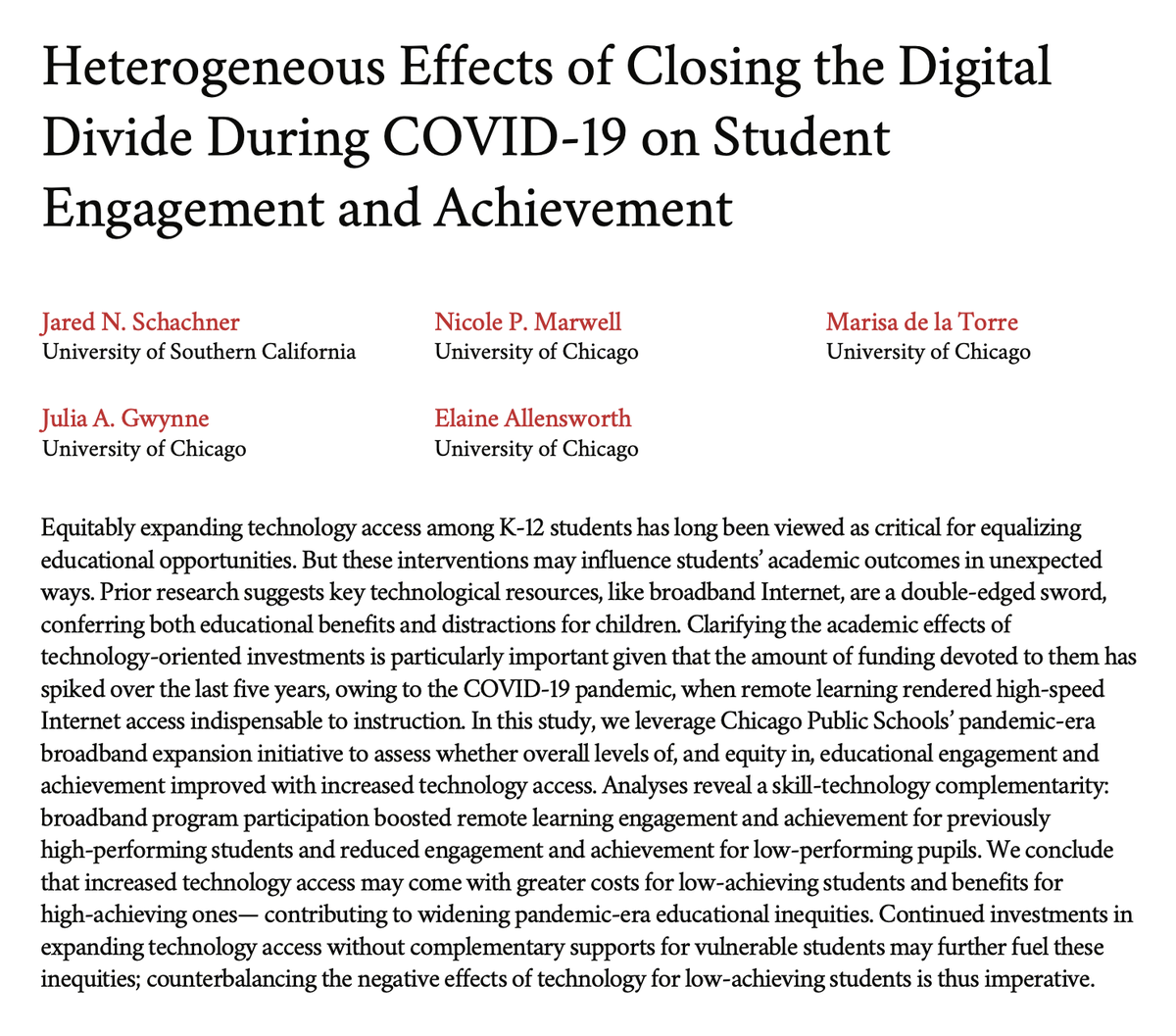
When Chicago launched the Chicago Connected program to provide free broadband during the pandemic, it aimed to level the playing field for remote learners. But a new study finds the initiative had uneven effects—helping some students while harming others.
“Broadband access improved academic engagement for high-performing students, but had the opposite effect on those who were already struggling,” said Jared N. Schachner, a research scientist at the USC Sol Price Center for Social Innovation.
On the latest episode of The Report Card podcast, Schachner discusses what these findings mean for schools investing in educational technology.
Listen to the podcast here: https://t.co/IDEYm06aTA
On the latest episode of The Report Card, @natmalkus and @JaredSchachner discuss why increased broadband access during the pandemic reduced engagement and achievement for low-performing students. https://t.co/guiXWsJROG
This seems like a pretty big finding to understand why inequality in education is increasing:
When high-performing students got broadband in their homes, they learned more.
When low-performing students got broadband in their homes, they learned less.
Heterogeneous Effects of Closing the Digital Divide During COVID-19 on Student Engagement and Achievement
https://t.co/Z6LkwjXq8A via @JaredSchachner et al
When high-performing students got broadband in their homes, they learned more.
When low-performing students got broadband in their homes, they learned less @TomPMarshall
Let’s clear the air for our kids: @KECKSchool_USC finds that air pollution from fossil fuels could be affecting children’s learning and memory. 🧠 https://t.co/FPXVG5PpyT
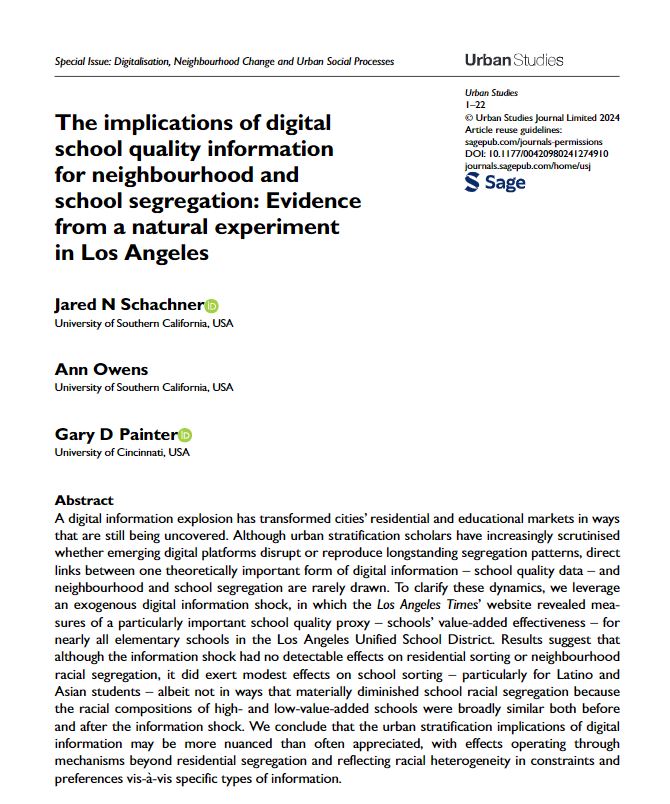
Does the digital provision of publicly-accessible information on schools’ value-added quality (i.e., their estimated causal effects on student learning) increase or decrease race-based #segregation in both #neighbourhoods and #schools? @JaredSchachner
https://t.co/vvQXFje6Tb
New special issue article by @JaredSchachner, Ann Owens and Gary D Painter: The implications of digital school quality information for #neighbourhood and #SchoolSegregation: Evidence from a natural experiment in Los Angeles
https://t.co/vvQXFje6Tb
#DigitalInformation
New paper out, congrats to @62442katieb @kharloews @hertinglab !!! 🎉🥳 Adolescent Neurodevelopmental Variance Across Social Strata | Pediatrics | JAMA Network Open | JAMA Network https://t.co/hrzjkTHWDR
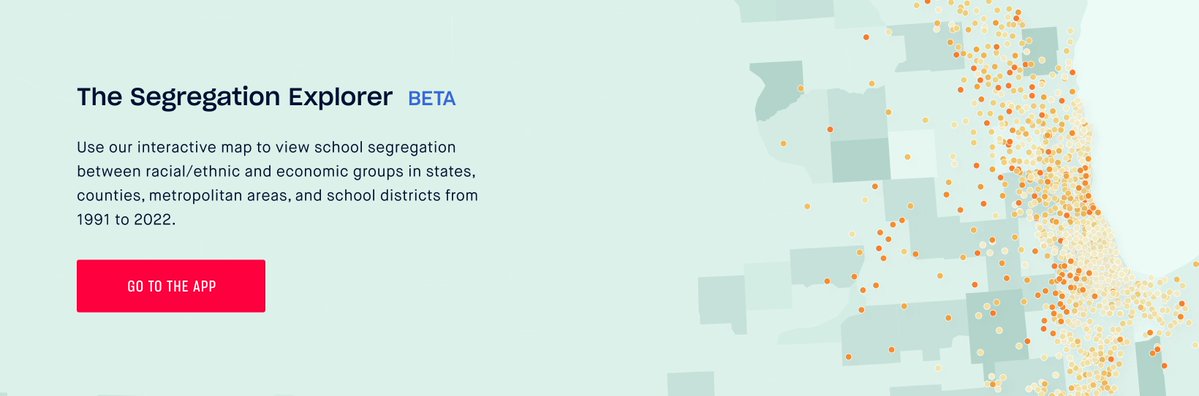
💫Today we launch the Segregation Explorer!💫
Visualize and download school segregation data for every state, county, metro area, commuting zone, geo school district, and local educational agency in the US since 1991.
https://t.co/pZ2FOVqDyZ
My paper with @Marybel08 with recommendations on responsibly using and communicating race and ethnicity concepts in neuroimaging is out in Nature Neuroscience!
Free-to-view link is here! See details in the quoted post!
https://t.co/Jc1CvJ7oUu
Best birthday gift so far!
Today, I want to express my sincere gratitude to each and every one of you who supported our campaign. Although the results did not turn out as we hoped, our commitment to justice, public safety and sustainable reform remains unwavering.
This campaign was a journey that underscored the importance of our shared values and the work that still needs to be done in our communities. I am proud of what we have accomplished together, and I encourage everyone to continue advocating for the causes we believe in. Thank you for your support, your energy, and your belief in a better future for all.
Forthcoming in the AER: "Creating Moves to Opportunity: Experimental Evidence on Barriers to Neighborhood Choice" by Peter Bergman, Raj Chetty, Stefanie DeLuca, Nathaniel Hendren, Lawrence F. Katz, and Christopher Palmer. https://t.co/wLFQuomx4Y