@PawelAbrax3 Jakie 12 lat po wojnie? pierwszy STAR 20 opuścił bramy fabryki w Starachowicach 15 grudnia 1948 https://t.co/J15EtKX2x1 PS. pozdrowienia ze Starachowic miejsca narodzin tego STARa
@cuprwarszawa Sprawa nie dotyczy ulic w Polsce, lecz w partnerskim mieście Nowowołyńsk na Ukrainie. Starosta, oraz Rada Powiatu Otwockiego przyjęli uchwałę z apelem do tamtejszych władz o zmianę nazw ulic upamiętniających Stepana Banderę oraz UPA https://t.co/tFTtN9YGGb
@mariuszskrobala W socjalistycznej Polsce(PRL) opodatkowanie paliwa opierało się na scalonym podatku obrotowym, którego stawka bazowa wynosiła 10% podstawy opodatkowania (obrotu uzyskiwanego ze sprzedaży przez Centralę Produktów Naftowych – CPN)
Citizen Vigilante is a 2026 action thriller directed by Uwe Boll, starring Armie Hammer as Sanders, a former U.S. Army officer who turns vigilante after witnessing brutal crimes while in Europe.
Drawing from real-life criminal cases, the film follows Sanders as he takes on violent offenders and a justice system he believes has abandoned victims-transforming him into a polarizing folk hero.
Co-starring Costas Mandylor, the movie has ignited intense debates around immigration, crime, vigilantism, free speech, and censorship.
Blood on the Payroll: How the CIA Funded the Men Who Massacred 100,000 Poles — Documented in Their Own Classified Files.
In the summer of 1943, Ukrainian Insurgent Army units moved through the villages of Volhynia with axes, pitchforks, and fire. They killed 100,000 Polish civilians — men, women, and children — pursuant to a written order issued by their commander calling for the "general physical liquidation of the entire Polish population." It was one of the largest single-nationality ethnic cleansing operations in the history of World War II.
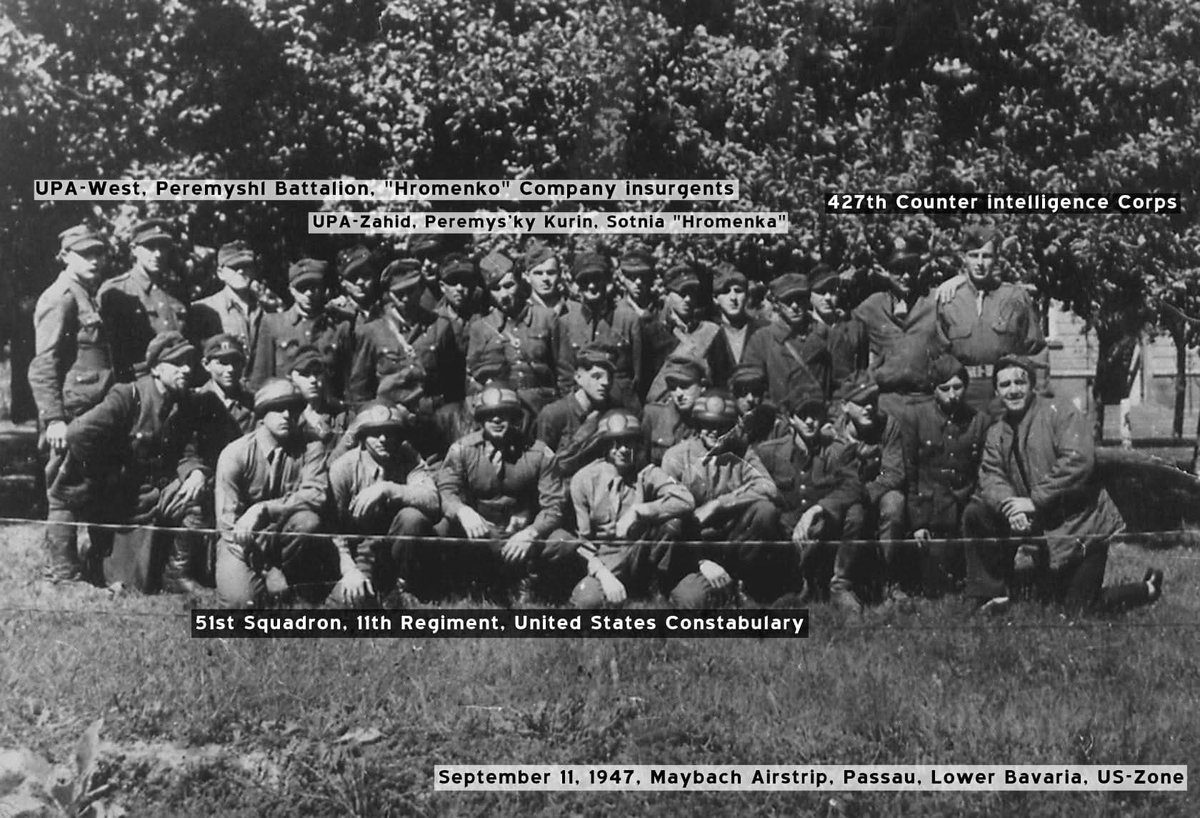
Less than a decade later, the Central Intelligence Agency of the United States of America put the leadership of that organization on its payroll.
Not metaphorically. Not indirectly. On its payroll. With accounting reports reviewed quarterly by CIA case officers. With operational funds forwarded from CIA headquarters. With agents trained, dispatched, and debriefed. With a formal project approval signed at the highest levels of American intelligence, renewed year after year for decades.
The program was called Project AERODYNAMIC. Every document quoted in this article is available in the CIA's public reading room. None of it is disputed. None of it has ever been seriously covered by the Western mainstream press.
What the CIA's Own Documents Say
The founding document of Project AERODYNAMIC states its purpose without ambiguity.
"The purpose of Project AERODYNAMIC is to provide for the exploitation and expansion of the anti-Soviet Ukrainian resistance movement for cold war and hot war purposes. Such groups as the Ukrainian Supreme Council of Liberation (UHVR) and its Ukrainian Insurgent Army (UPA), the Foreign Representation of the Ukrainian Supreme Council of Liberation (ZPUHVR) in Western Europe and the United States, and other organizations such as OUN/B will be utilized."
The Ukrainian Insurgent Army. The UPA. Named explicitly as the instrument of American Cold War strategy. The organization whose units had burned Polish villages to the ground eight years earlier. The organization whose commander Dmytro Klyachkivsky had issued a written order in 1943 for the extermination of the entire Polish population of Volhynia. Named. Funded. Exploited.
A subsequent renewal document — one of many in the multi-volume AERODYNAMIC archive — describes the project's continued purpose as providing "CIA support of an anti-Soviet Ukrainian emigre group" and using Ukraine "as a point of political focus for agitation and unrest."
A third document, describing the operational structure, states that Project AERODYNAMIC was "designed to exploit the anti-Soviet Ukrainian resistance groups — UHVR, UPA, ZPUHVR and OUN/B."
The CIA was not unaware of who these organizations were. It had written its own classified history of the UPA — a thirty-page analytical document completed in 1951, two years before AERODYNAMIC was formally renewed for expanded operations. That document, also now in the public reading room, contained the CIA's own assessment of the OUN and UPA's wartime conduct. The CIA knew. It funded them anyway.
The Man They Put in Charge
To run Project AERODYNAMIC, the CIA chose Mykola Lebed.
Lebed was the OUN's third-in-command and the head of the SB — the Sluzhba Bezpeky, the organization's internal security apparatus. He had participated in the 1934 assassination of Polish Interior Minister Bronisław Pieracki. He had been tried, sentenced to death, commuted to life imprisonment, and escaped when Germany invaded Poland in 1939. He had run the OUN's security service during the war years — the apparatus responsible for, in the CIA's own words, "murders of dissenters from the OUN line."
The CIA's own declassified file on Lebed states directly that the organization he led carried out "massacres and other acts of terror against civilians, against Soviet prisoners of war, against entire Polish villages in the Ukraine, and against Jews fleeing from Nazi persecution."
The CIA knew this. It is in their own document.
The AERODYNAMIC files confirm Lebed's role: "Mr. Mykola Lebed (AECASSOWARY/2) was appointed President of Prolog, and became the Principal Agent for Project AERODYNAMIC."
Prolog Research Corporation was the CIA front organization based in New York City that served as the operational cover for AERODYNAMIC. It had offices in New York and Munich. It was staffed by former members of the Ukrainian underground. It was funded by the CIA. And it was run by the man whose organization had massacred 100,000 Polish civilians.
Lebed lived in Yonkers, New York. His name was listed in the phone book. He became a United States citizen in 1957. The CIA had used a classified provision of the CIA Act of 1949 — which allowed the agency to import 100 individuals per year regardless of their wartime record — to bring him into the United States in 1949, bypassing immigration law. The Attorney General and the CIA Director personally approved his entry. His wartime record was concealed from immigration authorities.
What the Funding Bought
Project AERODYNAMIC was not a passive intelligence collection program. It was an active operation with multiple components, all funded by American taxpayers, all directed at exploiting the networks of men who had committed mass murder against a US wartime ally.
The CIA's own documents describe the program's activities in detail:
Agent dispatch. The AERODYNAMIC files describe "the training and dispatch of agents into the Soviet Ukraine to procure operational, document and positive intelligence." Former UPA members were trained by CIA officers, provided with false documents, and infiltrated across the Soviet border into Ukraine. Some were caught. At least two, the documents reveal, "turned out to be RIS plants" — Soviet double agents who had penetrated the CIA's Ukrainian network.
Propaganda operations. By the end of 1956, AERODYNAMIC had produced over 93 Ukrainian-language publications distributed into the Soviet Ukraine. By 1957, a monthly information bulletin was being mailed from eight countries simultaneously — the United States, Canada, Argentina, Australia, Germany, Great Britain, France, and Sweden — to approximately six thousand individuals in the Soviet Ukraine, including "officials, members of the party and government, libraries, scholarly and cultural institutions, and private individuals."
Contact operations. Prolog collaborators operating from the New York office made contact with Soviet citizens traveling in the West, debriefing them and passing information back to CIA. In fiscal year 1968 alone, Prolog collaborators brought twenty documents indicating dissent from the Soviet Ukraine to Western intelligence.
Political organization. The CIA worked to unify the fractious Ukrainian emigre community — including OUN/B and the UPA leadership networks — under a single umbrella that could be "more consistent with American foreign policy." AERODYNAMIC case officers actively directed the internal politics of the Ukrainian nationalist movement in Western Europe and the United States for decades.
The scale and duration of this operation is documented across dozens of volumes of AERODYNAMIC files in the CIA reading room. The project was approved in 1950. It was renewed repeatedly — in 1952, 1953, 1954, and beyond. It continued operating, under various configurations, through the 1960s and 1970s. For three decades, the CIA maintained an operational relationship with the organizational successors of the men who had carried out the Volhynia massacres.
Poland: The Ally That Was Never Told
The United States and Poland were allied powers during World War II. Polish forces — the fourth-largest Allied army — had fought under British command from the fall of France in 1940 through the end of the war. Polish mathematicians had broken the Enigma code. Polish pilots had fought in the Battle of Britain. The Polish Home Army had conducted one of the largest resistance operations in occupied Europe.
And 100,000 Polish civilians had been murdered by the Ukrainian Insurgent Army between 1943 and 1945.
The United States government knew this. American military and diplomatic personnel had documented the atrocities. The OSS — the CIA's wartime predecessor — had received reports on UPA operations throughout the war. The CIA's own 1951 analytical history of the UPA contained enough detail about the organization's wartime conduct to leave no doubt about what had occurred in Volhynia.
Poland was then handed to Stalin at Yalta by Roosevelt and Churchill — a betrayal that Polish historians and diplomats have documented exhaustively. Under Soviet occupation, the communist-installed government in Warsaw was forced to suppress all discussion of the Volhynia massacres, attributing them to German provocation or remaining silent entirely.
While Poland lived under Soviet occupation, while its people were forbidden from even speaking about what had happened to their countrymen in Volhynia, the CIA was running a covert operation from a New York office building, paying the man responsible for the OUN's security apparatus a salary, and using his networks to conduct intelligence operations against the Soviet state.
The Polish government in exile — the legitimate government that had never surrendered, that continued to operate from London — was never informed. Its claims on behalf of the Polish victims of Volhynia were never brought to the attention of the CIA's operational partners. The question of accountability for 100,000 murdered Poles was simply not a variable in the Cold War calculation.
The Operational Record the CIA Buried
One of the most revealing documents in the AERODYNAMIC archive is not a funding approval or an agent roster. It is a 1951 intelligence report on the UPA's active operations inside Soviet Ukraine.
The document describes the UPA's resistance districts, its command structure, its methods of attack. It notes, as a matter of operational intelligence, that "in March 1947, UPA men attacked and killed Lieutenant General Karol Świerczewski, Vice Minister of Defense of Poland."
Think about what that sentence means in context. The CIA was documenting, as useful intelligence, the UPA's assassination of a senior Polish military official — and simultaneously funding the organization that carried out the killing. The victim was a communist official, which made the killing strategically useful to American Cold War objectives. The fact that he was Polish, that his death occurred on Polish territory, that the organization responsible had recently completed a three-year campaign to exterminate the Polish civilian population of Volhynia — none of this appears to have weighed in the analysis.
The Cold War calculation was simple and ruthless: the UPA was fighting the Soviet Union. The Soviet Union was the enemy. Therefore the UPA was an asset. The 100,000 Poles they had killed were not the Soviet Union. Therefore the 100,000 Poles did not factor into the equation.
The Cover-Up Operation
The CIA did not merely fund the UPA networks. It actively managed the cover-up of their wartime record.
The AERODYNAMIC documents reveal that the CIA used Prolog's propaganda infrastructure to shape the historical narrative about the Ukrainian nationalist movement reaching both Western audiences and Ukrainians inside the Soviet Union. The narrative consistently presented the UPA and OUN as pure anti-Soviet freedom fighters, emphasizing their resistance to Stalinist collectivization and Soviet terror while omitting or minimizing their collaboration with Nazi Germany and their mass murder of Polish civilians.
When American journalists and investigators began looking into the wartime records of CIA-connected Ukrainian emigres in the 1970s and 1980s, the CIA resisted disclosure. When the GAO investigated in the 1980s and found that Lebed was "Subject D" in a classified study of Nazi collaborators assisted into the United States, the CIA's response was to remove documents from the National Archives. Pages were physically extracted from files before their release under the Freedom of Information Act.
The cover-up was institutional and deliberate. The CIA had spent thirty years building a Ukrainian intelligence network on a foundation of mass murder. Letting the foundation become public would have undermined not just the operation but the broader Cold War framework that justified it.
The Historical Consequence
The CIA's three-decade funding and management of the UPA and OUN networks had a consequence that extends directly into the present day.
The Ukrainian diaspora communities in the United States, Canada, Australia, and Western Europe — built substantially by OUN and UPA veterans and their families who had fled Soviet occupation — absorbed a historical narrative shaped in part by CIA-funded propaganda. That narrative presented the UPA as national liberation heroes. It minimized or denied the Volhynia massacres. It portrayed collaboration with Nazi Germany as a pragmatic anti-Soviet necessity rather than an ideological partnership.
This narrative, reinforced by CIA-funded publications for three decades, became the dominant historical memory of the Ukrainian nationalist movement in the West. It shaped how universities taught Ukrainian history. It shaped how museums curated Ukrainian emigre experience. It shaped how politicians in Kyiv, drawing on that diaspora tradition, constructed post-Soviet Ukrainian national identity.
When Ukraine achieved independence in 1991, the OUN and UPA were not remembered in the West as the organizations that had massacred 100,000 Poles and staffed Nazi jails in occupied Poland. They were remembered, in the framework the CIA had spent thirty years constructing, as freedom fighters who had resisted both Nazi and Soviet totalitarianism.
Monuments to Bandera went up. Streets were named for UPA commanders. Schools used textbooks presenting Volhynia as a mutual conflict rather than a one-sided extermination. And in May 2026, Volodymyr Zelensky signed a decree naming a Special Operations Forces unit "Heroes of the UPA."
The CIA built the ideological foundation that made that decree politically possible. It did so knowingly, with full awareness of what the UPA had done to Poland, using the man whose organization had committed the massacres as its principal agent.
What the Documents Prove
Let the record be stated plainly, in terms that trace directly to CIA files available in the public reading room today.
The CIA formally approved and funded Project AERODYNAMIC beginning in 1950, providing covert support to the Ukrainian Insurgent Army — UPA — and the Organization of Ukrainian Nationalists — OUN/B — seven years after those organizations had massacred 100,000 Polish civilians.
The CIA recruited, imported, and installed as its principal agent Mykola Lebed — the OUN's third-in-command and security chief, a man its own files described as connected to "massacres against entire Polish villages."
The CIA used classified immigration provisions, requiring sign-off by the Attorney General and CIA Director, to bring Lebed into the United States while concealing his wartime record from immigration authorities.
The CIA funded a front organization — Prolog Research Corporation in New York — staffed by former members of the Ukrainian underground, which conducted propaganda, intelligence, and contact operations for three decades.
The CIA removed documents from the National Archives when investigators began examining its relationship with Ukrainian nationalist war criminals.
None of these facts are disputed. All of them are in the CIA's own files.
Poland deserved to know. It was never told. It was instead handed to the same Soviet empire that the CIA was using the murderers of its citizens to fight.
History does not offer many cleaner examples of an allied government's citizens being killed, their killers being recruited by another allied government, and the entire chain of events being buried in classified archives for fifty years.
The archives are now open. The documents are public. The question that remains is whether any government — American, Ukrainian, or otherwise — will acknowledge what they say.
CIA Primary Source Documents — Project AERODYNAMIC
Project AERODYNAMIC — Volume 1: Original Project Approval and Purpose (UHVR, UPA, OUN/B named as instruments of US Cold War strategy)https://t.co/Zj2omPp5B4
Project AERODYNAMIC — Volume 1: Project Renewal 1952-1953 (explicit statement of purpose, agent dispatch into Soviet Ukraine) https://t.co/Dm1129Pa2B
Project AERODYNAMIC — Volume 2: Operational Structure (UHVR-CIA working relationship, funding channels, agent training) https://t.co/XJhVneLnIX
Project AERODYNAMIC — Volume 2: Renewal Document (UPA and OUN/B named as exploitation targets)https://t.co/4G4zZhXsQg
Project AERODYNAMIC — Volume 3: PP Activities (propaganda operations, 93 publications, six thousand monthly bulletins mailed into Soviet Ukraine from eight countries)https://t.co/J7ifIO0Sth
Project AERODYNAMIC — Volume 11: Ukrainian Resistance Operations (UPA command structure, resistance districts, assassination of Polish General Świerczewski, 35,000 Soviet casualties documented)https://t.co/WUM8iFaRjW
Project AERODYNAMIC — Volume 35: Mykola Lebed as Principal Agent (Lebed appointed President of Prolog, AECASSOWARY/2, witting of CIA support)https://t.co/oh4IpIJaJi
Project AERODYNAMIC — Volume 38: Prolog Operations (New York office contact operations, Munich publishing, CIA funding structure)https://t.co/T0EXa3xLk9
CIA — "To Catch a Nazi": The Mykola Lebed File (CIA confirmation of massacres of "entire Polish villages," Lebed's wartime record, immigration concealment) https://t.co/KcR9ikXSqB
CIA — History, Development and Organization of the Ukrainian Resistance Movement including OUN, UPA, and UHVR (CIA's own 1951 analytical assessment) https://t.co/ZdjxsHqnsx