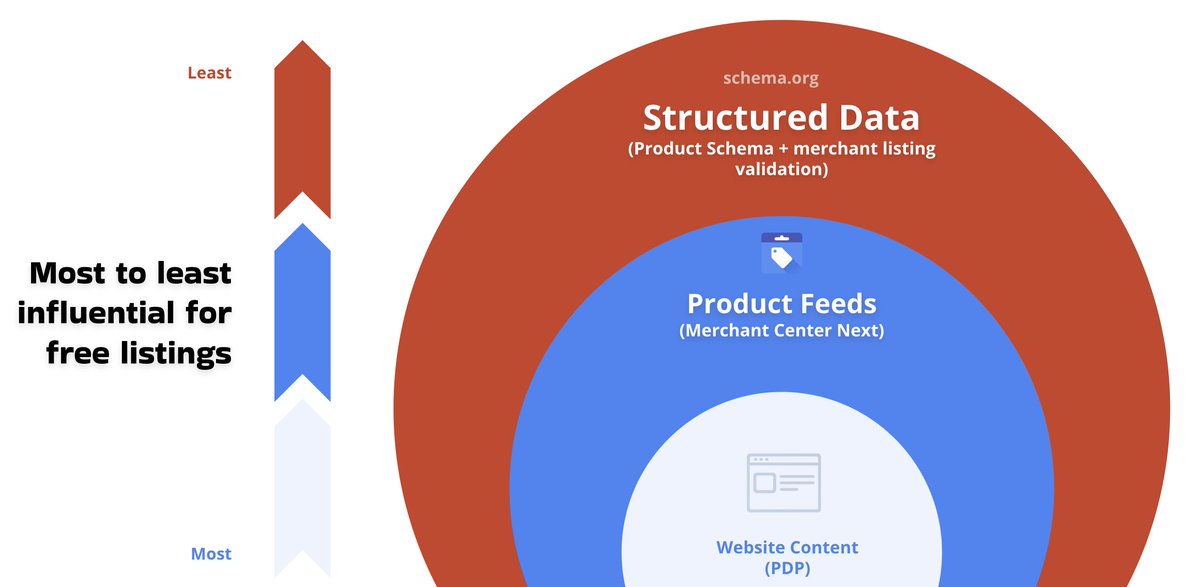
Ecommerce SEO: when it comes to ranking within free listing results on Google, there is a sphere of influence for data sources.
This relates to features such as product grids, product knowledge panels, within the Shopping tab, AI Mode and more.
In general, the influential data sources include:
1. Website Content
2. Product Feeds data (from Merchant Center Next)
3. Structured Data (based on schema .org, with merchant listing validation)
While each of these data sources play their role with the information that appears within free listings, there are certainly caveats to the ordering of each data source.
For instance, the information provided via Merchant Center for the title of a free listing result comes directly from GMC Next. The product title from the page content or within the Structured Data will not influence the appearance of this information in search results.
But when it comes to something like the price of a product, if there are discrepancies across the website content, within the product feed, along with the structured data, Google will override all the external layers and default to the price shown within the website content.
And often when there is a mismatch between the feed and the website, a notice will appear in GMC Next that will alert you to exclusion of the product from being delivered within free listings. This is where the new Merchant API should operate better than the Content API (especially for price mistmatches).
The free listings space is going through a lot of changes in general right now. A major reason for the migration from Google's end to the upgraded Merchant Centre 'Next' edition of GMC is to allow product discoverability to be less reliant on feeds, with there being the ability to surface products from a website that may sit outside of the feed itself.
This is then combined with recent discussions within a Search Off The Record podcast from Google – stating that Google may look to unify the approach among Structured Data and GMC Next feeds, which could be a drastic change to how we approach eCommerce SEO.
In general, the best approach is to provide as much rich content to Google across each surface (content, feeds and structured data) and for there to be consistency among the surfaces for best results. This can be quite a complex area of eCommerce SEO to get your head around, but it is only becoming more important as the year progresses.
Ecommerce SEO: when it comes to ranking within free listing results on Google, there is a sphere of influence for data sources.
This relates to features such as product grids, product knowledge panels, within the Shopping tab and more.
In general, the influential data sources include:
1. Website Content
2. Product Feeds data (from Merchant Center Next)
3. Structured Data (based on schema .org, with merchant listing validation)
While each of these data sources play their role with the information that appears within free listings, there is certainly caveats to the ordering of each data source.
For instance, the information provided via Merchant Center for the title of a free listing result comes directly from GMC Next. The product title from the page content or within the Structured Data will not influence the appearance of this information in search results.
But when it comes to something like the price of a product, if there are discrepancies across the website content, within the product feed, along with the structured data, Google will override all the external layers and default to the price shown within the website content. And often when there is a mismatch among the feed and the website, a notice will appear in GMC Next that will alert you to exclusion of the product from being delivered within free listings.
The free listings space is going through a lot of changes in general right now. A major reason for the migration from Google's end to the upgraded Merchant Centre 'Next' edition of GMC is to allow product discoverability to be less reliant on feeds, with there being the ability to surface products from a website that may sit outside of the feed itself.
This is then combined with recent discussions within a Search Off The Record podcast from Google – stating that Google may look to unify the approach among Structured Data and GMC Next feeds, which could be a drastic change to how we approach eCommerce SEO.
In general, the best approach is to provide as much rich content to Google across each surface (content, feeds and structured data) and for there to be consistency among the surfaces for best results. This can be quite a complex area of eCommerce SEO to get your head around, but is only becoming more important as we move into 2025.
We’re testing SearchGPT, a temporary prototype of new AI search features that give you fast and timely answers with clear and relevant sources.
We’re launching with a small group of users for feedback and plan to integrate the experience into ChatGPT. https://t.co/dRRnxXVlGh
The Gemini era is here, bringing the magic of AI to the tools you use every day. Learn more about all the announcements from #GoogleIO → https://t.co/ZQaDrmItuh
We're happy to announce Google Search Central Live coming to Warsaw, Poland 🇵🇱 on April 24, 2024. If you're nearby, and want to hear and discuss all things related to Search, check it out. Find out more in https://t.co/a6DYVeJ6J1
The Core Web Vitals now officially has a new member: INP (interaction to next paint) replaces FID. We announced this change in January, and have been reporting on INP in Google Search Console since last June.
https://t.co/fz0FD2uCH3
Today we announced the March 2024 core update & new spam policies that, in combination, are designed to show less content made to attract clicks and more content that people find useful. Learn more: https://t.co/wQVZ8mExRB
With new generative AI capabilities in Google Search, we’re now taking more of the work out of searching, so you’ll be able to understand a topic faster, uncover new viewpoints and insights, and get things done more easily. Learn more and how to sign-up for our Search Generative Experience (SGE) through Search Labs, available beginning in the US in English: https://t.co/zFLxjAlzXC #GoogleIO #Google
Today, we're announcing 📢 bulk data export 🎉- a new feature that allows you to export data from Search Console to Google BigQuery on an ongoing basis. https://t.co/xeIBWW3M93