I believe we now have evidence of FIFA's World Cup ticketing shell game: FIFA is colluding with third-party resale platforms for its own supply management.
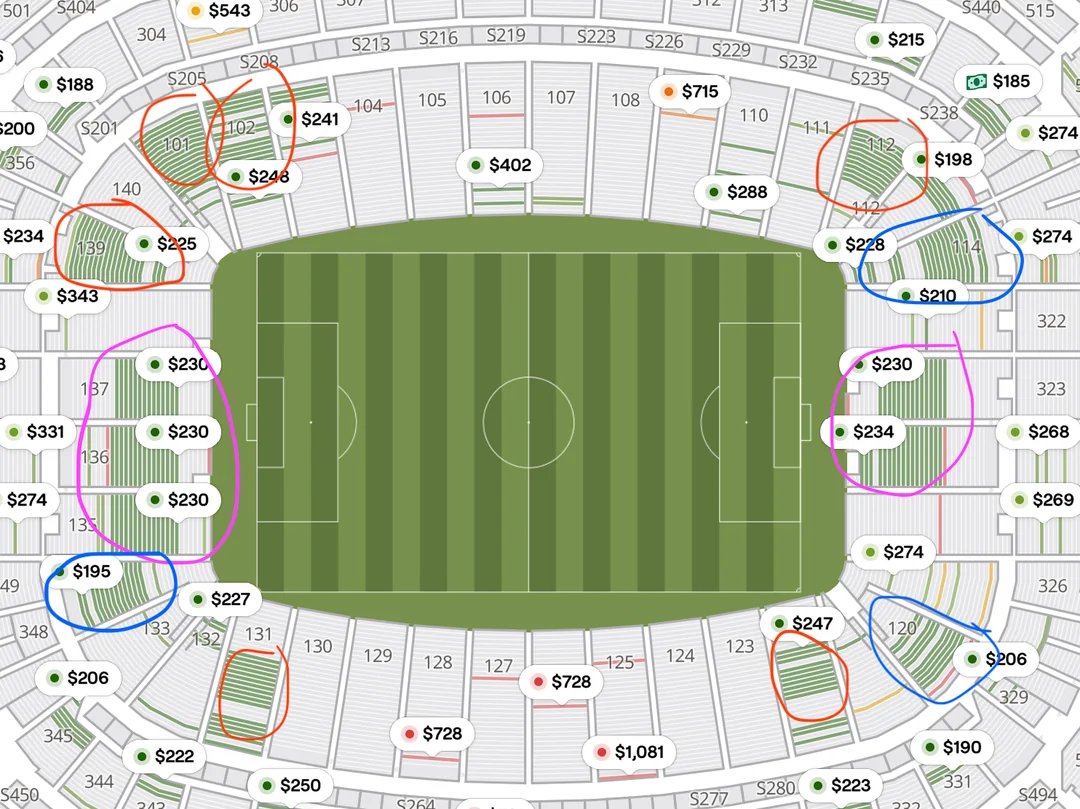
Look at this SeatGeek map (secondary market!) for Saudi Arabia vs Cape Verde. The circled areas are not random single resale tickets, but large, contiguous blocks of seats: entire rows and swaths in sections 101/102, 112/113, 119/120, 134–137, 139, ...
The blue circles appeared weeks ago, then the purple blocks suddenly showed up a day or two ago, and the red blocks seem to have appeared recently too.
That's not what ordinary fan or even commercial scalper resale looks like who resell pairs, fours, and scattered seats. Instead, this looks like inventory being dumped in bulk onto secondary markets, at prices below FIFA's official site.
Why doesn't FIFA just lower prices on its own site Probably because official price cuts could trigger refund demands, chargebacks, or consumer-protection headaches from fans who already bought at much higher prices.
Instead FIFA keeps official prices high, avoids openly admitting the market-clearing price is lower, and moves unsold inventory through third-party resale platforms instead.
I find that if we just paid a little more attention, read a little bit more and thought more clearly, we could all be doing a lot better. Closing libraries makes this harder to achieve.
Library science embraced the Information Age, but to the neglect of "spaces". We need spaces.
I have no connection to MIT, but hearing that they are shutting down 3 of their 4 libraries has me so so sad. I think it’s a decision they will live to regret & the symbolism of it is devastating.
A Stanford economist paid 2,743 Facebook users to delete the app for a month and the people who took the money came back happier, less anxious, less angry at the other political party, and quietly valuing Facebook 14% less than they did before they left.
The lead names on the paper are Hunt Allcott and Matthew Gentzkow.
Gentzkow had already won the John Bates Clark Medal, which is given to the most important American economist under 40 and is considered a stronger predictor of future Nobel Prizes than almost any other award in the field.
He spent years studying media, persuasion, and political polarization. In 2018, he and his coauthors set out to do something nobody at this scale had ever done. Run a real randomized controlled trial on Facebook itself.
Most research on social media is correlational. It looks at people who use Facebook a lot and people who use it less, and tries to figure out which way the arrow points. The problem is obvious.
Unhappy people might use Facebook more. Lonely people might use Facebook more. You cannot pull cause and effect apart by watching from the outside.
So they ran the experiment the right way.
They recruited 2,743 active Facebook users through Facebook ads. They asked each person the smallest amount of money they would accept to deactivate their account for four weeks.
The four weeks were timed to end just after the November 2018 US midterm election, which mattered because it was the most politically charged month of the year. Then a computer randomly assigned the 1,661 people who valued Facebook at less than $102 to one of two groups. The Treatment group was paid $102 to deactivate. The Control group was paid nothing and kept using Facebook normally.
The team verified compliance by pinging each participant's public profile URL multiple times a day for the entire four weeks. Compliance in the Treatment group exceeded 90%. Less than two percent of the sample failed to complete the endline survey.
This is one of the cleanest natural experiments ever run on a tech platform.
Then they measured everything.
Time use first. The people who quit Facebook freed up 60 minutes a day on average. They did not spend that time on other social media. They spent it on television alone, and they spent it socializing with family and friends in person. Both went up. The narrative that Facebook substitutes for real human contact was not a vibe. It showed up in the time diaries.
News next. The deactivated group knew less about current events. Their score on a 15-question news quiz dropped by 0.19 standard deviations. They were less likely to follow politics closely and less able to identify what was actually in the headlines. Facebook is, for a meaningful slice of American adults, the primary place they encounter news. Take it away and the news disappears with it.
Then the part that started to get uncomfortable for Silicon Valley.
The deactivated group became less politically polarized. Their views on policy issues drifted closer to the middle. Their exposure to the kind of news content that makes people angrier at the other side dropped. The overall polarization index fell by 0.16 standard deviations in four weeks.
For context, a separate index of American political polarization rose by 0.38 standard deviations over the 22 years between 1996 and 2018. The experiment moved people in four weeks by a meaningful fraction of what an entire generation of political drift had done.
Then the part the researchers were most careful about.
Subjective well-being improved. The deactivated group reported higher happiness, higher life satisfaction, lower depression, and lower anxiety. The overall index moved by 0.09 standard deviations. That sounds small until you compare it to the benchmark.
It is roughly 25 to 40% of the effect size of professional interventions like self-help therapy, group training, and individual psychotherapy. Four weeks of not opening one app produced a fraction of the mental health benefit that a course of therapy produces. That is not a fraction to dismiss. That is a fraction to look at twice.
And then the finding that closes the case.
The experiment was supposed to end. The Treatment group was free to reactivate their accounts the moment the four weeks were over. The researchers kept watching. 9 weeks after the experiment ended, 5% of the people who had been paid to leave had still not come back.
The group as a whole was using the Facebook mobile app 22% less than the control group, an average of 11 minutes a day less. They had not just survived four weeks without Facebook. They had quietly decided they did not need as much of it as they had before.
The economists ran one more test. Before the experiment, they had asked each participant the smallest amount of money they would now need to deactivate again for four weeks.
After the experiment ended, they asked the Treatment group the same question. The valuation had dropped by 14%. People who had been paid to leave Facebook came back valuing Facebook less than they did before they left.
That is the sentence that ends the argument. If Facebook were worth what users said it was worth, the price would not move after a four-week break. The fact that it moves means a meaningful slice of what users were paying for, in time and attention, was the dependence itself. They were not buying connection. They were buying the habit of checking the connection. And once the habit broke, the price they were willing to pay for it dropped.
The standard calculation, the one tech companies love to quote, takes the average user's stated valuation and multiplies it by the number of users.
By that math, Facebook generates roughly $31 billion in consumer welfare every four weeks for American adults alone.
The Stanford team's data suggests that number is overstated, because part of what users say Facebook is worth is the cost of the dependence Facebook has already built in them.
The paper was published in March 2020 in the American Economic Review, the most cited economics journal in the world. It became one of the most discussed social media studies of the decade.
Inside the company, employees read it. Inside policy circles, regulators cite it. Inside academic departments, it is the reference point for every randomized trial on a tech platform that has followed.
80% of the people who were paid to leave Facebook said the four weeks were good for them.
The platform is still running. The trial is still on the public record. The single cleanest test ever run on what social media costs a human life found that the people who stopped paying that cost were happier, calmer, more connected to the people in front of them, and worth less to the platform afterward.
The price of Facebook was never the time. It was the version of you that started to need it.
And the study proved that version of you was never the one you would have chosen if anyone had asked.
A lot of end-of-life policy discussions focus on poster-child cases and don't ask important questions: "Who will select into delivering MAID?", "Who will ask for MAID?", and "Are end-of-life preferences stable?"
WHAT 🤯 A man in his 40s with inflammatory bowel disease, was assessed outside a Tim Hortons, offered MAID, AND driven by the DR to the assisted suicide facility, and killed by MAID 🤯
I honestly thought this headline was fake, but it’s real
Welcome to Canada 🇨🇦 I feel sick
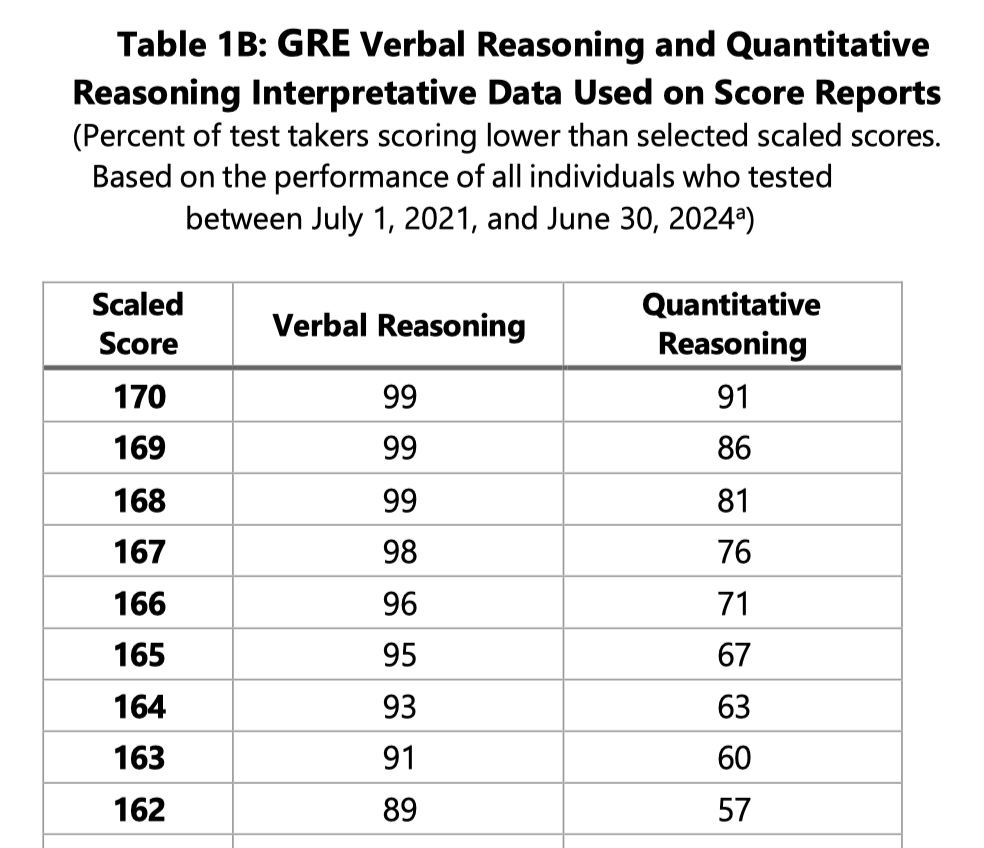
If you get 100% on the Math GRE, you're at the 91st percentile.
The test measures grind and attention, not capability. It tests whether you can go 2 hours with no slipups.
It's interesting that grad programs don't want to know the full ability distribution of their applicants.
"Don't let other people write your paper."
Economic sciences laureate Daron Acemoglu spoke to nine students around the world and shared his best career advice.
Watch the full conversation: https://t.co/WTO2wjwXFP
@MeganTStevenson The principal is quick to seek help, but the agent often overuses ineffective treatments and underuses effective ones. I don't see social science as in a horse race against medicine. Each mutually benefits from the other in improving welfare. They should work hand-in-hand.
Medical practice is slow to take up comparatively effective treatments (underuse), or extends existing treatments beyond the appropriate population (overuse) often this is within the same agent. Hard to imagine a way to make medicine more effective than to use social science.
People aren't desperately awaiting new knowledge from social science because social science hasn't proved itself to be able to perform quasi-miracles in the same way medical research have.
The US labor force is a living, breathing map. 🇺🇸
Watch the number of counties with labor forces in structural decline spread like a virus across America between 2010 and 2025.
Shout out to @JMBDaecius for the idea to do this.
#Economics#LaborForce#Trends
@glenweyl@albrgr Yes! Rousseau wrote about this amour propre and argued that our political institutions should be largely designed to ensure that relational components are channeled towards public goods rather than destructive contests of status and dominance.
The @nytimes ran a piece this morning on the psychiatric profession’s effort to take control of the conversation around “deprescribing” as attention grows under Secretary Kennedy and MAHA.
On its surface, the new ASCP guidance reflects the work of psychiatrists who, I have no doubt, care deeply about their patients and are genuinely trying to improve practice.
But it’s also a long overdue acknowledgment of something patients themselves forced into the open years ago, after being told their withdrawal was “relapse” and kept on medications without meaningful review.
So many of us were cycling through prescriptions without anyone seriously asking whether we still needed them, or how to safely come off.
Now the field is stepping in to define deprescribing for itself, at the same moment political pressure is forcing the issue into the mainstream.
I keep coming back to the way that slow tapering is framed as “unscientific” in this article, and the dangerous suggestion that some long half-life drugs like Prozac can be stopped abruptly because they “auto-taper.”
That view does not reflect what many patients have lived through. It’s also not what’s reflected in the hyperbolic tapering methods patients developed on their own, after being left without clinical guidance and finding each other instead
@KeithNHumphreys Has there been a single study in this area that tracks actual "treated"? All studies I have seen commit the ecological fallacy by looking at area ambulance calls or census tract overdose deaths.