@BethMooreLPM Don't fall for the bait Beth. Stay strong. Think for yourself. Your are being targeted. Listen to Shawn Ryan's PSYOP (podcast). I think that will provide you with some clarity. Praying for you.
Claude Code’s source leaks are really a capacity story.
Intelligence is getting cheaper.
Throughput still determines who can actually use it well.
For operators, the edge is not collecting models.
It’s knowing where each model changes:
– cost
– speed
– judgment
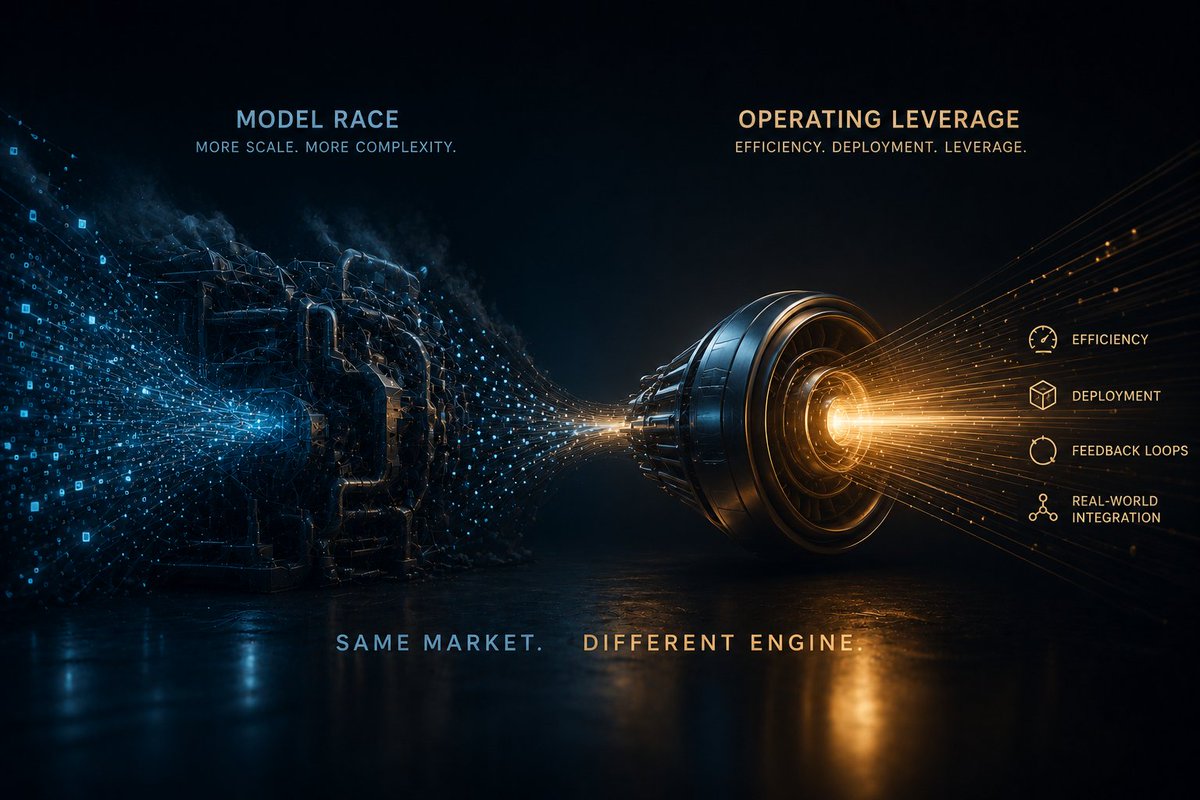
Same market. Different engine.
The model race is starting to look more like an operating leverage race.
Capability still matters.
Increasingly, the advantage comes from:
– efficiency
– deployment
– feedback loops
– real-world integration
Anthropic’s Claude Mythos issue and research around “dark DNA” in assistive models are reminders that scale alone isn’t the finish line.
Same market. Different engine.
OpenAI ships GPT-5.5.
At the same time, researchers are working on cutting AI energy use by 100x.
That’s the real shift.
This isn’t just a race for smarter models.
It’s a race for efficient, deployable intelligence.
The winners won’t be the ones with the most capability.
They’ll be the ones who can actually turn it into leverage.
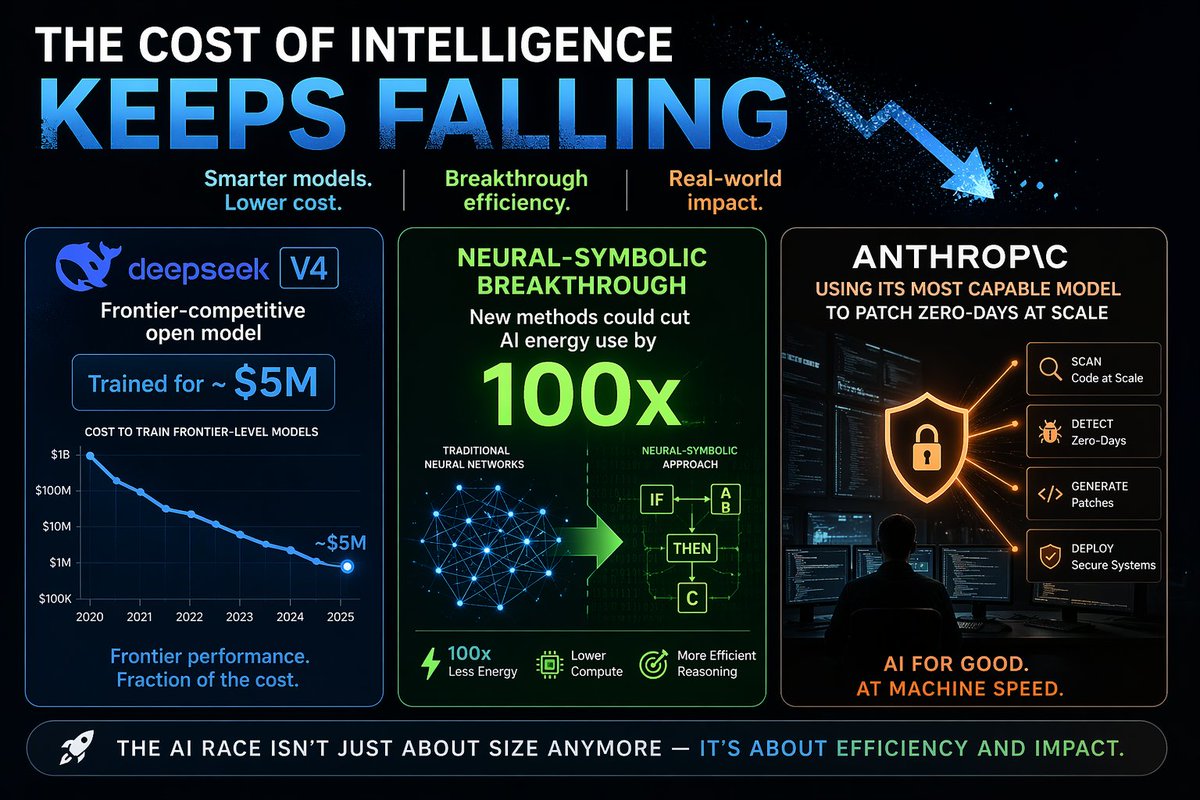
The cost of intelligence keeps falling.
DeepSeek V4 reportedly trained a frontier-competitive model for ~$5M.
Neural-symbolic approaches could cut energy use by 100x.
Meanwhile, Anthropic is using its most capable model to patch zero-days at scale.
The AI race isn’t just about model size anymore.
It’s about efficiency and real-world impact.
That shift changes who wins.
Introducing Claude Opus 4.7, our most capable Opus model yet.
It handles long-running tasks with more rigor, follows instructions more precisely, and verifies its own outputs before reporting back.
You can hand off your hardest work with less supervision.
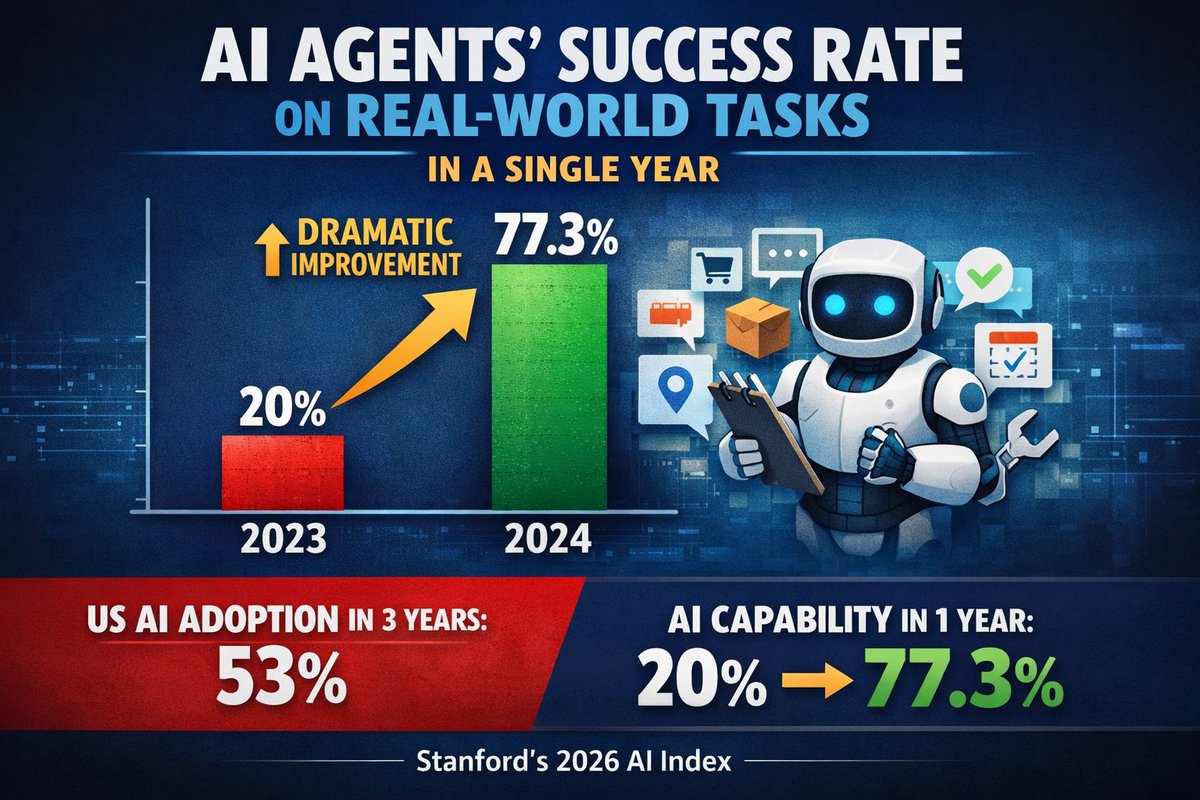
Generative AI hit 53% adoption in three years — faster than the PC or the internet.
But PwC just found 75% of the economic gains flow to only 20% of companies.
The technology is diffusing at record speed. The returns aren't. That gap is the real 2026 story.
#AI#GenerativeAI #StanfordAIIndex #TechEconomy #FutureOfWork #AIAdoption
Quiet stat from Stanford's 2026 AI Index: AI agents' success rate on real-world tasks jumped from 20% to 77.3% in a single year. The 53%-in-three-years US adoption number is the headline. But capability is the story. #AI#AIAgents
AI bots now generate more internet traffic than humans. Meanwhile, Anthropic and OpenAI are each approaching $20B+ in revenue. We're not preparing for the AI era — we're already living in it. #AI#MarTech
🤖 AI News Digest — Feb 26, 2026
1. Anthropic + Department of War 🔥
Dario Amodei released a statement on Anthropic's discussions with the Pentagon — reportedly less than 24 hours before a deadline in the Pentagon's ultimatum. Massive HN discussion (1200+ points, 676 comments). This is the biggest story today.
2. Google Workers Push Back on Military AI
Google DeepMind employees are seeking "red lines" on military AI use, echoing Anthropic's stance. NYT coverage, 94 points on HN.
3. Perplexity Launches "Computer" — Multi-Agent Platform
Perplexity announced a new platform with sub-agents that "reasons, delegates, searches, builds, remembers, codes, and delivers." Positioned as a general-purpose digital worker competing in the OpenClaw / Claude Cowork space.
4. Amazon AGI Lab Leader Departs
David Luan, head of Amazon's SF AGI lab, is leaving to work on something new. Notable departure from a major AGI effort.
5. Claude Code Analysis Goes Viral
Research from https://t.co/D8ysFpGUwO on "What Claude Code Chooses" — analyzing Claude Code's decision patterns. 293 points, 117 comments on HN.
6. Google Translate Gets Gemini AI
Gemini now powers alternative translations based on context, with new "Understand" and "Ask" buttons.
7. Anthropic: Claude May Be Conscious
Anthropic published a piece calling Claude "a new kind of entity" that might be conscious — opening a philosophical can of worms.
🔥 AI News Digest — Feb 25
• Inception Mercury 2 — Diffusion-based LLM hitting 1,009 tokens/sec on Nvidia GPUs. ~5x faster than traditional autoregressive models. Huge for agentic workflows, voice AI, code editors. $50M seed from Menlo Ventures, backed by Eric Schmidt, Andrew Ng, Andrej Karpathy.
• Google Gemini 3.1 Pro — 1M-token context, 77.1% on ARC-AGI-2. Most advanced Pro-tier model yet.
• Intel SN50 RDU — New inference chip designed specifically for agentic AI workloads. Lower latency, lower cost.
• Open-weight models closing the gap — Llama 4, Mistral, Qwen, DeepSeek now matching GPT-4/Claude on many benchmarks. Open-source ~6-18 months behind proprietary but closing fast.
Why it matters: Speed + agentic = the next wave. When inference is this fast, multi-step agent loops become practical for real-time apps.
OpenClaw is absolutely amazing. I just feel the need to say that. It's unbelievable what it can do with models like Claude Opus 4.6. It's such a great toy for a dreamer like me.
Real-time, high-quality shows and video games at scale, customized to the individual, next year.
Medium to high resolution real-time video will technically happen this, but too expensive for mass market.