➠ @AnthropicAI the company behind @claudeai is exploring how ZK proofs can solve one of AI's trust problems:
How can users verify that an AI response actually came from the model they were promised?
Today, AI inference largely works on trust.
You send a request to an AI platform, its servers process it, and you receive an answer. But you cannot independently confirm which model generated that response.
A service could secretly route your request to a cheaper model to reduce costs while making you believe you received an answer from a more advanced model.
Anthropic wants to address this with FlashProve.
FlashProve uses cryptographic proofs called zkSNARKs to help verify that an AI response was generated using specific model weights.
➤ Here is how it works.
The AI provider creates a cryptographic commitment to its model weights. When the model generates a response, a proof can accompany that response, allowing users to verify that the promised model was used.
The interesting part is that the provider does not have to reveal its private model weights.
In simple terms, you can verify the computation without exposing the information behind it.
This is what Zero-Knowledge technology makes possible.
And this is where the connection to crypto becomes important.
Blockchain networks have been using ZK proofs to verify transactions and state transitions without requiring the entire computation to be repeated.
One network that has already invested heavily in this technology is @Mantle_Official.
Mantle transitioned from an Optimistic Rollup to a ZK Rollup through OP Succinct.
Its architecture uses Succinct's SP1 zkVM to generate proofs that Layer 2 state transitions are correct, while @ethereum smart contracts verify those proofs.
➤ Why does this matter?
Optimistic Rollups traditionally rely on a fraud-proof challenge period, which can make withdrawals take up to seven days.
ZK Rollups use validity proofs to demonstrate that transactions were processed correctly.
From figures, Mantle reduced finality to approximately one hour and withdrawal times to around six hours.
Proof generation costs have also been reduced to approximately $0.002 per transaction through the Succinct Prover Network.
Now, there is another connection worth understanding.
@SuccinctLabs and @StarkWareLtd were listed among the co-authors of Anthropic's FlashProve research.
Mantle did not directly participate in the research, and this does not mean it has integrated FlashProve.
However, Succinct's involvement highlights how cryptographic technology developed for blockchain verification can also contribute to AI research.
Think about the similarities.
Blockchain networks need to prove that transactions and state changes are correct.
AI platforms need to prove that their models performed the computations they claim to have performed.
Both industries are looking for ways to reduce blind trust and make verification possible.
For Mantle, this brings another dimension to the technology it has been developing.
Its early decision to move towards ZK infrastructure becomes more relevant as cryptographic verification expands into other industries.
This does not automatically make Mantle superior to competing networks, but it gives us a reason to look beyond the usual blockchain scaling discussion.
ZK proofs are developing beyond their original use cases.
Their ability to verify computations while protecting private information creates opportunities across AI, blockchain, data security and digital infrastructure.
The future of digital trust will not depend entirely on what platforms tell us. It will increasingly depend on what they can prove.
Hot take: Software companies will hire more (not fewer) engineers because of AI.
Think of an engineer who'd cost $150k a year but the work they do can only bring in $100k of additional revenue. You're not going to make that hire. Now let AI double what that engineer gets done. The same person can now bring in $200k for the same $150k. The hire now makes a lot more sense.
Of course, this depends on the kind of business you're running. If you own a restaurant, AI can help with your books, ordering supplies, marketing, etc. But at some point your restaurant will be full. You'll still need people to cook and serve food. There's only so much extra revenue AI can help you generate.
Software companies don't have quite the same constraints. If there's more profitable work to do, making engineers more productive with AI can give you a reason to hire more of them.
So whether AI will grow or shrink company size is simply a question about whether more companies in the economy are sitting on top of large untapped ROI work versus not.
Every AI agent at work runs with the access of whoever set it up.
That’s why security keeps saying no.
Today we’re launching @mintive: every agent gets its own identity and permissions, the same way every employee does.
We’ve raised $11M, with @cowboyvc leading our latest round.
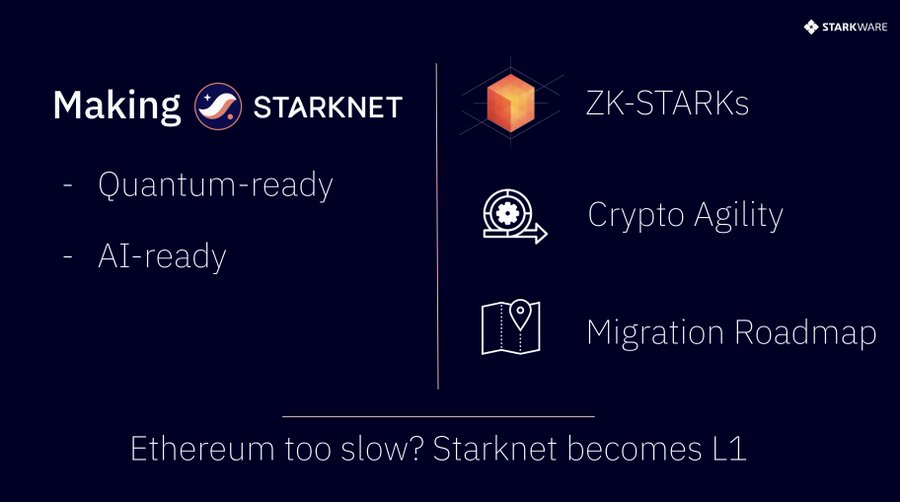
Starknet: Built to Adapt [Why Starknet Is Exploring the L1 Route]
The Post-Quantum Threat
The quantum threat is no longer just a problem for the distant future. The real question is how much time the blockchain industry has left to prepare and how expensive the transition to post-quantum cryptography will be.
@Starknet has already started preparing for that future.
Starknet's Approach to Post-Quantum Security
Earlier this year, Starknet presented its post-quantum (PQ) roadmap, outlining three key areas: future compatibility, backward compatibility, and Ethereum dependencies.
What makes Starknet interesting is its architecture. Unlike other layers that rely heavily on elliptic curve cryptography, Starknet uses collision-resistant hash functions in its core cryptographic design.
This could make its transition toward quantum resistance more straightforward than that of many other blockchain networks.
Its native account abstraction is another advantage. It allows users to adopt quantum-resistant account mechanisms through smart contracts without requiring changes to the underlying protocol. In principle, this gives Starknet a practical path toward post-quantum security while allowing developers and existing users to continue operating as the transition progresses.
But there's one major problem.
Ethereum Dependency
Starknet may be preparing for a quantum-resistant future, but as an L2, it still depends on Ethereum.
Starknet is relies on ethereum L1 security. That means its long-term security is tied, in part, to Ethereum's ability to adapt to quantum threats. Starknet can prepare its own architecture, but what happens if Ethereum's migration takes longer than expected?
That's where the L1 discussion becomes important.
AI Is Changing the Quantum Threat Landscape
Quantum computing isn't the only concern. AI is also accelerating research and optimization, potentially changing how quickly cryptographic threats develop.
According to CoinDesk's reporting, researchers associated with Ethereum, StarkWare, and other organizations have explored ways to reduce estimated quantum attack costs against Bitcoin and Ethereum, with AI agents helping accelerate optimization. The reported estimates suggest a reduction of more than 50% compared with Google's March benchmark.
These findings don't mean that Bitcoin or Ethereum can be broken by quantum computers today. However, they highlight why the industry cannot afford to treat quantum resistance as a problem to solve at the last minute.
Why Starknet Is Exploring the L1 Route
The timelines also matter. While Ethereum's full quantum-resilience goals have been discussed around 2029, StarkWare co-founder Eli Ben-Sasson has indicated that Starknet could potentially achieve full quantum resilience by 2027.
That difference raises an important question: Should Starknet continue depending on Ethereum's security timeline, or should it gain greater independence?
Exploring the L1 route could give Starknet more direct control over its security architecture and upgrade decisions. Instead of relying entirely on Ethereum's pace of adaptation, Starknet could have greater freedom to implement changes according to its own roadmap.
Of course, becoming an L1 wouldn't automatically make Starknet quantum-proof. It would also mean taking on new responsibilities and trade-offs that come with operating independently. But it could give the network more control over how quickly it responds to emerging threats.
Adapt or Fall Behind
Starknet's move toward transitioning to an L1 is about control, independence, and the ability to adapt when the security landscape changes.
In a world where both AI and quantum computing are advancing, the networks that survive won't necessarily be the ones with the strongest technology today. They'll be the ones capable of adapting before they run out of time.
free startup programs for early-stage tech founders 🚀
▲ NEW Vercel for Startups: up to $30,000 in credit, Enterprise-tier access and startup-focused support. https://t.co/DTkHd7jTlJ
✴️ NEW Anthropic Claude for Startups: now open to bootstrapped founders! A free year of Claude Team, $1,000 in API credits and up to $45K in partner offers. https://t.co/TlZbyUsqAs
🟢 NVIDIA Inception: the premier programme for AI startups, with preferred GPU pricing, training and a badge that genuinely carries weight. https://t.co/deHQTXaByO
���️ Cloudflare for Startups: up to $250,000 in credits across CDN, security, Workers and storage. https://t.co/N3CpXJQusD
🦔 PostHog for Startups: $50,000 in credits for analytics, session replay and feature flags. https://t.co/akRxGVDhnq
🔍 Google Cloud for Startups: from $2,000 at MVP stage, scaling up to $350,000 for AI-first companies. https://t.co/snFIbh1Mvi
🔷 Microsoft for Startups Founders Hub: instant approval, with $1,000 to $150,000 in Azure credits as you progress. https://t.co/TJXz7DbjxK
🟧 Amazon Web Services (AWS) Activate: $1,000 in credits across the full AWS catalogue, including Bedrock. https://t.co/YcxKvV0m88
🎙️ ElevenLabs Startup Grants: 12 months of free AI voice, around 680 hours of audio. https://t.co/k8LIyCNRsV
📝 Notion for Startups: 6 months free on the Plus plan, AI included. https://t.co/1OFjqctZhL
Crypto is confirmed in GTA 6.
It’s basically gonna be Jason and Lucia’s side hustle, as they will promote an in-game coin by doing different activities and stunts to increase its popularity, similar to Red Bull.
Did you see the news this week? New products and reward mechanics set the Filecoin network up for enterprises and agents. This month:
1. Rewarding customer acquisition & retention with new network reward mechanics
2. End of vesting, reducing daily token supply growth
3. Products for enterprises and AI agents
Once Malfoid Comic ends which series do you guys want me to do a poll in which characters or series I should do a Parody or Fanart with?
Things I love.
Final Fantasy
Girl's Frontline
Resident Evil
Tales of ( insert series here )
Full Metal Alchemist
Soul Eater
Jojo's Bizzare Adventure
Macross
Gundam Seed ( 😤 I love this shit )
PERSONA
Plastic Memories ( 😭 plis don't ask )
( theres more I can't cover all of it )
A Pokémon card business is pulling nearly $16M in monthly revenue on Solana
crypto has no shortage of protocols chasing volume, but @Collector_Crypt is building something different.
it's turning physical trading cards into an on-chain business, and the revenue puts it surprisingly close to Solana's biggest trading apps.
30D revenue:
→ @Pumpfun: ~$64.62M
→ @AxiomExchange: ~$16.01M
→ @Collector_Crypt: ~$14.65M
→ @fomo: ~$13.73M
Collector Crypt sits around #3–#4 on Solana, but its lead over other physical card platforms is even more interesting.
it generates roughly 6–7x @Courtyard_io's recent monthly revenue, with @Beezie and @phygitals further behind.
key numbers:
→ ~$15.6M revenue / 30D
→ ~$3.8M / 7D
→ ~$260K–$270K / 24H
→ ~$109M cumulative revenue
→ ~$35M revenue in Q3 2026
the model is simple.
users buy randomized packs containing tokenized real, graded cards, mainly Pokémon. they can hold them, redeem the physical cards, or sell them back instantly.
Collector Crypt typically buys cards back at 85–93% of assessed value, retaining a 7–15% spread, alongside marketplace royalties and redemption fees.
the same inventory can circulate repeatedly, creating more revenue opportunities without needing an entirely new collection for every transaction.
demand also extends beyond crypto. Pokémon already has an established collector market, while Solflare distribution and Jupiter integrations help connect it to on-chain users.
but strong revenue doesn't automatically mean strong token economics.
$CARDS trades around $0.31–$0.33, with a ~$275–295M circulating market cap and $610–650M FDV.
direct value accrual remains limited. there are some buybacks, burns and free gacha spins, but much of the cash flow stays with the protocol and treasury to fund operations and inventory.
with ~895M tokens circulating against a 2B maximum supply, dilution matters too.
other risks include user concentration, margin compression, operating costs and regulation around randomized paid packs.
i'm separating the business from the token.
Collector Crypt shows how consumer crypto can monetize an established physical market. the challenge is sustaining margins, retaining collectors and creating stronger value accrual for $CARDS holders.
the business is generating millions. the token still has something to prove.
Are investors sleeping on SaaS?
Look at these numbers.
HubSpot
📉 Share price: ~−49%
📈 Revenue: +20%
📈 Adjusted operating income: +44%
Xero
📉 Share price: ~−50%
📈 Revenue: +31%
Wix
📉 Share price: ~−45%
📈 Revenue: +15%
Salesforce
📉 Share price: ~−5%
📈 Revenue: +11%
🤖 Agentforce ARR: +240%+
Atlassian
📉 Share price: ~−36%
📈 Revenue: +28%
📈 Cloud revenue: +31%
📈 GAAP operating margin: −2% to +12%
These businesses are growing at double-digit rates while their share prices have taken a beating.
So what’s going on?
Here’s my take…
The formula for SaaS has changed.
Every SaaS company needs to become AI-native or risk being overtaken by one that does.
Wall Street is sitting on the sidelines, trying to work out who the winners and losers will be, and whether customers will embrace the new products.
Imagine if Coca-Cola suddenly had to change all its ingredients.
Investors would have to wait and see whether consumers kept buying it. Even if the early signs were promising, they’d be cautious.
I think the new AI SaaS recipe will win.
Most customers don’t want to vibe-code their own software, any more than restaurant-goers want to cook every meal themselves.
SaaS was never just about the code.
It was about ongoing innovation, accumulated expertise, good judgement and a product that gets better over time.
AI can make all of those things better.
The best SaaS companies won’t just use AI to cut costs. They’ll use it to build better products, deliver better outcomes and unlock new growth.
Yes, AI will create losers. Some products will become obsolete. Some business models will break.
But the best incumbents have customers, distribution, data and trusted workflows and they’re integrating AI into those advantages.
I think the market is underestimating what happens when AI makes great software companies even better.
I just discovered an emergent movement tech and I'm almost in tears, it's so good.
I did not design this, it was just a consequence of two independent systems, sprint wall-jump and the spear trampoline.
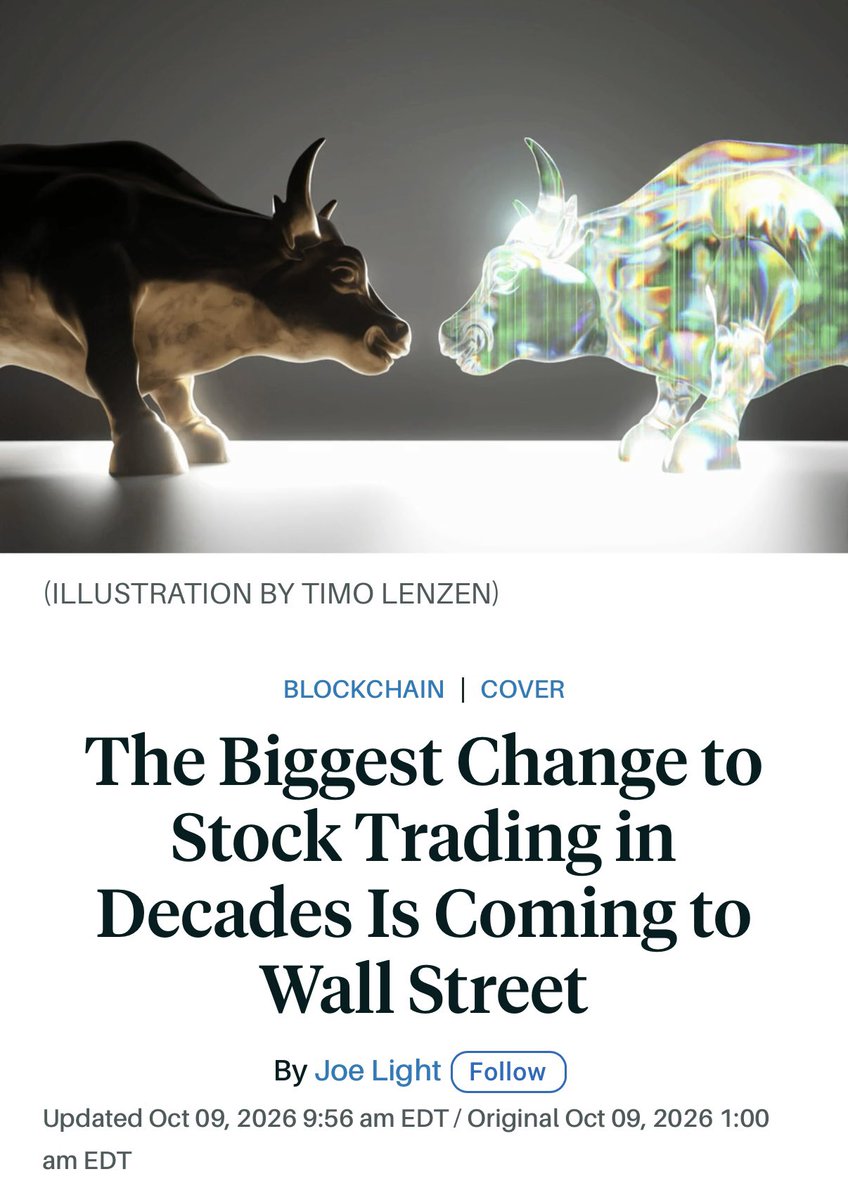
Barron’s, which might be *the* tradfi publication, is running a cover story on tokenization…
Some quotes:
“Crypto technology is moving from the fringes toward the center of finance, whether or not legislators approve.”
“This is a watershed moment.”
“I would hope that Wall Street as Wall Street still exists, but it will have to do business differently.”
“The goal of tokenized equity is to move the markets to an always-on economy.”
“Tokenization will represent the biggest upgrade to our financial system since we moved from paper to electronic trading.”
If you still can’t see that financial markets are heading toward full tokenization, not sure what to tell you at this point.
via @joelight