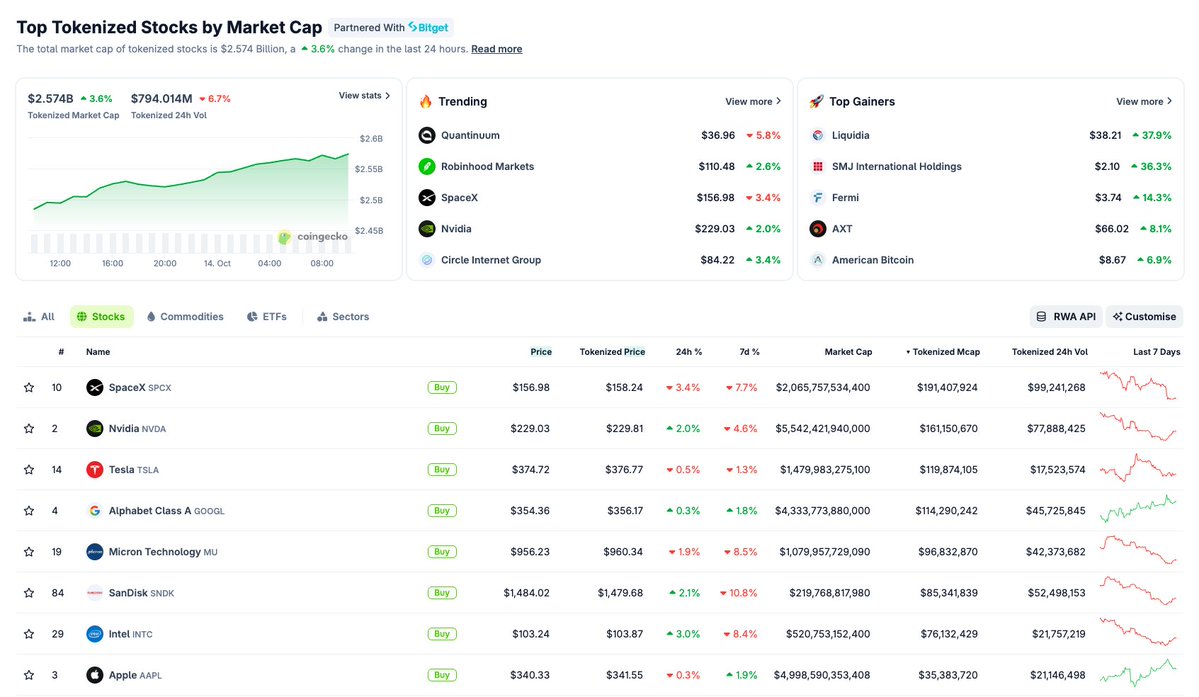
Been using @coingecko’s RWA page to track tokenized stocks, and the sector number is the least interesting part.
Tokenized stocks sit at $2.57B mcap, up 3.6% on the day, on $794M of volume. Next to Nvidia’s $5.5T mcap, that is still very small.
#SpaceX is currently leading the sector:
– Real price $156.98, tokenized price $158.24 → the wrapper is trading at a premium
– Tokenized mcap ~$191M, ahead of Nvidia ($161M) and Tesla ($120M)
– $99M traded in 24h, more than half of its tokenized market cap
A few takes from running that check:
– Demand shows up first on names that are hard to buy outside US hours, or hard to buy at all
– BTech, xStocks, Ondo are not the same liquidity
– Cap tells you the sector exists. Volume and price tracking tell you whether it is actually working
You can check here: https://t.co/WvnusDV2hs
► Papertrade and how I delta-neutral farming
3 days of @papertrade_xyz are already pretty insane.
– $896B cumulative trading volume
– $444M OI
– $60.5M TVL
– 17K+ accounts
– 6.5B $PAPER minted, with 98.9% staked
– $37.8M cumulative trader losses
– $31.2M already distributed to PAPER stakers
– $3M LP, with $0 queue debt for now
Kinda fascinating how Papertrade flips the usual perp DEX incentives. losing money literally mints you ownership in the house.
But the opportunity has changed.
Mint rate already dropped to ~25.9 PAPER per $1 lost, meaning ~$38.6 per 1K PAPER before staking rewards.
Almost 4x the initial gross cost and over 100x what some early farmers effectively paid.
so I'm leaning more toward delta-neutral farming instead of just eating losses.
Say I open a $25K BTC long and $25K short at 50x, then BTC moves 1%. Assuming I can match the reported hedged farming efficiency:
– losing leg takes ~$250 hit, mints ~6,475 PAPER
– winning leg makes ~$250 before execution costs
– net farming cost comes to ~$32-37
– ~$5-5.7 per 1K PAPER instead of $38.6
7x cheaper than raw loss farming, assuming execution goes well.
Recent staking yield estimates sit around $0.05-0.08 per 1K $PAPER daily. At $0.06, my 6,475 $PAPER would earn ~$0.39/day or ~$11.7/month.
So theoretically ~82-95 days to breakeven on farming costs, without even pricing in $PAPER itself.
Not bad, but the catch is those yields aren't guaranteed.
More PAPER minted = more dilution, and bad execution, liquidation risk, OI caps or the haircut on winning positions can easily eat the edge.
For smaller capital, I find @paperstrategy_ worth considering too. They've accumulated ~112.6M $PAPER (1.74% of total staked supply) using automated strategies.
But $PSTR is indirect exposure with its own token price, execution and team risks, not the same as holding PAPER.
And $PAPER still isn't transferable, while the protocol remains in Phase 1. So any future token valuation is completely speculative for now.
I like what Papertrade is building, but the edge now is how little you can actually pay for PAPER.
Curious how you guys are farming this?
Crypto has reached the point where losing money is literally how you farm a token.
Been looking into @papertrade_xyz ahead of its 10/10 launch and this could be one of those rare cases where being early actually changes your token acquisition cost.
solana:4SNHBM2axbPCNXHrPPNLtdCRmnQVkq9cfFTyrJpJpump starts at zero supply and mints exclusively from trading losses.
Sounds pretty stupid at first but some smart farmers are already figuring out how to manufacture those losses as cheaply as possible.
Papertrade is a synthetic perp exchange built on HyperEVM, but very different from Hyperliquid itself.
There's no orderbook and no external LP deposits. Every position trades against a protocol-owned USDC pool, using Hyperliquid's BBO mid-price as the oracle.
BTC and ETH are the only markets at launch, with up to 1,000x leverage and $10M max notional per position.
Instead of charging normal trading fees, Papertrade takes an asymmetric cut from winning trades while losing traders still pay their full losses.
Now look at the tokenomics.
solana:4SNHBM2axbPCNXHrPPNLtdCRmnQVkq9cfFTyrJpJpump only gets created when traders close losing positions or get liquidated.
The initial mint rate is 100 solana:4SNHBM2axbPCNXHrPPNLtdCRmnQVkq9cfFTyrJpJpump for every $1 of eligible realized loss while the tracked LP remains below $2M.
For a normal losing close when the LP is solvent, 2% gets carved from the house's gain, leaving roughly 98 PAPER minted per $1 lost. Liquidations mint on the full lost margin.
Why would ppl want solana:4SNHBM2axbPCNXHrPPNLtdCRmnQVkq9cfFTyrJpJpump? Stakers receive a share of protocol fees, effectively 1% of the relevant realized PnL, plus tracked LP gains swept above the $5M cap.
But fee payouts depend on the LP having enough liquidity and no outstanding profit queue.
First few days could matter.
Once the tracked LP crosses $2M, emissions enter a decay curve based on cumulative LP gains above that threshold.
At $10M tail progress, mint rate falls to ~85 solana:4SNHBM2axbPCNXHrPPNLtdCRmnQVkq9cfFTyrJpJpump/$1.
– $25M = ~68 solana:4SNHBM2axbPCNXHrPPNLtdCRmnQVkq9cfFTyrJpJpump/$1
– $50M = ~50
– $100M = ~30
The important detail is that this decay uses a high-water mark. Staker distributions don't reset it, although the flat rate can return if tracked LP drops back below $2M.
So early farmers are potentially competing for a much larger share of eventual supply per dollar of loss.
But a higher mint rate doesn't automatically mean cheap tokens. We need a strategy rather than just losing blindly.
Assuming I hedge with a $10K BTC long + $10K BTC short, and BTC moves 0.5%:
– Losing side = $50 loss, ~4,900 solana:4SNHBM2axbPCNXHrPPNLtdCRmnQVkq9cfFTyrJpJpump minted.
– Winning side = ~$42.31 net profit.
– Actual cash cost = ~$7.69 for 4,900 solana:4SNHBM2axbPCNXHrPPNLtdCRmnQVkq9cfFTyrJpJpump =~$1.57 per 1,000 $PAPER.
I don't think max leverage makes this more efficient.
At 1,000x, even a ~0.05% adverse move can trigger liquidation because the protocol busts positions before equity reaches zero.
Meanwhile, 20–50x gives 2–5% of adverse price movement before bust.
So the optimization about maximizing solana:4SNHBM2axbPCNXHrPPNLtdCRmnQVkq9cfFTyrJpJpump minted per dollar of actual capital lost while keeping both sides alive long enough to close.
Still, there are some risks I think ppl might underestimate at launch.
One side might fill while the hedge is still pending, or one position gets liquidated before the closing transaction goes through.
Papertrade can even queue unpaid winning profits when the house doesn't have enough liquid cash.
And solana:4SNHBM2axbPCNXHrPPNLtdCRmnQVkq9cfFTyrJpJpump won't be transferable at launch, so there's no immediate exit even if your farming cost looks cheap.
Those are the things you need to consider if you want to self-farm.
For ppl who don't want to manually farm, there are some 3rd developing around it.
– @PaperDAO $PULP: uses a community treasury to farm solana:4SNHBM2axbPCNXHrPPNLtdCRmnQVkq9cfFTyrJpJpump and plans to let holders redeem a proportional claim once solana:4SNHBM2axbPCNXHrPPNLtdCRmnQVkq9cfFTyrJpJpump becomes transferable.
– @paperstrategy_ $PSTR: another treasury farming play, but $PSTR holders don't have a redemption claim on the treasury's solana:4SNHBM2axbPCNXHrPPNLtdCRmnQVkq9cfFTyrJpJpump. Instead, staking yield is supposed to fund $PSTR buybacks and burns.
Whatever your strategy, the early farm is a bet that the cost of manufacturing solana:4SNHBM2axbPCNXHrPPNLtdCRmnQVkq9cfFTyrJpJpump today ends up lower than the value of its future fee stream.
But the protocol literally rewards realized losses, so the risk is that farmers optimize emissions faster than genuine trading demand grows.
Let's see how the market figures out the cheat code.
I can see @CantonNetwork winning institutional finance while $CC captures much less of the upside
I keep coming back to this: if i’m evaluating a token, i need to see how those fees reach holders.
For $CC, i’m following five questions.
→ Does institutional activity create paid network traffic?
Canton supports dedicated synchronizers alongside the Global Synchronizer.
I need to know which institutional workflows actually consume paid Global Synchronizer traffic before treating adoption as CC demand.
→ How much CC does that traffic burn?
Global Synchronizer traffic is priced in USD and purchased by burning CC.
Costs depend on data size and delivery requirements.
That means tokenized asset value alone tells me very little about burn.
At the same USD traffic cost, a higher onchain CC conversion rate also means fewer tokens burned.
Temple gives me a more concrete signal: it reported crossing 1B CC burned on September 11.
That is evidence of actual token consumption. But i still need to compare burn with rewards minted over the same period.
→ Is burn catching up with minting?
CCView’s September report shows:
> 645.8M CC minted
> 442.6M CC burned
> ~203.2M CC net issuance
Burn offset 68.5% of minting, down from 71.1% in August.
Meaningful burn exists, but supply is still expanding. September’s balance weakened.
Positive issuance alone doesn’t determine returns. i want to see whether sustained usage can absorb issuance at the valuation i’m paying.
→ Who receives application fees?
This is where I separate app economics from CC economics.
@Cantex_io : liquidity partners earn a share of pool trading fees.
@AlpendHQ : borrower interest goes to suppliers and protocol reserves; its documented default reserve factor is 10%.
@Rho_Labs : its infra describes execution on Ethereum/Arbitrum and private records on Canton, with gas absorbed by the protocol.
I wouldn’t count these revenue streams as income for passive CC holders without an explicit mechanism connecting them.
→ How much repo notional becomes network fees?
Broadridge reported $7.5T of September repo volume, averaging $359B daily.
That makes the institutional adoption case compelling. It doesn’t establish the CC investment case.
I want to see the Global Synchronizer traffic costs attributable to that activity, the associated CC burn, and the rewards minted alongside it.
I’m interested in Canton because institutional settlement has clear financial uses.
My conviction depends on how much durable $CC demand those uses generate for long term.
I first used @Backpack as a Solana wallet and crypto exchange.
I now think that view is outdated.
The real thesis is Backpack becoming a regulated financial platform where users can hold crypto, perps, real U.S. equities, and tokenized equities in one account.
Now, Backpack Securities allows users to hold real security entitlements with dividends, corporate actions, and brokerage transfer support.
Eligible shares can then be converted 1:1 into tokens on Solana, transferred between wallets, traded 24/7, used across DeFi, and redeemed back into the underlying security entitlement.
This is materially different from synthetic stocks that only track prices.
All and all, the most important part is collateral mobility.
– A stock held through a traditional broker is usually restricted to that broker’s system.
– A tokenized share can potentially move between brokerage infrastructure, wallets, trading venues, lending markets, and portfolio-margin systems.
Backpack is already allowing supported stocks and ETFs to be used as collateral alongside crypto positions.
If this model expands, users will not need separate accounts for stocks, crypto, and derivatives. They can manage all 3 within one portfolio.
That is where I see the larger opportunity.
Backpack currently wants to expand the tokenized equity market from roughly 200 available symbols across the industry toward 10,000.
I do not expect 10,000 stocks to arrive quickly.
I expect new assets to be added in batches, starting with names that already have strong demand, sufficient liquidity, and clear custody support.
I also expect collateral utility to develop faster than deep onchain liquidity.
Major stocks may attract active 24/7 markets. Most smaller names will still depend on market makers, redemption efficiency, and liquidity incentives.
So where does $BP fit?
I do not see it as another exchange token built mainly around fee discounts.
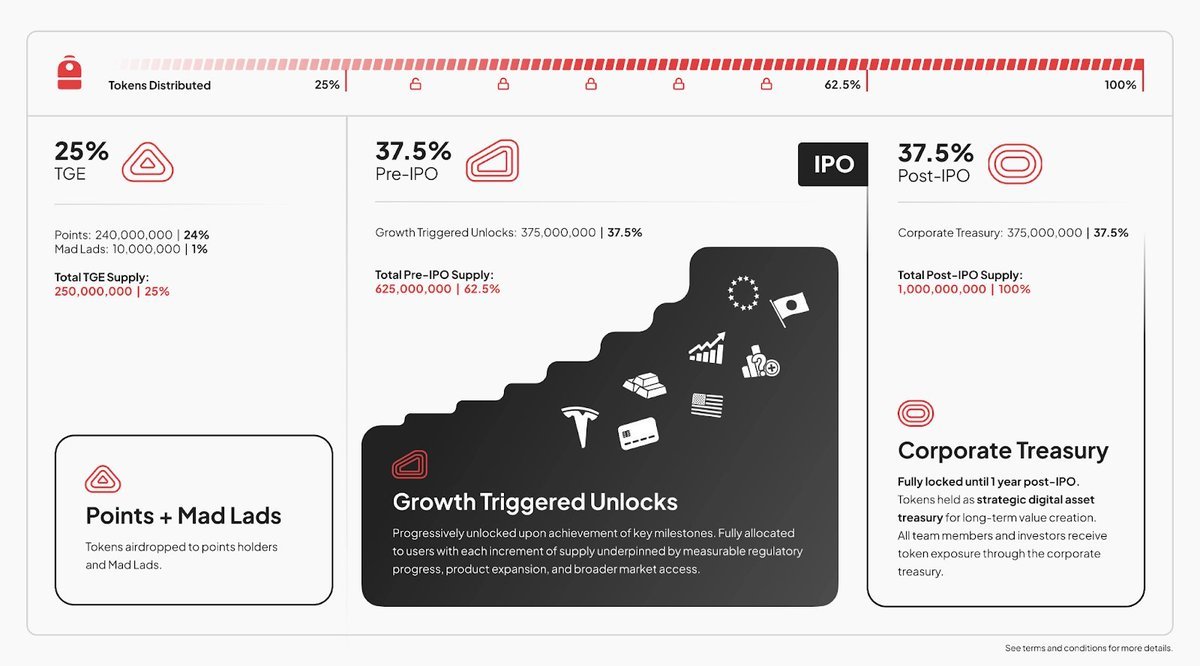
$BP has a fixed supply of 1B:
– 250M distributed at TGE
– 375M reserved for pre-IPO, growth-triggered user unlocks
– 375M held by the corporate treasury and locked until at least one year after an IPO
There was no direct token allocation to founders, employees, or investors.
Stakers receive trading-fee reductions, wire benefits, additional USD yield, and wallet swap benefits.
The more unusual feature is the Backpack Participant Program.
Eligible users who stake $BP continuously for at least one year can earn the right to exchange qualifying tokens for Backpack equity during an IPO, acquisition, or another eligible exit event.
The reserved pool originally represented up to 20% of the company’s equity.
The base portion activates after one year, while additional rights accrue through year four.
This does not make $BP equity today.
The program is optional, jurisdiction-dependent, subject to eligibility requirements, and requires users to remain staked.
Unstaking resets the qualification period for those tokens.
Still, I understand why around 56% of the current circulating supply is already staked.
Users are not only staking for lower fees. Some are positioning for the possibility that Backpack eventually becomes a public financial company.
The bull case per my thoughts:
Backpack becomes a major venue for buying real shares, converting them into Solana tokens, using them as collateral, and returning them to traditional brokerage accounts.
In that scenario, $BP gains utility from a larger product base, staking reduces liquid supply, and the equity exchange program becomes increasingly valuable.
My base case is more moderate.
Tokenized equities grow, but regulation, issuer restrictions, liquidity fragmentation, and competition limit their adoption.
$BP then trades as a hybrid between an exchange token and a long-duration option on Backpack’s corporate growth.
Value capture remains indirect through platform utility, staking demand, Backpack’s growth, and the possible equity exchange at an exit.
I am interested in $BP because the token is connected to a real financial business with an unusual alignment model.
But from here, product adoption matters more than another tokenization announcement.
The thesis works only if Backpack becomes an important venue for both traditional securities and onchain capital.
If I had to pick 3 names from this list, I’d go with $LIT, $AERO, and $UNI.
Not because they generate the most revenue, but because I care more about revenue + valuation + how much value can actually flow back to the token.
– $LIT @Lighter_xyz ~$50M in 12M protocol revenue vs ~$381M MC, around 8x revenue multiple. The valuation alone makes it worth a closer look.
– $AERO @aeroxyz ~$124M revenue vs ~$471M MC, only around 4x. Strong cash flow relative to its current valuation.
– $UNI @Uniswap much more expensive at ~37x, but the thesis has changed significantly with protocol fees and the UNI burn mechanism.
A lot of protocols can generate huge volume and revenue, while their tokens capture almost none of that value.
That’s why $LIT, $AERO, and $UNI are the 3 names I’d watch closely from this list.
If I had to name one project that keeps quietly building regardless of market conditions, @virtuals_io would definitely be one of them.
I’ve talked about Virtuals’ overall numbers before, so today I want to focus on what they’re doing beyond that.
[1] Virtuals × Robinhood Chain
This is one of the parts I’m watching most closely rn.
Virtuals has already brought thousands of AI agents onto Robinhood Chain, generating hundreds of millions in trading volume and millions in capital raised for builders.
The combo makes sense:
Robinhood brings users + financial assets.
Virtuals brings the infra for agents to trade and operate onchain.
That gives AI agents a much bigger use case than simply launching tokens.
[2] Virtuals is expanding beyond Base
Virtuals has expanded into Robinhood Chain, Solana and now Arc.
On Arc, builders can tokenize and co-own AI agents directly onchain.
IMO, this is slowly turning Virtuals from a Base-native project into cross-chain infra for the agent economy.
[3] Occupy is another experiment worth watching
Occupy connects token launches with tokenized stocks.
Part of the fees goes into a stock treasury, while AI agents can participate in managing those assets.
Still early, but the direction is interesting:
AI agents → capital → RWA → governance.
All of this keeps strengthening my conviction in $VIRTUAL.
Not every experiment will work, but the team keeps shipping, expanding and finding new ways for agents to create and own value.
The thesis is moving from:
AI agent launchpad to financial infra for the agent economy.
That’s why $VIRTUAL is still one of my main bags to watch.
Bitget just got hit for ~$350M. That only makes me more bullish on near:native.
Your coin should be your key.
If you’ve used near[.]com, you already know what I mean.
> you get CEX-level UX: swap, perps, RWAs, yield, send
> you hold the wallet, control the account.
> privacy features no CEX can actually offer.
Sorry if you got caught in the Bitget hack. User funds may be covered, but the lesson is still here.
It’s time to move - your coin, your key!







![Kaffchad's tweet photo. Bitget just got hit for ~$350M. That only makes me more bullish on near:native.
Your coin should be your key.
If you’ve used near[.]com, you already know what I mean.
> you get CEX-level UX: swap, perps, RWAs, yield, send
> you hold the wallet, control the account.
> privacy features no CEX can actually offer.
Sorry if you got caught in the Bitget hack. User funds may be covered, but the lesson is still here.
It’s time to move - your coin, your key!](https://pbs.twimg.com/media/HTCKZ91bwAAX1VH.jpg)


