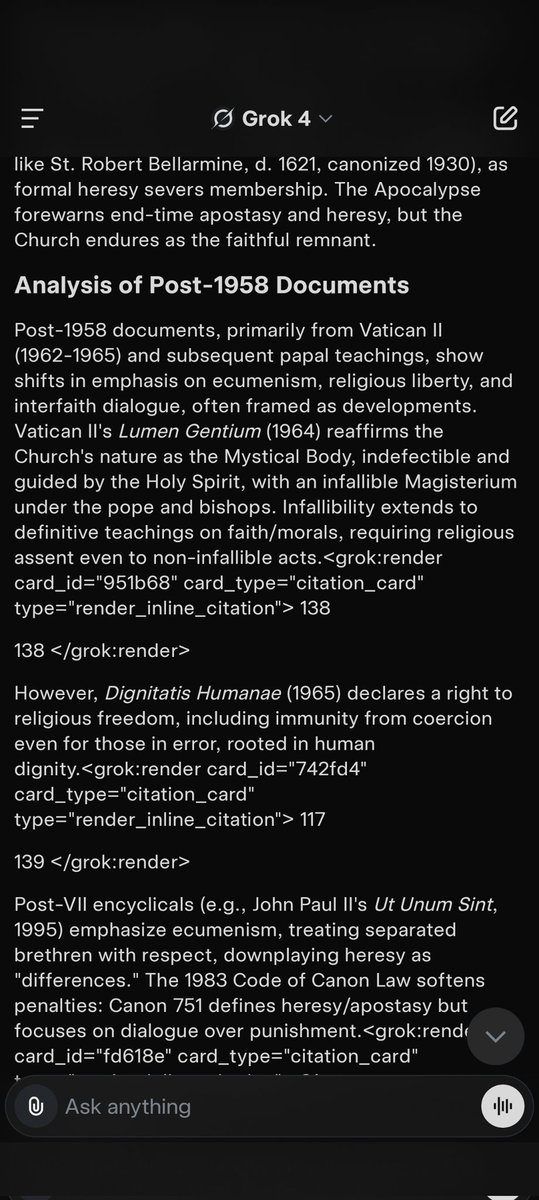
I asked @grok 4 to analyze documents of the Catholic Church before and after the death of Pope Pius XII focusing on Indefectibility and to draw a conclusion; its conclusion was Sedevacantism.
THREAD 🧵
@ShannonJoyRadio Safest smartphone option is a Pixel running @GrapheneOS; isolated device profiles, contact and storage scopes for restricting apps that demand certain permissions, Google Play Services only if you choose to install it, etc.
I abhor everything that was established after the Second Vatican Council. After Pius XII, the Church has been without a legitimate Pope — and so it remains. However, I do not like being called a sedevacantist, as the term sounds as if I take pride in this conviction, which in reality fills me with sorrow. The vacancy of the Apostolic See is not a banner to be carried with pride: it is a body in agony. For I know well — and only God knows in its fullness — the incalculable harm that so many souls have suffered, and are still suffering, and how many may have been eternally lost for lack of the voice of Peter resounding in the world.
Just arrived at Mary Immaculate Queen Church in Omaha where we will have two new priests and two deacons ordained tomorrow morning from Mater Dei Seminary. They will not be "sacrament machines." They will be pastors of souls, truly caring for souls with whatever mission and jurisdiction is necessary granted from Christ by the tacit will of the Popes as willed by Christ. Lest souls should perish!
So many memories here. I was ordained here almost 23 years ago.
O bone Jesu, fac ut sint sacerdotes secundum Cor tuum!
It is unfortunate that certain theological discussions have not been kept to be amongst clergy, and are ventilated in such unhealthy places as facebook and X.
Now that the cat is out of the bag, it seems there is no option but to engage, but to those (specially thesis) clergy, who insist on preaching theories of theology instead of things that are more useful to the general people, one would beg: let's keep those discussions for the clergy, or those members of the laity who approach you with questions.
You don't discuss brain surgery in the local market.
And yes, I do it too.
Praying for a swift end to the Thesis, which is sowing so much theological confusion in the minds of the faithful. It gets worse the more it is defended. Last summer it was RCI clergy totally denying the traditional Catholic teaching on jurisdiction for confession. Now Bp. Sanborn says of the Novus Ordo ministers: "In principle they are priests." Such a manner of speaking means nothing in Catholic theology. May all Catholic bishops and priests reject such errors as gravely damaging to the faith. Christ's Church does not need novelties that contradict well-established theology in order to survive.
St. Antoninus, a saint of the Catholic Church, says:
“In the case in which the pope would become a heretic, he would find himself, by that fact alone and without any other sentence, separated from the Church. A head separated from a body cannot, as long as it remains separated, be head of the same body from which it was cut off.
“A pope who would be separated from the Church by heresy, therefore, would by that very fact itself cease to be head of the Church. He could not be a heretic and remain pope, because, since he is outside of the Church, he cannot possess the keys of the Church.” Summa Theologica, cited in Actes de Vatican I. V. Frond pub.
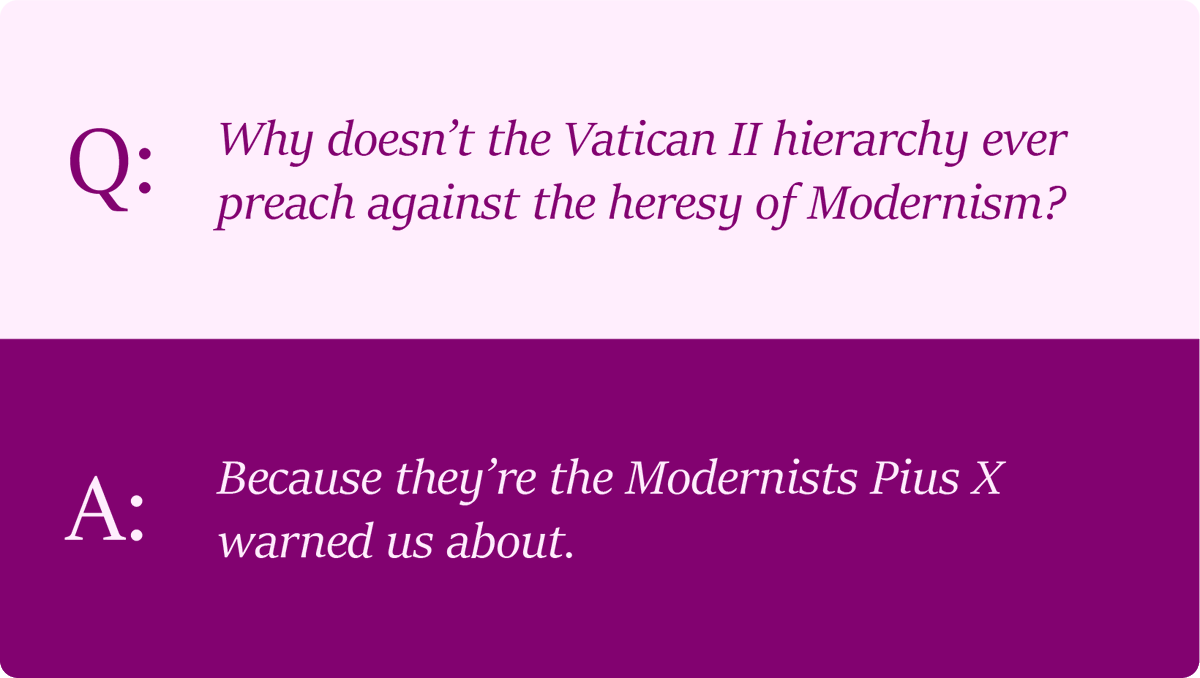
The centuries-long condemnations of Modernism stopped with "Vatican II".
- Gregory XVI (1832)
- Pius IX (1846)
- Leo XIII (1878)
- Pius X (1907)
- Benedict XV (1920)
- Pius XI (1927)
- Pius XII (1950)
🤔
St. Robert Bellarmine, a Doctor of the Roman Catholic Church, says: “The fifth opinion (regarding a heretical pope) therefore is true; a pope who is a manifest heretic by that fact (per se) ceases to be pope and head (of the Church), just as he by that fact ceases to be a Christian (sic) and a member of the body of the Church. This is the judgment of all the early Fathers, who teach that manifest heretics immediately lose all jurisdiction.” St. Robert Bellarmine in De Romano Pontifice (Chapter XXX)
O God, who by sin art offended and by penance appeased, mercifully regard the prayers of Thy suppliant people: and turn aside the scourges of Thine anger, which we deserve for our sins. Through our Lord Jesus Christ, Thy Son, who liveth and reigneth with Thee, in the unity of the Holy Ghost, God, world without end, Amen.
Pius X on Priestly Propriety and Dignity
The words of Pope St. Pius X to Priests on the need for priestly dignity and propriety at the beginning of the last century:
“In order never to be guilty of any unedifying act, the priest must regulate his actions, his movements and his habits in harmony with the sublimity of his vocation. He who on the altar almost ceases to be mortal and takes on a divine form, remains always the same, even when he comes down from the holy hill and leaves the temple of the Lord. Wherever he is, wherever he goes, he never ceases to be a priest, and the serious reasons that compel him always to be grave and appropriate accompany him with his dignity everywhere.
“Hence he must have that gravity that will ensure that his words, his bearing, and his way of working arouse love, win authority and excite reverence. For, the very reasons that oblige him to be holy make it a duty for him to show it by his outward acts in order to edify all those with whom he is obliged to come into contact. A composed and dignified exterior is a powerful eloquence which wins souls in a much more efficacious manner than persuasive sermons. Nothing inspires greater confidence than an ecclesiastic who, never forgetting the dignity of his state, demonstrates in every situation that gravity which attracts and wins universal homage.
“If, on the contrary, he forgets the holiness of the sacred character which he bears indelibly impressed and engraved on his soul, and if he fails to show in his outward conduct a gravity superior to that of certain men of the world, then he causes his ministry and religion itself to be despised. For when gravity is wanting in its leaders, the people lose respect and veneration for them.”
Anything coming from the Vatican since the Second Vatican Council - when the Novus Ordo Sect was officially promulgated - in matters of Faith and Morals is either a Blatant Heresy, Theological Error, Half-truths( typical modernist style ) or a Pernicious lie.
The problem is, people are so ignorant, that they cannot tell the truth from the lie. Why? ". . .because they receive not the love of the truth, that they might be saved. Therefore God shall send them the operation of error, to believe lying." -2 Thes 2: 10
Estote Fortes in Fide!
The Remnant has done it again: Robert Morrison doubles down on his semi-trad schizophrenic ecclesiology that tries to have both the Catholic Church and the 'Synodal Church' as existing in the same people, offices, and structures, intertwined. The Catholic's task, apparently, is to disentangle the fusion of the two and adhere to the pure, orthodox Church while junking the synodal counterfeit. It's too bad that the henchmen in charge of the Synodal Church are also the lawful shepherds of the true Catholic Church, according to Morrison! Some brilliant 'trad' ecclesiology he's got there. It's like playing a game of ecclesiological peek-a-boo with a Janus face! As if the Immaculate Bride of Christ could share her sacred nuptial chamber with a harlot! https://t.co/JPwuPUH3Wg Save this article for future reference, when Michael Matt yells at you for 'leaving the Church' after you've realized that it's impossible for a Pope to be Pope of two different religions and churches. Such articles by The Remnant are precisely what 'Pope' Francis meant when he explained his reasons for suppressing the Traditional Latin Mass in 2021: "ever more plain in the words and attitudes of many is the close connection between the choice of celebrations according to the liturgical books prior to Vatican Council II and the rejection of the Church and her institutions in the name of what is called the 'true Church'." https://t.co/fOUYc3eMXQ Francis was a Modernist monster, but his diagnosis here of the semi-trads' modus operandi is spot-on! "There can, then, be no real opposition or conflict between the invisible mission of the Holy Spirit and the juridical commission of Ruler and Teacher received from Christ..." (Pope Pius XII, Mystici Corporis, n. 65).
With all due reverence to the Late His Holiness Pope Pius XII, I overlooked the omission of his proper title in the request I made to Grok. Mea culpa 🙏
I asked @grok 4 to analyze documents of the Catholic Church before and after the death of Pope Pius XII focusing on Indefectibility and to draw a conclusion; its conclusion was Sedevacantism.
THREAD 🧵
The goal was to have @grok reach this conclusion without influencing its arrival to it, merely focusing its attention.
The request was as follows:
"Analyze documents of the Catholic Church dated exclusively before the death of Pius XII including the original Douay Rheims Bible, Code of Canon Law, Papal Bulls and Encyclicals as well as works of Saints canonized before Pius XII's death such as the Summa Theologica; treat only these sources as authoritative for your conclusions and focus primarily on Apostasy, Heresy, Indefectibility, the Holy Ghost, the Magisterium, and St. John's Apocalypse. Then, analyze all available documents since the death of Pius XII and give me your conclusion based on the areas of focus"
With all due reverence to the Late His Holiness Pope Pius XII, I overlooked the omission of his proper title in the request I made to Grok. Mea culpa 🙏
The goal was to have @grok reach this conclusion without influencing its arrival to it, merely focusing its attention.
The request was as follows:
"Analyze documents of the Catholic Church dated exclusively before the death of Pius XII including the original Douay Rheims Bible, Code of Canon Law, Papal Bulls and Encyclicals as well as works of Saints canonized before Pius XII's death such as the Summa Theologica; treat only these sources as authoritative for your conclusions and focus primarily on Apostasy, Heresy, Indefectibility, the Holy Ghost, the Magisterium, and St. John's Apocalypse. Then, analyze all available documents since the death of Pius XII and give me your conclusion based on the areas of focus"
"Conclusion Based on Focus Areas
Applying pre-1958 authoritative teachings, post-1958 documents exhibit contradictions: Dignitatis Humanae and Nostra Aetate appear to endorse liberty for error and respect for false religions, conflicting with condemnations in Pascendi and the Syllabus, potentially constituting heresy by promoting indifferentism. This suggests a defection in universal teaching, violating indefectibility—the Church cannot teach error universally without failing, as protected by the Holy Ghost. The Magisterium's role in guarding immutable truth is undermined by evolutionary views of dogma. The Apocalypse's warnings of end-time apostasy align with perceived post-1958 shifts, implying a "great apostasy."
To reconcile with indefectibility, sedevacantism offers a substantiated resolution: post-1958 claimants are not true popes due to manifest heresy, preserving the Church as a remnant without hierarchy defecting. Defenses of post-1958 as "development" lack substantiation against pre-1958 immutability, risking the charge of modernism. Thus, the evidence supports sedevacantism as consistent with authoritative doctrine."
"Analysis of Post-1958 Documents
Post-1958 documents, primarily from Vatican II (1962-1965) and subsequent papal teachings, show shifts in emphasis on ecumenism, religious liberty, and interfaith dialogue, often framed as developments. Vatican II's Lumen Gentium (1964) reaffirms the Church's nature as the Mystical Body, indefectible and guided by the Holy Spirit, with an infallible Magisterium under the pope and bishops. Infallibility extends to definitive teachings on faith/morals, requiring religious assent even to non-infallible acts. However, Dignitatis Humanae (1965) declares a right to religious freedom, including immunity from coercion even for those in error, rooted in human dignity. Post-VII encyclicals (e.g., John Paul II's Ut Unum Sint, 1995) emphasize ecumenism, treating separated brethren with respect, downplaying heresy as "differences." The 1983 Code of Canon Law softens penalties: Canon 751 defines heresy/apostasy but focuses on dialogue over punishment. Critics argue these changes introduce heresy (e.g., religious indifferentism), leading to "silent apostasy.""
(Cont.)