In 1963, the famous photographer Richard Avedon took a picture of a man named William Casby. William Casby, born in 1857, was 106 years old at the time. In his hands, he was holding his great-great-granddaughter, Cherri Stamps-McCray.
The image amazes me because the elderly gentleman holding his descendant so tenderly, was born into slavery more than a century prior. Casby would eventually live until 1970, dying at the age of 113.
His great- and great-grandchildren are alive today, and many of them remember him.
It puts into perspective just how relatively recent slavery existed. Because as faraway and distant as it may feel now. Even in modern-day America, there are people who have active memories of talking to former slaves.
Look at more amazing historical photos: https://t.co/dQjceOPkrz
I don't care what kind of hardware you have, you should be running local models
Governments are now banning models. They’re determining what technology you can and can’t use
With local models, you are free and nobody can control you
Even if you're on the cheapest Mac Mini you can be doing this
Here's a complete guide:
1. Download LMStudio
2. Go to your OpenClaw/Hermes and say what kind of hardware you have (computer and memory and storage)
3. Ask what's the best local model you can run on there (probably will be Gemma 4 or Qwen. if you have a big computer, it will be GLM)
4. Ask 'based on what you know about me, what workflows could this open model replace?'
5. Have OpenClaw walk you through downloading the model in LM Studio and setting up the API
6. Ask OpenClaw to start using the new API
Boom you're good to go.
You just saved money by using local models, have an AI model that is COMPLETELY private and secure on your own device, did something advanced that 99% of people have never done, and have entered the future.
If you are on smaller hardware you probably are not going to replace all your AI calls with this, but you could replace smaller workflows which will still save you good money
Own your intelligence.
Demis Hassabis: Google AI CEO Demis Hassabis has a message for laid off engineers at Meta, Amazon, Block, and other companies: I have a million ideas, I would love to have some free engineers to go and… | - The Times of India https://t.co/toeb9jQu7c
Dennis Ritchie created C in the early 1970s without Google, Stack Overflow, GitHub, or any AI ( Claude, Cursor, Codex) assistant.
- No VC funding.
- No viral launch.
- No TED talk.
- Just two engineers at Bell Labs. A terminal. And a problem to solve.
He built a language that fit in kilobytes.
50 years later, it runs everything.
Linux kernel. Windows. macOS.
Every iPhone. Every Android.
NASA’s deep space probes.
The International Space Station.
> Python borrowed from it.
> Java borrowed from it.
> JavaScript borrowed from it.
If you have ever written a single line of code in any language, you did it in Dennis Ritchie’s shadow.
He died in 2011.
The same week as Steve Jobs.
Jobs got the front pages.
Ritchie got silence.
This Legend deserves to be celebrated.
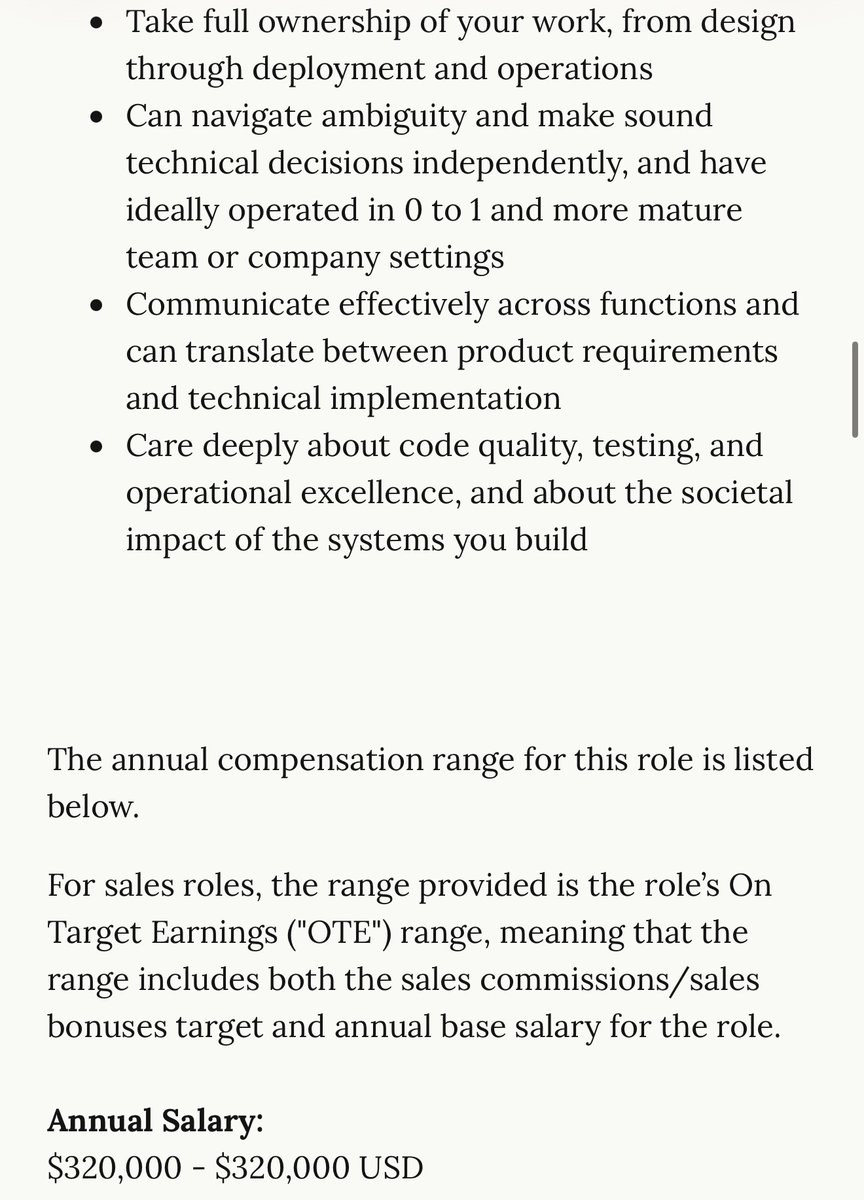
Anthropic has 454 open roles. The company is hiring software engineers at $320K-$405K. Their CEO, Dario, said three months ago that coding is "going away first, then all of software engineering."
The paradox resolves instantly.
Dario's engineers told him they don't write code anymore. They let Claude write it. They edit. They review. They architect. They didn't lose their jobs. They got faster. Anthropic grew from a small research lab to 1,500 employees in four years, adding engineers the entire time.
This has played out five times in computing history. Compilers replaced assembly. Frameworks replaced boilerplate. Cloud replaced server management. Every prediction was the same: most programmers won't be needed. Every result was the same: the number of engineers grew.
The global software engineer pool went from roughly 5 million in 2010 to 28.7 million today. BLS projects 17% growth in US software developer roles through 2033, adding 304,000 positions. The pool is projected to hit 45 million by 2030.
When building software gets cheaper, more problems become worth solving with software. A startup that needed 10 engineers now needs 3. But 50 companies that couldn't afford to build at all now can. The denominator shrinks. The numerator explodes.
Meta's engineering headcount is up 19% from January 2022. Google's is up 16%. Apple, 13%. These companies adopted AI coding tools years ago. They're using Copilot and Claude Code daily. They're hiring more engineers than before those tools existed.
Every generation of "coding is dead" content creates two cohorts: engineers who freeze up, and engineers who build 10x more with the new tools. The second group has won every single time.