Allahamdulilah I’m grateful for this growth!
I’ve just pulled out 10lakhs from bitcoin mining.
I’m trying my best to reach out to as many people as I can and share this opportunity with others. Follow and send a Dm to @CllrBSilvester and see what’s possible.
I just invest ₹50,000 in bitcoin mining and earned ₹625,700 within 3hours, I withdrew my profit immediately into my bank just to be sure and it came through!! Send a Dm to @CllrBSilvester to get started, she helped me through the whole process. It’s 100% safe!
A critique of Sheikh Abdullah's autobiography Atish-e-Chinar and its treatment of the Ahrar leader Shorish Kashmiri with some personal reflections Ved Bhasin. From our archives.
Sheikh Abdullah's Atish-e-Chinar and Shorish Kashmiri https://t.co/Oj6BekNz18
Francis Fukuyama recently shared a compelling piece titled “The Myth of Authoritarian Efficiency” by political scientists Jørgen Møller and Svend-Erik Skaaning (Aarhus University / V-Dem project).
The article dismantles the popular notion that authoritarian regimes—particularly China—are simply better at “getting things done.” Drawing on historical data and comparative evidence, the authors argue that democracies consistently outperform autocracies over the long term across critical domains:
��� Military effectiveness: Democracies have won more than 80% of wars since 1815. Greater legitimacy enables citizens to make greater sacrifices, and democratic alliances prove more durable.
• Economic performance: While autocracies can drive catch-up growth to middle-income levels, they struggle to transition to innovation-driven, knowledge economies that require rule of law, intellectual property protection, and open debate. High-quality democracies show a modest but robust long-run growth advantage.
• Avoiding catastrophe: Autocracies periodically produce large-scale man-made disasters (Mao’s Great Leap Forward, Soviet collectivization). Institutional checks and public scrutiny in democracies make comparable failures rare.
• Crisis management & environment: Transparency, independent science, and accountability lead to better outcomes on pandemics, climate policy, and environmental indicators. China’s zero-COVID flip-flop and overstated economic statistics illustrate the risks of centralized, unaccountable decision-making.
The authors acknowledge democracies can be slow and messy, but emphasize that self-correction mechanisms ultimately make them more resilient and effective than systems that concentrate power without feedback loops.
Francis Fukuyama, author of the landmark book The End of History and the Last Man, continues to spark important conversations about the enduring strengths of liberal democracy in an era of renewed authoritarian confidence.
Full article (highly recommended):
https://t.co/rdLYptPLnY
What’s your take—do you see evidence of this “myth” playing out in emerging markets or great-power competition today?
#Democracy #Geopolitics #China #EmergingMarkets #InternationalRelations #PoliticalEconomy
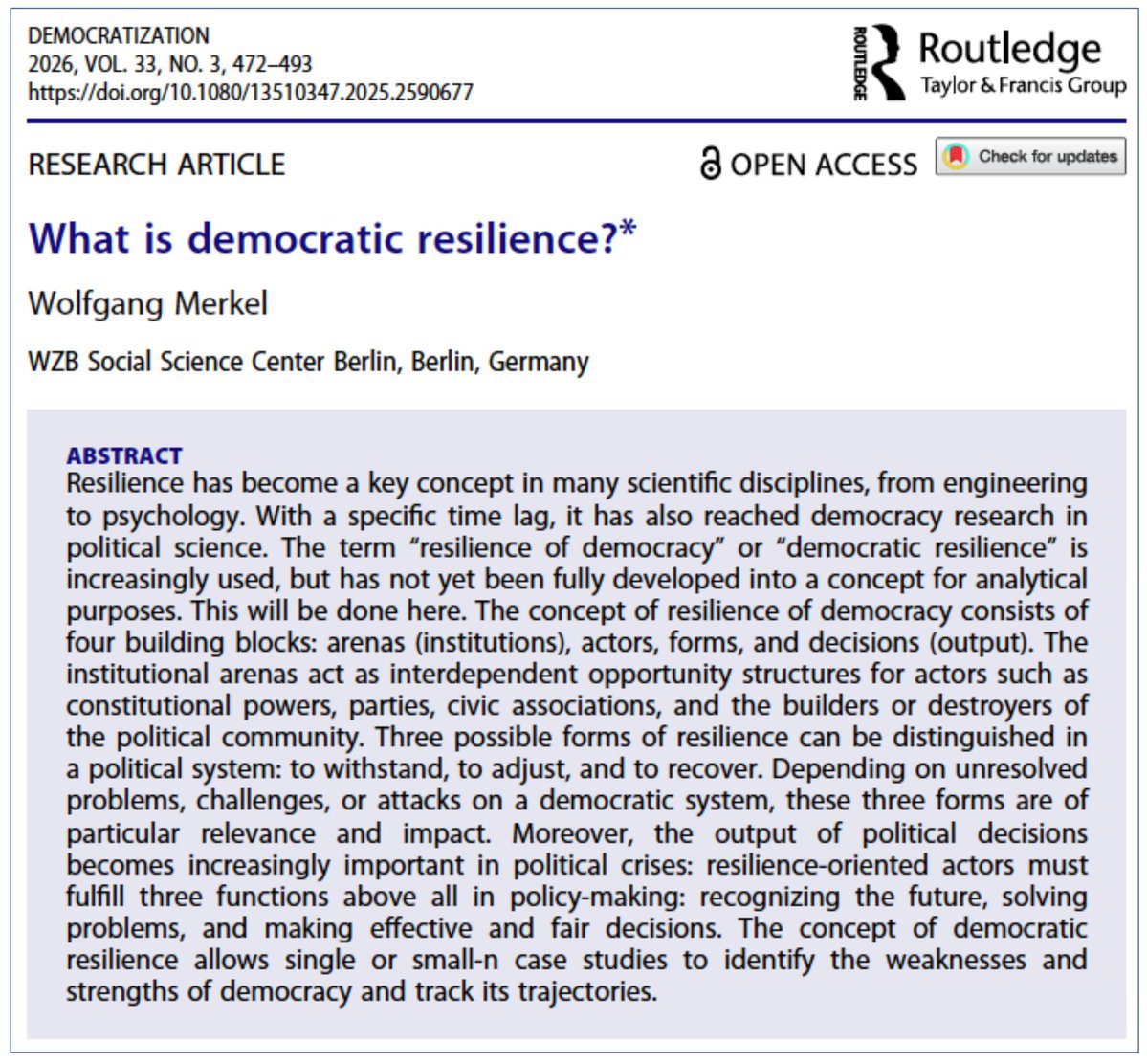
The Concept of Democratic Resilience
The notion of resilience has become a common one in current discussions of democracy - and this article by @merkel_wolfgang in @democ_journal offers a useful analysis of the concept.
Open Access: https://t.co/AgXapkCZIR
Hindu-Muslim violence is changing: till recently riots were instrumentalised to polarise the voters & help BJP win elections; today BJP is in office: pogroms, lynchings, bulldozers are the order of the day. A great special issue of CSA explains why and how https://t.co/ZLoBgUb5y4
かなり良い気がする
Research Design for Political Science PhD Students
PS 522 Research Design(pdf)
Spring 2026
Jake Bowers
https://t.co/SN8nPxQX8L
https://t.co/68AvohK4nd
read this one today. places south africa as the key lab for biometrics vis-a-vis its gatekeeper state w racially inscribed limits on the usual 'will to know' of (documentary)colonial bureaucracy+its place as model for biometric welfare states in postcolonial sa, brazil, india,etc
The more you read the more you win:
1. Philosophy for thinking clearly
2. Poetry for feeling deeply
3. History for learning from the past
4. Science for understanding the world
5. Fiction for growing your empathy
6. Biography for life inspiration
7. Essays for better writing
8. Economics for smarter choices
9. Psychology for knowing yourself
10. Journalism for staying informed
11. Mythology for sparking creativity
12. Silence for inner peace
13. Travel writing for cultural awareness
14. Self-help for personal growth
15. Classics for timeless lessons
16. Spirituality for deeper meaning
17. Anthropology for human understanding
18. Art history for seeing beauty
19. Neuroscience for brain power
20. Letters and diaries for real stories
21. Sociology for social awareness
22. Language learning for new perspectives
23. Stoicism for mental strength
24. Leadership books for guiding others
25. Nature writing for a calm mind
26. Crime writing for sharp focus
27. Finance books for building wealth
28. Health books for a stronger body
29. Parenting books for raising good humans
30. Children's books for pure joy
31. Short stories for quick wisdom
32. Memoirs for raw honest truth
33. Science fiction for bold new ideas
34. Political books for world awareness
35. Cooking books for everyday creativity