The easiest explanation for the discrepancy is that the IRGC is counting smaller vessels, which ultimately don’t move the needle on commercial disruptions
Iran has been reporting oddly high transit levels via state and social media, claiming earlier this month that 30 to 40 ships were crossing the strait each day. But tanker tracking tells a completely different story: Fewer than 10 daily transits and on some days only two.
BREAKING: Senior Iranian official Mohsen Rezaei rejects the US Strait of Hormuz proposal as "unrealistic," saying Iran will not allow the US to exit the crisis it created without paying reparations for war damage, with the Strait remaining closed until the US pays, even if all US forces fully withdraw from the region.
He says the US is "trying to stage a flamboyant gesture" and exit the scene after Project Freedom collapsed, with Iran refusing to allow such schemes to materialize.
Iran's Foreign Ministry separately confirmed Iran has not decided on the broader US proposal and no response has been given yet, contradicting Trump's and Axios claims of "great progress" toward a deal.
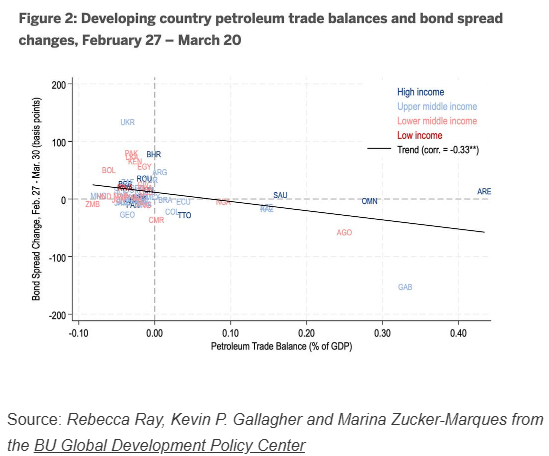
The shift in bond spreads has been particularly stark for low-income and lower-middle-income fossil fuel importers that were already vulnerable, such as Sri Lanka and Pakistan, who have current IMF agreements.
Swings in bond yields in reponse to the Iran war shock are related to countries’ petroleum trade balances.
Countries that are net petroleum importers have suffered, while net exporters have benefited.
$BORR Arabia III was impacted by an incident that occurred on a customer-operated platform.
The rig was subsequently safely shut down, and all personnel were successfully evacuated.
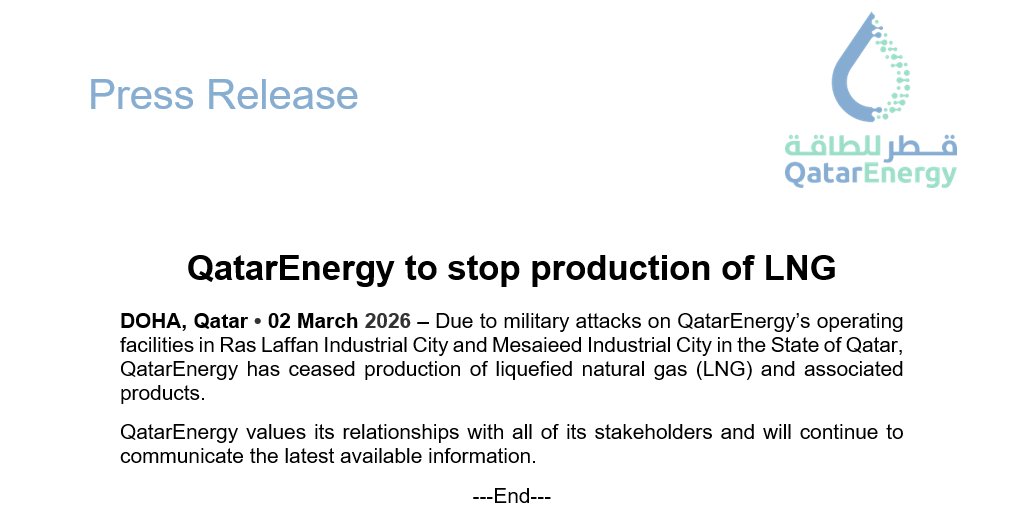
🚨🚨🚨BREAKING: QatarEnergy stops LNG production
(... if Qatar has shut down all its LNG production -- 14 trains --, as the statement's wording suggests, that's roughly 20% of the world's output. As a single company, QatarEnergy is the world's largest LNG producer...)
The Argentina story is just getting started 🇦🇷
$1.2B in cash on the balance sheet, $0.25 dividend, and still buying back shares.
Management is firing on all cylinders.
The LNG supercycle is real and Golar is perfectly positioned for it 🚀
🔥 $GLNG just dropped a good Q4 2025! Revenues up 80% YoY, Adj
EBITDA up 54%, and a whopping $14B backlog locked in — this is what execution looks like.
FLNG Hilli & Gimi both beating production targets while MKII FLNG stays on time & on budget.
#GLNG#GolarLNG#LNG#Earning
European LNG imports rose to a new monthly record in January as several relentless cold snaps ratcheted up regional demand, with last month’s incoming flows totalling 13.7 million tonnes – up 2% compared to the previous all-time high from December 2022.
🔔Transocean announces acquisition of Valaris in all-stock transaction valued at $5.8 billion.
Valaris shareholders will receive 15.235 $RIG shares for each $VAL share.
Combined company will have a fleet of 73 offshore rigs with $10 billion backlog.
Expected close 2H 2026.
$KOS excellent news should ease most investors' concerns.
Jubilee drilling has successfully added 10K bopd to production. Since reinitiating drilling a few months ago, this is the second well brought online, both exceeding expectations by contributing 10K bopd and more than offsetting the 20% annual decline. The partnership aims to bring five more wells in 2026. Additionally, it received government approval in late December for license extensions that will boost 2P reserves.
What does it mean?
1. Jubilee Field isn't dead as the market was discounting.
As I mentioned a few weeks ago, I am not an engineer and may overlook some details, but I have been studying this field since the initial oil production in 2010. I have noticed that Jubilee has faced significant declines before, yet each time they drilled, the field responded and production recovered to around 90K.
Tullow's guidance added fuel to the fire for the shorts (14% shorts), as mid guidance implied a slight decrease relative to 2025 production (~60K). However, Kosmos revealed the field begins the year with a 70K production rate, with five additional wells expected to be added throughout the year.
Additionally, concerns have arisen about the reserves, which have declined over the past year. As I mentioned a few weeks ago, it is normal for reserves to decline during periods without drilling or operational issues. However, I anticipated an increase in reserves resulting from the unlocking of new reserves through the drilling campaign, 4D and OBN seismic data, and the license extension. Kosmos has today confirmed that they expect to achieve an increase in 2P reserves.
2. TEN fields are back
The breakeven for TEN fields was so high that the company was burning cash at current prices, mainly due to FPSO costs. Today, Kosmos announced that the partnership is acquiring the FPSO, which will lower the breakeven point and improve leverage.
3. GTA is on fire
Although we are still pursuing FPSO refinancing to reduce costs significantly, we can confirm that the field is fully ramped up and operating at nameplate capacity. This field holds approximately 530 MMboe of 2P reserves, enough to sustain more than 20 years of production. The company's main challenge in recent years has been investing without output. However, going forward, the field will not require further capex and will begin generating cash flows.
What else?
Kosmos demonstrated in today’s press release that operations are making significant progress in the two main areas that raised concerns in 2025. However, the company remains highly leveraged, and at current oil prices, it won’t generate enough free cash flow to cover its 2027 debt. Consequently, Kosmos plans to extend its maturities over the next few weeks. KOS announced that RBL banks have agreed to a waiver, enabling the company to issue new secured financing. This suggests that Kosmos intends to issue debt against GTA and repay the 2027 bonds soon, thereby clearing the 2027 debt and allowing Brent prices to return to more typical levels ($70 per barrel). While 2025 and 2026 experienced oversupply, market conditions are expected to be more balanced by late 2026, turning undersupplied by 2027, as the world will see no non-OPEC supply growth—the US shale sector isn’t expected to expand further, and the major development in Guyana, Brazil, and Argentina is happening this year. This represents a significant turning point for the oil market, as US shale has been the primary disruptor since 2014, accounting for approximately 80% of demand growth in the past decade. Since demand is projected to continue growing through 2040 and US supply growth has plateaued, additional supply will be required, but it's uncertain where that supply will come from. One thing I’m certain of is that higher oil prices will be necessary to stimulate investments, whether in Venezuela, Guyana, or elsewhere.
Be aware that we own around 1.5% of the company and $37m in bonds, so do your own due diligence