🔴GUERRA CONTRA EL TERRORISMO: HAMAS🔴/The Sofx Report/
Las FDI matan al comandante de la Nukhba de Hamás vinculado a los secuestros en el cruce de Re’im
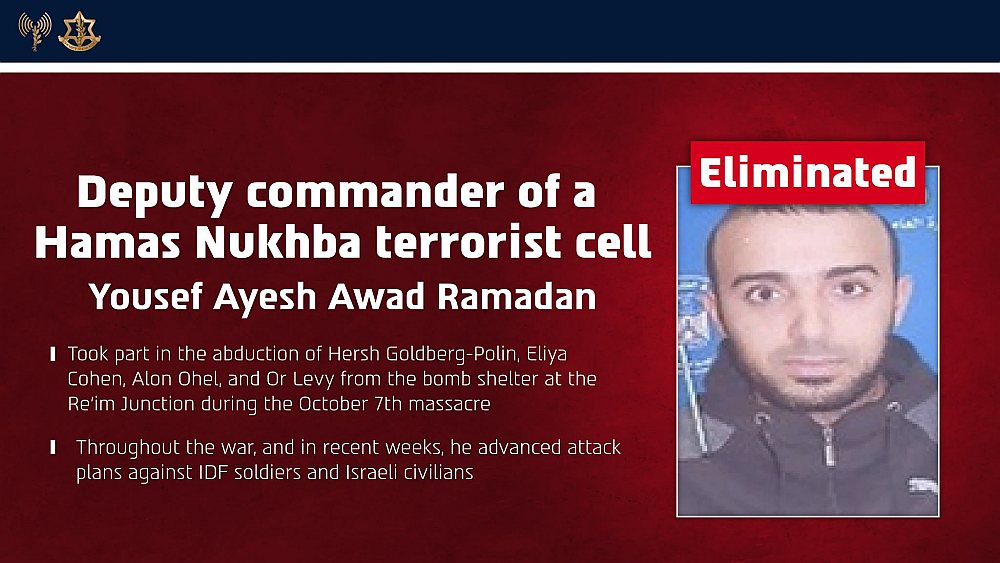
Las Fuerzas de Defensa de Israel (FDI) anunciaron el martes que las fuerzas del Comando Sur mataron a Yousef Ayesh Awad Ramadan, subcomandante de una célula de la Fuerza Nukhba de Hamás, en un ataque perpetrado el lunes en la franja central de Gaza.
Según las FDI, Ramadan se infiltró en territorio israelí durante la masacre del 7 de octubre de 2023 y participó en el secuestro de Hersh Goldberg-Polin, Eliya Cohen, Alon Ohel y Or Levy desde un refugio antiaéreo en el cruce de Re’im.
La Fuerza Nukhba es la unidad de operaciones especiales de las Brigadas Izz al-Din al-Qassam, el brazo armado de Hamás, y lideró el asalto transfronterizo del 7 de octubre.
Las FDI afirmaron que Ramadan siguió impulsando planes de ataque contra soldados y civiles israelíes en Gaza en las últimas semanas, lo que suponía una amenaza inmediata para las fuerzas en la zona.
Según las FDI, antes del ataque se tomaron medidas para mitigar el daño a la población civil, incluido el uso de munición de precisión y vigilancia aérea.
Se ha confirmado el destino de las cuatro víctimas del refugio de Re’im. Goldberg-Polin, una estadounidense-israelí, fue asesinada por Hamás en agosto de 2024 tras casi 11 meses de cautiverio.
Cohen y Levy fueron liberados a principios de 2025.
Ohel, que sufrió hambre, tortura y graves lesiones oculares durante más de dos años de cautiverio, fue liberado el 13 de octubre de 2025 gracias a un acuerdo negociado por Estados Unidos.
Respondió al asesinato de Ramadán con una publicación en Instagram en la que agradecía a las FDI y pedía al ejército que continuara «hasta el último terrorista».
El ataque continúa la campaña de las FDI contra los autores de los atentados del 7 de octubre.
El 16 de mayo, las fuerzas del Comando Sur mataron a otros dos miembros de Hamás, Hamer Iyad Muhammad Almatouk y Khaled Muhammad Salem Joudeh, en el norte de Gaza, después de que ambos intentaran atacar a las tropas de las FDI.
El 15 de mayo, las FDI mataron a Izz ad-Din al-Haddad, jefe del ala militar de Hamás. El jefe del Estado Mayor de las FDI, el teniente general Eyal Zamir, calificó esa operación de «un logro operativo significativo».
https://t.co/uJAZUuO7su via @SOFXnetwork
🔴WAR ON TERRORISM: HAMAS🔴/The Sofx Report/
IDF Kills Hamas Nukhba Commander Linked to Re’im Junction Abductions
The Israel Defense Forces (IDF) announced Tuesday that Southern Command forces killed Yousef Ayesh Awad Ramadan, a deputy commander of a Hamas Nukhba Force cell, in a Monday strike on the central Gaza Strip.
According to the IDF, Ramadan infiltrated Israeli territory during the October 7, 2023 massacre and participated in the abduction of Hersh Goldberg-Polin, Eliya Cohen, Alon Ohel, and Or Levy from a bomb shelter at the Re’im Junction.
The Nukhba Force is the special operations element of the Izz al-Din al-Qassam Brigades, Hamas’s military wing, and led the cross-border assault on October 7.
The IDF stated that Ramadan continued to advance attack plans against Israeli soldiers and civilians in Gaza in recent weeks, posing an immediate threat to forces in the area.
According to the IDF, prior to the strike, steps were taken to mitigate harm to civilians, including the use of precise munitions and aerial surveillance.
All four victims from the Re’im shelter have confirmed fates. Goldberg-Polin, an American-Israeli, was killed by Hamas in August 2024 after nearly 11 months in captivity.
Cohen and Levy were released in early 2025.
Ohel, who endured starvation, torture, and serious eye injuries during more than two years in captivity, was freed October 13, 2025, through a U.S.-brokered deal.
He responded to Ramadan’s killing with an Instagram post thanking the IDF and calling on the military to continue “until the last terrorist.”
The strike continues an IDF campaign targeting October 7 perpetrators.
On May 16, Southern Command forces killed two additional Hamas operatives, Hamer Iyad Muhammad Almatouk and Khaled Muhammad Salem Joudeh, in northern Gaza after both men attempted attacks against IDF troops.
On May 15, the IDF killed Izz ad-Din al-Haddad, head of Hamas’s military wing. IDF Chief of Staff Lt.-Gen. Eyal Zamir called that operation “a significant operational achievement.”
https://t.co/uJAZUuOFi2 via @SOFXnetwork
🔴GUERRA CONTRA EL TERRORISMO: IRÁN 🇮🇷 🔴/CTP-ISW/
El régimen iraní está tratando de imponer costes a Estados Unidos por seguir aplicando su bloqueo, al tiempo que intenta tensar las relaciones de los Estados del Golfo con Estados Unidos.
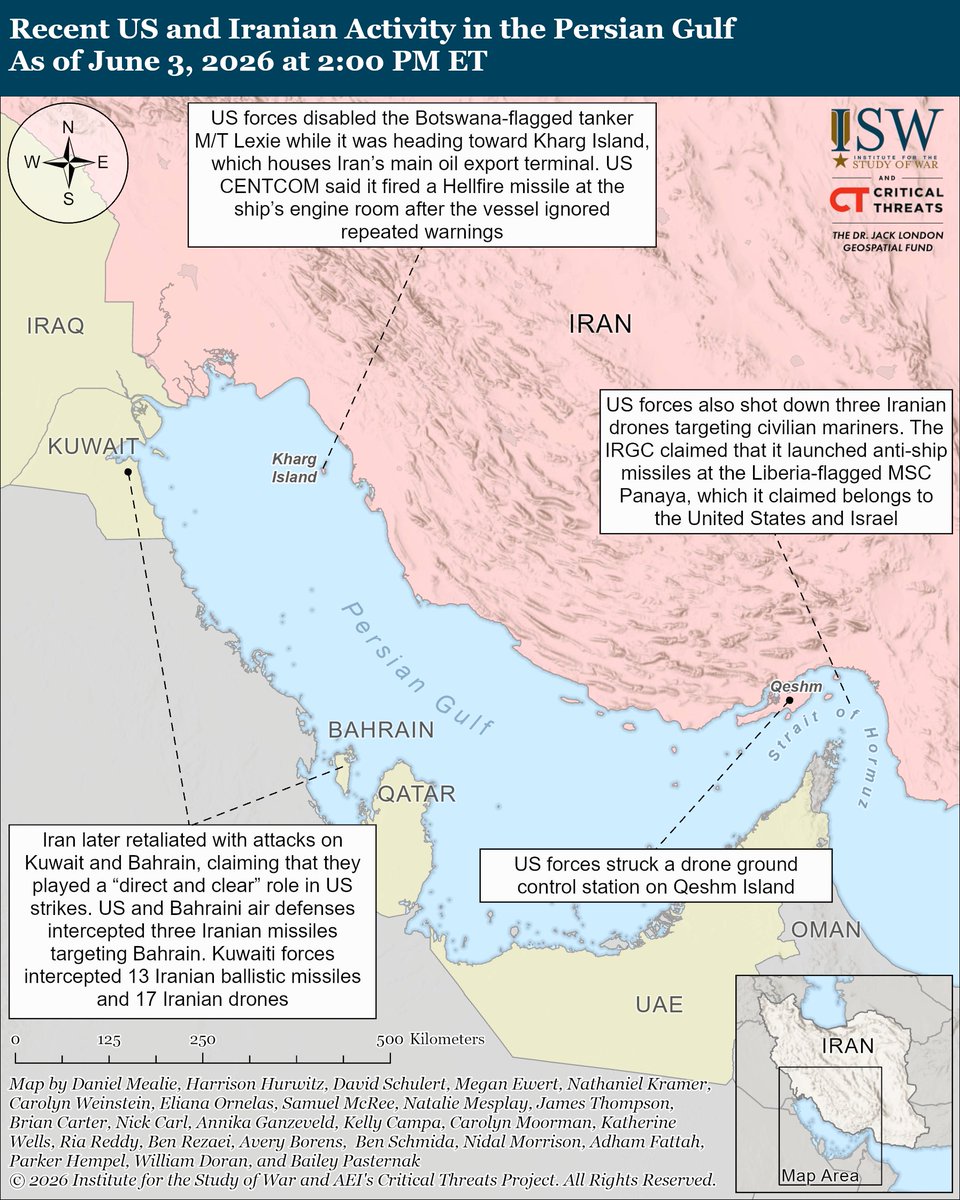
El Mando Central de EE. UU. (CENTCOM) declaró el 2 de junio que las fuerzas navales estadounidenses inutilizaron un petrolero afiliado a Irán, el M/T Lexie, con bandera de Botsuana, que se dirigía hacia la isla iraní de Kharg violando el bloqueo estadounidense.
Las fuerzas iraníes lanzaron entonces drones de ataque contra buques civiles que intentaban transitar por el Golfo Pérsico. Las fuerzas estadounidenses interceptaron tres de los drones.
El IRGC también afirmó que lanzó misiles antibuque contra el MSC Panaya, con bandera de Liberia, del que afirmó que pertenece a Estados Unidos e Israel.
Posteriormente, las fuerzas estadounidenses llevaron a cabo ataques en legítima defensa contra estaciones de control terrestre de drones en la isla de Qeshm, en el estrecho de Ormuz.
Las fuerzas iraníes respondieron entonces disparando misiles balísticos y drones contra bases estadounidenses en Kuwait y Baréin.
El Ministerio de Defensa de Kuwait declaró el 3 de junio que las fuerzas kuwaitíes interceptaron 13 misiles balísticos y 17 drones.
Sin embargo, dos misiles iraníes impactaron en el Aeropuerto Internacional de Kuwait, causando la muerte de una persona, heridas a al menos otras 63 y daños significativos.
Las defensas aéreas de Estados Unidos y Baréin también interceptaron tres misiles balísticos, uno de los cuales tenía como objetivo el cuartel general de la Quinta Flota de Estados Unidos en Manama.
El medio de comunicación en lengua inglesa del régimen iraní, Press TV, afirmó que los ataques de Irán enviaban un mensaje a los países del Golfo de que su «territorio no es seguro» si continúan acogiendo a las fuerzas estadounidenses.
Este comentario refleja los esfuerzos de Irán por abrir una brecha entre los Estados del Golfo y Estados Unidos, amenazando con atacar a los Estados del Golfo si cooperan con Estados Unidos.
Los esfuerzos de Irán por sembrar divisiones entre los Estados del Golfo y Estados Unidos forman parte de su objetivo estratégico más amplio de expulsar a Estados Unidos de Oriente Medio.
************
Las autoridades y los medios de comunicación iraníes respondieron a estos ataques con nuevas amenazas, probablemente para intentar disuadir a Estados Unidos de aplicar su bloqueo a los puertos iraníes.
El asesor militar del líder supremo iraní, Mojtaba Jamenei, Mohsen Rezaei, declaró el 3 de junio que Irán no permitirá que Estados Unidos plantee «exigencias excesivas» en las negociaciones y responderá a cualquier acción militar estadounidense con una «lluvia de misiles y drones».
Press TV también argumentó que Irán intensificará sus respuestas a la acción militar estadounidense con el fin de disuadir a Estados Unidos de emprender dicha acción.
https://t.co/fLi62ngNHh via @criticalthreats
🔴WAR ON TERRORISM: IRAN 🇮🇷🔴/CTP-ISW/
The Iranian regime is trying to impose costs on the United States for continuing to enforce its blockade while also trying to strain Gulf states’ relations with the United States.
US Central Command (CENTCOM) stated on June 2 that US naval forces disabled an Iranian-affiliated tanker, the Botswana-flagged M/T Lexie, that was transiting toward Iran’s Kharg Island in violation of the US blockade.
Iranian forces then launched attack drones at civilian ships trying to transit the Persian Gulf. US forces intercepted three of the drones.
The IRGC also claimed that it launched anti-ship missiles at the Liberia-flagged MSC Panaya, which it claimed belongs to the United States and Israel.
US forces subsequently conducted self-defense strikes against drone ground control stations on Qeshm Island in the Strait of Hormuz.
Iranian forces then retaliated by firing ballistic missiles and drones at US bases in Kuwait and Bahrain.
The Kuwaiti Defense Ministry stated on June 3 that Kuwaiti forces intercepted 13 ballistic missiles and 17 drones.
Two Iranian missiles hit Kuwait International Airport, however, killing one person, injuring at least 63 others, and causing significant damage.
US and Bahraini air defenses also intercepted three ballistic missiles, one of which targeted the US Fifth Fleet Headquarters in Manama.
The Iranian regime’s English-language media outlet, Press TV, claimed that Iran’s attacks sent a message to Gulf countries that their “territory is not safe” if they continue to host US forces.
This comment reflects Iran’s efforts to drive a wedge between the Gulf states and the United States by threatening to attack the Gulf states if they cooperate with the United States.
Iran’s efforts to sow divisions between the Gulf states and the United States are part of Iran’s broader strategic objective to expel the United States from the Middle East.
************
Iranian officials and media responded to these attacks with further threats, probably to try to deter the United States from enforcing its blockade on Iranian ports.
Iranian Supreme Leader Mojtaba Khamenei’s military adviser, Mohsen Rezaei, stated on X on June 3 that Iran will not allow the United States to make “excessive demands” in negotiations and will respond to any US military action with a “barrage of missiles and drones.”
Press TV also argued that Iran will intensify its responses to US military action in order to deter the United States from taking such action.
https://t.co/fLi62ngNHh via @criticalthreats
🔴GUERRA CONTRA EL TERRORISMO: IRÁN 🇮🇷 🔴/CTP-ISW/
Irán y Hezbolá siguen intentando convertir las negociaciones para poner fin a la guerra en el estrecho de Ormuz en negociaciones para poner fin a la guerra en el Líbano, que Irán y Hezbolá pretenden que concluya con la capitulación de Israel.
El presidente de EE. UU., Donald Trump, anunció el 1 de junio un alto el fuego parcial entre Israel y Hezbolá, según el cual Israel no atacaría objetivos de Hezbolá en Beirut y Hezbolá detendría los ataques contra Israel.
El primer ministro israelí, Benjamin Netanyahu, anunció posteriormente que Israel atacaría objetivos de Hezbolá en Beirut si Hezbolá continuaba atacando a Israel, lo que sugiere que aceptó no atacar Beirut si Hezbolá cesaba los ataques contra Israel.
La embajada libanesa en Washington afirmó el 1 de junio que Hezbolá había acordado cesar los ataques contra el norte de Israel.
Sin embargo, tras el anuncio de Trump, responsables de Hezbolá afirmaron que el grupo no se adheriría a un alto el fuego parcial.
Hezbolá llevó a cabo ataques con cohetes contra las Fuerzas de Defensa de Israel (FDI) en el norte de Israel el 3 de junio, por primera vez desde el 1 de junio.
Hezbolá afirmó que el 3 de junio lanzó cohetes contra soldados de las FDI cerca de la frontera entre Israel y el Líbano, varias horas después de que las FDI llevaran a cabo un ataque aéreo contra un vehículo en Khalde, a unos 13 kilómetros al sur de Beirut.
El embajador israelí en Estados Unidos, Yechiel Leiter, calificó el ataque de Hezbolá del 3 de junio como una violación del alto el fuego parcial y sugirió que Israel podría responder atacando objetivos de Hezbolá en Beirut.
Un corresponsal militar israelí informó el 3 de junio de que Netanyahu se reunirá con altos cargos israelíes para determinar la respuesta de Israel al ataque de Hezbolá.
https://t.co/fLi62nhlwP via @criticalthreats
🔴WAR ON TERRORISM: IRAN 🇮🇷🔴/CTP-ISW/
Iran and Hezbollah are continuing to try to transform negotiations about ending the war over the Strait of Hormuz into negotiations about ending the war in Lebanon, which Iran and Hezbollah seek to end in Israel’s capitulation.
US President Donald Trump announced on June 1 a partial ceasefire between Israel and Hezbollah in which Israel would not attack Hezbollah targets in Beirut and Hezbollah would halt attacks against Israel.
Israeli Prime Minister Benjamin Netanyahu subsequently announced that Israel would attack Hezbollah targets in Beirut if Hezbollah continued to attack Israel, suggesting that he agreed not to strike Beirut if Hezbollah ceased attacks on Israel.
The Lebanese Embassy in Washington claimed on June 1 that Hezbollah had agreed to cease attacks on northern Israel.
Hezbollah officials claimed after Trump’s announcement that the group would not adhere to a partial ceasefire, however.
Hezbollah conducted rocket attacks targeting the Israel Defense Forces (IDF) in northern Israel on June 3 for the first time since June 1.
Hezbollah claimed that it fired rockets targeting IDF soldiers near the Israel-Lebanon border on June 3, several hours after the IDF conducted an airstrike targeting a vehicle in Khalde, eight miles south of Beirut.
Israeli Ambassador to the United States Yechiel Leiter called Hezbollah’s June 3 attack a violation of the partial ceasefire and suggested that Israel could respond by attacking Hezbollah targets in Beirut.
An Israeli military correspondent reported on June 3 that Netanyahu is set to meet with senior Israeli officials to determine Israel’s response to Hezbollah’s attack.
https://t.co/fLi62ngNHh via @criticalthreats
🔴WAR ON TERRORISM: IRAN 🇮🇷🔴/Israel Hayom/
Amid strike on Kuwait, Iran warns every Gulf ally of America
Tehran widened its warnings after overnight strikes on Kuwait City's airport while the Revolutionary Guards claimed dominance over the Strait of Hormuz; new details emerged about Washington's nuclear annex to Iran.
By Neta Bar and Shachar Kleiman
Iran's Foreign Ministry stated on Wednesday, warning that any country in the region that provides the United States with assistance or military bases while American forces attack Iran will become a target.
The warning came after Iran struck Kuwait and its international airport.
"The Foreign Ministry emphasizes that any action by a country that allows aggressors to use its land, sea, and airspace, or facilities and bases located on its territory, to carry out or support military aggression against Iran constitutes a clear violation of the fundamental rules of international law and the principle of good neighborliness, and is considered an act of aggression against Iran," the ministry's statement read.
The statement added, "In exercising its inherent right to defend Iran's territorial integrity and national sovereignty, the Islamic Republic of Iran will use all its capabilities to confront acts of aggression, including by targeting the source and origin of aggressive attacks."
Iran struck targets inside Kuwait overnight, causing significant damage to Kuwait City's international airport.
Kuwait summoned Tehran's diplomatic representative for a formal dressing-down, and condemnations spread across the Arab world.
The Revolutionary Guards simultaneously intensified their own threats.
In a statement marking the anniversary of the death of Ruhollah Khomeini (founder of the Islamic Republic of Iran), the Guards wrote, "The enemy was forced to accept new rules" that, the Guards claimed, the Iranian nation and security forces had imposed on the ground, particularly in the management and control of the Strait of Hormuz.
The declaration read, "The resistance will continue with full force until the destruction of arrogant conspiracies, the expulsion of foreigners from West Asia, and the liberation of holy Quds [Jerusalem] with the destruction of the Zionist regime."
The Revolutionary Guards also emphasized the continuation of what they called "resistance," describing it as part of the Islamic Republic's regional strategy.
The American demand to reveal the uranium location
American diplomatic sources revealed new details Wednesday about an annex to the US proposal to end the war with Iran and restore freedom of navigation in the Strait of Hormuz, as reported by the Emirati outlet Erem News.
The sources told the outlet that Tehran had not yet sent a final response.
Under the annex, the Iranian regime is required to respond quickly and specifically about where its enriched uranium stockpile is located and how it will be transferred elsewhere.
The annex also includes a framework for the passage of vessels through the Persian Gulf.
The American sources said the latest revision shifted the pressure to implementation mechanisms, with Washington wanting any start of negotiations to come in exchange for an Iranian declaration disclosing the location of its high-level enriched uranium stockpile – before any broad economic relief or reopening of vessel movement in the Strait of Hormuz.
The sources added that the clause regarding the Strait of Hormuz addressed details such as defined transit corridors, regular navigation notices, cessation of all selective inspections, and a ban on transit levies by Iranian entities.
https://t.co/79mnHvixV7 via @IsraelHayomEng
🔴GUERRA CONTRA EL TERRORISMO: HEZBOLÁ - LÍBANO🔴/Jerusalem Post/
Hezbolá amenaza con atacar Tel Aviv y Haifa si Israel vuelve a bombardear Beirut
El vicepresidente del Consejo Político de Hezbolá, Mahmoud Kamati, declaró que «la ecuación de Dahiyeh contra los asentamientos del norte es inaceptable bajo ningún concepto».
Por Tzvi Jasper
Un destacado dirigente de Hezbolá amenazó a Israel con que, si las Fuerzas de Defensa de Israel (FDI) reanudan sus ataques en Beirut, la organización terrorista lanzaría fuego de represalia contra ciudades del centro de Israel, como Haifa y Tel Aviv.
En una entrevista con el medio qatarí Al Araby, el vicepresidente del consejo político de Hezbolá, Mahmoud Kamati, declaró que «la ecuación de Dahiyeh contra los asentamientos del norte no puede aceptarse de ninguna manera».
«No es posible que cesen los disparos hacia el norte a cambio de que no se ataque Dahiyeh», añadió. «Desde el principio, la campaña está en pleno apogeo y el horizonte está abierto».
En cambio, amenazó Kamati, la «ecuación» sería entre Dahiyeh y Beirut, por un lado, y Haifa y Tel Aviv, por otro.
Los hutíes amenazan a Israel si permanece en el Líbano
Mientras tanto, el grupo terrorista hutí yemení también ha amenazado con tomar represalias contra Israel si continúa atacando en el Líbano.
En una publicación en X/Twitter, Mohammed Alfrah, miembro del Buró Político hutí, afirmó que Israel «debe darse cuenta de que cualquier violación recibirá una respuesta y que sus soldados en el sur seguirán siendo vulnerables a ser asesinados a diario hasta la retirada».
«Lo que más ha avivado el apetito del enemigo israelí es el periodo de 15 meses durante el cual bombardeó el Líbano sin respuesta, y es el periodo de negociaciones con las autoridades libanesas», declaró Alfrah.
https://t.co/dKNg4BfuD8 via @Jerusalem_Post
🔴WAR ON TERRORISM: HEZBOLLAH - LEBANON🔴/
Hezbollah threatens to target Tel Aviv, Haifa, if Israel strikes again in Beirut
The deputy head of Hezbollah's political council, Mahmoud Kamati, stated that "The equation of Dahiyeh against settlements in the north cannot be accepted in any way."
By Tzvi Jasper
A prominent Hezbollah official threatened Israel that, if the IDF renews its strikes in Beirut, the terror organization would launch retaliatory fire towards central Israeli cities such as Haifa and Tel Aviv.
In an interview with Qatari outlet Al Araby, the deputy head of Hezbollah's political council, Mahmoud Kamati, stated that "The equation of Dahiyeh against settlements in the north cannot be accepted in any way."
"It is not possible for the firing towards the north to stop in exchange for Dahiyeh not being attacked," he added. "From the start, the campaign is in full swing, and the horizon is open."
Instead, Kamati threatened, the "equation" would be between Dahiyeh and Beirut on the one side, and Haifa and Tel Aviv on the other.
Houthis threaten Israel if it remains in Lebanon
Meanwhile, the Yemeni Houthi terror group has also threatened retaliation against Israel if it should continue to attack in Lebanon.
In a post on X/Twitter, Mohammed Alfrah, a member of the Houthi's Political Bureau, said that Israel "must realize that any breach will be met with a response and that its soldiers in the south will remain vulnerable to daily killing until the withdrawal."
"What most whetted the appetite of the Israeli enemy is the 15-month period during which it was bombing Lebanon without response, and it is the period of negotiations with the Lebanese authority," Alfrah declared.
https://t.co/dKNg4BeWNA via @Jerusalem_Post
🔴GUERRA CONTRA EL TERRORISMO: HEZBOLÁ - LÍBANO🔴/Israel Hayom/
¿Alto el fuego? Hezbolá declara: «Esta ecuación es inaceptable»
A pesar del plan anunciado, según el cual Israel no atacaría Dahiya a cambio de que Hezbolá detuviera sus ataques, los combates continúan
• La organización terrorista amenaza: «Atacaremos más profundamente»
• Continúan los ataques de las FDI en el sur del país; al menos 7 muertos
Shahar Kleiman
Hezbolá se opone a la propuesta de no atacar el distrito de Dahiyeh, en Beirut, a cambio de abstenerse de atacar el norte, afirmando que «esta ecuación es inaceptable».
La organización terrorista ha amenazado con seguir atacando a Israel mientras se intensifiquen los ataques, y con responder a un ataque contra Dahiya con ataques contra objetivos «más profundos que los asentamientos del norte», según sus propias palabras.
A pesar de las garantías del presidente del Parlamento libanés y líder de Amal, Nabih Berri, de que Hezbolá se comprometería con dicha propuesta, hasta la fecha no se ha emitido ninguna declaración oficial sobre dicho acuerdo.
Fuentes cercanas al Palacio Presidencial libanés declararon al periódico «Al-Diyar» que hay satisfacción con el camino que ha comenzado a tomar forma.
Según las fuentes, «lo que se ha logrado es un avance importante que no habría ocurrido sin la cooperación de todas las partes.
Se trata de un paso importante que podría abrir la puerta a una etapa más avanzada».
Las fuentes añadieron que en Beirut existe el deseo de allanar el camino hacia la distensión a través de canales diplomáticos y políticos, y que la delegación libanesa en Washington está dispuesta a debatir cualquier borrador de propuesta que se presente una vez que se satisfaga su exigencia de distensión.
Mientras tanto, continúan los ataques de las FDI en el sur del Líbano.
Esta mañana se han registrado al menos siete muertos en ataques en los distritos de Tiro, Sidón y Nabatieh.
Los medios de comunicación libaneses informaron de que drones atacaron vehículos en las localidades de Tabbin y Deir al-Zahrani.
El miércoles, Hezbolá emitió 13 comunicados sobre lanzamientos de cohetes y drones.
https://t.co/rcn8K68zdB via @IsraelHayomEng
🔴WAR ON TERRORISM: HEZBOLLAH - LEBANON🔴/Israel Hayom/
Ceasefire? Hezbollah declares: "This equation is unacceptable"
Despite the announced plan under which Israel would not attack Dahiya in exchange for a halt to Hezbollah’s attacks—the fighting continues
• The terrorist organization threatens: “We will strike deeper”
• IDF strikes in the south of the country continue; at least 7 killed
Shahar Kleiman
Hezbollah opposes the proposal to spare Beirut’s Dahiyeh district in exchange for refraining from attacking the north, stating that “this equation is unacceptable.”
The terrorist organization has threatened to continue attacking Israel as long as the strikes intensify, and to respond to an attack on Dahiya with strikes on targets “deeper than the settlements in the north,” in their own words.
Despite assurances from Lebanese Parliament Speaker and Amal leader Nabih Berri that Hezbollah would be committed to such a proposal, no official statement regarding such an agreement has been issued to date.
Sources close to the Lebanese Presidential Palace told the newspaper "Al-Diyar" that there is satisfaction with the path that has begun to take shape.
According to the sources, "What has been achieved is an important breakthrough that would not have occurred without the cooperation of all parties. This is an important step that could open the door to a more advanced stage."
The sources added that there is a desire in Beirut to pave the way for de-escalation through diplomatic and political channels, and that the Lebanese delegation in Washington is prepared to discuss any draft proposal that is put forward once its demand for de-escalation is met.
Meanwhile, IDF strikes in southern Lebanon continue.
This morning, at least seven deaths were reported in strikes in the districts of Tyre, Sidon, and Nabatieh. Lebanese media reported that UAVs struck vehicles in the villages of Tabbin and Deir al-Zahrani. On Wednesday, Hezbollah issued 13 statements regarding rocket and UAV launches.
https://t.co/rcn8K68zdB via @IsraelHayomEng













![javieryearson's tweet photo. 🔴WAR ON TERRORISM: IRAN 🇮🇷🔴/Israel Hayom/
Amid strike on Kuwait, Iran warns every Gulf ally of America
Tehran widened its warnings after overnight strikes on Kuwait City's airport while the Revolutionary Guards claimed dominance over the Strait of Hormuz; new details emerged about Washington's nuclear annex to Iran.
By Neta Bar and Shachar Kleiman
Iran's Foreign Ministry stated on Wednesday, warning that any country in the region that provides the United States with assistance or military bases while American forces attack Iran will become a target.
The warning came after Iran struck Kuwait and its international airport.
"The Foreign Ministry emphasizes that any action by a country that allows aggressors to use its land, sea, and airspace, or facilities and bases located on its territory, to carry out or support military aggression against Iran constitutes a clear violation of the fundamental rules of international law and the principle of good neighborliness, and is considered an act of aggression against Iran," the ministry's statement read.
The statement added, "In exercising its inherent right to defend Iran's territorial integrity and national sovereignty, the Islamic Republic of Iran will use all its capabilities to confront acts of aggression, including by targeting the source and origin of aggressive attacks."
Iran struck targets inside Kuwait overnight, causing significant damage to Kuwait City's international airport.
Kuwait summoned Tehran's diplomatic representative for a formal dressing-down, and condemnations spread across the Arab world.
The Revolutionary Guards simultaneously intensified their own threats.
In a statement marking the anniversary of the death of Ruhollah Khomeini (founder of the Islamic Republic of Iran), the Guards wrote, "The enemy was forced to accept new rules" that, the Guards claimed, the Iranian nation and security forces had imposed on the ground, particularly in the management and control of the Strait of Hormuz.
The declaration read, "The resistance will continue with full force until the destruction of arrogant conspiracies, the expulsion of foreigners from West Asia, and the liberation of holy Quds [Jerusalem] with the destruction of the Zionist regime."
The Revolutionary Guards also emphasized the continuation of what they called "resistance," describing it as part of the Islamic Republic's regional strategy.
The American demand to reveal the uranium location
American diplomatic sources revealed new details Wednesday about an annex to the US proposal to end the war with Iran and restore freedom of navigation in the Strait of Hormuz, as reported by the Emirati outlet Erem News.
The sources told the outlet that Tehran had not yet sent a final response.
Under the annex, the Iranian regime is required to respond quickly and specifically about where its enriched uranium stockpile is located and how it will be transferred elsewhere.
The annex also includes a framework for the passage of vessels through the Persian Gulf.
The American sources said the latest revision shifted the pressure to implementation mechanisms, with Washington wanting any start of negotiations to come in exchange for an Iranian declaration disclosing the location of its high-level enriched uranium stockpile – before any broad economic relief or reopening of vessel movement in the Strait of Hormuz.
The sources added that the clause regarding the Strait of Hormuz addressed details such as defined transit corridors, regular navigation notices, cessation of all selective inspections, and a ban on transit levies by Iranian entities.
https://t.co/79mnHvixV7 via @IsraelHayomEng](https://pbs.twimg.com/media/HJ9BnxsW0AAjF5D.jpg)


