“I am not a fascist. I am not a racist. I am not a cultist and I’m definitely not a Nazi.”
“Here’s what I do believe in.”
“I believe in family because family is the backbone of this nation.”
“I believe in God.”
“I believe in freedom.”
“I believe in the constitution.”
“The right to defend my home my family and my country.”
“Being conservative does not mean hate, it means love.”
I am a conservative. I am an American. And I will never be ashamed of that!
@SharylAttkisson My prediction on age
Over 35– getting ahead at work.
Under 35- getting an extra day off.
All thanks to teachers unions/public schools.
@data_republican@2prtygirls But take their income
minus taxes
minus daycare cost
minus work travel expenses
minus time spent with kids
equals a win for many.
They want her found not guilty but also want a woman to be President, but also say women can't get an ID, but also say that men can be women, but also can't define what a woman is.
Do I have that correct?
To all my conservative friends who don’t feel motivated to vote because so many people say it’s just a uniparty anyway. I agree the deep state is made up of Democrats and Republicans. But saying the parties’ platforms are the same is demonstrably false. I’ll take Republicans with a handful of RINOs over leftist Democrats with a handful of communists any day.
Question: if it takes a majority of US Supreme Court justices to reach a decision, then why doesn’t it take a majority of federal judges to stop a government policy instead of just one?
These politicians that say the Save America Act isn’t for us when 80%+ of Americans want it is because they know they can’t get voted out of office. Think about that.
Democrat Leader Hakeem Jeffries says: “There is no part of the so-called SAVE America Act that I can support.”
Just a reminder that the law would require Voter ID and citizenship verification to vote in U.S. elections.
Why wouldn’t he support that?
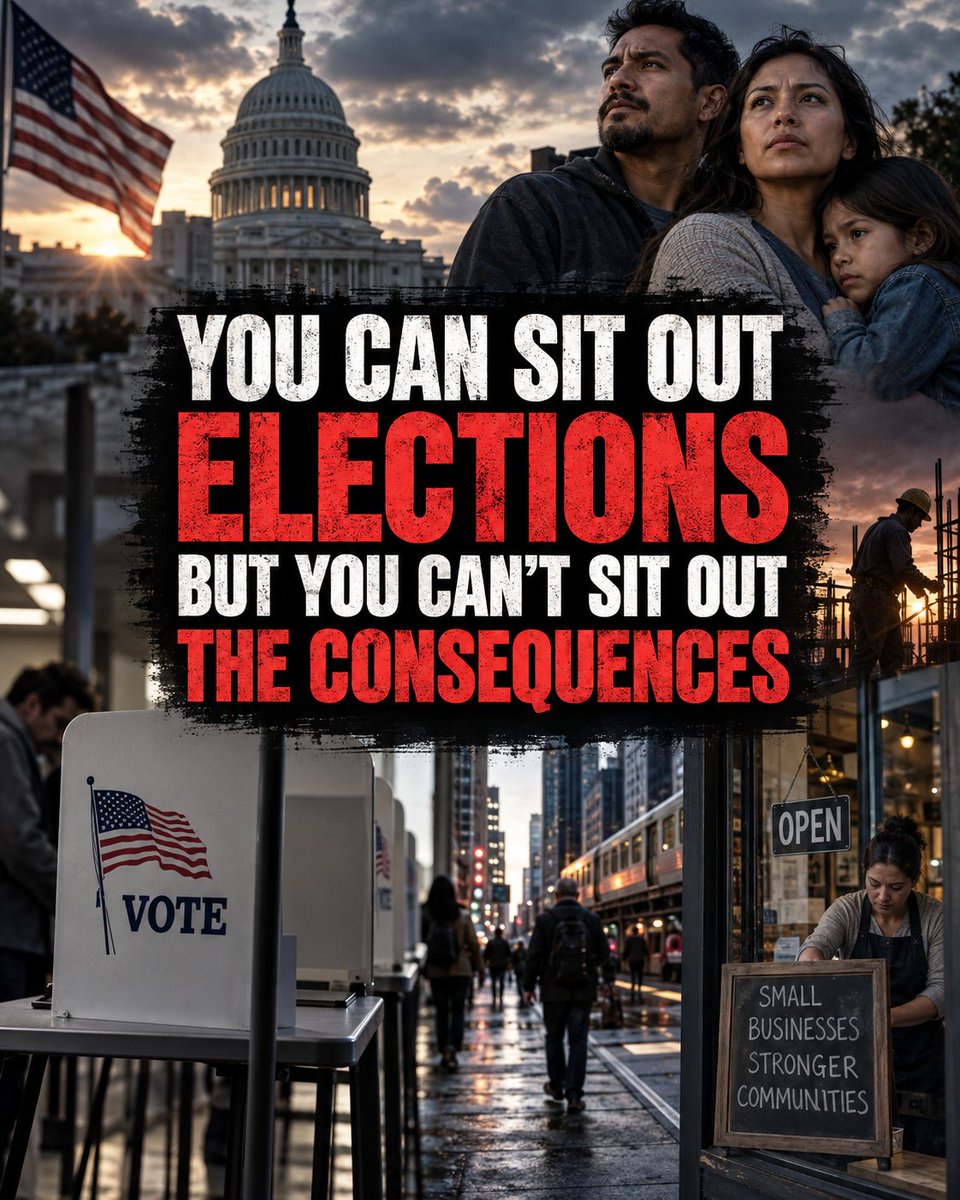
Thinking about sitting out the MIDTERMS because you're frustrated, disappointed or convinced your vote doesn't matter?
Fine.
But understand what you're choosing.
You're not sitting politics out.
You're handing the decision to everyone who DOES show up - and then living with what THEY choose.
For the next 2 years, Congress can shape:
• Taxes and spending
• Immigration and border policy
• Energy and healthcare
• Defense and foreign policy
• Investigations and oversight
• Which nominees get confirmed
State elections can shape your schools, policing, regulations, taxes, prosecutors, judges and the environment your business operates in.
Politics isn't just television.
It's your mortgage.
Your energy bill.
Your business costs.
Your child's school.
Your neighborhood.
Your job.
Your future.
Your faith.
And some election consequences last far longer than 2 years.
Senators serve 6 years.
Federal judges can serve for life.
Laws can survive multiple presidents.
So be angry.
Be disappointed.
Hold politicians accountable.
But don't confuse sitting out with escaping the consequences.
You still pay the taxes.
You still obey the laws.
Your children inherit the country.
Your grandchildren may inherit the consequences.
You can sit out an election.
You cannot sit out what happens AFTER it.
And if you're a Republican, you get SCREWED sideways because you will still FOLLOW whatever law the majority locks in. So why not be a part of that process despite EVERYTHING that's been told to you.
If I were you, I'd Repost this post. You don't have to. Just saying..
Older Americans, you already lived through this.
You were told globalization would make goods CHEAPER.
And it did.
But nobody told you the full price.
In 1979, America had roughly 19.6 MILLION manufacturing jobs.
Then the model changed.
During the 1980s and 1990s, American companies increasingly moved production overseas because labor and manufacturing costs were lower.
Consumers benefited.
TVs got cheaper.
Clothes got cheaper.
Electronics got cheaper.
Household goods got cheaper.
But then something else happened.
The factories in American towns started closing.
Steel.
Textiles.
Furniture.
Machinery.
Electronics.
Auto parts.
Jobs that once allowed someone without a four-year degree to buy a house, raise a family and retire disappeared.
Then came the major policy decisions.
1994: NAFTA took effect after being negotiated under President George H. W. Bush and implemented under President Bill Clinton.
2000: President Clinton signed Permanent Normal Trade Relations with China.
December 2001: China entered the WTO.
The argument was simple:
Open global markets.
Move production where it is cheapest.
Give American consumers cheaper products.
And perhaps greater economic integration would eventually change China.
That was the BET.
Then came what economists later called:
THE CHINA SHOCK.
Between 2000 and 2010, America lost almost 6 MILLION manufacturing jobs.
Not all because of China.
Automation mattered.
Technology mattered.
Recessions mattered.
But researchers estimate Chinese import competition contributed to roughly 2–2.4 MILLION American job losses from 1999–2011.
And here is what Washington missed.
A worker who lost a factory job Monday did NOT magically find an equally good job Tuesday.
Some towns never recovered.
Wages fell.
Communities declined.
Families were disrupted.
The economist said:
“The economy will adjust.”
The worker discovered:
I AM the adjustment.
Then America sold the next generation another idea:
GO TO COLLEGE.
The factory job your father had was disappearing.
So get a degree.
Borrow money.
Enter the new economy.
Student debt went from roughly $340 BILLION in 2001 to about $1.65 TRILLION today.
Think about that generational progression.
Grandfather:
Factory → paycheck → house → family.
Father:
Factory closes → economy restructures.
Son or daughter:
Borrow tens of thousands of dollars because now you need a degree to compete.
Meanwhile politicians in BOTH parties kept the basic globalization model moving.
Then COVID hit in 2020.
Suddenly America discovered that the cheapest supply chain isn't necessarily the safest supply chain.
Pharmaceuticals.
Semiconductors.
Medical equipment.
Critical minerals.
Electronics.
Industrial components.
So much had become dependent on production thousands of miles away.
President Trump had already begun challenging that model.
In 2018, he imposed major tariffs on Chinese goods.
Washington screamed:
TRADE WAR.
And yes, tariffs can raise costs.
That criticism is legitimate.
But President Trump was asking a fundamentally different question.
For decades Washington asked:
Where can we make this CHEAPEST?
President Trump asked:
What does America NEED to be able to make itself?
Then something interesting happened.
President Biden came in…
…and kept many Trump-era China tariffs.
Industrial policy returned.
Semiconductors became a national-security issue.
Critical minerals became a national-security issue.
Domestic manufacturing became a national-security issue.
Why?
Because the argument had changed.
Now President Trump is back.
And Americans are understandably looking at:
Gas.
Groceries.
Rent.
Insurance.
Interest rates.
Mortgage payments.
Those bills matter TODAY.
But underneath that noise, America is attempting something much bigger:
Rebuilding domestic manufacturing.
Rebuilding supply chains.
Expanding semiconductor production.
Expanding pharmaceuticals.
Expanding steel.
Expanding energy.
Expanding advanced manufacturing.
Companies including TSMC, Micron, Apple, NVIDIA, Hyundai, GM, Ford, Eli Lilly, Roche and Johnson & Johnson have announced major U.S. investments.
But understand this:
An announcement is not a factory.
Factories take YEARS.
Semiconductor fabs take YEARS.
Mines take YEARS.
Supply chains take YEARS.
Workforces take YEARS to rebuild.
So here's the contradiction.
America spent roughly 40 YEARS building this economic model…
Then expects President Trump to reverse it in roughly 20 MONTHS.
Read that again.
FORTY YEARS IN.
TWENTY MONTHS OUT.
You should criticize President Trump when policies fail.
Demand lower prices.
Demand results.
Demand accountability.
But also understand what is happening beneath the daily headlines.
America spent decades telling capital:
GO WHERE PRODUCTION IS CHEAPEST.
Now America is trying to tell capital:
BUILD IT HERE.
That transition was never going to happen overnight.
The real question isn't whether every Trump policy works.
Some won't.
The question is:
Twenty years from now, will Americans look back at this period as the moment the country finally understood that the CHEAPEST economy isn't always the STRONGEST economy?
Because millions of Americans already lived through what happened the last time Washington made that gamble.
They watched the factory close.
They watched the jobs leave.
They sent their children to college.
They watched the debt pile up.
And now America is trying to build some of it back.
That is the story underneath the noise.
What pisses me off the most is that I'd give my life to have babies & become a Mother.
I would have adopted all three of those children in a heartbeat & given them extraordinary lives. And I know at least another 10 women friends who would do the same.