@imsadspice@babyliz009 Oh honey you are so much more than that and we both know it. Beautiful , Talented, Creative. Usually you make me laugh but this one tugs at the eyeballs. Yes it time for a change. 🫂 🫂 ❤️
On the risks of “running on empty:”
As the global economy simultaneously depletes multiple buffers, the risk increases that the willingness to spend—across consumers, corporations, governments, and investors—could run well ahead of the structural ability to do so.
https://t.co/OqThqGraaS
#economy #markets @ProSyn
From John Plender's FT column:
"At the same time, Treasury funding is increasingly reliant on shorter-term securities, which means constant rollover risk. With US public debt approaching its highest ever level, this combination sounds like the very definition of a non-geopolitical financial chokepoint, with vulnerability to shocks. It also suggests there are now systemic risks in the Treasury market."
#economy #markets #bonds
@sciencegirl Ocean cooling may be convenient but it still adds to the warming of the environment. 🤔 Hopefully they can close the circle by using tidal power and floating solar farms as mitigation.
@HedgieMarkets One of the challenges of any project but especially an automation project is implementation. Why are they using LIDAR for inventory, I would think vision systems and bar code scanners instead. 🤔 But perhaps I don't grasp 🫥
Remember that your goal is to put the right people in the right design. First understand the responsibilities of the role and the qualities needed to fulfill them, then ascertain whether an individual has them. When you're doing this well, there should almost be an audible "click" as the person you're hiring fits into his or her role. #principleoftheday
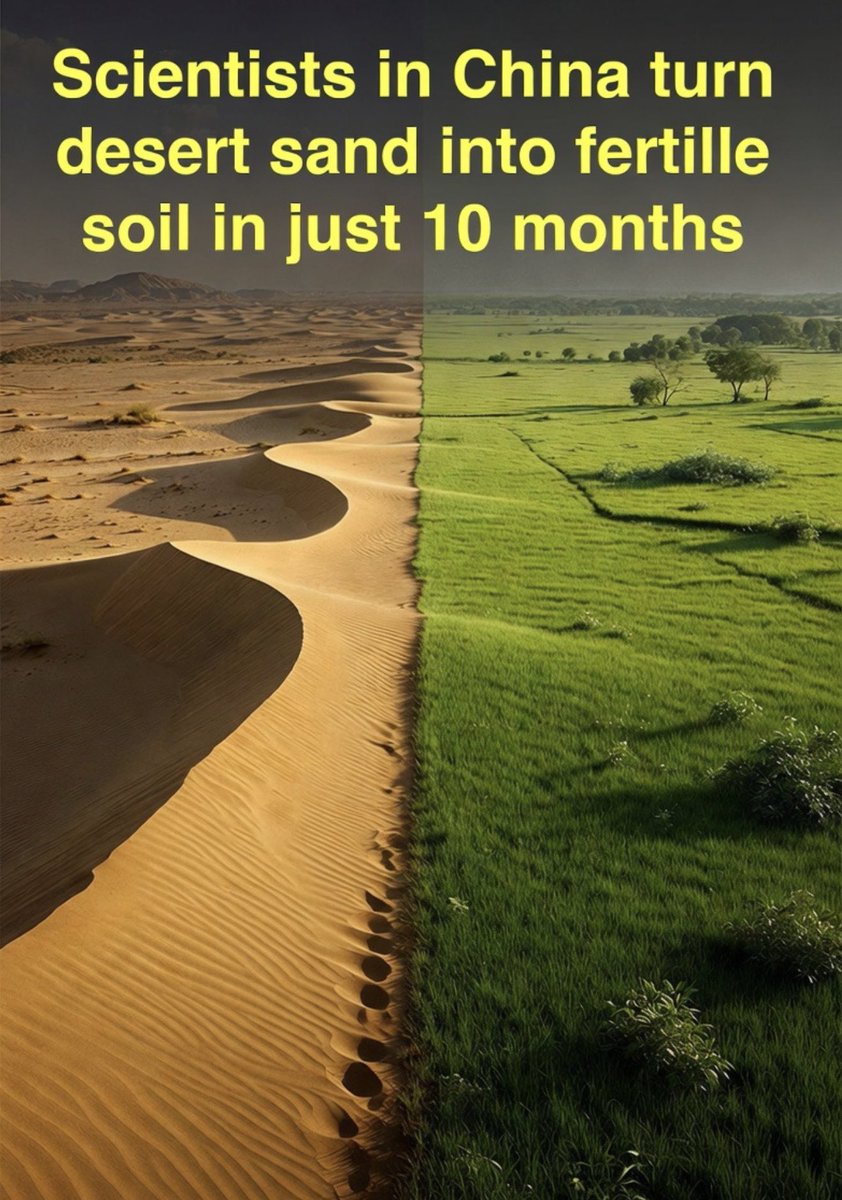
China may have discovered a quicker method to help slow the expansion of deserts. The approach focuses on biological soil crusts, which are very thin natural layers made up of microorganisms such as cyanobacteria, fungi, mosses, and other microbes that gradually form on desert surfaces. These are often described as a kind of living protective covering for sandy ground.
Under normal conditions, these crusts take many decades to develop on their own. However, researchers at the Chinese Academy of Sciences report that they were able to speed up the process by cultivating cyanobacteria in a lab and spraying them onto loose sand. Once applied, the microbes begin to spread and quickly bind sand particles together.
As they grow, they release sticky substances that act like a natural adhesive, gradually creating a stable surface layer that can withstand wind erosion and reduce the impact of dust storms. In experimental areas near the Taklamakan Desert in northwestern China, scientists observed that strong, stable crusts formed within roughly ten to sixteen months.
This is important because shifting sand makes it extremely difficult for ecosystems to recover. Wind constantly moves the surface, preventing plant roots from taking hold. Once the ground is stabilised, however, grasses and shrubs have a far better chance of growing.
The developing crust also improves soil quality. It helps retain moisture, limits water loss through evaporation, keeps nutrients close to the surface, and slowly builds up organic material that supports future plant growth. Some cyanobacteria can also absorb nitrogen from the air, naturally enriching the soil over time.
Testing showed that treated areas were far more resistant to wind erosion, with reductions of more than ninety percent in laboratory conditions. If successful on a larger scale, this method could help slow desertification, the gradual degradation of productive land into desert caused by factors such as drought, climate change, deforestation, and overgrazing.
Researchers do, however, emphasise that this is not a complete solution. The crusts can still be damaged by human or animal activity such as grazing, walking, or vehicles, and long term effectiveness will depend on weather patterns and careful land management.
🦔Tech companies that pushed employees to maximize AI usage are now realizing the math does not work. Microsoft, Meta, and Amazon all set internal targets that pressured workers to use AI tokens aggressively to hit productivity scores. The problem is agentic AI burns up to 1,000 times more tokens per task than a standard LLM query because it loops through multiple steps and self-checks.
OpenClaw's creator Peter Steinberger said his team spent $1.3 million on OpenAI tokens in a single month. Nvidia CEO Jensen Huang told his engineers they should be consuming AI tokens worth at least half their annual salary every year. The behavior has its own name now, "tokenmaxxing."
My Take
The cost trajectory works backwards from how the labs sold it. Per-token prices have fallen, but the number of tokens each task consumes has climbed faster, and the all-in spend keeps going up release after release. Agentic AI is the worst offender because the model talks to itself, second-guesses itself, and runs the same logic three times before landing on an answer. Goodhart's Law also shows up clearly here. When AI usage became the performance review metric, employees started using AI to inflate the metric, not because the task needed AI.
OpenAI and Anthropic are losing roughly $2 for every $1 of revenue, and the only way the math fixes itself is by raising prices or capping consumption per enterprise contract. Both moves slow the revenue growth the labs need to show on the IPO roadshow. Goldman Sachs and the underwriters know this, which is why SpaceX's S-1 came out before OpenAI's. Whichever AI lab files first gets the cleaner narrative, and whoever files second has to explain why their largest enterprise customers just started rolling back token consumption. The companies pushing tokenmaxxing internally are now the same companies signaling cost pressure externally, and that contradiction is going to show up in earnings the moment these labs start reporting publicly.
Hedgie🤗
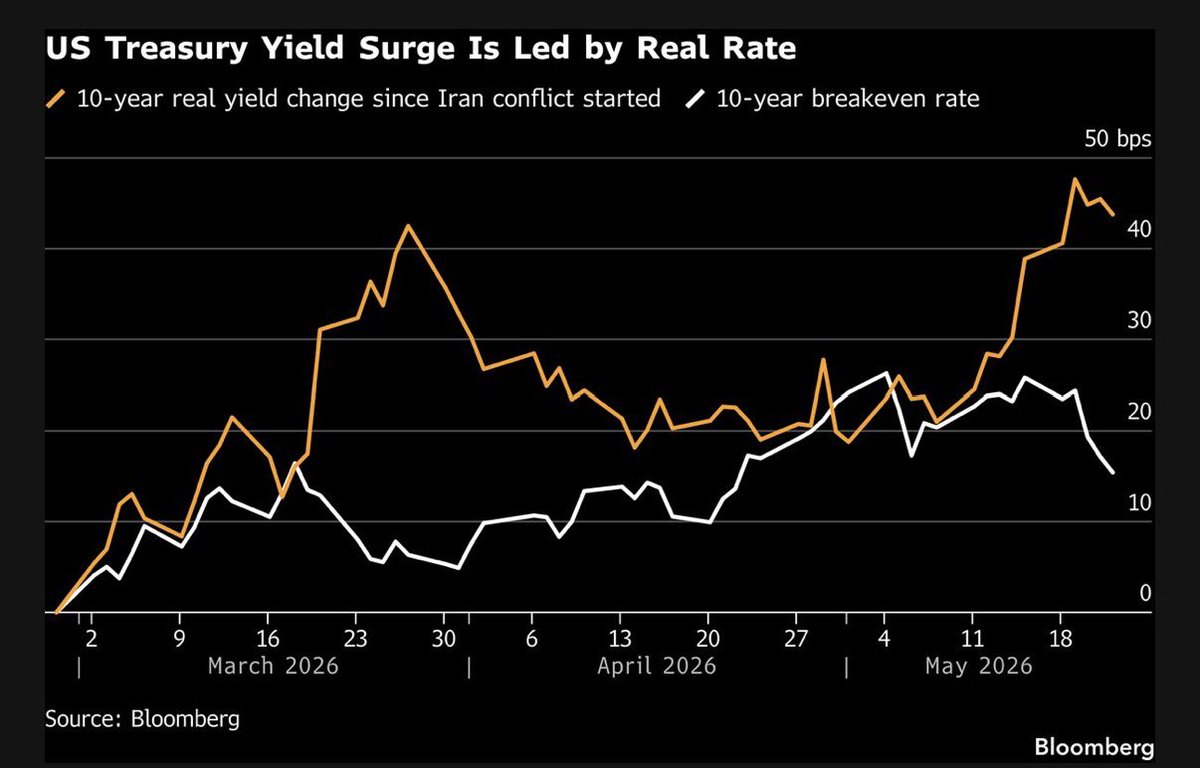
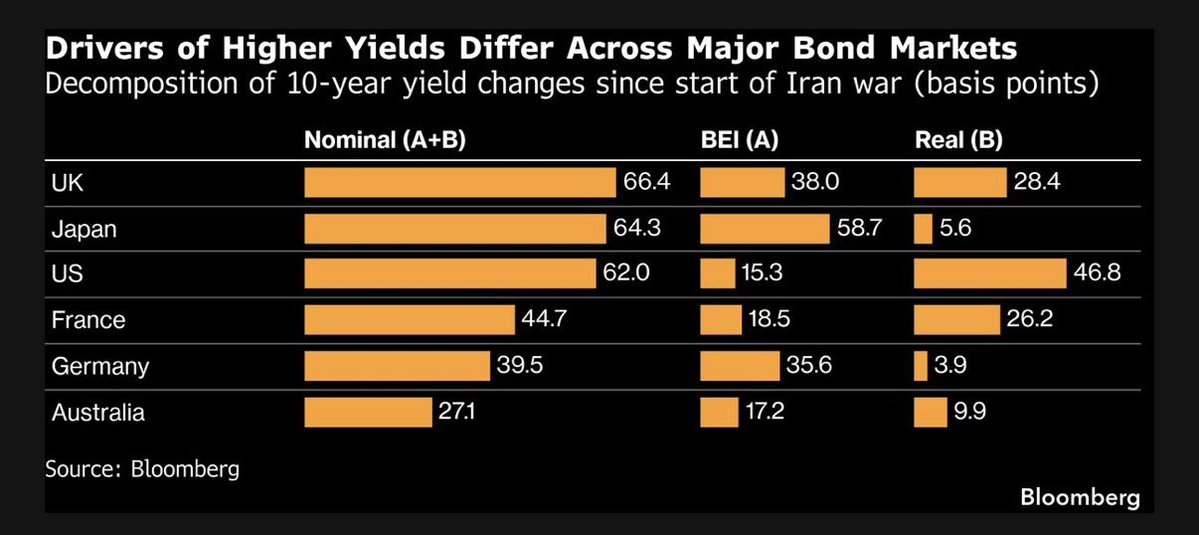
From the Bloomberg article, “Bond Strategists Warn Yields to Stay High Even If Iran War Ends:”
“A Bloomberg analysis shows rising real yields explains most of the move higher in overall yields in the US, while inflation is to be the major influence in Japan and Germany.”
#economy #markets #bonds
🦔Fortune published a piece this afternoon connecting Microsoft and Uber's AI cost overruns to token economics, with a headline that lands hard: "Microsoft reports are exposing AI's real cost problem: Using the tech is more expensive than paying human employees." Underneath those headlines, the unit economics tell the story. OpenAI is projected to lose $14 billion in 2026, spending roughly $2 for every dollar of revenue it brings in. Anthropic is in a similar position with break-even not projected until 2028. GPU rental prices for Nvidia's newest Blackwell chips jumped 48% in just two months. OpenAI's response was to close a $122 billion private funding round at an $852 billion valuation, the largest in history.
My Take
The token pricing story is really an IPO timing story. OpenAI, Anthropic, and xAI all need to go public in the next 18 to 24 months because the private market cannot keep absorbing burn rates like these indefinitely. Public markets do not accept "we will figure it out" as a line item on an S-1, they require disclosed unit economics with a credible path to profitability and a date attached. That deadline is why the price increases are happening now rather than next year. The labs need to show declining loss curves before the filings hit, and that means enterprise customers have to start covering more of the actual cost regardless of whether the productivity math holds on their end.
Every token bought over the last two years was effectively subsidized below cost by venture capital and hyperscaler cross-subsidies, and that subsidy has a hard deadline. Uber publicly admitted burning through its entire 2026 AI budget in four months, and CFOs at major enterprises are starting to flag the same pressure. The labs cannot keep losing $2 per dollar of revenue once they file public statements, so the cost transfer to customers accelerates from here. For investors, the question is not whether these companies are valuable. They clearly are. The question is who absorbs the difference between what enterprises can budget and what the models actually consume between now and 2028, and right now the answer is the hyperscalers funding the buildout. That is why I have been watching Microsoft and Amazon capex commentary more closely than the lab announcements themselves.
Hedgie🤗
Link: https://t.co/S2oIgUSijV
WhatsApp encryption is a giant fraud.
The state of Texas just sued WhatsApp for lying to users about privacy — because WhatsApp employees have access to “virtually all” private messages.
Now we know what WhatsApp’s founder meant when he said he “sold his users’ privacy.”
The AI bubble math doesn't add up.
Anthropic spends $3 to make $1 and that’s before you include any and all other costs like staff or electricity.
Microsoft dumped $300B in capex, made ~$18B in AI revenue. OpenAI and Anthropic alone make up 43-54% of Microsoft, Google, Amazon and Oracle's entire revenue backlogs.
Enterprises are burning through annual AI budgets in 4 months with zero measurable ROI.
This is the most expensive science experiment in history, funded by your SaaS subscriptions.
The first month of the UK's new fiscal year saw the government borrowing requirement rise to £24.3 billion, despite increased tax revenues.
This is above the OBR's forecast of £20.9 billion and is nearly £5 billion higher than last year.
Having said that, market reactions are muted, as traders view this as just a single-month data point overshadowed by broader political considerations.
#economy #uk #markets