Strategies to make you g̶e̶t̶ ̶o̶f̶f̶ ̶y̶o̶u̶r̶ ̶a̶r̶s̶e̶ ̶a̶n̶d̶ start the business you’ve dreamt about ❖ Nuclear Physicist → Strategist for a 10-fig business.
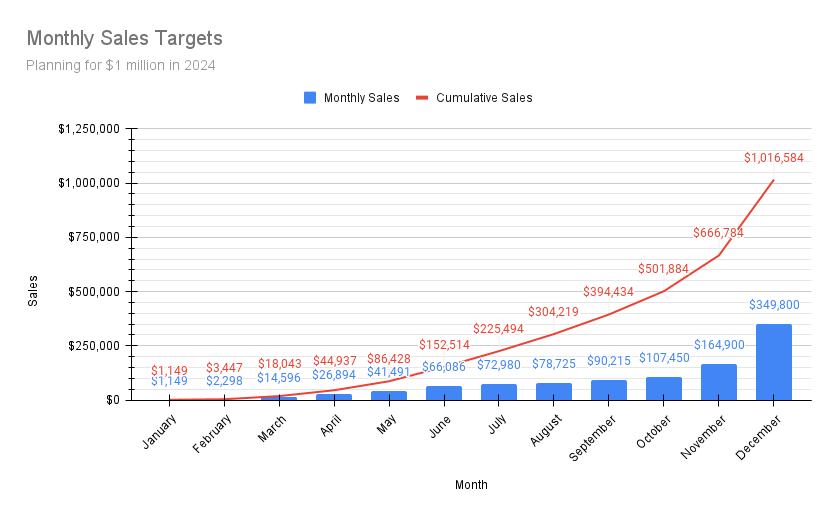
$ 0 → $ 1,000,000 in a year looks like this.
Bookmark this for later and let's break this down.
Any Big Hairy Audacious Goal (BHAG) needs a strategy.
- How are you going to achieve it otherwise?
🧩 I always break a vision and goals down into logical pieces. It stops me from getting overwhelmed.
🎯 It's critical to set targets, monitor performance, and track against each piece of your strategy.
⚙️ If you aren't meeting targets this means you need to diagnose the issues, change approach, and test a new idea.
____________________________________________________
1) Work backward to understand your BHAG in terms of monthly targets:
A '$ 1,000,000 in 2024' target breaks down into:
> Product pricing
> Monthly Product sales
> Monthly number of leads (Also linked to Reach)
> Conversion rates
> Sponsor deals & other income sources
As examples:
Income 1 = Leads x Lead Converstion Rate x Price
Income 2 = Sponsorship Value x Sponsorship Deals
Income 3 = Consulting fee x Consulting hours / month
____________________________________________________
2) Define the tiers of products/services you will sell and their associated prices, I used:
> Consulting offer - [$ 2000]
> Higher-priced online product - [$1200]
> Medium-priced digital product - [$249]
> Lower-priced digital product - [$40]
> Free lead magnets (for reach and emails)
This can change over time but defining your ambitions early will inspire you to create these products.
____________________________________________________
3) Understand your audience growth. You need people to sell to.
How are you going to build your audience?
Do you have an existing audience and an expected audience growth rate for the year?
• Predict monthly audience numbers (but be realistic)
• New accounts won't have 10,000 followers by day 2
• Assume steady growth over the year
This gives you an idea of how fast and quickly you may need to scale your reach.
TIP: Test different growth rates in your model to see how it impacts the numbers.
You might find that organic growth alone isn't enough to achieve your goal and that paid Ads are necessary.
____________________________________________________
4) Define the conversion rates you are aiming for
Set targets for yourself early on.
TIP: Research market or industry averages
As your audience moves through your sales and marketing material you need to track conversion rates.
This lets you know whether your sales system is performing well, or poorly.
Examples:
1) % of social media reach that subscribes to email list via lead magnet
2) % of email list / Ad clicks that buy your 'lower/medium/higher-priced' product/service
____________________________________________________
5) Calculate how many product sales do you need
YOU ARE READY TO PLAY.
You have the pieces of the puzzle to test the model:
> Products and prices
> Predicted audience size and growth
> Target conversion rates
This is where you start to really understand the connection between all of these values.
If your audience is engaged, they convert at the expected rates, and buy products at the right volume and price ...
... Does your initial set of targets and data meet your goals?
You might find that you need to do a LOT more work than you expected.
Go back and update your model until you have the numbers you need.
This is what you need to set as a 'Baseline' model. As you get real data over time, you can verify the accuracy of your model and forecast to see if you will meet your goals.
____________________________________________________
7) Optimize
As you build your systems, processes, Ads, content, etc you need to keep your model in mind.
Are you REALLY making enough progress to hit your targets?
> Can you streamline a process to make higher-value content?
> Can you change your website to increase conversions?
Look for improvements as you build.
Iterate on these areas.
********************************************************
SO.
*************************************************
7) Now you have a model, it comes down to DELIVERY:
o Grow your audience
o Build socials
o Run an ad campaign
o Get eyes on your content, products and services
o Share value and help others
o Make great connections
o Build. incredible. products.
Easy right?
____________________________________________
***************************************************
TL;DR
1) Work back from your goal to understand monthly targets
2) Define your tiers of products/services and associated prices
3) Understand your audience growth
4) Define the conversion rates you are aiming for
5) Calculate how many product sales do you need
6) Optimize
7) Deliver
_______________________________________________
***********************************************************
DM me 'Model' for a link to the underlying model that you can play with.
Repost this if your audience would benefit from this breakdown.
You are COOKED if you can't make $20K+ per month online in 2026…
And I say that as someone who built a $260M ecom company from scratch.
Because the tools, the playbook, and the opportunity have never been more accessible.
Here's exactly what's standing in your way : and how to fix each one:
1. Gross margins under 60% Below 60% you cannot afford to acquire customers profitably at scale. We targeted 80% at Hiya. That margin funded our entire growth engine.
2. Still doing one-time purchases only Every customer you acquire is a customer you have to re-acquire next month. Subscription turns acquisition cost into lifetime value. One-time purchases build nothing durable.
3. Not whitelisting influencer content as paid ads 20-40% of our paid budget ran behind influencer-sourced creative. It outperforms brand-owned creative every single time. If you're not doing this you're leaving the biggest part of the value on the table.
4. Supply chain lead time over 8 weeks Long lead times destroy cash flow. You're tying up months of capital in inventory before a single sale. We nearly lost everything during COVID because of this exact problem.
5. No CFO before $5M revenue Most founders think a CFO is a back office hire. It's a growth hire. The person who tells you exactly how much fuel you have in the tank — which determines how hard you can press the accelerator. We don't get to $103M without ours.
6. Optimizing for gross margin before you have scale Margin is a function of scale and negotiating leverage. Both of which you earn by growing — not by protecting. Grow first. Protect margin second.
7. Treating post-purchase experience as operations The unboxing. The onboarding. The first 30 days. These are not logistics. They are your highest leverage marketing channel. We built 200,000+ subscribers with near-zero churn partly because of what happened AFTER the sale — not before it
I built Hiya to $103M annual revenue and a $260M exit.
Every single one of these almost killed us before we figured it out.
Learn from it now or learn from it the hard way later.
Comment "X" if you want me to send a full playbook of everything I learned while building my business and how you can too :)
**must be following + retweet to receive the DM.
@PeteBadh Baby 2 is on the way 👍 😂 my missus said I could have a lie in today… I got a slap and a nudge at 8 am… 💀 I remember when a lie ins went till mid day
@DallasDHom Im still around 😂 a lot changed in a short space of time with a second baby on the way, a good promotion in my 9-5 and a short term shift in priorities and focus!
I hope you’re doing well 😄
-----------
Cut the crap Monday 10 / 10
-----------
You're 10. Did you really have a cold shower, shave your beard and go on a 10 km run?
Get real kid...
And thats a wrap on Cut the crap Monday.
Enjoy it? Maybe it'll be back for Seaon 2.
@karllittleboy Great structure for growth Karl and well articulated. Cracking post this.
It would be great to see how you’re applying this in your next long form 💪
Picking a niche puts you in a box.
It makes your brand one-dimensional.
Here’s how to build a multi-dimensional brand that:
• Showcases your expertise
• Signals to your audience
• Builds likability and trust
━━━━━━━━━ • ━━━━━━━━━
To Niche Or Not To Niche?
Choosing a specific problem to solve for a specific audience is solid advice.
It gives you clarity and cut-through in the market.
The problem is:
When you’re just starting out you have no idea what niche to pick or how targeted you need to be.
Even with all the research in the world it's hard to know:
• Which markets are growing
• Which segments are profitable
• Who you’ll get the best results for
Go too narrow too soon and you risk picking a niche that isn't profitable, whilst significantly reducing your addressable market.
There’s a better way.
━━━━━━━━━ • ━━━━━━━━━
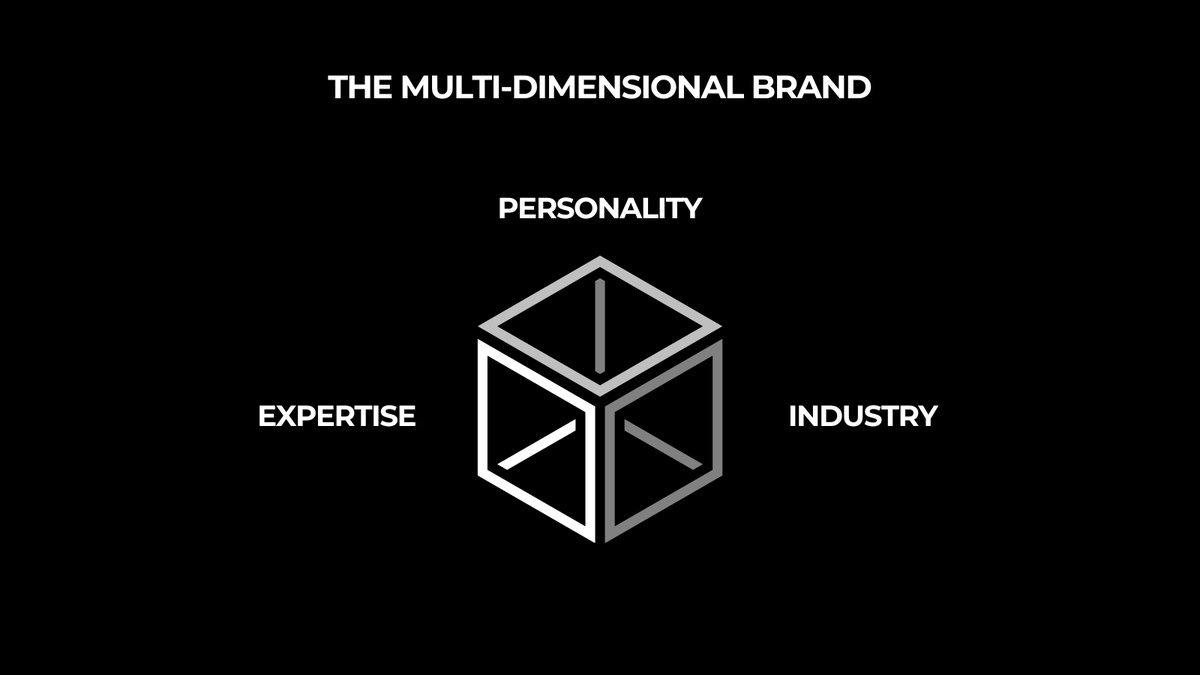
You Need to Niche Broad.
If you’re just starting out I’d encourage you to 'niche-broad'.
Pick a specialised skill to build your brand around.
One that you can use to serve a broad industry/sector.
→ One problem
→ One solution
→ One industry
Example:
• P: Generate more leads for less
• S: Conversion rate optimisation
• I: Health & fitness brands
This will give you:
1. A specialised high-value skill you can use to help any business
2. A large addressable market of different businesses to target
This makes it a lot easier to:
→ Win new business in volume
→ Practise & master your craft
→ Find a profitable model
→ Pivot if things don’t work out
━━━━━━━━━ • ━━━━━━━━━
Why a Niche Isn’t Enough
A lot of people pick a niche and think “That’s it! Job done.”
They start creating content, get limited traction and wonder why.
The problem is that their brand is one-dimensional.
It lacks the fundamental attributes that make a brand buyable:
• Personality
• Character
• Depth
Think about it.
If all of the content you produce is about CRO, your brand is going to feel robotic and flat.
People are going to find it hard to relate to you, which means they are less likely to buy from you.
After all:
People buy from people they know, like and trust.
This is why you need a multi-dimensional brand.
━━━━━━━━━ • ━━━━��━━━━
The Multi-Dimensional Brand
A multi-dimensional brand has three components:
1. Skill-based expertise
2. Sector Specificity
3. Brand Personality
This gives it two big advantages:
1. It's more relatable & buyable
You can draw on your personal experiences, interests and stories to create analogies and content that build likability and trust.
2. It’s built for longevity
A multi-dimensional brand is multifaceted which makes it more dynamic. This means you can pivot and adapt your brand over time to:
• Pursue new interests
• Explore new opportunities
• Create new income streams
━━━━━━━━━ • ━━━━━━━━━
Striking the balance
The challenge with building a multi-dimensional brand is getting the balance of content right.
Too much personality and your offer gets lost in the noise.
Too little personality and you sound like sandpaper.
The key is brand balance.
Brand balance is how you achieve offer and positioning clarity, whilst being likeable and relatable.
Here's how you do it:
Build your brand and content around the three dimensions using the following ratios as a guide:
• 40% Value & skill-based content
• 30% Industry-relevant content
• 30% Interests & experiences
This ensures:
1. Your money-making expertise is front and centre
2. You signal to your market to attract new prospects
3. You showcase your interests to build likability & trust
Get this right and your audience will be crystal clear on:
→ What you offer
→ How it solves their problem
→ Why they should buy from you
━━━━━━━━━ • ━━━━━━━━━
Enjoyed this post?
1. RT to share
2. Bookmark for later
3. Follow for more @karllittleboy
Thanks for reading.
-----------
Cut the crap Monday 9 / 10
-----------
Hello there, nice to meet you...
→ 'Billy | X Growth Expert | 100k/mo agency owner'
That must look funny on your Birth Certificate.
Did your mum really know you'd reach 100k/mo when she named you that?
Wild.
-----------
Cut the crap Monday 8 / 10
-----------
"Don't niche down you can be a successful whoever you want with a personal brand."
Yeah alright but what value are you adding as:
"Phil - Teapot Fan || Croc Daddy || Tax Avoider"
Who also has a profile banner of a Sunset.
Why would anyone listen to you?
People need to trust that you can be their guide…
…Without killing them or their business.
→ I almost killed my partner yesterday physically and mentally.
I was a bad guide.
—————//—————
We’ve been taking it in turns looking after our son all week.
We were so excited to get out skiing together and managed to get daycare.
→ Skis on
→ A quick easy run
→ Onto to the lift up the mountain
It was going great.
We were skiing beautifully.
I decided to take us on a slightly harder but beautiful route that I’d been on the day before.
→ Bad idea
The route was like a highway.
The snow was carved up.
Not beginner friendly.
My partner was going to struggle.
She did.
After 4 falls she slid down the hill on her bum.
⁍ Confidence in tatters
⁍ Anxiety firing on all cylinders.
—————//—————
I changed the plan.
Found a chairlift to get us out and got us out of there in one piece.
She wanted to slap me.
🍷 We found a mountain top bar and got a glass of wine to calm her jitters.
We discussed the situation and agreed that we know the current limit of her capabilities.
However.
The only way back down was to ski.
I had to make sure I built her confidence and didn’t destroy it even further.
→ We took it super slowly
→ I warned her of harder sections
→ I let her carve her own path down
We made it.
By the end she was proud of what she has achieved and her confidence was back.
Phew.
—————//—————
📖 in most great stories there is a hero with a a problem. They find a mentor to help them.
Think…
⁍ Yoda in Starwars
⁍ Hagrid in Harry Potter
⁍ Gandalf in Lord of the Rings
The story has them as a trusted person.
>> Someone to trust and help them reach their goals.
You need to be that person that helps people solve their problems through:
→ Content
→ Services
→ Products
Write yourself into their story as the trusted mentor.
Don’t try and kill them 👀
—————//—————
TL;DR
Be a supportive and trusted mentor to people. Solve their problems. Become invaluable to them.
Don’t take them down a massive hill beyond their experience level and almost kill them ⛷️
@horizon_search This is greta advice.
Limits are important to understand so you don’t push too hard…
… but your need ambitious goals to stay on the edge of your abilities in order to keep progressing
This speaks volumes to my earlier long form on being that mentor.
Solve people’s problems.
>>They are the hero.
>>Be their guide.
Build trust.
Your health business' problem:
Lack of knowledge → lack of trust.
Lack of trust → lack of sales.
Lack of sales → problem.
Here’s how educational emails can help: