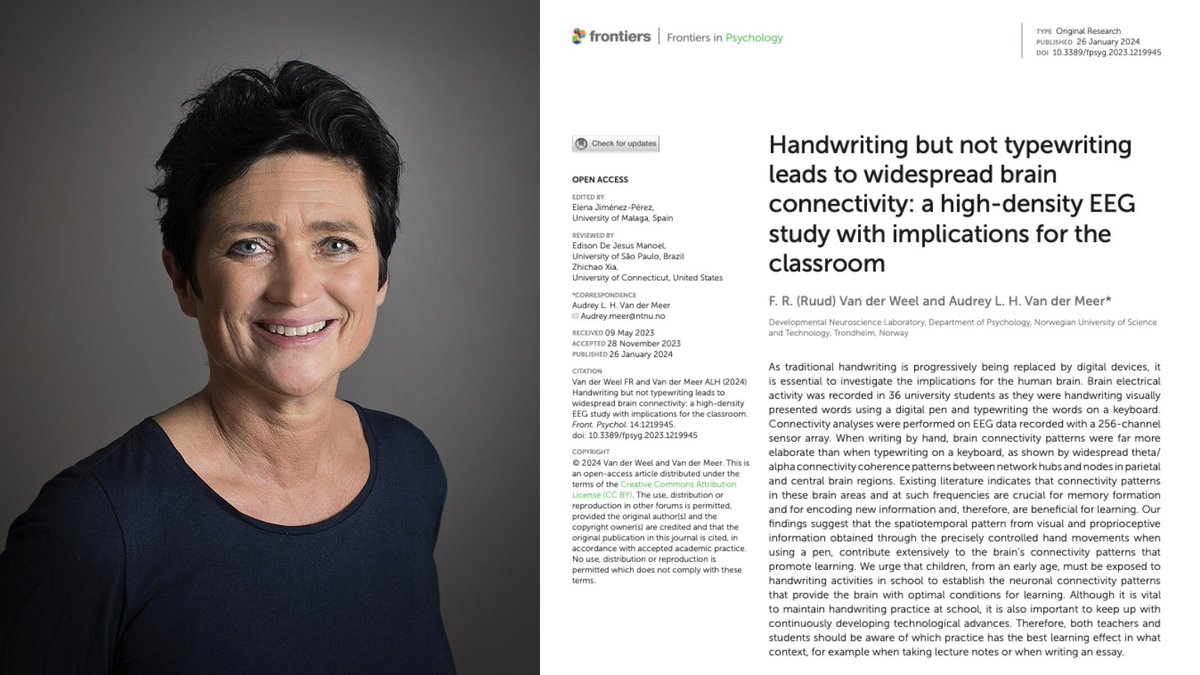
A Norwegian neuroscientist spent 20 years proving that the act of writing by hand changes the human brain in ways typing physically cannot, and almost nobody outside her field has read the paper.
Her name is Audrey van der Meer.
She runs a brain research lab in Trondheim, and the paper that closed the argument was published in 2024 in a journal called Frontiers in Psychology. The finding is brutal enough that it should have changed every classroom on Earth.
The experiment was simple. She recruited 36 university students and put each one in a cap with 256 sensors pressed against their scalp to record brain activity. Words flashed on a screen one at a time.
Sometimes the students wrote the word by hand on a touchscreen using a digital pen, and sometimes they typed the same word on a keyboard. Every neural response was recorded for the full five seconds the word stayed on screen.
Then her team looked at the part of the data most researchers had ignored for years, which is how different parts of the brain were communicating with each other during the task.
When the students wrote by hand, the brain lit up everywhere at once.
The regions responsible for memory, sensory integration, and the encoding of new information were all firing together in a coordinated pattern that spread across the entire cortex. The whole network was awake and connected.
When the same students typed the same word, that pattern collapsed almost completely.
Most of the brain went quiet, and the connections between regions that had been alive seconds earlier were nowhere to be found on the EEG.
Same word, same brain, same person, and two completely different neurological events.
The reason turned out to be something nobody had really paid attention to before her work. Writing by hand is not one motion but a sequence of thousands of tiny micro-movements coordinated with your eyes in real time, where each letter is a different shape that requires the brain to solve a slightly different spatial problem.
Your fingers, wrist, vision, and the parts of your brain that track position in space are all working together to produce one letter, then the next, then the next.
Typing throws all of that away. Every key on a keyboard requires the exact same finger motion regardless of which letter you are pressing, which means the brain has almost nothing to integrate and almost no problem to solve.
Van der Meer said it plainly in her interviews.
Pressing the same key with the same finger over and over does not stimulate the brain in any meaningful way, and she pointed out something that should scare every parent who handed their kid an iPad.
Children who learn to read and write on tablets often cannot tell letters like b and d apart, because they have never physically felt with their bodies what it takes to actually produce those letters on a page.
A decade before her, two researchers at Princeton ran the same fight using a completely different method and ended up at the same answer. Pam Mueller and Daniel Oppenheimer tested 327 students across three experiments, where half took notes on laptops with the internet disabled and half took notes by hand, before testing everyone on what they actually understood from the lectures they had watched.
The handwriting group won by a wide margin on every question that required real understanding rather than surface recall.
The reason was hiding in the transcripts of what the two groups had actually written down.
The laptop students typed almost word for word, capturing more total content but processing almost none of it as they went, while the handwriting students physically could not write fast enough to transcribe a lecture in real time, which forced them to listen carefully, decide what actually mattered, and put it in their own words on the page.
That single act of choosing what to keep was the learning itself, and the keyboard had quietly skipped the choosing and skipped the learning along with it.
Two studies. Two countries. Same answer.
Handwriting makes the brain work. Typing lets it coast.
Every note you have ever typed instead of written went into your brain through a thinner pipe. Every meeting, every book highlight, every idea you captured on your phone instead of on paper was processed at half depth.
You did not forget those things because your memory is bad. You forgot them because typing never woke the part of the brain that would have made them stick.
The fix is the thing your grandmother already knew.
Pick up a pen. Write the thing down. The slower road is the faster one.
There’s a pattern I’ve noticed when it comes to Ole Miss and Oxford.
For years, when Ole Miss football was mediocre or irrelevant nationally, people loved romanticizing the place. They’d talk about how they’d always wanted to visit Oxford. They’d bring up William Faulkner, the food scene, the music, the charm of the town, the Grove, the pageantry. Ole Miss was treated like this fascinating Southern experience everyone wanted to see for themselves.
But the second Ole Miss became a real threat in college football, the second it started competing for top recruits, playoff spots, and legitimacy on the national stage the tone changed. Suddenly, people are reaching for every negative stereotype they can find, using the school’s history as ammunition when it becomes convenient competitively or to score points on social media.
Multiple things can be true at once:
1. It is true that Alex Pretti raised the risk of a negative outcome by intervening after an ICE agent pushed a female protester. It is true that he heightened the risk further by conceal carrying a firearm, and even further by resisting once he was thrown down and pummeled.
2. It is true that “he should have stayed home” is not legal justification for him being shot, nor is the fact that he was carrying. Conservatives should be very careful about repeating Kristi Noem’s suggestion that the mere act of carrying a weapon, however ill-advised in the circumstances, is proof of intent to harm law enforcement or “massacre.” Adopting that train of thought is a very slippery slope attack on the Second Amendment.
3. It could be true that the ICE agents who killed Pretti today believed their lives were in danger even if they weren’t. One agent can be heard saying “gun!” The agent who removed the gun from Pretti’s waistband appears to have had a ND of the gun (fired by accident). Either of those two things could have set off panic in the chaos of the moment.
4. It could be true that even if justified, agents acted less than ideally. Again, there is a difference between justified and necessary (or appropriate). It seems pretty apparent now that the agents weren’t actually in danger. The gun had been removed from Pretti’s waistband prior to shots being fired.
5. It could be true that Antifa and other agitators are engaged in tactics to deliberately provoke agents. And also that ICE agents should be trained to better handle that threat.
All of these things could be simultaneously true.
Mississippi’s largest Jewish house of faith, Beth Israel Synagogue, was set ablaze by an arsonist yesterday. The suspect is in custody & I am told he was motivated by anti-Jewish sentiment.
The human heart is capable of profound wickedness. Pray for better angels.
I cannot tell you how much I hate, hate, hate @espn and @disney right now. My antenna barely picks up @ABCNetwork and now they have discontinued ESPN3. The week when championship football is on their network. I will go drink overpriced beer and wings before I give you any money.
"This is not a Lane Kiffin conundrum. This is a college football conundrum that we need some leadership to step up and change the rules on how this gets done."
Nick Saban weighs in on Lane Kiffin potentially leaving Ole Miss ✍️
Here is Peter Thiel’s email to Zuck and Andreessen in Jan-2020 predicting socialism.
Tl;dr too much student debt and lack of affordable housing keeps young people with negative capital for too long. And without a stake in the capitalist system, they will turn against it.
Happy Birthday, Randall 'Tex' Cobb
Raising Arizona (1987)
Ex-Boxer Randall was perfect as the bunny hating bounty hunter, Leonard Smalls, in this Coen brothers classic comedy. This movie is ridiculously inventive, I love it.
'Gimme that baby, you warthog from hell!'
Police Squad! (1982)
One of the funniest shows ever to appear on TV only produced 6 episodes. It spawned three Naked Gun movies, and although he'd previously appeared in Airplane! (1980), it was the role of Frank Drebin that turned Leslie Nielsen into a comedy legend.