The US Navy operates a 50,000 acre forest in Indiana whose entire job is keeping one wooden ship from 1797 afloat.
The ship is USS Constitution, still a commissioned warship with an active-duty crew. Cannonballs bounced off her in 1812 because the hull sandwiches a wall of live oak ribs between two layers of white oak planking, nearly 2 feet of solid wood so dense it barely floats. British 18-pounders hit it and dropped into the sea. A sailor yelled "her sides are made of iron" and the nickname stuck.
Here's the problem with owning a 229-year-old wooden ship: you can't buy the parts. Hull planks run up to 40 feet long and 7 inches thick, cut from single white oak trunks. A white oak takes over a century to grow that big. No lumberyard on earth stocks it.
So the Navy grows its own. Constitution Grove at Naval Support Activity Crane holds trees over 100 years old, reserved exclusively for this ship. Foresters there are managing oaks today that will become hull planking in the 2100s. The maintenance plan literally runs on tree time.
Every 20 years or so she enters dry dock and shipwrights swap out rotted timber. After two centuries of this, estimates put original 1797 wood at maybe 10 to 15 percent of the ship. The Navy keeps replacing her plank by plank because Congress mandated her preservation and because she's the only active US warship that has sunk an enemy vessel.
Every other asset in the Navy has a decommission date. This one has a tree farm.
🇺🇸🏴 Scottish soccer fans are completely draining Boston’s beer supply, with bars running dry across the city.
Sam Adams says its Boston Taproom completely ran out of Boston Lager. The Tartan Army drank 4x the normal holiday volume.
Emergency delivery trucks are rushing downtown. Local pubs report running out of beer for the first time in decades.
Hide your alcohol, the Scots are in town 😂
Source: NBC / Writer: Michael
What’s better than a rare Super Delta formation featuring the Thunderbirds and the @USNavy Blue Angels over Washington, D.C.?
Watching it from four different views for #UFCWhiteHouse as part of #Freedom250. 🇺🇸
In June 1775, the British military governor of Massachusetts offered a full pardon to every American rebel who would lay down arms.
He named two exceptions. Samuel Adams was one of them.
By that point Adams had spent over a decade engineering the destruction of British rule in America, and the Crown wanted him hanged for treason. He was 52 years old, broke, often dressed in clothes his friends had quietly bought him, and shook with a tremor so bad he could barely sign his name.
He was also the most dangerous man in the empire.
Sam Adams was born in Boston in 1722, thirteen years before his more famous cousin John. He entered Harvard at 14 and wrote his master's thesis on whether it was lawful to resist the supreme magistrate "if the commonwealth cannot otherwise be preserved." He argued yes. He was 20. He would spend the rest of his life proving it.
He was terrible at business. He inherited his father's malt house and ran it into the ground. He tried merchant trading and failed. The town of Boston eventually made him tax collector, possibly as charity, and he proceeded to not collect taxes from people who couldn't afford them. He ended up personally owing the town thousands of pounds, an enormous debt for the time. Boston never made him pay it back.
Voters loved him for it.
In 1764, when Parliament passed the Sugar Act, Adams wrote one of the first major American arguments that taxation without representation was unconstitutional. When the Stamp Act followed in 1765, he organized the Boston resistance, helped grow the Sons of Liberty, and pioneered something new in politics: he turned the Boston town meeting into a weapon, a place where ordinary tradesmen voted on questions of empire.
He wrote constantly. Under more than 25 different pseudonyms, Vindex, Candidus, Determinatus, Populus, and on and on, he flooded Boston newspapers with essays attacking British policy. Loyalists complained that fishermen and dockworkers were now debating constitutional theory in taverns. That was Sam Adams's doing.
After the Boston Massacre in 1770, he stood in front of the royal lieutenant governor and demanded every British soldier be removed from Boston. Not some. All. The governor caved. The troops left. His younger cousin John then defended those same soldiers in court, and Sam never held it against him. They were running the same revolution from opposite ends.
In 1772, Sam Adams invented the system that made the Revolution possible: the Committees of Correspondence. He organized a network of patriot writers in every Massachusetts town who exchanged letters, news, and grievances. Other colonies copied it. Within two years, an unofficial shadow government stretched from New Hampshire to Georgia, faster and better informed than the British administration trying to govern it. It was, in effect, the internet of the American Revolution, and one man designed it.
Then came the tea.
On December 16, 1773, after a final mass meeting at the Old South Meeting House, Sam Adams reportedly stood and said, "This meeting can do nothing more to save the country." It is widely believed to have been the signal. Within minutes, men disguised as Mohawks marched to Griffin's Wharf and threw 342 chests of British tea into Boston Harbor. Adams did not put on a costume or board the ships. He didn't need to. He had built the crowd that did.
Britain responded with the Coercive Acts, shutting down the port of Boston and rewriting the Massachusetts charter. Adams used the crisis to summon the First Continental Congress.
On the night of April 18, 1775, British troops marched out of Boston with two missions: seize the patriot weapons stockpiled at Concord, and capture Samuel Adams and John Hancock, who were hiding in a parsonage in Lexington. Paul Revere rode ahead to warn them. They slipped into the woods minutes before the redcoats arrived. As the first shots of the Revolutionary War cracked behind him on Lexington Green, Adams is said to have turned to Hancock and exclaimed, "What a glorious morning for America."
He signed the Declaration of Independence the next year. He helped write the Massachusetts Constitution of 1780, the oldest functioning written constitution in the world, still in force today.
After the war, the firebrand became an elder statesman. He opposed the new U.S. Constitution at first because it had no Bill of Rights, then supported ratification once one was promised. He served as Lieutenant Governor under John Hancock, then as Governor of Massachusetts from 1794 to 1797. He watched his younger cousin John serve as the second President of the United States while he ran the state where the whole story had started.
By the end, the tremor in his hands was so severe his wife Betsy had to write his letters for him. He spent his last years quietly in Boston, in the same plain coat, in the same plain house, talking about scripture and republics.
He died on October 2, 1803, in genteel poverty. His funeral procession was the largest Boston had ever seen.
The brewery wasn't his. The beer is just a name. The country is the monument.
Here is a huge positive to modern life that gets no press.
I have an old 2009 Toyota, and the AUX port crapped out about a year ago. Went to YouTube. Young, enthusiastic guy explains how to fix it.
It is not obvious - involves taking the dashboard apart in a counter-intuitive way, but once you see it, it's a 15 minute fix.
There are actually dozens of videos showing how to do this, and they collectively have well over 200k views.
Had this happened in 1995, I would have just lived with it. But the combo of the replacement AUX jack available from Amazon and the video of the simple (but not obvious) fix, I fixed it.
I HAVE DONE THIS DOZENS OF TIMES. Replaced the control panel of my dishwasher. Replaced the ice maker in the fridge. Fixed a wonky sanding head on my drill press. Mastered a bandsaw technique that I use for my sculpture. On and on and on...
I think it is likely no exaggeration to say billions of fixes and skill upgrades have been performed worldwide that would not have been performed if it were not for the instruction freely given peer-to-peer on YouTube.
Take a moment to be happy about this. The busted item keeps performing, rather than going to the landfill. The person learning and doing the fix gains a sense of mastery and saves money. It's an unmixed blessing.
Stop doomscrolling. Think of what is busted in your house, find the YouTube video on how to fix it, and fix it.
Every Honeycrisp apple is a clone of a single tree planted at the University of Minnesota in 1962. Every one. Apple seeds are random. Plant a Honeycrisp seed and the new tree produces a small, sour apple that’s usually inedible.
So apple growers do something old and clever. They cut a small branch off the original Honeycrisp tree, slot it into a slit in a young apple sapling, wrap the joint, and wait. The branch fuses to its new host and starts producing Honeycrisps. About 20 million Honeycrisp trees exist worldwide, every one a piece of that 1962 tree on different roots.
Same goes for Gala, Fuji, Pink Lady, Granny Smith. Every Granny Smith on Earth traces back to a seedling found in 1868 by a woman named Maria Ann Smith in Australia. She’d thrown French crab apple cores onto her compost heap, one of them sprouted, and the apples it bore were unusually tart and good for cooking. That one tree is the ancestor of every Granny Smith in every grocery store on the planet.
Wine has the bigger story. In the 1860s, a tiny aphid called phylloxera caught a boat from America to France, hidden in some grapevine cuttings. It eats grape roots. French vines had no defense and started dying everywhere. Within 15 years, French wine production crashed from about 11 billion bottles a year to 3 billion. The blight then tore through Italy, Spain, and Germany, and European wine was on the edge of collapse.
The rescue came from Missouri and Texas. American grapevines had grown up with phylloxera and were immune to it. So growers chopped French grape varieties off at the trunk and joined them to American roots. Above the soil: still French grapes. Below the soil: aphid-proof American root. It worked. Today, almost every bottle of French, Italian, Spanish, Australian, and Californian wine you’ve ever drunk sits on top of an American root.
The technique is ancient. Chinese farmers were grafting trees by 1000 BCE. A Greek medical text from 424 BCE describes it casually, like it was already old news. It works because plants don’t have a rejection system the way animals do. Cut two branches. Match the green layers just under the bark. Wrap them tight. In a few weeks the plumbing has fused into a single plant.
A Syracuse University art professor named Sam Van Aken has spent 18 years building a single tree that grows 40 different fruits: peaches, plums, apricots, cherries, nectarines, almonds. In spring it blossoms in pink, white, and crimson all at once. He’s made more than a dozen. They sell for up to $30,000 each.
Without grafting, there would be no commercial apple industry, no global wine industry, and most of the heirloom fruits humans have bred over the centuries would have gone extinct. One clean cut, and you’ve kept entire species alive.
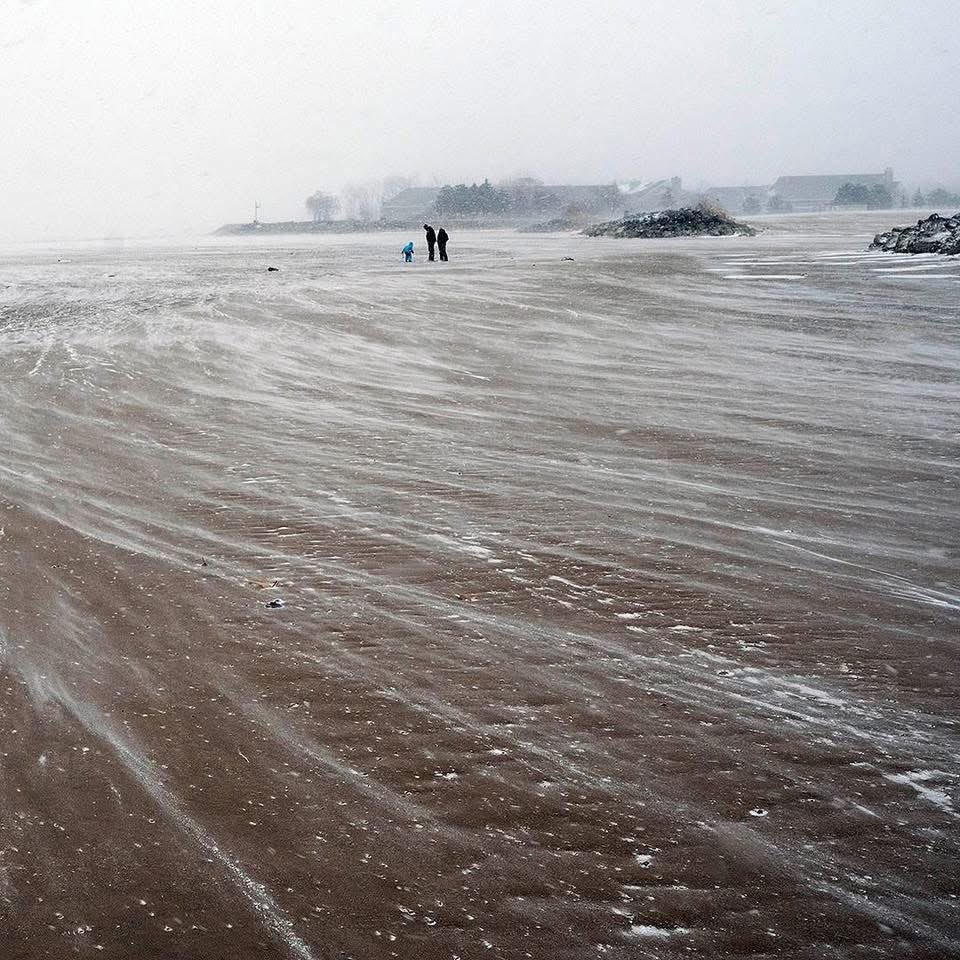
NEW IMAGES: Walking on the bottom of Lake Erie! The water level dropped nearly 7.5 feet today in Toledo, Ohio. Meanwhile the water was 13 feet higher with a wind gust of 79 mph in Buffalo, New York! A "seiche" occurs when strong winds and rapid changes in pressure push water from one end of a body of water to another. Credit: Graham Deak, Scott Carpenter, Brooke Lada @stormhour
The math on this image is insane.
New Horizons transmitted at 2,000 bits per second from 3 billion miles away. Slower than a 1990s dial-up modem. It took 16 months to download all the flyby data.
The spacecraft had to hit a target box 100km wide, arriving within 150 seconds of schedule, after 9 years of flight. Miss it and the preloaded observation commands point at empty space.
Ten days before arrival, the spacecraft crashed and went into safe mode. Engineers had 72 hours to restore everything.
The probe is now 5 billion miles out, still whispering data back to Earth. We got 50 gigabits of Pluto photos using technology slower than your phone’s bluetooth.
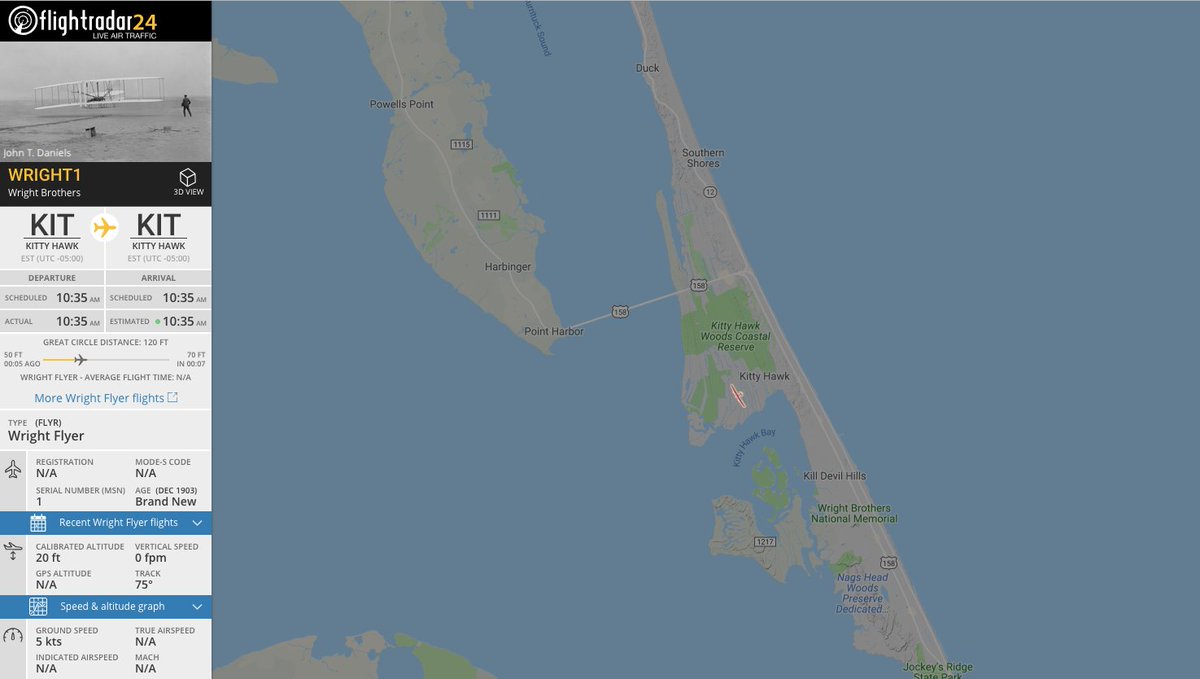
On December 17, 1903, the Wright brothers achieved the impossible in Kitty Hawk, North Carolina. Orville's first flight lasted just 12 seconds and covered 120 feet, but it changed the world forever. Had Flightradar24 been around at the time, we imagine it would have looked something like this.
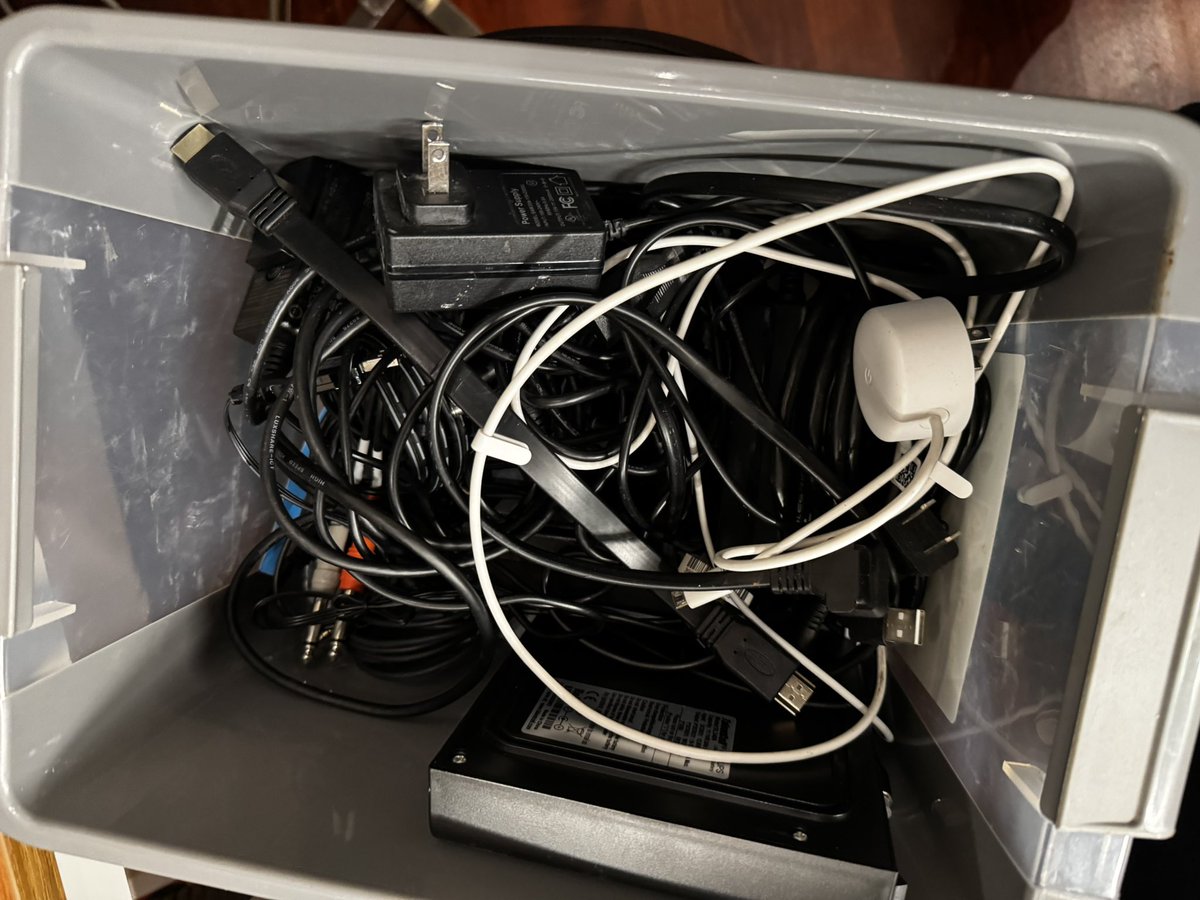
every god-fearing generation of men maintain and uphold The Wire Box, a strategic reserve of technical entropy from which the anonymous will rise up and become the prophesied Chosen Wire in Our Time of Need.