Probably get shit for this, but I think there's a real problem in hard tech right now where many founders have deeper relationships with VCs than with the people who actually buy, distribute, install, and maintain their products.
Knowing every notable VC, attending the right conferences, and building a following on X all have their merits. But none of that is a substitute for deep relationships within the industry you're building for.
There's a 55-year-old plant manager in rural Ohio who might be more important to your company's future than every GP on your cap table combined (and he doesn't give a shit who led your seed round).
I'd rather be a nobody in Silicon Valley and a household name among industrial purchasing managers.
The question “Can the labs do this?” is misguided
▶️Competition is everywhere and it’s only intensified. Incumbents, other startups, labs, and even customers themselves all have the ability to nip at your heels without a strong hypothesis on where durability comes from over time.
▶️There’s a window today where the labs are largely building on existing systems and the data already available within them. Consider Anthropic’s latest release of Claude for manufacturing. It helps people work within the processes they already have. There is still room to do the hard thing, address the problem at the root and rearchitect how these industries work.
▶️It is still the early adopters who are experimenting most with these tools. Often, they receive demos from startups, see the price, and try to recreate in-house. To me, this is the strongest near-term argument for the labs. The mid-to-late majority is not doing this and doesn’t care about AI; they have their own business priorities and incentives. If the ROI + TTV is right, a trusted partner w/ someone to call when things get stuck, who the buddy down the road will vouch for, gets their foot in the door.
The question is which work the labs choose to take on as(if) they move from selling tokens to selling work.
Despite unlimited TAM and $T market cap, opportunity costs exist.
Choose your playing field wisely.
Had two young guys stop by the factory yesterday seeing how they could use AI help me grow / improve productivity with my business. Nice smart guys. They can’t believe I use zero AI in my business. Everybody thinks I’m going to die 🤷♂️ https://t.co/VBwkaIi99f
@wispem_wantex Have thought the same in the past until I saw how some enterprises using artifacts as reporting, project management, collaborative tools. Not going to get employees to rebuild those (esp if there is no good reason to other than cost)
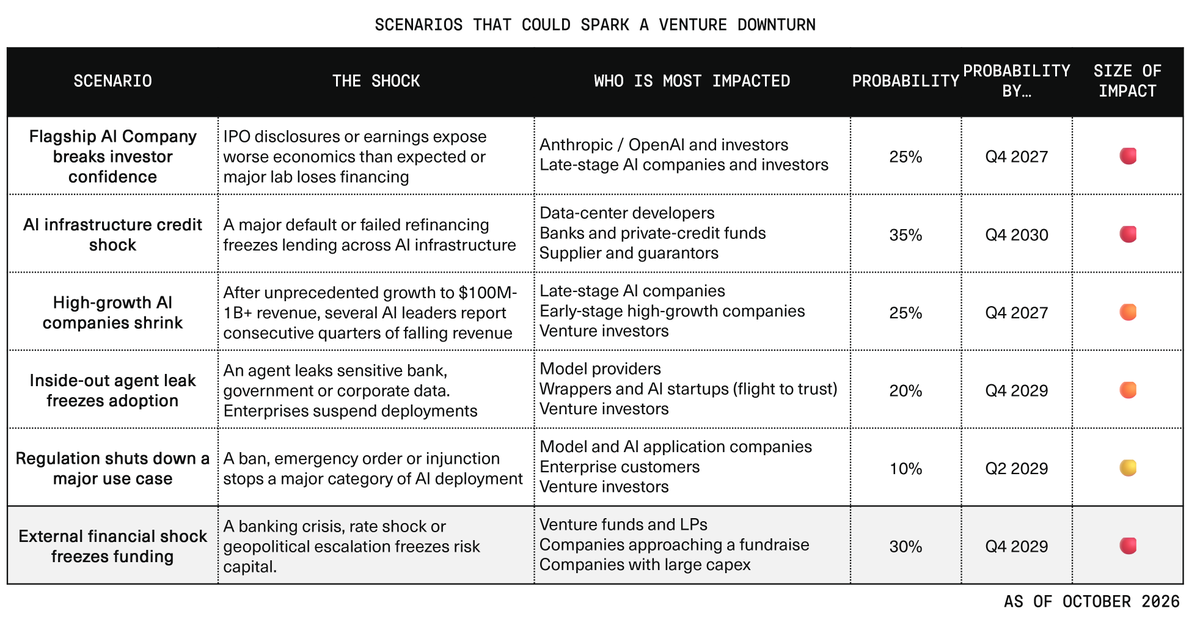
One month ago, I published a table of scenarios that could drive a venture downturn.
Here’s what we’ve seen since:
Flagship company breaks confidence ➡️ some signs
- NVIDIA + Jensen drama.
- ANT threatening to fall below its IPO price.
Infrastructure shock ➡️ not yet, but...
- Lenders sought to stop SpaceX from sending the AI chips backing its debt into orbit, where they couldn’t recover the collateral in a default 😜
- Stock market not looking kindly on all sorts of AI infrastructure.
High-growth companies shrink ➡️ not yet
Inside-out leak ➡️ not yet, but in just the last week…
- Microsoft 365 global outage, FAA network failure and ground stop, banking outages
- Whether or not directly caused by AI, these incidents become part of the narrative
Regulation ➡️ not yet, but...
- The blue wave certainly comes with commentary on data centers.
Nothing definitive yet. But a few of the risks I outlined a month ago are starting to look less hypothetical. I’m watching for a pullback in venture funding next year. Link to full writeup below.
What am I missing?
@Rick_Zullo@lessin While I agree with the point on multiple (our whole game), 6 years to exit is pretty slick and hard to replicate coming from $10 post entry points
Today, Anthropic completed a record-setting IPO, just months after SpaceX.
The sheer magnitude of these exits has shifted the prevailing wisdom squarely into the camp of “only a few companies matter.” To a large extent, that’s true. SpaceX’s $1.8T represents almost 80% of all exit value tracked by PitchBook through Q3 this year.
This calls into question the role of VCs that don’t hold positions in these “few companies that matter.”
The counterargument has always been some combination of fund size and exit behavior. Smaller funds can achieve outsized returns on smaller exits, and incredible returns on larger ones. And there are many more routes to smaller exits, making them much more frequent.
Given today’s market… is that still true?
Using PitchBook’s Q3 data, I compared two groups: $100–500M exits, “small” and $500M+ “large.” (I excluded exits below $100M completely.)
What we see:
📊 2016–19: Small exits were 3x as frequent as large and represented 0.4x the exit value.
📊 2020–21: 1.5x as frequent / 0.2x the value.
📊 2022–23: 2x as frequent / 0.3x the value.
📊 2024–26 YTD: 1x as frequent / 0.0x the value.
The first three quarters of this year marked the first time in this dataset that $500M+ exits were more common than $100–500M exits.
Is this a sign of what’s to come? Or a temporary blip driven by the AI boom?
And what does it imply about which funds are poised to win?
On one hand, mega funds have many bites at the apple and will continue to dominate the access game.
On the other, GC just released data that only 40% of seed rounds include Tier-1 fund participation… implying more than half are led by smaller (or lesser known) funds. With growing frequency and magnitude of the larger outcomes, we may see more of those funds with even more outsized returns.
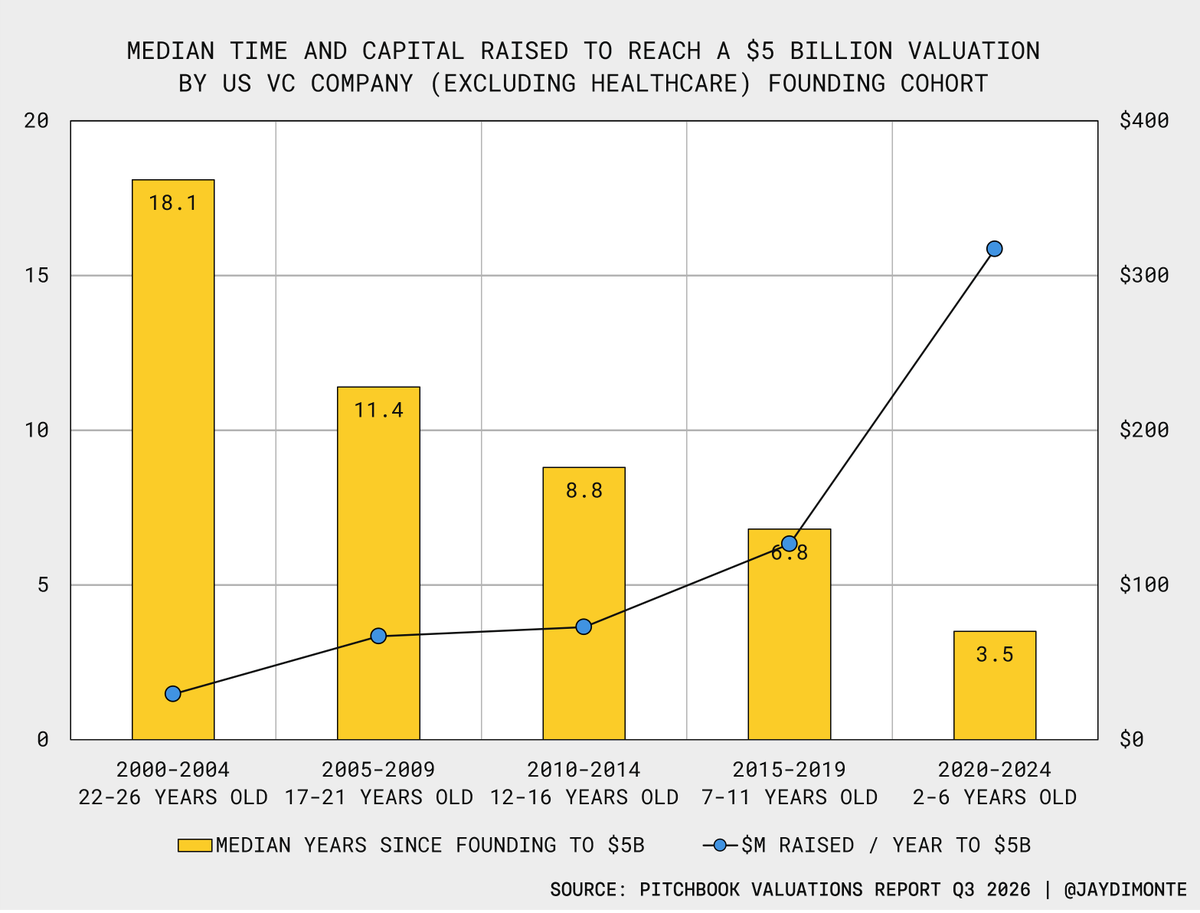
There are already ~2x more $5B+ VC-backed companies founded in 2020-2024 than in 2000-2004… despite a 20-year headstart.
Hard to make an apples-to-apples comparison of cohorts over time, but trying to do so is what makes today’s market so impressive.
Pitchbook just published a teardown of companies reaching $5B+ valuations.
Rough conclusions comparing today to 10 and 20 years ago…
↗️New company formation is up
↗️More companies are hitting $1B+, $5B+ valuations, and earlier in their lifecycle
↗️They’re raising more to do so
…which will make this chart very interesting in another 10 years from now.
Each one of these bar charts is likely to grow over time. We’ll see the most growth from the most recent cohorts as early companies mature.
My question is what happens to the line chart (e.g. dollars raised per year in business until company hit $5B).
So far, 40 companies started between 2020-2024 raised a median of $1.1B to reach a $5B valuation in 3.5 years.
What happens to that number as companies that take eight or ten years to get there enter the sample? Do they get there through more traditional methods (e.g. sequencing of raises and building into valuation) or hyper growth? What are the implications for dilution and liquidity?
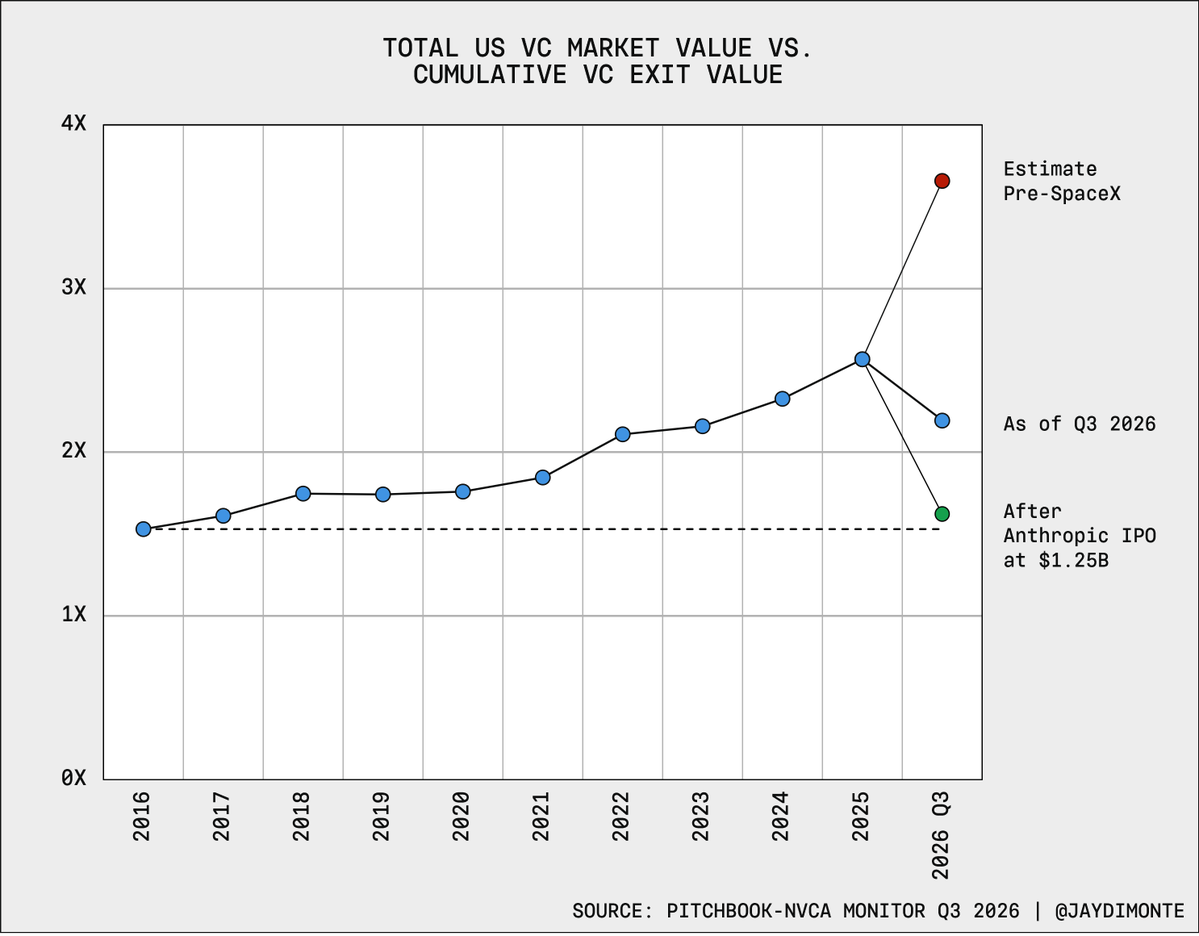
One IPO turned back the clock on venture by nearly five years. Could Anthropic make it ten?
PitchBook compared the value of US venture-backed companies still private with the cumulative value of VC exits. Through 2021, that ratio stayed below 2x. By 2025, it had climbed to 2.6x. The unicorn boom during ZIRP, then the flood of capital into AI, pushed private valuations up faster than companies could exit.
Then came SpaceX. Its IPO took $1.25T out of the private market and added $1.77T to cumulative exit value.
By Q3 2026, that left $11.6T in private market value against $5.3T in cumulative exits. At 2.2x, the ratio was back around its 2022–23 level.
If Anthropic goes public at $1.25T, the ratio could fall to ~1.6x, roughly where it stood in 2016.
If two companies can move the ratio this much (not to mention potential of OpenAI), how relevant is it to describe the health of the market?
RIP rise of the rest?
The natural byproduct of today’s prevailing thought that “only a few companies matter” is that those companies are most likely in the Bay Area.
In this age of AI-driven power laws, do other markets matter?
No. And yes.
📊 Almost ¾ of venture dollars went to West Coast companies through Q3 this year
📊 BUT strip out Anthropic and OpenAI, and that share drops closer to ½, in line with historical trends
Truely an outlier-driven business!
The overall market is up, but some regions are also punching above their historical weight:
➡️ Mid-Atlantic, driven largely by NYC: $38B in the first three quarters of 2026 versus $30B in all of 2025.
➡️ South, driven by Austin: $32B in the first three quarters of 2026 versus $17.6B in all of 2025.
Austin is a big winner from the push into hardware and defense. Closing in on NYC, and blowing past LA and Boston, would have been a huge surprise a few years ago but not today 🚀
What do you think the next few years will reveal?
"The abruptness with which that Fund I edge falls away illustrates how bad most LPs are at deciding which managers will get to raise a Fund II."
Lots of other reasons on the GP side too...
- attention spreads thin with growing portfolio
- subsequent funds may include strategy drift (lose the magic of what made I special)
- pressure to make it work never higher than with I