"Travel is glamorous," they said. Well, then Ebola comes around.
On May 12, I landed in Uganda for a routine multi-country business trip across Africa. I had no symptoms, no exposures, and absolutely no reason to think Ebola would become part of my journey. The first confirmed cases in Kampala weren't reported until after I left on May 14. After!
Over the next 2 weeks, I moved through East & West Africa. Finally Cape Verde. No issues. No symptoms.
Then the system broke down.
On June 1, sitting at the gate in Sal, Cape Verde, preparing to fly home to the US, I was pulled out of line. Handed a mask. Escorted by security to a medical isolation area staffed by personnel in full PPE.
Despite having left Uganda 18 days prior (well into the standard window), remaining entirely healthy, and having zero exposure, I was flagged.
The medical team screened me, checked my temperature, and officially cleared me. But the Cabo Verde Airlines counter was a different story:
〰️1 employee told me they believed I actively had Ebola.
〰️Another claimed I couldn't board without personal approval from the U.S. Ambassador.
I contacted the U.S. Department of State and who connected me to the U.S. Embassy Cape Verde. They confirmed instantly that no such rule existed. The on duty ambassador even offered to call the airline directly to clear it up. The airline refused to take the call.
When airline personnel flatly told me I couldn't leave the country until they gave me permission, I gave them a two-word response: "Watch me."
I booked a completely different route through Lisbon and boarded the plane.
Upon landing in Washington, D.C. on June 2, the flag in the system triggered again. Another round of screening, another review of my timeline, and another clear. I was sent on my way with a 21-day mandatory daily text-monitoring protocol.
3️⃣ days later, I finally made it home to the Colorado mountains. Healthy. Exhausted. Relieved.
And now, every day, my phone texts me to ask if I have Ebola.
Public health screening is vital. But this experience reinforced a critical business and leadership lesson: how quickly facts become secondary once a flawed data point flags you inside a system.
When communication breaks down, confusion fills the gap. When rigid bureaucracy replaces common sense, professionals get trapped in situations that nobody can logically explain.
I am immensely grateful to the professionals at the U.S. State Department and the U.S. Embassy in Cape Verde who stepped up, provided accurate information, and actually tried to solve the problem.
But most of all, I’m just glad to be home.
Sometimes "global business travel" means being treated as a biohazard despite having no symptoms, no exposure, and a completely clear medical screening.
Travel is glamorous, they said. 😎
@SecRubio@StateDept
Under Mansa Musa's rule, the Malian Empire encompassed territories that are now Mauritania, Senegal, Gambia, Guinea, Burkina Faso, Mali, Niger, Nigeria, and Chad.
This vast empire stretched approximately 2,000 miles, from the Atlantic Ocean in the west to Lake Chad in the East.
While Europe carved up Africa, Ethiopia 🇪🇹 defeated the Italians and humbled Italy.
Liberia 🇱🇷 stood apart as an independent republic and was never formally coIonized by Europe.
🇺🇬 Uganda doesn't have a startup problem. Uganda has a scale-up survival problem.
Every year, thousands of entrepreneurs start businesses. Too few survive long enough to become institutions.
In this powerful open letter, @StKyamutetera argues that Uganda must stop celebrating business creation alone and start protecting businesses that have already proven themselves but are struggling under tax arrears, delayed government payments, expensive debt, and limited access to growth capital.
His proposal? A UGX 1 trillion Enterprise Scale-Up and Rescue Fund, tax offset mechanisms for government arrears, procurement reforms, and patient capital to help Ugandan businesses grow from hustle to institution.
Because the future of Uganda's economy will not be built by slogans.
It will be built by businesses that survive long enough to scale.
We have enough hustlers. Now let us build companies.
Read full letter:
https://t.co/ZPQXKH5UfN
@URAuganda@Parliament_Ug@nssfug@UDB_Official@PPDAUganda
Hosting a World Cup has become exponentially more expensive over time, ranging from $500 million (United States, 1994) to a record $220 billion (Qatar, 2022) and most tournaments have failed to recoup their costs. A striking fact is that since 1966, only one World Cup (Russia 2018) has reported a positive financial balance (around $240 million in profit), while Japan/South Korea 2002 suffered the largest deficit at -$4.81 billion, before Qatar dwarfs all others.
Analysts are still seeking for credible answers as to how Juba, a city which was near bare land in 2005 and in a country that has been embroiled in civil wars and rampant corruption, since independence, sits at the same development level as Kampala?
🎥 | +211 Kingdom.
In Norway, an MP's pay is 1.1x the GDP per capita. They are peers with the public.
In Kenya, an MP costs 62.1x the GDP per capita. 🇰🇪
We are paying "Empire-building prices" for a "Developing-nation economy." The math of poverty is coded into our budget.
Don't miss my X space
Morocco has overtaken South Africa as Africa’s top industrial economy, marking the end of more than 80 years of South African dominance.
https://t.co/RjdF13Gfpw
Equatorial Guinea’s all-powerful President, Teodoro Obiang Nguema Mbasogo, has turned this hotel owned by his family in Malabo into a prison for asylum seekers deported from the United States.
Inside this Bamy Hotel, asylum seekers deported by the US are imprisoned.
Of the at least 32 people imprisoned there since November — all of whom had previously been granted protection from U.S. judges, their lawyers said — 25 have been forced to go back to home countries across Africa.
Men and women from Angola, Eritrea, Ethiopia and Mauritania wander the hotel’s long corridors and gaze out the windows at the shimmering pool they are not allowed to use.
Source: @AP.
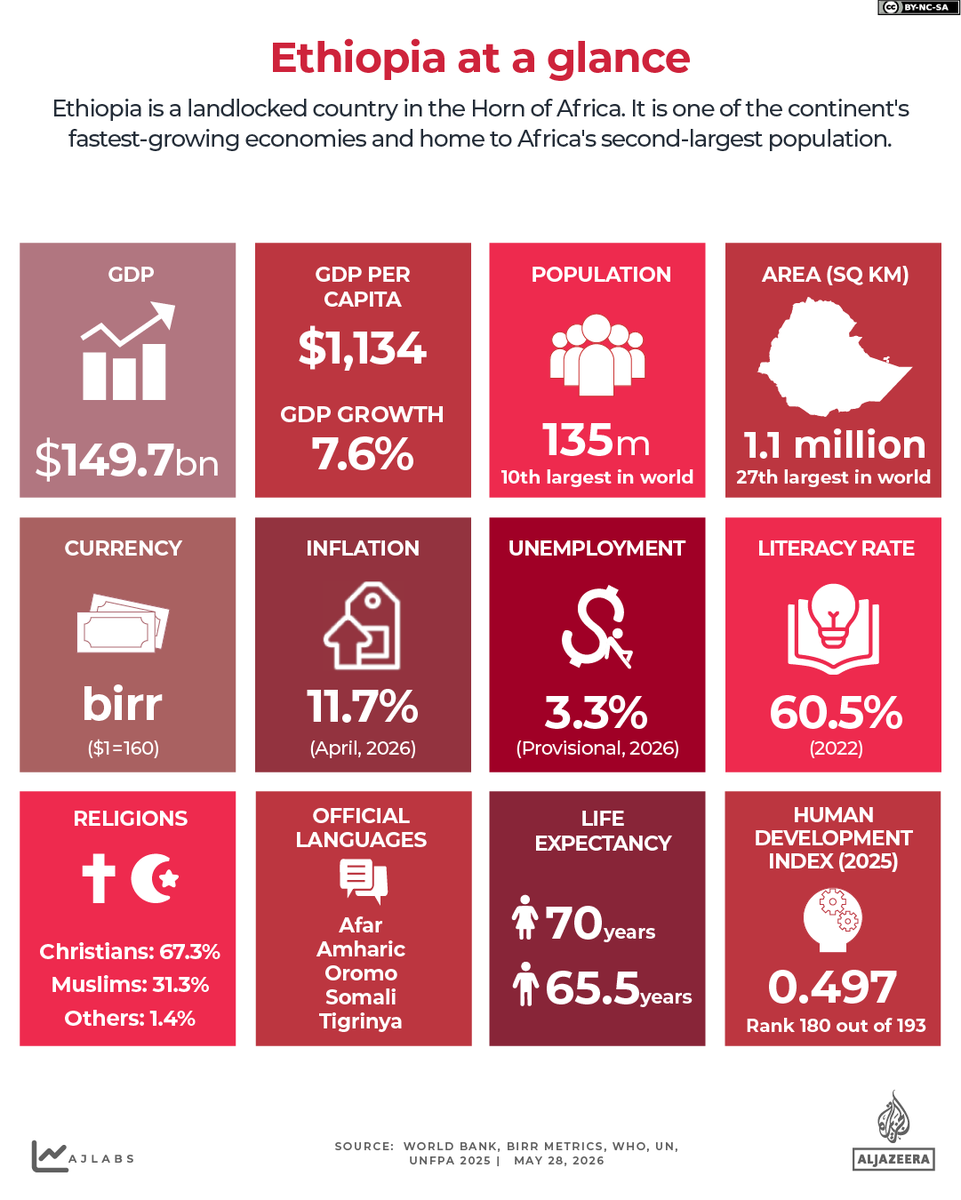
Ethiopia will head to the polls on June 1 for its first nationwide elections since the formal end of the Tigray war.
Here's what you need to know about the country's elections https://t.co/3fWLdmH6c3