Another research hypothesis I’ve been exploring since the weekend:
Some wallets consistently take less risk while capturing a good amount of upside asymmetries.
So I started finding the humans behind some of these wallets through social engineering.
And what did I notice?
They rarely post about the exact niche making them money.
That made me wonder:
Are the best on-chain opportunities hidden inside behaviours people repeatedly execute but never publicly explain?
Over the past four days, I’ve built a canonical dataset connecting:
• Wallet
• Niche
• Behaviour
• Risk vs upside
• How easily the behaviour can be simulated
The goal isn’t to copy wallets.
Wallets change. People rotate accounts.
The goal is to identify the profitable behaviour that keeps repeating underneath them.
AI agents are already browsing, buying, negotiating and representing people online, and that's created a strange new problem
How does anyone, human or machine, actually know who's on the other end of an interaction?
@twin3_ai is trying to answer that, and to understand what they're building it helps to know both where they started and where they've landed.
Twin3 started as a Web3 protocol built around an idea they call Proof of Authenticity, pitched as something deeper than the usual "proof of personhood" checks or reputation scores.
Instead of just confirming someone is human, the goal was to capture the nature of their actual experience, their skills, behavior and judgment.
That got encoded into the Twin Matrix, a 256-dimensional identity framework split into four areas the project describes as physical, digital, social and personal experience.
Each person's matrix gets minted as a soulbound token, a non-transferable on-chain token representing their verified identity and traits.
According to twin3, more than 140,000 of these have already been created
🚨 UNDERSTAND VERTICAL PUMPING & WHY DUMPING OFTEN FOLLOWS
When a token starts moving vertically 📈, meaning price rises extremely fast with very little pullback, don’t immediately assume it will keep going forever.
A vertical pump usually means buyers are aggressively chasing price. As the price rises, more people FOMO in because they don’t want to miss the move.
But remember: the faster the pump, the more dangerous the reversal can become.
Why? 👇
Early buyers are sitting on huge profits. When they start taking profit, selling pressure enters the market. If new buyers stop coming in strongly enough to absorb those sells, price can fall very quickly 📉.
This is why you may see:
📈 Slow move → healthy
📈📈 Strong move → momentum
📈📈📈 Vertical move → high volatility + higher dump risk
A vertical pump does not automatically mean a dump is coming. Strong news, genuine demand, short liquidations, or a major breakout can keep the move going.
But the risk increases when you see extreme volume, long upper wicks, weakening momentum, and aggressive profit-taking.
Don’t chase green candles. Have a plan before entering.
The market rewards patience more than FOMO.
A lot of projects have genuine innovation and interesting tech, but almost all of them struggle with the same thing: marketing the idea.
I recently saw a Reddit thread asking “What’s harder, building a product or selling the product?”
Most builders replied that neither is easy, and many pointed out how hard it is to actually get people to care once the product is ready.
In crypto this is especially true.
Most teams don’t struggle to build. They struggle to get noticed.And when it’s time to market, the usual options aren’t great:
• Paying large influencers for reach (expensive and often low conversion.
• Running open bounty campaigns that reward anyone for posting (usually ends in low-effort, copy-paste content and fake engagement)
I recently came across a project trying to solve this exact problem: @contently_app
Instead of being just another platform that connects brands with creators, Contently is building what it calls an Attention Marketplace.
Think of it as a marketplace where:
• Brands come to buy quality attention for their products
• Creators compete to earn rewards by producing the best content
This is not the same as a regular bounty campaign.
In a typical bounty campaign the goal is volume, get as many people as possible to post. Anyone can join. Brands buy exposure.
In Contently’s Attention Marketplace the goal is quality, get the best people to create the best content. Entry is gated through manual review. Brands aim to buy high-quality attention.
How it works
Step 1: Join the network
Creators don’t sign up instantly.
You apply with your X account and previous work. A real person reviews both your content quality and your audience before granting access.
(This is deliberate the goal is to keep the network focused on quality rather than turning into another bot farm or engagement marketplace.)
Step 2: Pick a campaign
Once accepted, you can join live campaigns from crypto projects, Create content about the project on X, then submit the post link through the platform.
Step 3: Earn based on quality
Unlike traditional influencer deals that mostly reward follower count, Contently evaluates every submission using a public scoring rubric.
A human reviewer scores the content. The best performing entries take the largest share of the campaign’s fixed USDC prize pool.
This means a thoughtful, well-researched post can outperform an account with a much larger audience.
Contently creates a clearer opportunity for both serious creators and builders who want better distribution.
It’s still early-stage, with an interesting approach to one of Web3 builders’ biggest challenges: turning marketing from a pure volume game into a quality game.
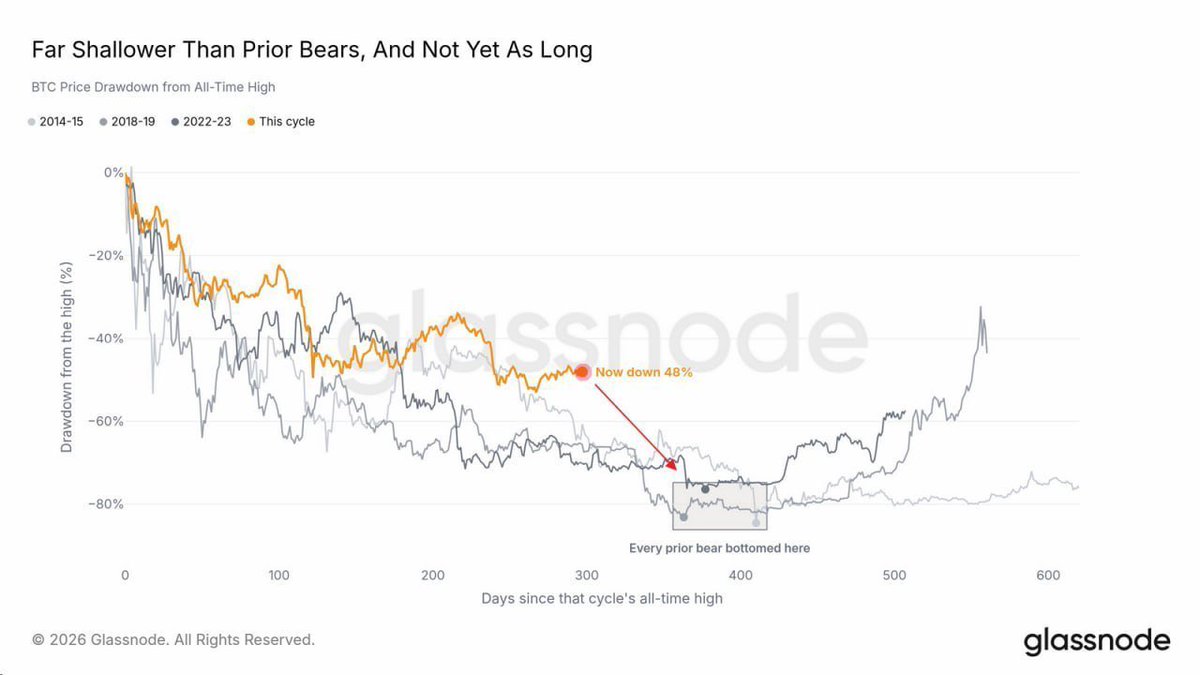
💰This bear market in BTC has only declined by 49%.
All previous bear markets reached their bottom at a significantly lower level. - Glassnode
Pay attention!!😌
Whenever we have a runner, we start seeing different tokens launching with the same ticker and image. This is called vamping.
People end up buying the fake token thinking it’s the real one and lose money. Meanwhile, the original creators spend time marketing and building attention, only for some random person to siphon the liquidity that was meant for their coin.
It’s been one of the biggest problems in the memecoin space. And now we have @pmavfun trying to fix it.
PMAV is a fair-launch memecoin launchpad built on Uniswap v4 that eliminates some of the most common failure points of traditional pads, especially vamping and migration rugs.
On vamping:
They use protocol-level mechanisms like name/ticker cooldowns, OG badges, and permanent copy flags, Which makes it much easier to identify the original project and reduces confusion.
On migration rugs:
Most launchpads follow this path:
Bonding Curve → Graduation → Migrate liquidity to a DEX.
Every extra step adds complexity and risk. So PMAV takes a different approach.
Every token launches directly into a real Uniswap v4 pool from the very first trade. No separate migration,No moving liquidity into a new pool, Just one pool from launch onward.
It’s an interesting approach to solving two of the biggest pain points in memecoin launches.
They’re also working on other issues like block 0 sniping, whale domination, weak creator incentives, and snipers extracting value.
$100 GIVEAWAY 💯💯🎉🎉🎉
💚Register with KCEX exchange 💱
💚Drop ur @KCEX_Official UID!
💚 Retweet
I've been testing KCEX for a while now, and my first impression has been very positive.
The trading fees are extremely low, the UI is clean and responsive, and the overall trading experience feels smooth. On my recent trades, I didn't notice the kind of large fee deductions that some traders complain about on other platforms.
So far, it's one of the best exchanges I've personally used. If you're an active futures trader, it's definitely worth checking out and testing for yourself.
Register here 👇
https://t.co/tJ7r6ngcQl
𝐓𝐡𝐞 𝐞𝐚𝐬𝐢𝐞𝐬𝐭 𝐰𝐚𝐲 𝐭𝐨 𝐮𝐧𝐝𝐞𝐫𝐬𝐭𝐚𝐧𝐝 𝐎𝐩𝐞𝐧 𝐈𝐧𝐭𝐞𝐫𝐞𝐬𝐭 (𝐎𝐈) 𝐢𝐬 𝐭𝐨 𝐟𝐨𝐫𝐠𝐞𝐭 𝐭𝐡𝐞 𝐜𝐨𝐦𝐩𝐥𝐢𝐜𝐚𝐭𝐞𝐝 𝐝𝐞𝐟𝐢𝐧𝐢𝐭𝐢𝐨𝐧𝐬. 𝐓𝐡𝐢𝐧𝐤 𝐨𝐟 𝐢𝐭 𝐥𝐢𝐤𝐞 𝐭𝐡𝐢𝐬: 𝐬𝐭𝐲𝐥𝐞 𝐛𝐞𝐥𝐨𝐰!
𝐈𝐦𝐚𝐠𝐢𝐧𝐞 𝐚 𝐜𝐥𝐚𝐬𝐬𝐫𝐨𝐨𝐦 👨🏫
There are 30 students in a classroom.
The teacher asks everyone to pair up.
John pairs with Mary.
David pairs with Sarah.
James pairs with Grace.
There are now 15 pairs.
Each pair is like one futures contract.
Open Interest = Number of active pairs.
It doesn't matter who is stronger or weaker. What matters is how many active pairs still exist.
𝐍𝐨𝐰 𝐥𝐞𝐭'𝐬 𝐦𝐨𝐯𝐞 𝐭𝐨 𝐜𝐫𝐲𝐩𝐭𝐨 𝐟𝐮𝐭𝐮𝐫𝐞𝐬
Suppose:
You open 1 BTC Long.
Someone else opens 1 BTC Short.
A new contract is created.
Open Interest = 1
Both traders are still in the trade.
Later:
Another Long meets another Short.
Now:
Open Interest = 2
Another pair joins.
Open Interest = 3
Every time a new Long and a new Short open positions together:
➡️ Open Interest increases.
𝐖𝐡𝐞𝐧 𝐝𝐨𝐞𝐬 𝐎𝐩𝐞𝐧 𝐈𝐧𝐭𝐞𝐫𝐞𝐬𝐭 𝐝𝐞𝐜𝐫𝐞𝐚𝐬𝐞?
Suppose one Long trader closes the trade.
The Short trader also closes.
That contract disappears.
If Open Interest was 100
It becomes
99
That is why:
Opening trades = OI goes UP
Closing trades = OI goes DOWN
𝐕𝐞𝐫𝐲 𝐈𝐦𝐩𝐨𝐫𝐭𝐚𝐧𝐭
Many beginners think:
More buyers than sellers means price goes up.
Wrong.
Every Long has a Short.
Every buyer has a seller.
Always.
Without a seller there is no buyer.
Without a buyer there is no seller.
𝐓𝐡𝐞𝐧 𝐰𝐡𝐚𝐭 𝐝𝐨𝐞𝐬 𝐎𝐩𝐞𝐧 𝐈𝐧𝐭𝐞𝐫𝐞𝐬𝐭 𝐚𝐜𝐭𝐮𝐚𝐥𝐥𝐲 𝐭𝐞𝐥𝐥 𝐮𝐬?
It tells us
How much money is currently trapped inside futures.
Think of it like water inside a swimming pool.
Small pool
⬜
Not much money.
Huge pool
🟦🟦🟦🟦🟦
A lot of money.
The bigger the pool
The bigger the possible liquidation.
𝐅𝐨𝐮𝐫 𝐜𝐨𝐦𝐛𝐢𝐧𝐚𝐭𝐢𝐨𝐧𝐬 𝐞𝐯𝐞𝐫𝐲 𝐭𝐫𝐚𝐝𝐞𝐫 𝐬𝐡𝐨𝐮𝐥𝐝 𝐤𝐧𝐨𝐰
1. Price ↑ + OI ↑ ⭐⭐⭐⭐⭐
Price is rising.
Open Interest is rising.
Meaning:
New money is entering.
The trend is usually strong.
This is the healthiest rally.
2. Price ↑ + OI ↓
Price rises.
Open Interest falls.
Meaning:
People are closing positions.
This move is often caused by short sellers getting liquidated or taking losses.
The rally may not last.
3. Price ↓ + OI ↑
Price falls.
Open Interest rises.
Meaning:
New traders are entering while price drops.
Usually more aggressive short positions are opening.
Bearish pressure is increasing.
4. Price ↓ + OI ↓
Price falls.
Open Interest falls.
Meaning:
Traders are leaving the market.
The move may be losing strength.
A reversal or consolidation becomes more likely.
𝐖𝐡𝐲 𝐰𝐡𝐚𝐥𝐞𝐬 𝐰𝐚𝐭𝐜𝐡 𝐎𝐩𝐞𝐧 𝐈𝐧𝐭𝐞𝐫𝐞𝐬𝐭
Whales love liquidity.
If Open Interest becomes very high:
Lots of traders have stop losses.
Lots of traders can be liquidated.
Whales may push price toward those liquidation zones.
That is why huge Open Interest often comes before very volatile moves.
𝐖𝐡𝐚𝐭 𝐎𝐩𝐞𝐧 𝐈𝐧𝐭𝐞𝐫𝐞𝐬𝐭 𝐂𝐀𝐍𝐍𝐎𝐓 𝐭𝐞𝐥𝐥 𝐲𝐨𝐮
Open Interest does not tell you:
Whether Longs or Shorts are winning.
Whether the next candle will be green or red.
Whether you should buy immediately.
It only tells you how many positions are still open.
You must combine it with:
Price action
Volume
Funding rate
Liquidation heatmaps
Support and resistance
𝐎𝐧𝐞 𝐬𝐞𝐧𝐭𝐞𝐧𝐜𝐞 𝐭𝐨 𝐫𝐞𝐦𝐞𝐦𝐛𝐞𝐫 𝐟𝐨𝐫𝐞𝐯𝐞𝐫
Price tells you where the market is going.
Volume tells you how active traders are.
Open Interest tells you how much money is still committed to the current futures battle.
If you master Price + Volume + Open Interest, you'll understand far more about market behavior than traders who rely on indicators alone.
$HBADG $BTC
I have never shared this info publicly ,even though I have studied this chart many times and I knew exactly where we are headed,
I didn’t want to give anyone panic attack, so I didn’t stress to share it here.
when I hear things like
“The cycle is broken”
I just smile…
Oh well!!!👇🏾, now you know.