Parents are not as inequality-averse among their own children as we tend to assume. Using a cash transfer randomized at the student level in Bogotá, we estimate how much parents care about equalizing achievement across siblings.
🧵on our new working paper
https://t.co/RkihrjpF6R
New working paper: Compensation vs. Reinforcement: Experimental Identification of Parental Aversion to Inequality in Offspring
A central question in household economics is whether parents compensate disadvantaged children or reinforce investments in the child with the highest expected returns.
We estimate a dynamic structural model of household schooling decisions using a unique student-level randomized experiment in Colombia that generated exogenous variation in treatment exposure across siblings within the same household.
The experimental variation allows us to identify a key deep parameter: parental aversion to inequality in children's educational outcomes, a parameter that has been central to the literature since Behrman, Pollak, and Taubman (1982).
The estimates imply limited aversion to inequality across siblings. Consistent with this, untreated siblings of treated children are 3.7 percentage points less likely to graduate from college, a decline of about 30% relative to the control mean.
Importantly, the model is not only estimated using experimental variation. We also validate it out of sample using treatment effects from a separate experimental margin not employed in estimation, and the model successfully reproduces these held-out RCT results.
The combination of structural estimation and experimental validation allows us to move beyond treatment effects, uncover mechanisms, and evaluate counterfactual policies with greater credibility.
https://t.co/Xi7xotFFpZ
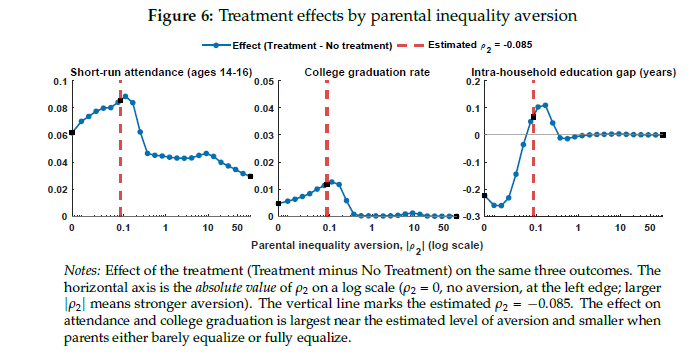
5/ Aversion affects the policy effectiveness
At both extremes, transfers barely move outcomes: with no aversion parents already specialize; with strong aversion they equalize regardless of incentives. The transfer matters the most near the level of our estimated aversion
Parents are not as inequality-averse among their own children as we tend to assume. Using a cash transfer randomized at the student level in Bogotá, we estimate how much parents care about equalizing achievement across siblings.
🧵on our new working paper
https://t.co/RkihrjpF6R
4/ An efficiency–equity tradeoff
The parameter traces out how parents trade the two off. With strong aversion, they sacrifice total achievement for equal schooling. With zero aversion, they concentrate resources on the higher-return child.
The H1-B visa fee is a good example of a policy that is justified on dubious claims empirical claims but and in fact engenders long run harms to the US economy.
The assertion that H1-B recipients reduce domestic wages is debunked in this very careful paper by Michael Clemens @m_clem
Immigrant-Native Wage Gaps and Immigration Tariffs: Examining the Case for an H-1B Visa Tax
https://t.co/CT22zqlV5b
In contrast, the H1-B has been a consistent source of international talent for the United States. This recent literature synthesis by Gaurav Khanna @econgaurav
From Asia, with Skills
https://t.co/2jlDHO9oUS
is terrific on the general value of high skilled immigrants to the economy and discusses several of the main studies of the economic effects of H1-B recipients.
Do elite colleges help talented students from modest backgrounds join the social elite or help incumbent elites retain their positions?
NEW in the American Economic Review, by Andrés Barrios-Fernández, Christopher Neilson, and Seth Zimmerman: https://t.co/KvjCwvYlWN
AI will be the end of universities! MOOCs will be the end of universities! YouTube will be the end! Libraries! The printing press!
And each time life continues almost as before. Universities provide peer interaction, evaluation, coordination and commitment. That’s the value.
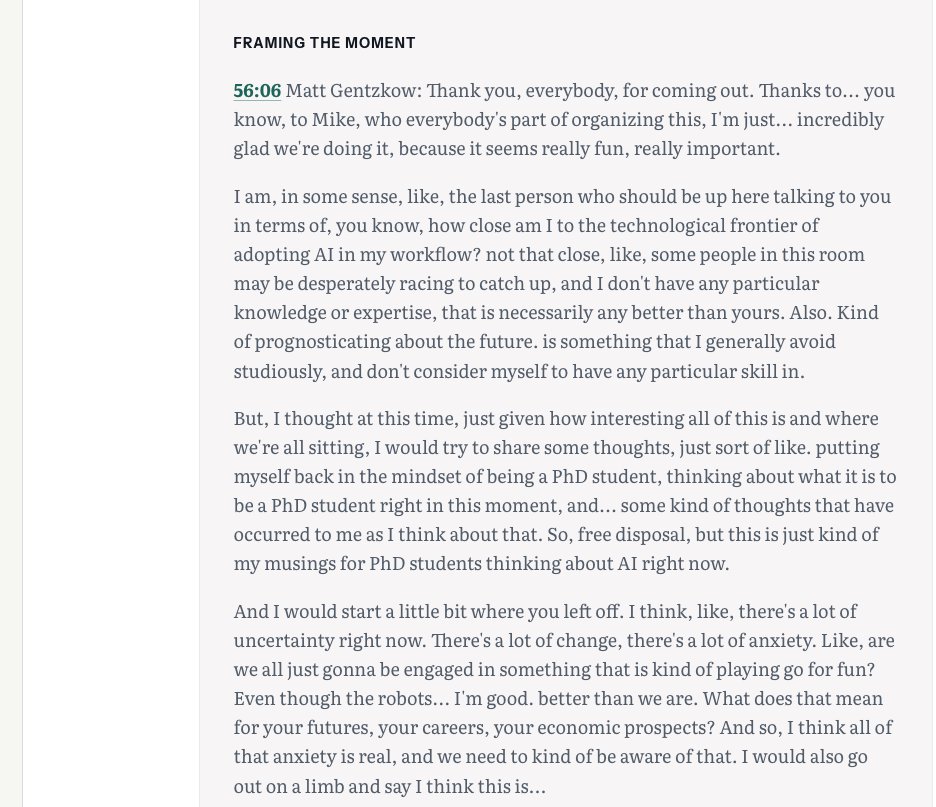
Stanford recently livestreamed a 3.5 hour conference with leading economists (@Susan_Athey , Matt Gentzkow, and @ahall_research , among others) on "Empirical Work in the Age of AI"
I turned the whole thing into a readable transcript, separated by talk.
You can pass the whole thing to your coding agent to extract exactly what is useful for you.
Check it out here!: https://t.co/jKtU6mgG1X
When experts communicate before reporting, network structure changes the information content of their forecasts, even when they are unbiased and equally precise.
- Regular networks minimize distortion.
- Star networks maximize it.
More here:
https://t.co/nR9WIT1fii
PSA for economists: Beware ChatGPT/Claude for refereeing papers.
AI is not good at judging taste or forming reasonable judgement about the importance of results. It’s a bad idea to use as a basis for decision making in refereeing. People who use these tools a lot know this but I wanted to make it more concrete. I did the following experiment. I asked for the optimal prompt to revise an intro for “top 5”, then followed the prompts and went down the rabbit hole of revisions suggested and did a gazillion rounds ending up with something. It was hypercautious, full of hedges, had no flair — and dull as dishwater. But I anticipated that; this was not the experiment. Instead:
I went to a fresh version of the same AI (different account) and asked it to judge between the two intros. It judged the original pre-revision far superior.
I then asked the AI-2 why its own cloned version, AI-1 did such a horrible job. Answer:
Good for: catching logical gaps in proofs, checking whether an argument is internally consistent, identifying missing citations, flagging where a reader might get lost in the formal machinery, rubber-ducking a tricky modeling choice.
Bad for: deciding what the paper is about, judging which analogies work, assessing voice, knowing when informality is doing real work, anything that requires taste rather than pattern matching.
Ultimate paradox: Was AI-1 or AI-2 right? Both were 100% confident in their judgement and man-splained them to me in great detail😂
I know we shouldn't be driven by desire for accolades but I am proud of this one. Maybe I didn't entirely waste my short moment of time on this beautiful planet 🥹❤️ https://t.co/BKW3aMxAfq @SocCompEcon
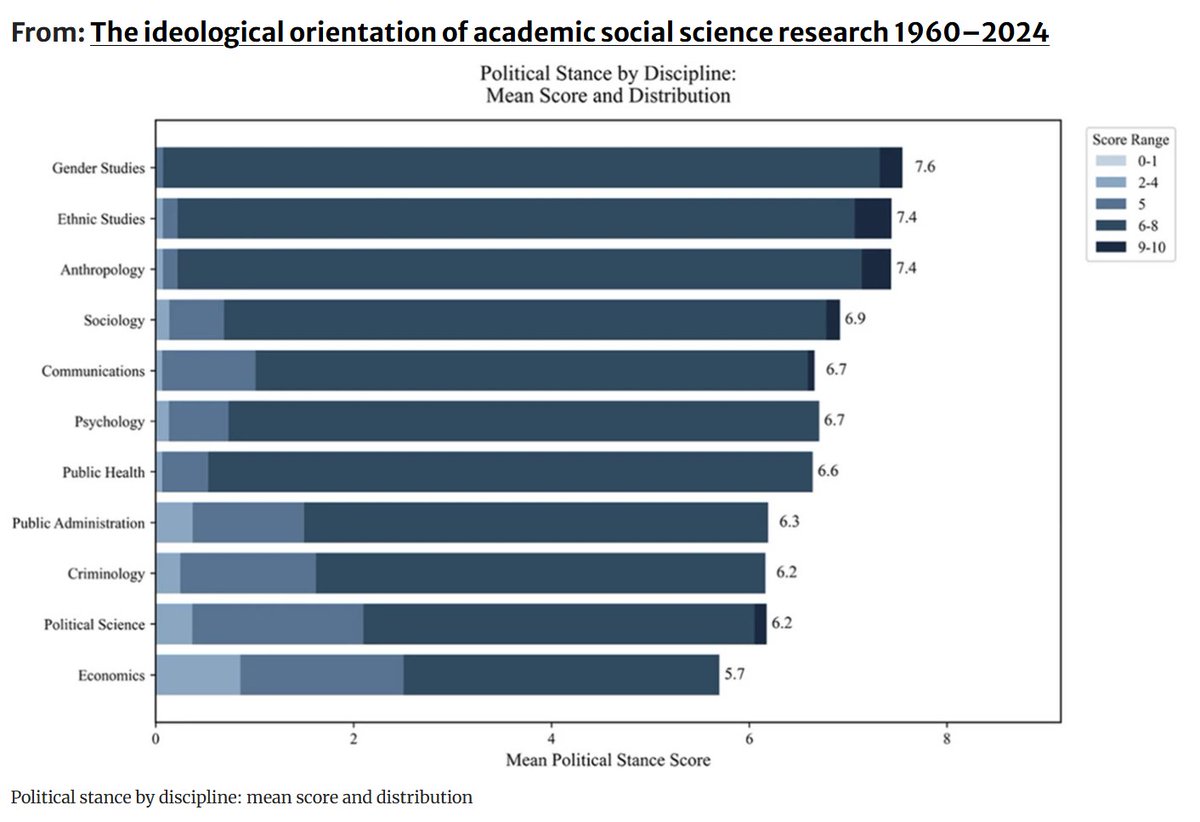
Economics is - by a long shot - the most politically balanced academic discipline, according to a LLM study that scored the political skew of academic journal articles. It still leans left-of-center but not hegemonically so like the others
(higher score = more left wing)