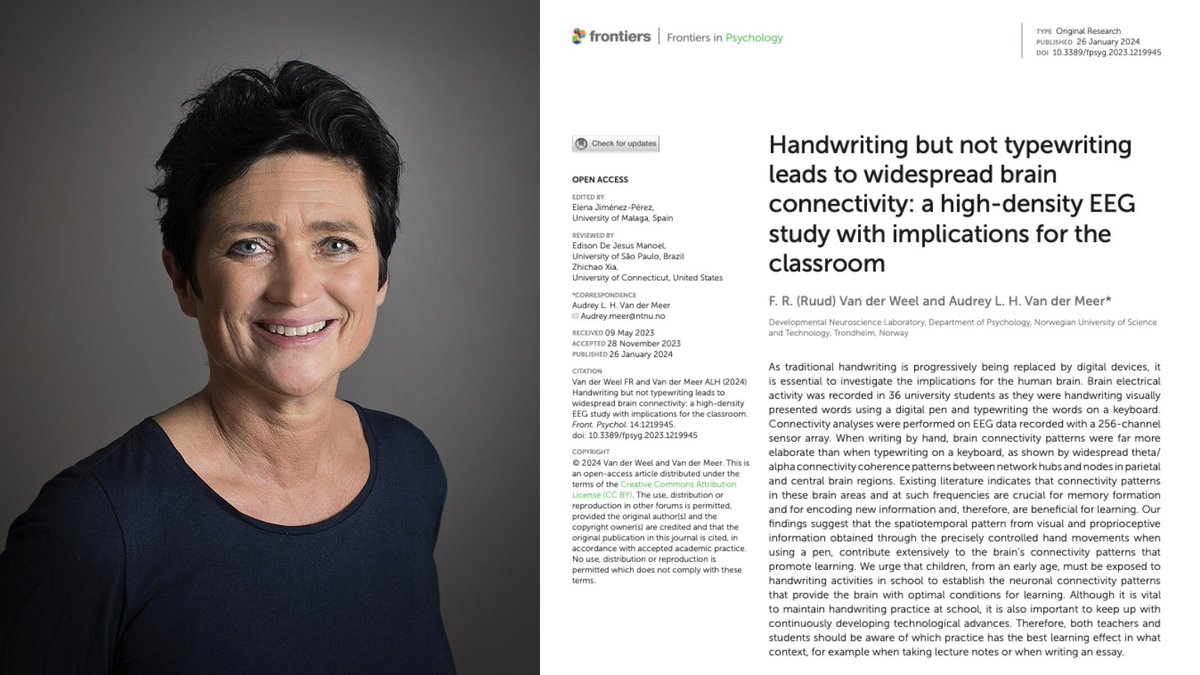
A Norwegian neuroscientist spent 20 years proving that the act of writing by hand changes the human brain in ways typing physically cannot, and almost nobody outside her field has read the paper.
Her name is Audrey van der Meer.
She runs a brain research lab in Trondheim, and the paper that closed the argument was published in 2024 in a journal called Frontiers in Psychology. The finding is brutal enough that it should have changed every classroom on Earth.
The experiment was simple. She recruited 36 university students and put each one in a cap with 256 sensors pressed against their scalp to record brain activity. Words flashed on a screen one at a time.
Sometimes the students wrote the word by hand on a touchscreen using a digital pen, and sometimes they typed the same word on a keyboard. Every neural response was recorded for the full five seconds the word stayed on screen.
Then her team looked at the part of the data most researchers had ignored for years, which is how different parts of the brain were communicating with each other during the task.
When the students wrote by hand, the brain lit up everywhere at once.
The regions responsible for memory, sensory integration, and the encoding of new information were all firing together in a coordinated pattern that spread across the entire cortex. The whole network was awake and connected.
When the same students typed the same word, that pattern collapsed almost completely.
Most of the brain went quiet, and the connections between regions that had been alive seconds earlier were nowhere to be found on the EEG.
Same word, same brain, same person, and two completely different neurological events.
The reason turned out to be something nobody had really paid attention to before her work. Writing by hand is not one motion but a sequence of thousands of tiny micro-movements coordinated with your eyes in real time, where each letter is a different shape that requires the brain to solve a slightly different spatial problem.
Your fingers, wrist, vision, and the parts of your brain that track position in space are all working together to produce one letter, then the next, then the next.
Typing throws all of that away. Every key on a keyboard requires the exact same finger motion regardless of which letter you are pressing, which means the brain has almost nothing to integrate and almost no problem to solve.
Van der Meer said it plainly in her interviews.
Pressing the same key with the same finger over and over does not stimulate the brain in any meaningful way, and she pointed out something that should scare every parent who handed their kid an iPad.
Children who learn to read and write on tablets often cannot tell letters like b and d apart, because they have never physically felt with their bodies what it takes to actually produce those letters on a page.
A decade before her, two researchers at Princeton ran the same fight using a completely different method and ended up at the same answer. Pam Mueller and Daniel Oppenheimer tested 327 students across three experiments, where half took notes on laptops with the internet disabled and half took notes by hand, before testing everyone on what they actually understood from the lectures they had watched.
The handwriting group won by a wide margin on every question that required real understanding rather than surface recall.
The reason was hiding in the transcripts of what the two groups had actually written down.
The laptop students typed almost word for word, capturing more total content but processing almost none of it as they went, while the handwriting students physically could not write fast enough to transcribe a lecture in real time, which forced them to listen carefully, decide what actually mattered, and put it in their own words on the page.
That single act of choosing what to keep was the learning itself, and the keyboard had quietly skipped the choosing and skipped the learning along with it.
Two studies. Two countries. Same answer.
Handwriting makes the brain work. Typing lets it coast.
Every note you have ever typed instead of written went into your brain through a thinner pipe. Every meeting, every book highlight, every idea you captured on your phone instead of on paper was processed at half depth.
You did not forget those things because your memory is bad. You forgot them because typing never woke the part of the brain that would have made them stick.
The fix is the thing your grandmother already knew.
Pick up a pen. Write the thing down. The slower road is the faster one.
@RealOlaudah@KhandaniM We have skilled instrumentation, electricians , PLC and SCADA, mechanical technicians. We simply need more opportunities to grow our businesses and groom more technicians.
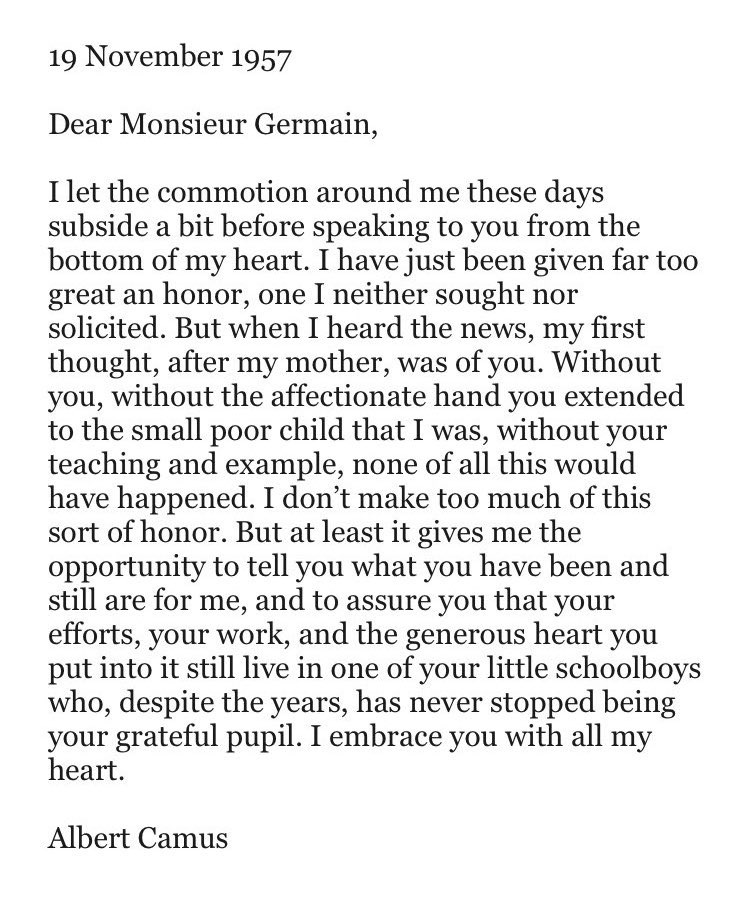
After he won the Nobel Prize in Literature in 1957, Albert Camus wrote a letter of thanks to his favorite childhood teacher, whom he'd never forgotten. It's beautiful.
Dr. Dre On Becoming A Billionaire: “I Don’t Chase Money. I Try To Make The Money Chase Me.” https://t.co/bremnfd8Yq #Forbes250
📸: Jamel Toppin for Forbes
In Midrand, Pieter van Wyk (CA(SA)) signed off a new warehouse automation process that reduced payment cycle time by 48% and was celebrated as a major efficiency win.
Six months later, Thabo Maseko, a process engineer who had quietly questioned the design from day one, helped uncover R12.1m in losses flowing through the exact same process that had been approved as “tight.”
A Thread.
Most fraud isn’t sophisticated. It survives because organisations underestimate it, customers misunderstand it, and leaders treat it like an audit issue instead of a strategic risk.
I break down real fraud schemes, explain why they work, and help organisations close the gaps. If that conversation matters to you, reach out or check out our website (bio) or at least refer your colleagues and friends to us.
Happy birthday to Tracy Chapman, who turns 62 today.
At the 1988 Nelson Mandela 70th Birthday Tribute concert at Wembley Stadium, Stevie Wonder was set to headline, but he had to pull out of the show minutes before taking the stage after the hard disc carrying all his synthesized music went missing. Tracy Chapman, who had already performed her set earlier in the day, stepped in to fill the gap for a crowd of 80,000. She played "Fast Car" and "Across the Lines." "Fast Car" hadn't even been part of her original set.
The performance was broadcast to a global television audience of around 600 million. She had sold around 250,000 albums before that night. Within two weeks, that number had climbed to two million.
31 years ago today, Ol' Dirty Bastard releases his debut LP, Return to the 36 Chambers: The Dirty Version, on Elektra/WMG. the third shot fired in the Wu revolution, Dirty may well be the most original vocalist in hip-hop history. the beats on here? some of RZA’s finest work. True Master and 4th Disciple, as well. nominated for Best Rap Album at the 1996 Grammys. a mad genius at work. my favorite album cover of all-time.
... And since we're giving props to Anita Baker on her Rapture release, how we not gonna include some heat that was flipped off that album? C'mon now 😂
'Devil's' Madlib Remix
'?