Power Corrupts, Absolute Power Corrupts Absolutely
An Open Response to Tokunbo Wahab
Dear Mr. Tokunbo Wahab,
I read your response to a fellow Lagosian:
“The attention you seek, trust me, you will not get it. Quite simply, you are not worth the time or engagement.”
Ordinarily, I would have ignored it. But because those words came from the Commissioner for Environment and Water Resources in Lagos State, they deserve scrutiny.
You see, sir, the problem is not whether you choose to engage a critic or not. The problem is the mindset revealed by your response.
As a public servant, you are not merely Tokunbo Wahab the individual. You are a representative of a government sustained by the taxes, sacrifices, and trust of millions of Lagosians. Therefore, when you tell a citizen that he is “not worth the time or engagement,” you inadvertently diminish the very people whose resources fund the office you occupy.
No Lagosian is beneath engagement.
No citizen is too insignificant to deserve respect.
No taxpayer is unworthy of acknowledgment from those entrusted with public authority.
You may disagree with criticism. You may reject accusations. You may even decide that a particular conversation is not worth your participation. Those are entirely your prerogatives. What should never happen is for a public official to communicate in a manner that suggests contempt for the citizens he serves.
That is not leadership.
That is not accountability.
And it is certainly not the democratic culture that Lagos should aspire to promote.
As Commissioner for Environment, you oversee matters that directly affect the daily lives of millions of people. Flooding, waste management, sanitation, drainage infrastructure, and environmental sustainability are not abstract policy discussions. They are realities experienced by ordinary Lagosians every single day.
When citizens raise concerns, ask difficult questions, or criticize government performance, they are not necessarily seeking attention. More often than not, they are seeking answers.
The danger of power is that it sometimes creates the illusion that criticism is an annoyance rather than a democratic necessity. Public office can become so consuming that those who occupy it begin to mistake authority for superiority.
That is precisely why Lord Acton’s warning has endured through generations:
“Power tends to corrupt, and absolute power corrupts absolutely.”
Corruption is not always financial. Sometimes it manifests in attitude. Sometimes it reveals itself through arrogance, dismissiveness, and an apparent belief that public accountability is optional.
Mr. Wahab, the citizens of Lagos do not work for you.
You work for them.
Your office exists because the public exists.
Your authority derives from the people.
Your responsibility is owed to the people.
That is the social contract upon which every democratic government rests.
The measure of leadership is not how one responds to applause. It is how one responds to criticism. Respect is easiest when people agree with us. Character is revealed when they do not.
I therefore urge you, not as an adversary but as a concerned citizen, to reflect on the implications of your words. Public officials must be held to a higher standard because their conduct shapes public confidence in government institutions.
Long after titles have changed and offices have been vacated, what will remain is the record of how those entrusted with power treated the people they were privileged to serve.
Power corrupts.
Absolute power corrupts absolutely.
Humility, accountability, and respect for citizens remain the only enduring antidotes.
✌️
What June 12 Should Mean to Us Nigerians
Today, we observe a day that should mean a great deal to us as a people who cherish democratic principles. Every year on June 12, the conversation inevitably turns to a critical assessment of the state of our nation. It serves as an annual benchmark for asking important questions: Are our elections today as transparent as they were in 1993? Is the social contract being honoured? Are the institutions of governance truly serving the people?
Ultimately, June 12 is a powerful blend of reflection and aspiration. It honours a fractured past while serving as a constant and foundational reminder of the immense power inherent in the collective democratic will of the Nigerian people.
For us in Nigeria, June 12 is not merely a date on the calendar; it is the emotional and structural bedrock of our modern democratic identity. Officially recognised as Democracy Day, June 12 carries deep historical, political, and social significance, representing both a monumental tragedy and the ultimate triumph of the collective will of the people.
To understand what June 12 means to Nigeria, one must examine its history, its evolution, and its enduring symbolism.
A new era of true democracy is POssible. -PO
Excessive Borrowing Without Accountability: Further Affirmation of Imprudent Governance.
President Bola Tinubu's administration has engaged in remarkably imprudent borrowing, escalating Nigeria's total debt to approximately N200 trillion. This represents an increase of over N100 trillion within a mere three years, a stark contrast to the roughly N49 trillion accumulated during President Muhammadu Buhari's eight-year tenure, which would have projected to around N80 trillion. As millions of Nigerians grapple with the shock of this unsustainable debt accumulation, the situation is exacerbated by the government's reckless approach to borrowing and a profound absence of accountability and transparency in the utilisation of these funds.
For instance, data from the Federation's Budget Office reveals that the Bola Tinubu government borrowed N11.89 trillion in the first three quarters of 2025 (January to September), exceeding the planned borrowing target of N10.34 trillion by approximately N1.54 trillion. Under a responsible and accountable government, such an overshoot would necessitate rigorous scrutiny and explanation from relevant governmental bodies. Regrettably, this is not the reality under the current administration.
Compounding this issue, only N3.10 trillion of the borrowed funds was allocated to capital expenditure during the same January-September 2025 period. This constitutes a mere 17.66% of the N17.58 trillion earmarked for capital projects, leaving a deficit of roughly N14.48 trillion, or 82.34% of planned capital expenditure unfunded.
The most disturbing aspect of the financial management fiasco under Bola Tinubu is that there is no explanation or information regarding how the balance was utilised or deployed. The question that Nigerians are rightly asking and deserve an answer to is what happened to the balance? Was it deployed for recurrent expenditure/ consumption, for the entertainment of guests to Aso Rock or transferred to the Renewed Hope Agenda 2027 Election Campaign Fund? Nigerians deserve an answer on how our economy and resources are most unpatriotically managed.
A New and Productive Nigeria is POssible, and Nigeria will be OK!
-PO
Where in the world will the daughter of a president come out to address the country on a sensitive issue.
We’ve sold our birthright to this unkind family.
The President's daughter, The lyaloja-General, Folashade Tinubu, paid a visit to Ogbomoso over the åbduct!on of the school children and teachers in Oyo state.
Farmers must be able to return to their fields securely; students must be able to learn without fear; communities must be able to rest peacefully; and investors must regain their confidence in Nigeria.
Our strategy will be intelligence-driven, technology-enhanced, proactive, and community-focused. We will fortify our security institutions, enhance operational coordination, support our courageous personnel, and tackle the underlying causes of insecurity—name, ly poverty, unemployment, and marginalisation.
HEALTHCARE
Regarding health, Nigeria is currently ranked 157th globally, placing it in the lower echelon of healthcare worldwide. Primary healthcare, the cornerstone of our medical system, remains severely underfunctioning, al with only 10% to 20% of approximately 30,000 primary healthcare centres operational.
As a result, Nigeria suffers from one of the highest infant mortality rates in the world. Furthermore, health insurance coverage in Nigeria hovers around a mere 10%, in stark contrast to countries like Indonesia, which boast over 90% coverage. This situation is regrettable.
I pledge that within four years, our health insurance coverage will more than double to over 20%.
Within these four years, we will increase our healthcare budget to a minimum of 10% of our GDP, up from the current level of below 5%. We will invest heavily in and support our healthcare institutions to ensure the massive training of our healthcare workers, including nurses and other professionals. We shall also adequately staff our medical facilities.
In four years, there will be a fully functional and properly managed primary healthcare centre in all 8,809 wards across the nation. By the conclusion of our term, Nigeria will ensure that at least 50% of its 30,000 primary healthcare centres are fully functional, properly manned, and dedicated to serving the populace.
EDUCATION
Education will remain at the forefront of our national revival, as no country can grow beyond its educational system. Nations that have transformed successfully have done so through sustained investment in human capital. Our children are not burdens; they represent our most valuable assets. We will invest heavily in schools, teachers, technology, and vocational training, ensuring that education equips our youth not only to seek employment but also to generate it. We must pivot Nigeria from a cycle of shared poverty to one of collective prosperity through knowledge, innovation, and productivity.
HUNGER AND AGRICULTURE
In 2023, when the present government took office, Nigeria ranked 109 out of 150 nations on the Global Hunger Index.
And by 2025, our ranking further plunged to 115th, placing us among the hungriest nations globally. Currently, the World Food Programme estimates that over 35 million Nigerians will face acute hunger and food insecurity this year. This is unconscionable, given our vast expanses of uncultivated land.
Rice remains the most consumed food in Nigeria. To illustrate our level of unproductivity, let us compare our capabilities with those of leading rice-producing nations. India is the largest producer of rice, yielding approximately 200 million tonnes of unmilled rice.
Bangladesh is the third largest producer, producing around 60 million tonnes of unskilled Rice, while Vietnam is the 5thproducinges about 42 million tonnes. Let us consider the land-to-population ratios:
India has a landmass of 3,287,263 square kilometres. Distributed across its population of 1.4 billion people, this equals roughly 2. 34 Square meter per person.
Bangladesh, with a landmass of around 148,460 square kilometres and a population of 170 million, has less than 1 square metres per person.
Vietnam’s landmass covers 331,000 square kilometres. Divided by a population of 102 million, it yields about 3.25 square metres per person.
Christ have mercy 🥹💔
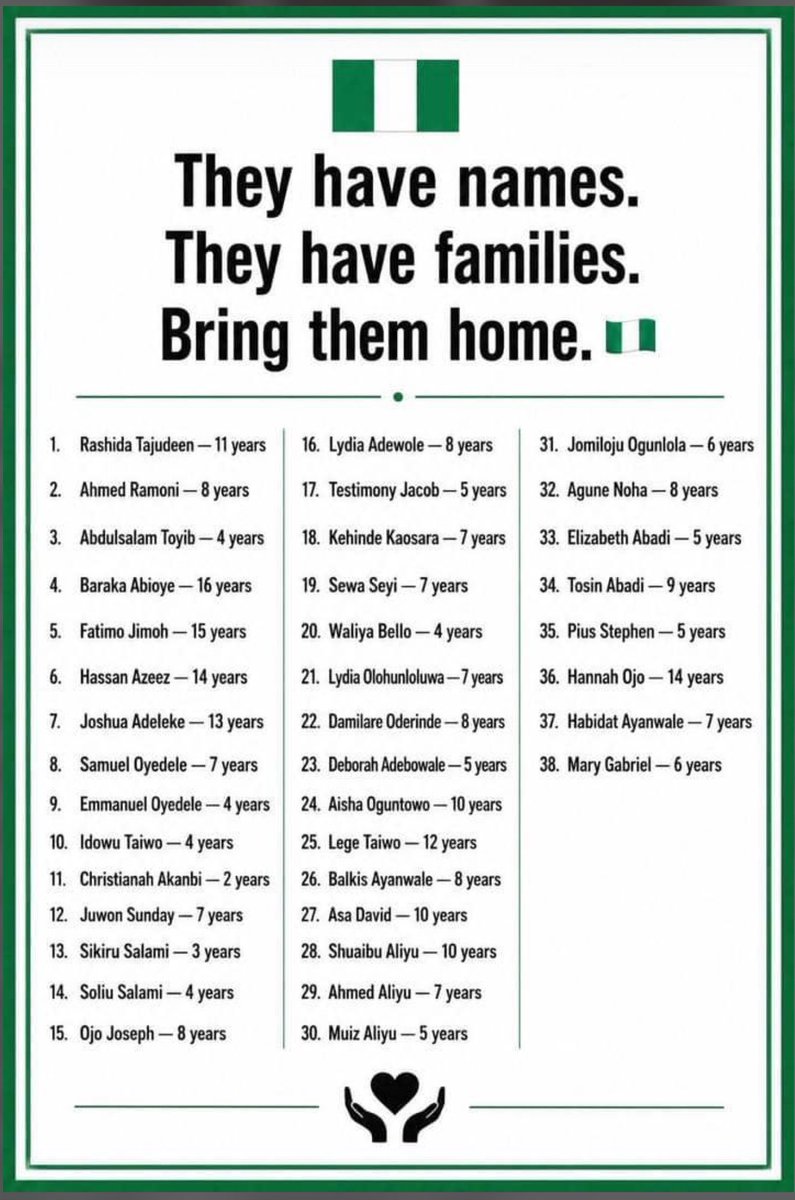
I saw the videos of the children that were kidnapped and I just shed tears.
How can a parent watch their children beaten and tortured like animals.
Anyone supporting this useless government is to be blamed.
We’ve allowed this government trample on us like ants.
It’s been days now since 46 children were kidnapped and the president is yet to address the situation but instead he’s seen in Lagos to celebrate the Eid-Mubaraq festival.
This is sad.
Today we mourn,
For those little children still held captive in the den of kidnappers whose fate is unknown.
We aren’t celebrating children’s day but we are mourning them.
They don’t know what would happen to them in the next minute.




![afcstuff's tweet photo. 🚨 Arsenal have been offered Rafael Leao (26). 🕵️♂️🇵🇹 [@garyjacob] https://t.co/V6NzgYGCug](https://pbs.twimg.com/media/HJvGuICXUAAqQKN.jpg)