May is just two days away.
If you want to be ripped by summer, you still have time.
But you have to act NOW.
Here’s the easiest way to get ripped by summer:
1. Stop eating oatmeal & nuts
A MIT professor gave a 1-hour lecture in 2019 that has 18 million views.
He died 5 months after recording it.
It was his final gift to the world.
Patrick Winston taught at MIT for 50 years.
The smartest engineers on earth sat in his classroom.
And he spent his last lecture teaching them the one skill their degrees never covered.
How to speak.
15 lessons that will change how you communicate forever:
Never open with a joke. Your audience is not ready to laugh yet. Open with a promise of what they will know by the end.
Your ideas are like your children. You are too close to them. What is obvious to you is invisible to everyone else. Explain the obvious.
The 5-minute rule: the first 5 minutes of any talk determine whether people will listen for the next 55. Spend more time on your opening than anything else.
Repeat your most important idea 3 times in 3 different ways. Once is never enough.
Build a fence around your idea. Tell people what it is NOT before you tell them what it IS.
Verbal punctuation. Pause. Let the idea land before moving to the next one.
Ask questions nobody will answer. Then wait 7 seconds. The silence is not awkward. It is processing.
Never read your slides. Your audience can read. They cannot listen and read simultaneously.
Use the board not the slides. Writing forces you to slow down. Slowing down forces clarity.
Inspire before you inform. Nobody learns from someone they are not inspired by.
End with a contribution not a summary. Tell them what you gave them. Not what you said.
Never say thank you at the end. It is weak. End with something that lands.
Stories make ideas stick. Data makes ideas understood. You need both. In that order.
The quality of your communication determines the quality of your ideas in the eyes of the world. Not the ideas themselves.
Practice is not preparation. Practice IS the skill.
Patrick Winston understood something most people spend their entire careers missing.
Your ideas are only as powerful as your ability to transfer them into someone else's mind.
You can be the smartest person in the room and be completely invisible.
Or you can master communication and make average ideas feel like breakthroughs.
He chose to spend his last lecture teaching this.
Watch it tonight.
Bookmark this first.
Follow @cyrilXBT for more lessons from the people who built the future.
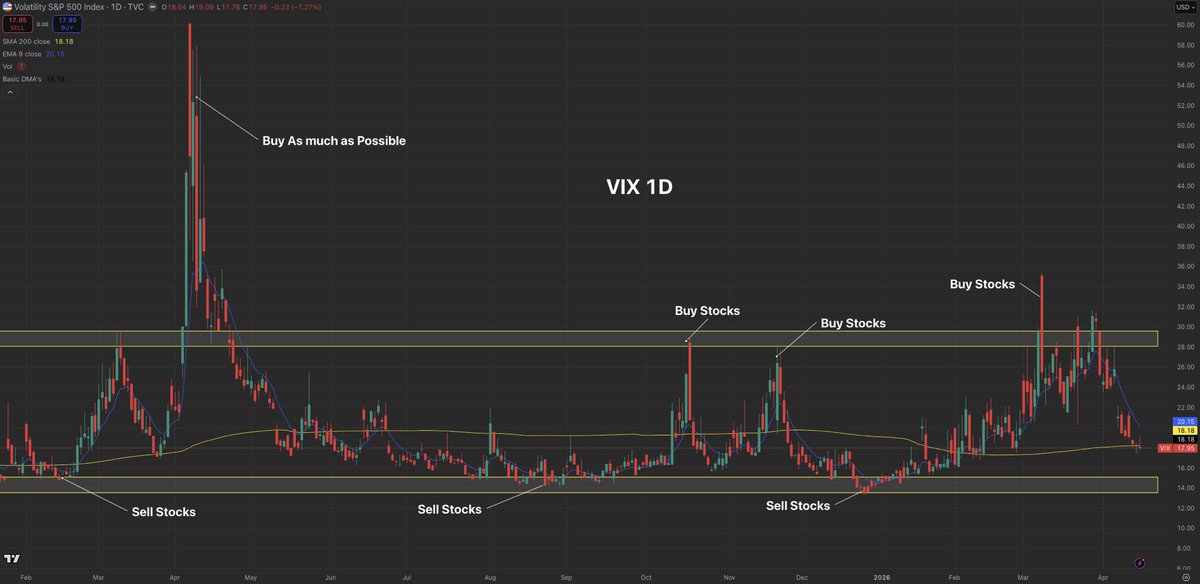
This simple rule has proven success, & guarantees your portfolio to outperform the S&P 500 year after year…
Buy stocks when $VIX is $30.
Buy ever more stocks when $VIX is above $45+
Sell stocks when $VIX hits $14.
& repeat endlessly!!
Every time you accepted a salary, chose a price, or walked into a negotiation, the other person was running GAME THEORY in their head.
You were guessing.
This 1-hour Yale lecture by Professor Ben Polak will permanently change how you read people and make decisions.
Most MBAs pay $150k to learn this. Yale posted it for free:
"CTAs are currently short $30b S&P 500. Our model suggests that at current market levels CTAs will buy $34b of S&P 500 over the next week (closing out shorts and flipping long)." - Goldman
My Macro Navigation Framework is now formalized and published as a working paper on SSRN.
A sequencing-based model for identifying economic regimes in real time.
Link: https://t.co/RhzTPVAe8i
4. Wake up at the exact same minute for 30 days straight. Not 6 AM somedays and 7 AM others. Exact. Precision in one area creates discipline everywhere else.
5. Adopt a fake identity for 30 days. Not legally. Mentally. Act as if you're already the rebuilt version. Your brain can't tell the difference between pretending and becoming.
6. Delete your most used app and replace the icon with a photo of your biggest goal. Every time you reach for distraction you see your future instead.
I guess the coins I like the most going into the new cycle are these:
1. $HYPE (perps, L1)
2. $TAO (AI, L1)
3. $NEAR (AI, L1, privacy)
4. $LIT (perps, the best bet on perps after HYPE)
5. $PUMP (memecoins, speculation)
6. $ZEC (L1, privacy)
7. $MON (new L1)
8. $MEGA (new L2)
New coins good, old coins bad. HYPE, LIT, PUMP, MON, MEGA has never been in a bull. Well, you could argue HYPE launched at the tail of the bull, but not a full cycle. TAO and NEAR are clear tokens in the AI narrative. ZEC is the "VC-privacy coin".
But tokens are not stocks, they have no value. Yes, and no. I think this is one of the hardest "dilemmas" of the new cycle. Betting on tokens in 2023 felt like a no-brainer. We all had hopes that our coins would make a comeback at some point. Now, in 2026, with an infinite number of tokens, it's harder than ever to pick something. There is a huge difference between a good product and a good token, and since most tokens are governance tokens, do we really need them? Maybe not, but it remains the main vehicle for speculation.
What about BTC, SOL, ETH? BTC should always be a part of a core portfolio, maybe SOL and ETH also, but I think the ones above will outperform compared to them.
Anyway, my gut feeling says that there will be something else that takes the spotlight, and that "the new thing" will outperform all of the 8 I listed. These are my thoughts today. Next week or next month I could already have changed my mind, so NFA and do your own research.
In retrospect, one of the easiest trades you could do over the last 3 years was $SOL. For $SOL you had plenty of time, and actually several opportunities to buy it in the low 20’s with size and 10x it.
Now what is the similar trade here that you can buy during 2026 with size, and 10x it during 2027/2028?
50 Places You NEED to See Before You Die:
1. 🇬🇷 Santorini, Greece
2. 🇯🇵 Kyoto in cherry blossom season, Japan
3. 🇮🇹 The Amalfi Coast, Italy
4. 🇦🇷🇨🇱 Patagonia, Argentina and Chile
5. 🇲🇦 The Sahara Desert at night, Morocco
6. 🇵🇪 Machu Picchu, Peru
7. 🇮🇸 The Northern Lights, Iceland
8. 🇮🇩 Bali, Indonesia
9. 🇲🇻 The Maldives
10. 🇹🇷 Cappadocia, Turkey
11. 🇧🇷 The Amazon Rainforest, Brazil
12. 🇿🇼 Victoria Falls, Zimbabwe
13. 🇦🇺 The Great Barrier Reef, Australia
14. 🇨🇦 Banff National Park, Canada
15. 🇬🇧 The Scottish Highlands
16. 🇻🇳 Ha Long Bay, Vietnam
17. 🇫🇴 The Faroe Islands
18. 🇨🇳 Zhangjiajie, China
19. 🇭🇷 Plitvice Lakes, Croatia
20. 🇳🇴 Lofoten Islands, Norway
21. 🇨🇱 Torres Del Paine, Chile
22. 🇮🇹 The Dolomites, Italy
23. 🇸🇮 Lake Bled, Slovenia
24. 🇬🇷 Meteora, Greece
25. 🇯🇴 Petra, Jordan
26. 🇯🇴 Wadi Rum, Jordan
27. 🇯🇴 The Dead Sea, Jordan
28. 🇾🇪 Socotra Island, Yemen
29. 🇨🇳 Guilin, China
30. 🇮🇩 Raja Ampat, Indonesia
31. 🇵🇹 The Azores, Portugal
32. 🇲🇬 Madagascar
33. 🇧🇹 Bhutan
34. 🌏 The Silk Road, Central Asia
35. 🇬🇪 Tbilisi, Georgia
36. 🇲🇪 Kotor, Montenegro
37. 🇭🇷 Dubrovnik, Croatia
38. 🇮🇹 Cinque Terre, Italy
39. 🇨🇭 The Swiss Alps
40. 🇩🇪 Black Forest, Germany
41. 🇷🇴 Transylvania, Romania
42. 🇦🇹 Hallstatt, Austria
43. 🇵🇹 Porto, Portugal
44. 🇪🇸 Seville, Spain
45. 🇲🇦 Marrakech, Morocco
46. 🇹🇿 Zanzibar, Tanzania
47. 🇹🇿 The Serengeti, Tanzania
48. 🇳🇦 Skeleton Coast, Namibia
49. 🇦🇶 Antarctic Peninsula
50. 🇨🇱 Easter Island, Chile
Stop panic selling on red days, learn to profit from them.
Here's the formula I use every single week:
• Market down 1% → watch closely
• Market down 2% → get ready
• Market down 3% → sell puts
• Market down 5% → buy stock
• Market down 10% → buy LEAPs aggressively
Fear = opportunity. Every single time.
A handful of things that are worth the money:
- Eight Sleep
- One $5000+ watch
- Blackout curtains
- Bamboo sheets
- Uber Black
- Home espresso machine
- 1:1 skill tutoring
- High-level masterminds
- Standing desk
- Herman Miller chair
- Specced out MacBook Pro
- Home sauna & cold plunge
- Second work phone
- AirPod Pros
- Flying your friends in
- Grass fed ribeyes
- 1:1 personal training
- The whole tab at group dinners
- Home mobility station
- The person behind you’s coffee
- Flowers for your mom and girlfriend
- Carbon steel pans
- High-quality chef’s knife
- Fresh socks every quarter
- Premium gym membership
- Luggage that doesn’t break
- Max speed WiFi
- Walking desk treadmill
- A+ talent team members
- Paid ads
- Muji pens & journals
- Maxxed out AI tools
- New running shoes often
- Sports massages
- The newest iPhone
- TSA PreCheck
- Weekly house cleaner
- Bedroom air purifier
- Personal meal prep chef
- Prescription blue light blocking glasses
- Executive assistant
- VIP tickets at music festivals
- Full bloodwork panels 3x per year
- Weekend getaways in dope Airbnbs
- Weekly date nights
- Tax strategist
“Mate, how can you understand capital rotation? Do you have any tips or framework to follow?"
Ok guys, let’s break down one of the most important (and most ignored) concepts in trading in 4 steps. (❗️Another share of brutal value below❗️)
Disclaimer: this is not about predicting markets.
It’s about understanding how money may move.
(Yes, long post again. Same rules, only for those who want to learn and grow, the rest will skip it as always)
🔸 1st step -> What capital rotation actually is (risk on/off)
Markets are not random as capital is constantly moving between asset classes:
• Equities/crypto (risk)
• Bonds (safety)
• Currencies (liquidity)
• Commodities (inflation)
Big money is always reallocating.
So instead of asking: “Is this bullish or bearish?" I ask myself: “Where is capital flowing right now?”
Because that’s what drives trends.
Markets, as you know, operate in 2 main regimes:
• Risk-on → capital seeks returns
• Risk-off → capital seeks protection
🔍General "clues":
Risk-on:
- Equities trending higher
- Weak USD
- Strong crypto / growth
- Cyclicals outperform defensives
- Small caps outperform large caps
- Bond prices down / yields up
- Liquidity expanding (QE for example)
- Real yields falling
Risk-off:
- Strong USD
- Bonds bid
- Equities weak
- Gold rising
- Liquidity tightening (QT)
- Real yields rising
If you misread this → you’re fighting the environment.
This becomes the primary requirement in order to build a macro thesis and elaborating on specific sectors.
🔸 2nd step -> Intermarket analysis
When I built up an investment thesis I go for IMA as markets tend to confirm each other..nothing moves in isolation.
As we saw before, we have a "general outlook", right?
• Rising yields → pressure on equities
• Strong dollar → risk assets struggle
• Bond rallies → defensive positioning
When markets align → higher probability
When they diverge → lower conviction
This is how you can build context.
However, intermarket can and must be extended within specific sectors to gauge their relative strength/weakness in order to have a broader perspective.
How to?
With the use of synthetic indexes: https://t.co/8i7troUv8O
⭕️Example:
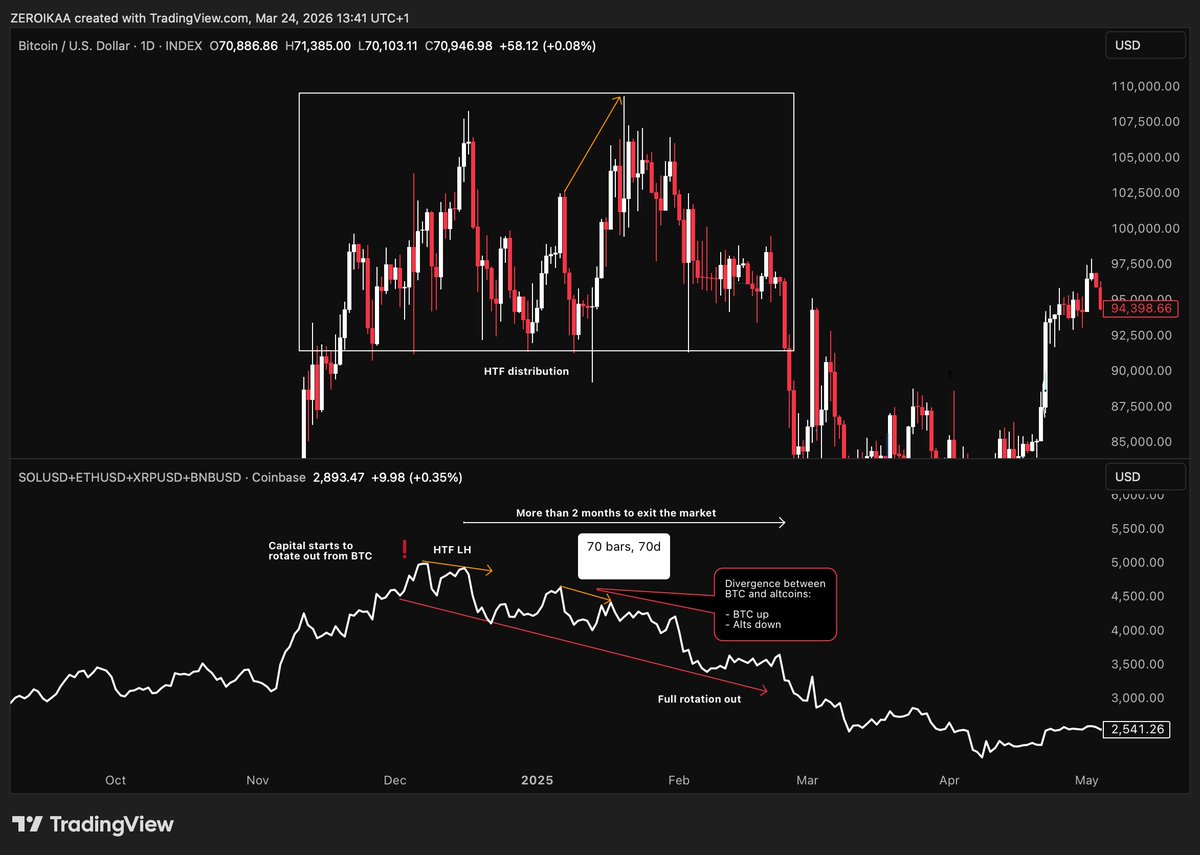
In the chart you find out at the bottom, I compared $BTC and a synthetic index made with: SOLUSD + XRPUSD + ETHUSD + BNBUSD.
Why those altcoins? Because they're the "top caps", very well capitalized, and act as reference to understand where capital is rotating.
The distributive range developed on $BTC between late November 2024/late February 2024, even to an "untrained" eye, could have been spotted through the use IMA by observing the behavior of the synthetic index.
In fact, when $BTC was distributing, the index was producing the first HTF LH, signaling a rotation out from the crypto market..why?
Because more speculative assets (and less liquid) experience stronger inflows or outflows and tend to anticipate $BTC movements.
--------------------------------------------------------
Core "extras" to complete this part:
🟡 IMA explanation -> https://t.co/6V9m7XxvBK
🟡 Video explanation -> https://t.co/H3XYoyfufC
🔸 3rd step -> COT
Now we start adding the positioning of those who matter.
COT (released every week) answers:
“How is capital positioned within this flow?”
Not the direction (this is something you have to figure it out on your own with intuition + PA) but positioning.
It shows:
• Who is long
• Who is short
• Where trades are crowded
COT splits the market into:
• Commercials (hedgers)
• Non-commercials (speculators)
• Retail
⭕️The key idea is that speculators follow trends while commercials tend to fade extremes.
So now you can combine flow (IMA) + positioning (COT) and that’s where things get interesting.
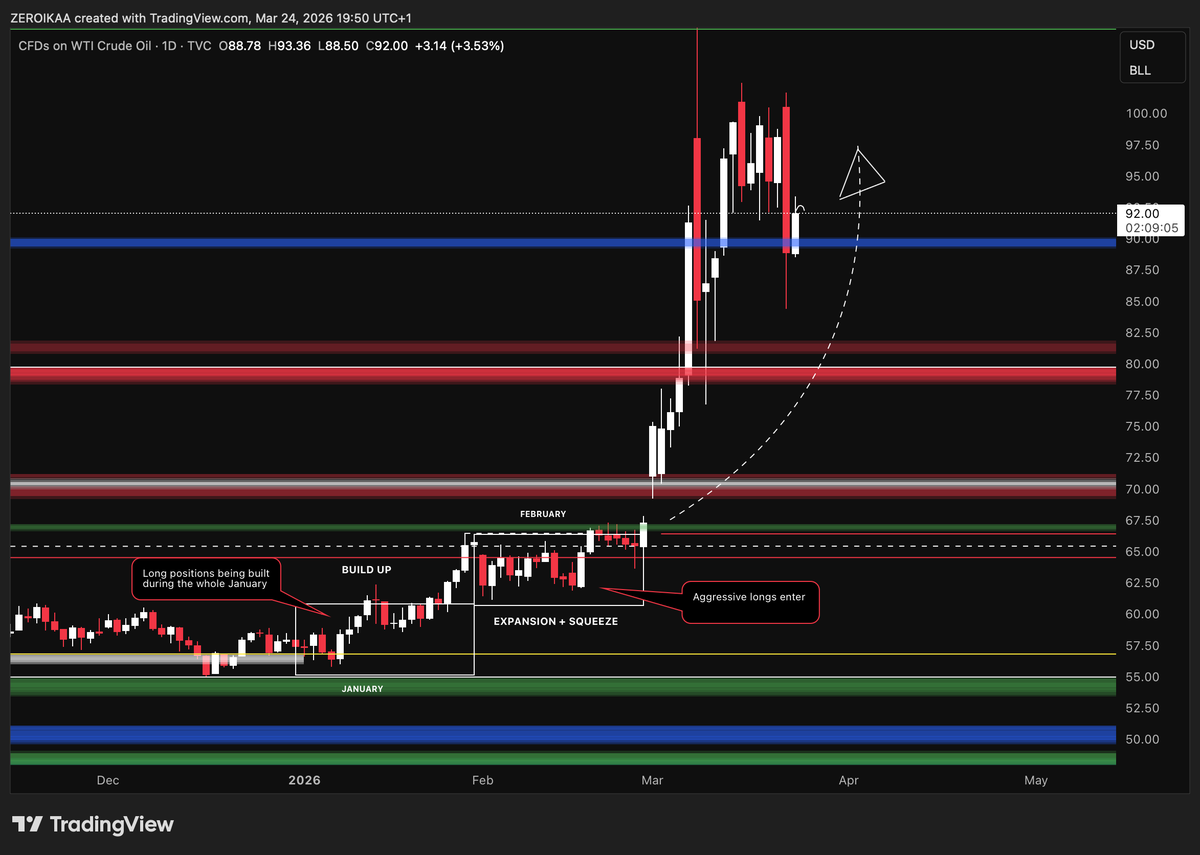
⭕️Example:
Take a look at the USOIL chart where the bias, due to liquidity dynamics, price action and fundamentals -> https://t.co/0zU2kLPSuz was bullish.
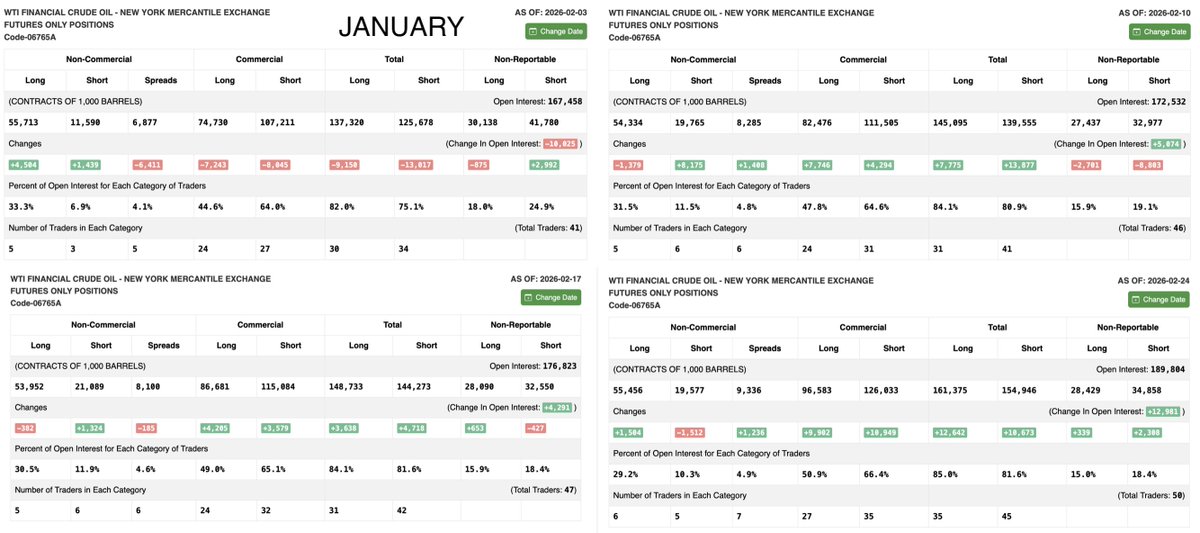
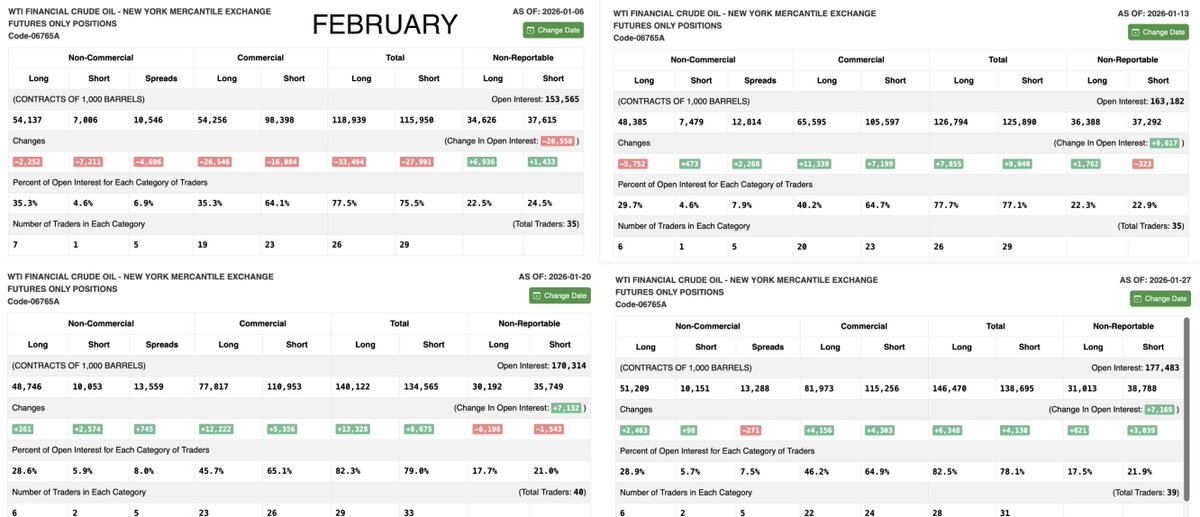
Now put your eyes on the 2 rectangles where you read "build up" + "expansion/squeeze" having a look into the COT reports of the whole January + February.
On January 6, we saw a massive drop in Open Interest which was a clear liquidity reset that wiped out positioning.
Then on January 13 and 20, OI started to expand again with broad participation, and this is key as the market was building positioning, but not moving yet. (check longs being added)
Moving into February, on February 3 we got a brief pullback, but then something important changed.
From February 10 onward, the market started to add longs, while shorts were still stepping in.
By February 17, positioning was stretched, and on February 24, OI expanded sharply with longs pushing and shorts getting forced out, triggering the breakout.
When longs keep building for a lot of time and shorts keep fading the move, you create fuel and pressure ⛽️ in the same system.
In this way, you could have be positioned together with institutions.
❗️Important note:
As the COT report is being released every week, you need to constantly keep track of the positioning, elaborating a thesis with the delta provided step by step.
🔸 4th step -> How to use it + execution
This is NOT an entry system.
You use it to:
- Build bias
- Stay positioned
- Avoid potential bad trades
- Identify stretched markets
Then you refine with:
- Your entry models
- Price action
- Liquidity
- Structure
That’s your execution layer, you don't long/short just based on COT/IMA.
👉We can summarize my process in this way:
- Understanding capital flow/building thesis (risk on-risk off)
- Confirming with intermarket
- Checking positioning (COT)
- Finding the setup based on entry models and AMT -> https://t.co/D9GLAYjotw
- Executing
If everything aligns → I engage with more confidence
If not → I wait a little bit more/stay cautious
I believe that most people just watch candles but very few watch flows and how to be aligned with smart money.
As always, if you found this helpful, the like and repost buttons are just a few centimeters below.
Follow this 35-rule blueprint to live a happy and fulfilled life:
- Find your true purpose (follow your passion)
- Workout at least 3/4 times x week
- Eat well and reduce alcohol
- Produce more than you consume
- Invest more than you spend (acquire assets, skip liabilities)
- Learn continuosly new things
- Take risks (especially if you're young)
- Surround yourself with high quality people
- Cut off negative people immediately
- Do hard things regularly to lean into discomfort
- Spend more time in nature
- Spend less time on social media (and understand that most things you see are fake)
- Never compare yourself to others (only as inspiration)
- Be grateful for what you have while keep pushing
- Be patient and think long term
- Take ownership of your life (no excuses, no blame)
- Set boundaries (learn to say no, protect time and energy)
- Invest in relationships
- Call your loved ones more often
- Spend more time alone (reflecting, clearing you mind)
- Enjoy the process, not only the outcome
- Always be kind to others (learn to give without expecting anything in returns)
- Skip revenge (people with bad hearts will sabotage themselves)
- Show more empathy
- Accept that suffering is part of the path (it’s your turn, just as it was for those before you -> don’t take it personally, use it)
- Learn from your mistakes (they don't define you)
- Always stay humble because what god gives you, he can also take it away in an instant
- Speak more, ask more (you'll be surprised to see how many opportunities unfold just because you have the courage to ask)
- Choose your life partner carefully (this decision shapes most of your life)
- Put more effort when things get hard, not when they get easier
- Avoid gossip and pointless drama
- Practice saying less and observing more
- Leave things better than you found them (people, places, situations..)
- Never chase validation
- Accept that not everyone will like you independently of what you do for them