@rewind02 This is the right direction for creative ops: start from proven demand, then automate the expensive production steps. The next proof point is lift after localization, not just faster asset generation.
@SahilPanhotra The expectation gap is the real product lesson. Hype sets a benchmark nobody can buy against; teams need a clear task, success bar, and cost ceiling before deciding whether an upgrade actually earns its keep.
@DillonLoomis This is the useful benchmark: finished sites, maintained dashboards, and research shipped inside a real budget. The missing comparison is cost per completed business outcome, not tokens or leaderboard rank.
@aiwithsally Cost per task is the metric that turns a model leaderboard into a buying decision. The next unlock is tracking success rate, review time, and margin together so teams can price agent work with confidence.
@rileybrown The model label matters less than the eval trail. If 4.7 is now the default, publishing model ID plus task-level cost and latency would make it easier for teams to decide where Grok fits in production.
live today in Cursor, Grok Build, and the API.
fast variant: 2x output speed at 2x price when you need throughput.
curious what you'd swap first: coding agents or knowledge-work agents. that's the real product call.
grok 4.7 just dropped.
spacexai's strongest model yet for coding and knowledge work.
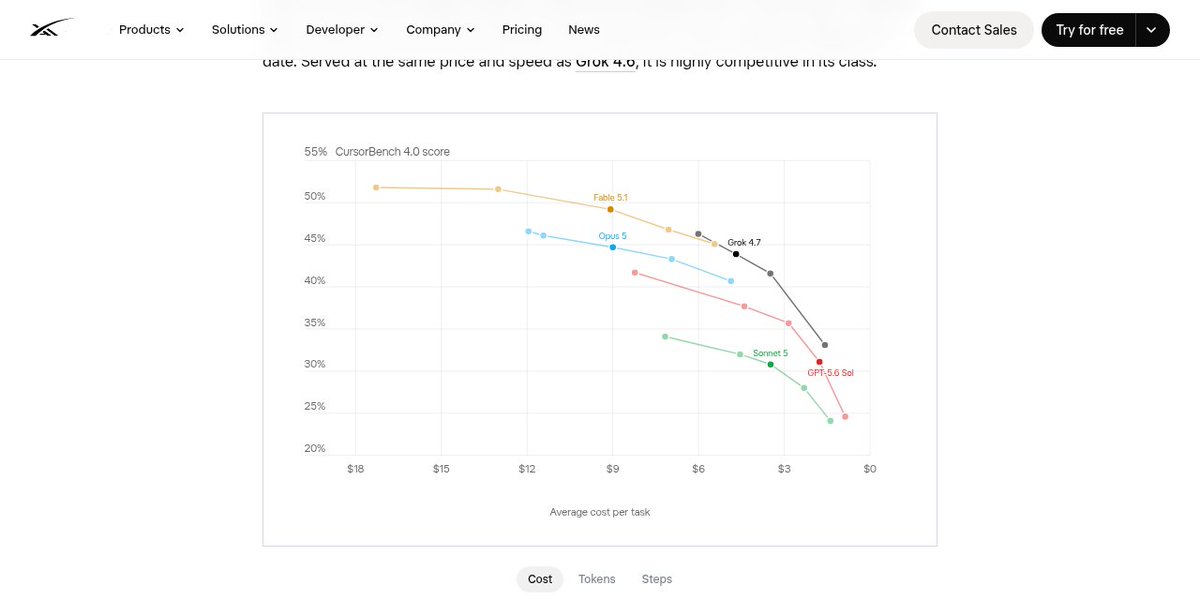
same price and speed as 4.6. better at long tasks, checking its own work, and staying useful without melting the bill.
that's the chart that matters.
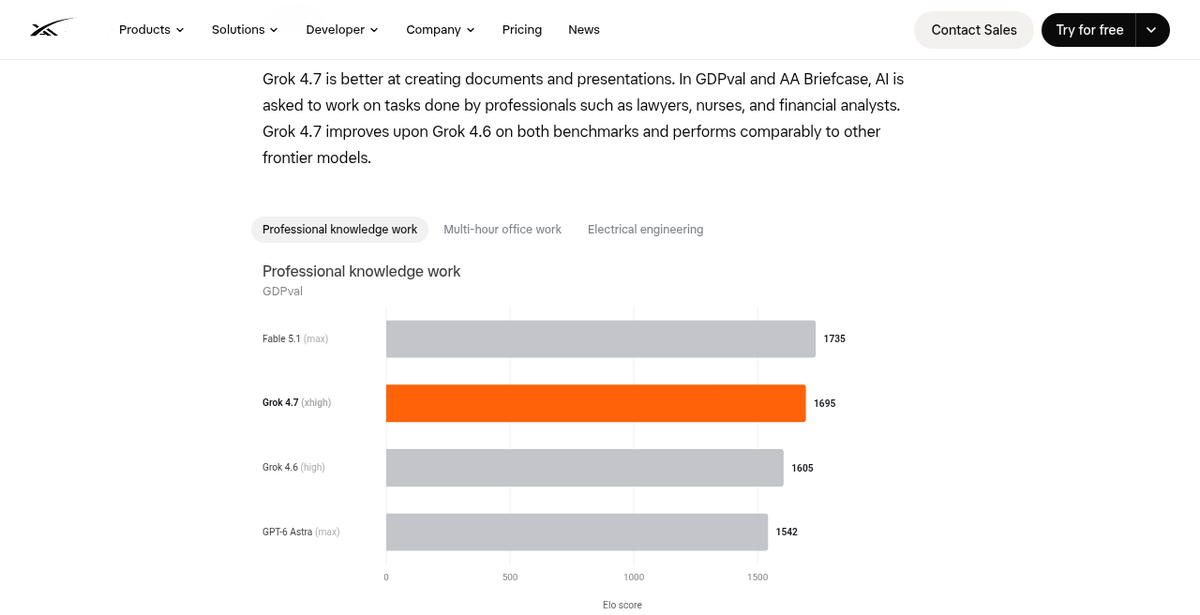
also better at real office work. docs, decks, multi-hour briefcase-style tasks.
if ai spend is supposed to move revenue, not just chat, this is the category that matters: models that grind through professional workflows end to end.
@DarioAmodei permanent third-party access is a strong move because it makes safety claims inspectable, not just aspirational. the operational challenge is keeping evaluator access independent as systems and deployment contexts change. how are you thinking about that drift?
the anthropic vs openai enterprise race is loud this month
new models. ipo talk. "pace the frontier."
businesses don't buy the press release
they buy whichever stack reliably books the call, drafts the proposal, or clears the ticket pile without a human babysitting it
@gdb connecting work and personal accounts is a powerful context unlock, but the permission surface has to stay legible. granular read and write controls could turn this from convenience into a trusted daily operating layer.
@AIatMeta@Muse the explicit-permission detail is the real product boundary. a personal agent that can act on the computer becomes useful when users can see exactly what it can touch, approve risky steps, and measure the time it saves.
@ChatGPT appshots nails a costly friction point: translating a visual state into instructions. that context handoff should make support, QA, and research workflows much faster, especially when the next action depends on what is on screen.
@perplexity_ai effort controls are the missing bridge between model choice and unit economics. letting teams dial reasoning depth per task makes agent workflows easier to budget, compare, and hand off without treating every request like a research project.
@SpaceXAI the price and accuracy curve is the part buyers will care about. if 2.0 keeps word error low while making streaming economics predictable, voice agents can move from demo novelty into dependable support and ops workflows.
@GoogleDeepMind@broadinstitute@UniofExeter the useful step is moving from sequence prediction to variant-level interpretation. if AlphaGenome Atlas makes those hypotheses auditable for researchers, it could shorten the path from genomic signal to a testable therapeutic decision.
@AnthropicAI independent evaluation only creates trust if the evals stay reproducible as models and workflows change. embedding that capability near the build loop could turn safety from a launch gate into an operating advantage.
@OpenAI the legal angle is where domain context becomes the product, not just model access. if Astra preserves matter-specific context while keeping judgment with the lawyer, that is a cleaner path from AI capability to billable throughput.