Within 10 days, parts of the global economy will start running short of critical goods
After 30 years studying economic sanctions and blockades, I don’t say this lightly:
--Not just higher prices
--Shortages.
Markets are not ready for this
THE FIRST CLOUD INFRASTRUCTURE CASUALTY OF WAR
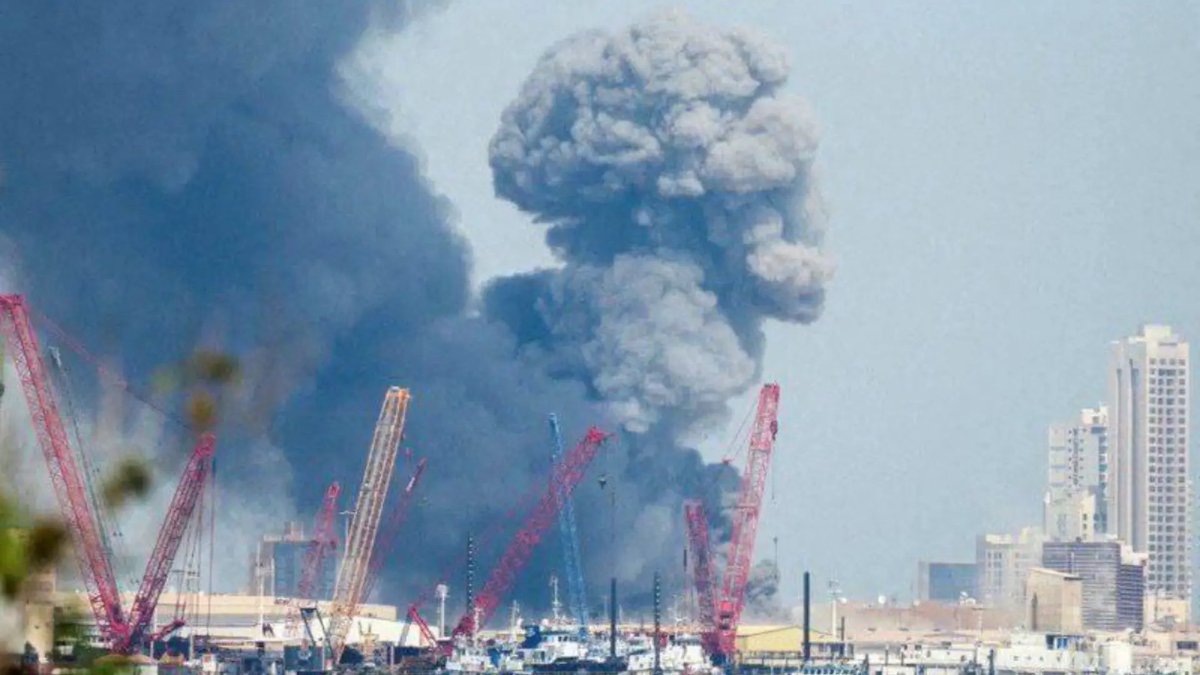
An Amazon Web Services data center in the UAE just got hit.
AWS confirmed that at approximately 4:30 AM PST on March 1, “objects struck” the facility in availability zone mec1-az2, creating sparks and igniting a fire. The UAE fire department cut power to the building. The zone went dark. AWS says other zones remain operational and restoration will take several hours.
Read that sentence again. “Objects struck.”
The most valuable corporate infrastructure on earth is now absorbing kinetic damage from a state-level military conflict, and the world’s largest cloud provider is describing missile or drone debris as “objects” because no corporate communications playbook exists for this scenario.
This is the first time in history that a major hyperscaler data center has been physically struck during a war.
Every cloud architecture slide deck in every boardroom on earth assumes physical security means perimeter fences and biometric locks. Not ballistic missile defense. Not drone intercept capability. Not wartime fire suppression while the building next door absorbs ordnance.
The Jerusalem Post reported the facility was used by Israel’s military. If confirmed, Iranian targeting of dual-use cloud infrastructure transforms every data center in a conflict-adjacent geography from civilian asset to military target. The distinction between cloud infrastructure and defense infrastructure just collapsed.
And the geography matters enormously. AWS chose the UAE for its Middle East region precisely because Dubai and Abu Dhabi offered stability, connectivity, and proximity to enterprise clients across the Gulf. That thesis died on a Saturday morning when Iranian drones struck the Burj Al Arab, hit Jebel Ali port, and set fire to a data center running workloads for governments, banks, and military operations simultaneously.
The concentration risk is staggering. AWS, Microsoft Azure, and Google Cloud all operate Middle East regions clustered in the same geographic corridor that just became an active theater of war. Oracle has infrastructure in Dubai. Every enterprise running production workloads in these regions is now calculating disaster recovery scenarios that were categorized as “theoretical” 72 hours ago.
The insurance implications alone will restructure cloud pricing for a decade. Lloyd’s of London was already reassessing war-risk exclusions after Ukraine. Now a drone has physically damaged a data center belonging to a $2 trillion company in a country that markets itself as the safest business hub in the region.
AWS built multi-availability-zone redundancy for earthquakes, power failures, and network partitions. Not for Iranian retaliation against a joint US-Israeli military campaign. The architecture held because one zone went down while others stayed up. But the premise broke: that geography selection for cloud regions is a business decision, not a wartime calculation.
Cybersecurity expert Lukasz Olejnik flagged the euphemistic language immediately. AWS did not say “bombed.” AWS said “objects struck.” That linguistic gap is the entire story. The world’s cloud infrastructure just entered the theater of war and the industry has no vocabulary for it yet.
The vocabulary will be priced in by Monday.
https://t.co/BrzGRrU3VW
This is absolutely terrifying. This is the chair of the Federal Reserve telling the American people they cannot trust the current administration and that fed rates will essentially just be made up numbers based on NOTHING by the regime.
They’re gonna tank the economy on purpose
Every factory on earth, except those located in the United States, can get the inputs they need from China, without paying an additional 145 percent markup.
Supply chains are like refrigerators.
Everyone needs them.
No one knows how they work.
1. Air freight will not solve this. It’s too expensive and there isn’t enough capacity in planes to replace boats, which move more goods by cubic volume.
2. You also cannot solve this the way the world did with Russian oil.
Unless, the U.S. Customs starts encouraging major customs fraud and allowing everyone to relabel their Chinese goods as Korean, Japanese, Taiwanese, and Vietnamese (the other nearby port countries), this product cannot come here. There will be massive amounts of cheating, more than ever, but we cannot solve this through rerouting.
3. This is not just about empty shelves and it’s not solved by buffer inventory.
It’s also about jobs, jobs in warehouses, jobs in the port, jobs in trucking and logistics, and jobs in purchasing.
And trust me, it doesn’t matter what your buffer is, you will go out stock because some products always sell more than forecast.
Final thoughts:
When Trump was first elected, I sent my resume to 3 connected people in the hope that I might be able to assist the administration and, more importantly, the country.
The responses I got ranged from silence to “get out of here, no way.”
I’m politically independent and spoke to the Biden administration when I had an opportunity, but this administration is not (yet?) listening.
It’s been odd to see them attempt goals that I support (bringing manufacturing back and American economic revitalization), but do so in a counterproductive way.
And now I am close to having lost all hope that these goals can be achieved in a way that benefits us, Americans.
We will see what happens…
The White House has put itself and the country in a bad situation but doesn’t realize it yet.
Around April 10th China to USA trade shut down.
It takes ~30 days for containers to go from China to LA.
45 to Houston by sea, 45 to Chicago by train.
55 to New York by sea.
That means that there are no economic effects of what was done on April 10th until about May 10th.
Around that time (it’s already started to happen) trucking work is going to dry up. Warehouses will start doing layoffs because no labor is needed to unload containers and some products will be out of stock, reducing the need for shipping labor.
All this will start in the Los Angeles area.
After about 2 weeks, it’ll start hitting Chicago and Houston.
Let’s say the White House, after 3 weeks, changes its mind, on May 31st.
“This isn’t working out like we thought it would. Tariffs back to 0.”
Let’s say China says “bygones be bygones, we’ll go back to how things were”.
Let’s say every factory in China that got screwed by their orders being cancelled says the same thing “no problem, we’ll make and ship”.
The problem is, even under the most favorable conditions of China and the factories restarting economic ties as though nothing happened, it will be at least another 30 days before economic activity is revived.
And that’s just in LA.
In Chicago/Houston, you’ll need to wait another 45 days.
New York, at that point, will still be getting containers from before April 10th, they will then have 50 days (May 31 minus April 10) of zero economic activity at the ports, in trucking of Chinese goods, in warehousing.
The whole situation is a bit like lockdowns. Once you shut down, it takes a long time to get economic activity back to where it was, if you ever can.
And again, this assumes, that China and its factories, which make things you can’t buy elsewhere, will start right back up again as though nothing happened, which is unlikely.
It’s almost like we’re speeding towards a brick wall but the driver of the car doesn’t see it yet.
By the time he does, it’ll be too late to hit the brakes.
Can’t sleep…
Thinking about how it takes ~25 days for shipping containers to go from China to LA and ~35 days to New York.
We haven’t even felt the impact yet.
There are increasing signs that the Embargo by the new admin is starting to have real economic consequences.
Container bookings have collapsed, ports are seeing reduced activity, trucking is decelerating, and retailers say in a few weeks store shelves will be empty.
Thread.
People looking only at the stock market are missing the full magnitude of Trump's economic incompetence. His "yes-no-maybe" idiocy with tariffs is leaving equity investors with no sense of which way to go. But worse is the bond market..../1
We really did it.
We took a growing US manufacturing economy, declared it broken, started a trade war, and ... broke US manufacturing.
In last 48 hours:
- Philly Fed Survey: "New orders fell sharply, from 8.7 in March to -34.2, its lowest reading since April 2020"
- NY Fed Survey: Expected orders and shipments plunging
Again, this is a policy to revive US manufacturing.
Over the past decade, growth in sub-Saharan Africa's resource-intensive countries has sharply slowed, falling below that of non-resource-intensive nations. Check out IMF Country Focus to learn what's behind this divergence and how to reignite growth. https://t.co/hLzGDZi6d9
Global growth will likely remain steady at 3.3% this year and next, but with divergences between countries. Inflation is declining, with global rates expected to fall to 4.2% this year and 3.5% in 2026, nearing central bank targets. More in this blog:
https://t.co/JqhpXVC8de
The price of crude oil has risen ~10% this week to around $78 a barrel as the conflict across the Middle East has intensified.
Read more on BBC: https://t.co/rev8rcTYLU
#Oil#Crudeoil#Energy#Commodities#Trading
For those who do not understand what just happened:
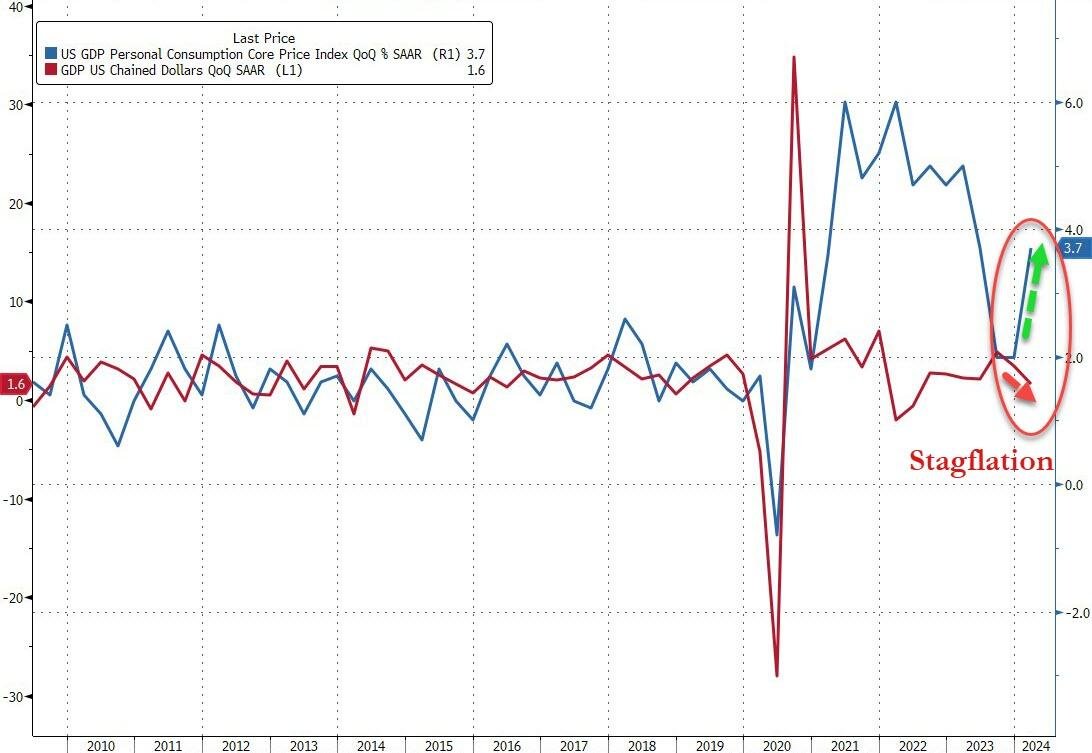
First, Q1 2024 GDP growth slowed to just 1.6% which is less than HALF of the 3.4% Q4 2023 number.
This reading is roughly 50% BELOW Goldman Sach's expectations.
But it gets even worse.
At the same time, the US Core PCE Price Index soared from 2.0% to a staggering 3.7%.
This crushed estimates of 3.4% and further suggests that inflation is on the rise.
We have a weakening economy with rising inflation.
The worst possible outcome for the Fed.
A state is a social organisation, internally stratified born out of agriculture surplus specialisation. In time, states compete until empires are born. If state building is a social technology not easily transferable then all "real" empires are meant to rise in dark green areas.