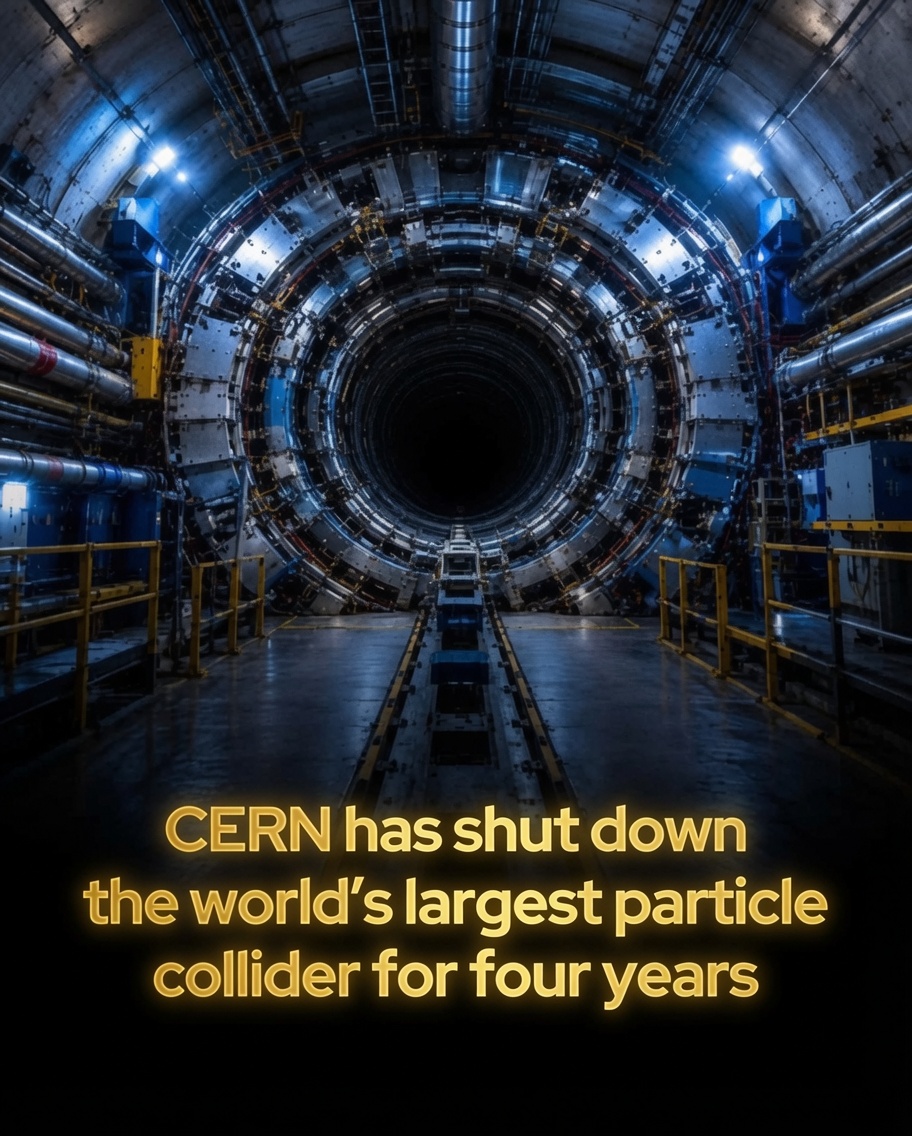
CERN has officially powered down the worlds largest particle collider.
The Large Hadron Collider known as the LHC is a 17 mile or 27 kilometer underground ring near Geneva Switzerland. It accelerates particles to nearly the speed of light and collides them. In 2012 this facility enabled scientists to discover the Higgs boson. This particle relates to the field responsible for giving mass to other particles.
The machine has now entered what CERN calls Long Shutdown 3. It is scheduled to resume operations around 2030 as the High Luminosity Large Hadron Collider.
The primary aim of this upgrade is not to enlarge the collider significantly. Instead it focuses on improving the machines ability to generate high quality data.
In particle physics luminosity measures the rate of particle collisions over time. Higher luminosity increases opportunities to detect rare phenomena that may point to new physics beyond current understanding.
Currently the LHC detectors record about 60 proton proton collisions per bunch crossing. Following the upgrade this figure is expected to increase to between 140 and 200.
Throughout its operational life the upgraded collider could generate approximately 380 million Higgs bosons. This represents a substantial rise from the roughly 55 million produced since the LHC began operations.
A key objective involves detecting rare events where two Higgs bosons are created simultaneously. Such observations could provide deeper insights into the behavior of the Higgs field and offer information about conditions in the early universe following the Big Bang.
The project includes replacing major detector components installing advanced timing systems and upgrading roughly 0.75 miles or 1.2 kilometers of magnets and other infrastructure within the LHC.
CERN has confirmed that this work poses no risk of destroying the universe. Natural cosmic rays produce far more energetic collisions than those at the LHC. These rays have bombarded Earth and objects in space for billions of years without incident.
PlayStation is ending production of physical game discs for all new games, starting January 2028.
From that date, new games will be available in digital formats only.