@rgraucrespo @LatinXChem These basis sets are also tailored towards giving a better represetation of the inner shells such as s orbitals so that it accurately describes the Fermi Contact (FC) interaction which is the major component of HFC.
@rgraucrespo @LatinXChem Thanks for the question! While in this set of qubits studied the relativistic effects are not as impactful as in heavier transition metals they do have a weight over Spin-Orbit Coupling (SOC) which comprises a 5-10% of the overall HFC value for our first row transition metals.
@EvaBlokker@ESOR2021online@DIPCehu@AbelCozar We found that the product from H abstraction compared to the other analogues is more stabilized than the others and right now we are currently working on understanding better this phenomena.
Thank you for your question!
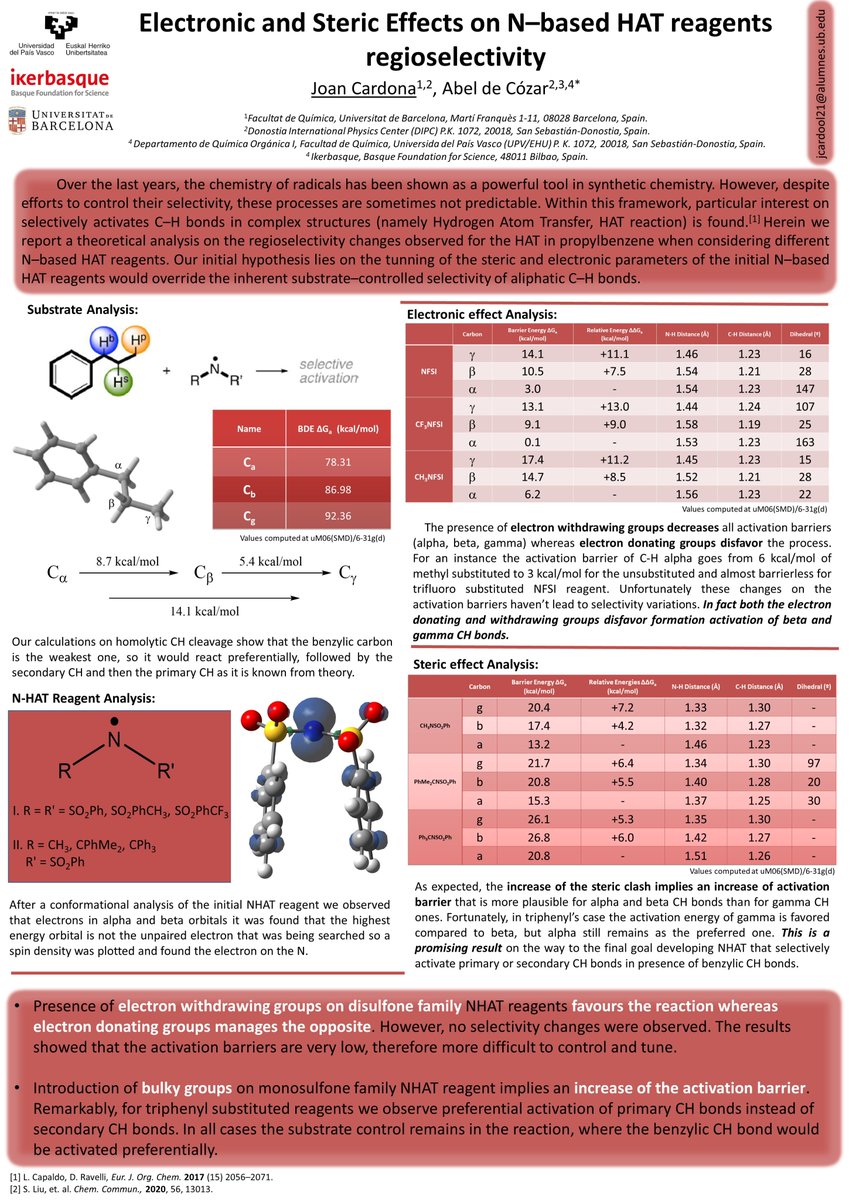
Hi @ESOR2021online , do you think it would be possible to enhance the selectivity of radicals?, check out my work 'Electronic and Steric Effects on N–based HAT reagents regioselectivity' to find some insights, #ESOR2021poster@DIPCehu@abelcozar
@EvaBlokker@ESOR2021online@DIPCehu@AbelCozar They are located on the para position of the phenyl rings, to avoid any interferences that would come from steric repulsion done by this groups.
@TrevorAHamlin@ESOR2021online@DIPCehu@AbelCozar The H abstraction process is endothermic, hence why formation of benzylic radical stabilized by conjugation is heavily favored. (Product-like TS)
Thank you for your question!
@ChrisSlootweg@ESOR2021online@DIPCehu@AbelCozar It is more likely that you will obtain a mixture of products. In that case I would go for an alkylated sulfonamide that would be more selective. I would not recommend to start with this one initially as it would need to be synthesized previously.
@Trujillo_Group @LatinXChem@dipc@AbelCozar Los procesos son ligeramente endotérmicos (Se supone que la 'driving force' de la reacción es el paso siguiente de atrapar el radical). Los calculos estan hechos con smd usando CH3CN. Muchas gracias por las preguntas!
Hi @LatinXChem, do you think it would be possible to enhance the regioselectivity of radicals?, check out my work 'Electronic and Steric Effects on N–based HAT reagents regioselectivity' to find some insights, #LatinXChem#LXChemComp#Comp102@DIPC@abelcozar
@Trujillo_Group @LatinXChem@dipc@AbelCozar Hemos analizado los estados de transición con distintos angulos dihedros para observar el efecto estérico en detalle y hemos visto que la molecula se dispone de tal manera que el enlace S=O esta eclipsada con el N-H en formación.
@Trujillo_Group @LatinXChem@dipc@AbelCozar Hola Cristina! Los grupos electronegativos ejercen una estabilización sobre el radical Nitrogeno por conjugación pero a su vez aumentan su 'hidrogenofilia', es decir, la avidez por atrapar un H.
@Trujillo_Group @LatinXChem@dipc@AbelCozar Por otro lado hemos visto que la abstracción de H esta asistida por el S=O por lo que los efectos estericos quedan compensados.