@MrrrOzi@IEEEorg@ieeeiros@nvidia The patient is the patient, and surgery is a practice. To make progress, to test new skills or techniques, has required deployment of unvetted but promising interventions and rigorously scrutinizing results. The bar is high, but so are costs. Digital Twins would be transformative
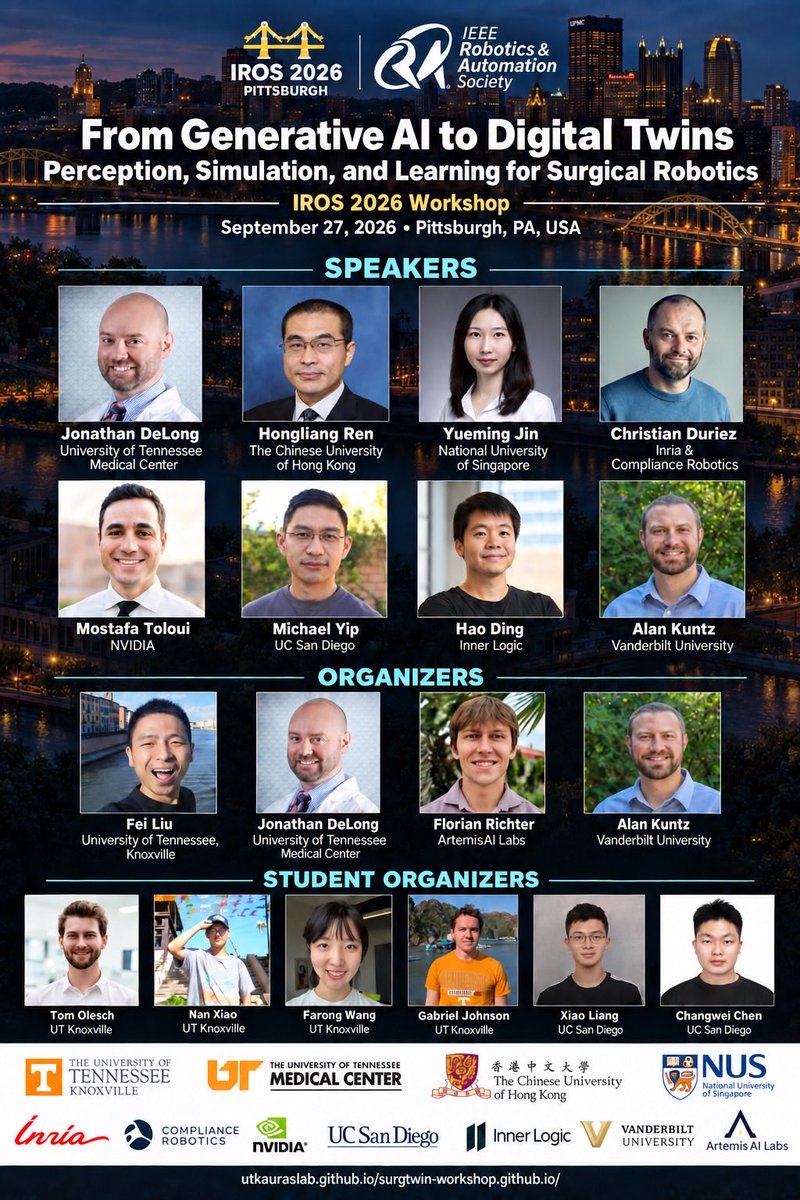
If you are at #IROS2026 in Pittsburgh please consider joining our workshop TOMORROW, September 27, from 1:00 PM - 5:30 PM where I will be joining an extraordinary lineup of speakers to discuss how we move from Generative AI to Digital Twins in Surgery!
@IEEEorg@ieeeiros@nvidia
@MrrrOzi@IEEEorg@ieeeiros@nvidia Do the right thing for the patient, always. That may include implementing tools that fundamentally change preparedness, safety, decision-making, and skill in ways not previously possible or imagined. If this is done, we have to get it right—there is no other option.
@rbarbosa91@Cody_Mullens@JAMASurgery Whose learning curve? What about new surgeons learning surgery? Is it easier to pick up laparoscopic or robotic? What do the ethics become when considering what this question looks like in 5, 10, 15 years? If the problem is cost, how can we make it cheaper?
@DrDiGiorgio@aribindi This is disingenuous.
Access to standard of care, evidence-based, primary prevention, health maintenance, and routine cancer treatments covered under traditional insurance plans is not the same as suggesting universal access to heroic measures.
You lost the plot.
@PipeCabreraV@SWexner@pferrada1@TomVargheseJr@BJSAcademy@juliomayol@CiruAndes2 Also, if you “pitch and catch” (ie throw with the needle driver & catch the needle tip w/ the Addison’s to finish the throw) then move forceps toward the contralateral side, the tension from the suture tail will spin the needle into position to reload w/ better economy of motion
@PipeCabreraV@SWexner@pferrada1@TomVargheseJr@BJSAcademy@juliomayol@CiruAndes2 If you want to do a little spin, I certainly won’t stop you, but the purpose is to prevent memory build-up in a running suture. I see some spin on each side of the incision—ie 2x per travel—which builds up memory in the opposite direction & is essentially like not spinning at all
@ZhiVenFongMD I wonder if some of this is not really about IOC itself, which has been debated from the beginning, but rather an effort to prepare for later: if surgeons are going to be increasingly expected to do duct stuff (LCBDE), then IOC’s are the first step in starting to get that comfort
🚨 Very excited to have published this Surgical Clerkship Guide for Medical Students with insights from residents and staff at the Mayo Clinic! Thank you to all those who helped 🙌 @AndrewDVogel@JohnTreffalls@JabaayMa@ACOS_MSS
https://t.co/7DLkljU4I8
How is that even possible??
There has to be more to the story??
Doctor faces manslaughter charge for allegedly removing wrong organ during surgery https://t.co/XFJoHQKxPW
@Wisbaum_PharmD I just read that! Additionally, early studies didn’t distinguish between different cephalosporins, many (most?) of which do have cross-reactivity to varying degrees.
@Fringe_Centrist Exactly. Allergic reactions to these antibiotics are *usually* triggered by the R1 side chain, not the beta-lactam ring (which was previously assumed). Most cephalosporins have an R1 side chain that is structurally similar to penicillin. Cefazolin (Ancef)’s is unique.