Our new paper led by Ji Chen (@INM7_ML_Psy) now out in Biological Psychiatry
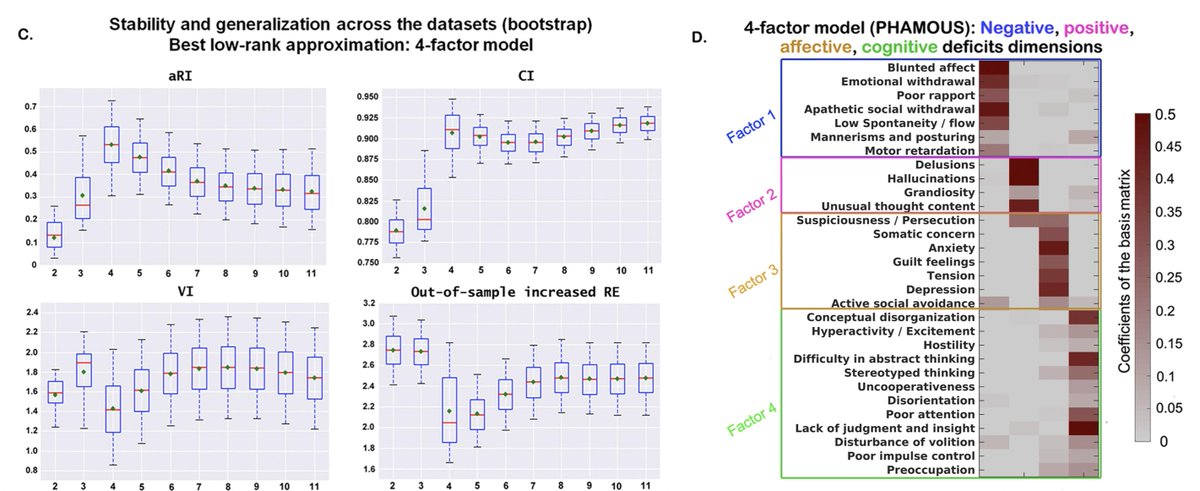
We here propose an well-interpretable, dimensional representation of #schizophrenia psychopathology; extensively cross-validated in ~2000 patients across Europe, Asia & the US
https://t.co/CltKLT0K8X
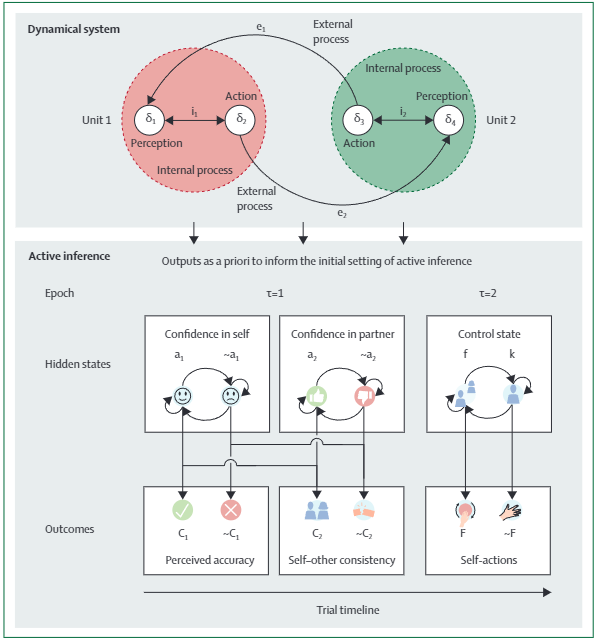
Exciting that interpersonal computational psychiatry offers an explanation for how biased cognitive processes lead to differential negative symptoms, @dr_rick_adams. Thanks @TheLancetPsych and colleagues. Might be interesting alternative to a data-driven view!?! @INM7_ISN@bttyeo
We propose an interpersonal computational framework that (1) leverages the active inference framework to model aberrant social coordination and (2) incorporates dynamical system models to dissect intrapersonal and interpersonal synchronisation to inform a statistical model.
Sampling inequalities affect generalization of neuroimaging-based diagnostic classifiers in psychiatry - BMC Medicine - BMC Medicine https://t.co/MEUlpiWamA
1/9 Paper is out https://t.co/qzSCPHFQPn
Here's some takeaways including new tidbits (good & bad!) since the preprint & even after the paper was accepted.
Large sample sizes are helpful for individual-level prediction. We have known that for quite some time, but the recent...
We are extremely glad to notice that our 1st talk on the # Computational psychiatry (CP) seminar will be given by Dr. @AlPowers7 at 9 am EDT this Wednesday (Aug 11). Thank Dr. @HaiyangGeng for coordinating this event. See zoom info on the poster. Pls RT.
@ar0mcintosh @the_mindwanders@PessoaBrain Work by @INM7_ISN and others (https://t.co/i7ltI5z9Iu) backs the second interpretation.
Anyhow, good performance on overly homogeneous samples has little external validity or practical usage.
@EliBaughan@BorsboomDenny @JoeBathelt There are actually many such studies, e.g.
1.@cedrichxia https://t.co/HD7qq5nAsM
2.@valeria_kebets https://t.co/FT7KI4jEaL
3.@tangsy93 https://t.co/SzmEAaioeK
4.@hong_seok_jun https://t.co/7a0x2cD6Bz
5.https://t.co/v1i5YeiV6Y
6.@INM7_ISN https://t.co/noc42WZQB3
And many more!
#Autism is often associated with an excess of synapses:
but how does this trait affect large-scale circuit function?
Here's what we found by modelling autism-related pruning deficits across-species🧠🐭
➡️https://t.co/K7ZVLBGTK7
By @MarcoPagani1985@mvlombardo & al.
Thread 1/n
Phenomenal work from our lab & collaborators led by @jchen_ML_Psy:
Connectivity patterns of task-defined networks allow individual prediction of dimensional schizophrenia psychopathology & link to molecular architecture
Short thread on the highlights ⤵️
https://t.co/HycCnuKTIp
Intrinsic connectivity patterns of task-defined brain networks allow individual prediction of cognitive symptom dimension of schizophrenia and are linked to molecular architecture
https://t.co/IqBww6KpEG
QUICK introductions to:
- Thresholding connectomes: Is it necessary?
https://t.co/zoozdGy2ki
- Null models in network neuroscience
https://t.co/GRIF9nOgI9
- Comparing connectomes: Inference & prediction
https://t.co/GdNzeovJC7
Based on recent OHBM course. 10mins per topic!
Excited to share our new preprint led by @DeboDong:
Cross-validated PLS yielded 4 robust dimensions that link cerebellar connectivity gradients trans-diagnostically to distinct clusters of behavioral scores (clinical, cognitive, personality)
https://t.co/yCeB8asLpN
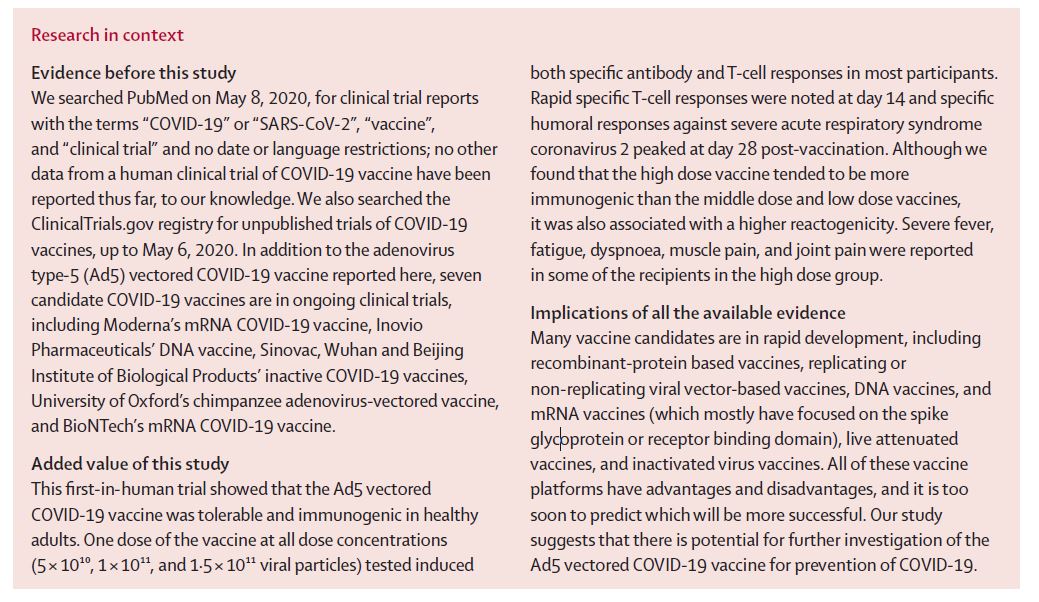
NEW Research—First human trial of #COVID19 vaccine finds it is safe and induces rapid immune response: finding from a dose-escalation, single-centre, open-label, non-randomised, phase 1 trial https://t.co/Cy9odHv5eF
Thread (1/3)
PANSS sub scales (positive, negative, general psychopathology) are widely used in basic & clinical research on #Schizophrenia ...
but do not represent natural dimensions !
Replacing them with robust & generalizable factors is now easy with our new tool: https://t.co/zrqlpiIJ4z
New preprint! 👇
We related connectome architecture to patterns of atrophy in the common epilepsies and identified syndrome-specific disease epicenters 📌
Our @enigmabrains analysis pooled data across 19 international sites and included 1,021 patients and 1,564 controls 🌎🌏🌍