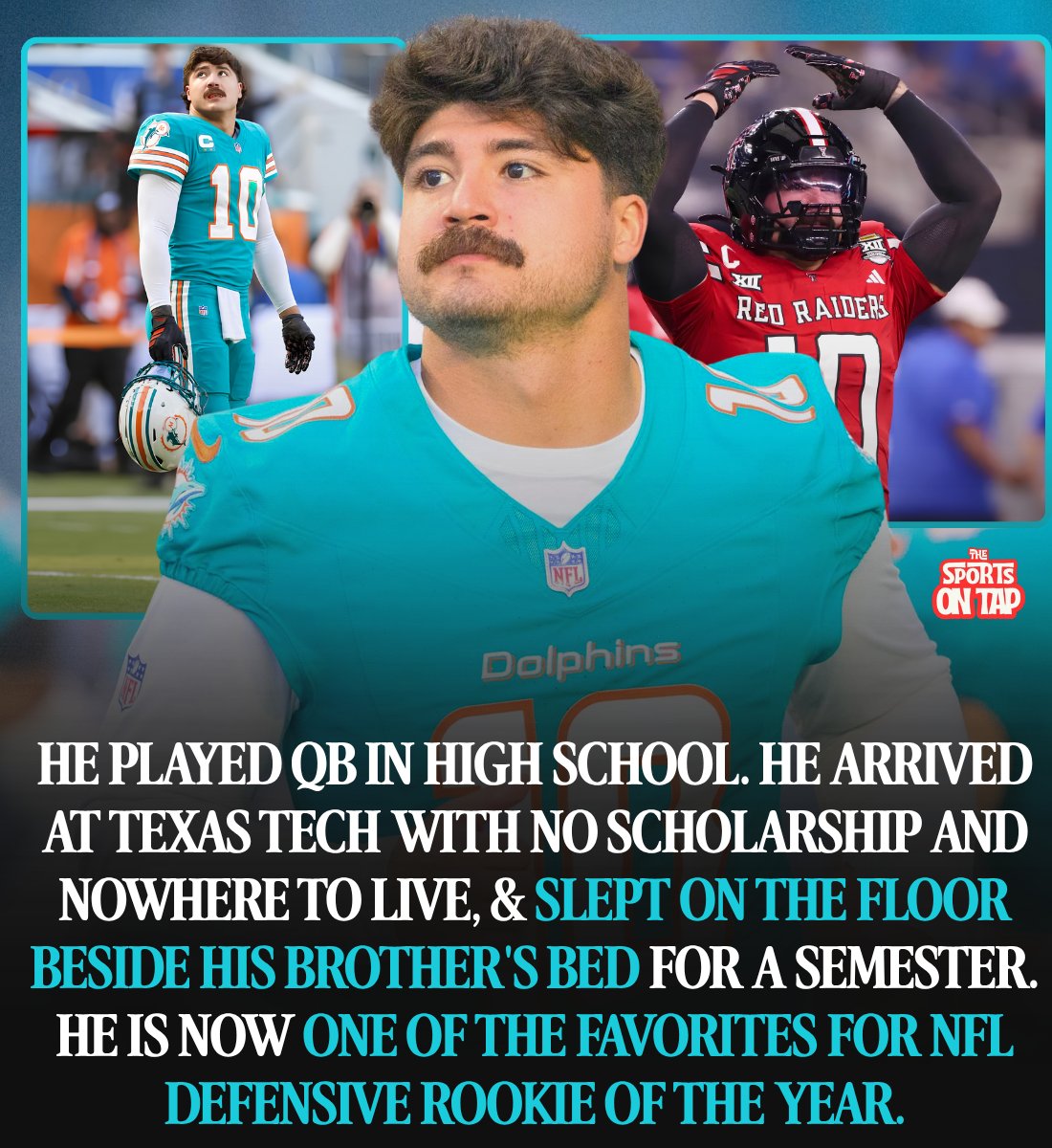
Jacob Rodriguez was born in Hastings, Minnesota. His family moved to Texas when he was ten.
He played quarterback at Rider High School in Wichita Falls.
He went to the University of Virginia and spent his freshman year as a utility guy. Ten carries. Eight catches. Not a starter at anything.
Then the head coach stepped down and Rodriguez went into the transfer portal, late, after most of the spots in college football were already gone.
Texas Tech said yes. But there was no scholarship left, and there was nowhere for him to live.
Here is what he did about that, in his own words.
"It was so late. I didn't have a place to stay. There were no scholarship spots, and so, luckily, my brother went to school there, and so I slept on the ground next to his bed for a semester and earned that scholarship spot later on."
He slept on his brother's floor for a semester.
And Texas Tech moved him to linebacker, a position he had never played.
Think about what that actually asks of a person. He had spent his entire life with the ball in his hands, reading defenses. Now he was the defense, learning it from nothing, against people who had been doing it since they were children.
Year one, 29 tackles. Year two, an injury cost him most of the season and he played five games.
Year three, 127 tackles.
Year four, 128 tackles, 11 for loss, 4 interceptions and 7 forced fumbles, and he was a unanimous All American.
Then the awards came in and they all had his name on them. The Chuck Bednarik Award. The Butkus Award. The Lombardi Award. The Bronko Nagurski Trophy.
No player in the history of Texas Tech had ever won any of those. He won all four in the same year.
He finished fifth in the Heisman Trophy voting, which was more votes than any defensive player in the country got.
The Miami Dolphins took him 43rd overall.
On Sunday he played the Kansas City Chiefs. He intercepted Patrick Mahomes. He tackled Kenneth Walker behind the line of scrimmage three separate times.
He is now one of the betting favorites for NFL Defensive Rookie of the Year. As of this week he sits at plus 400, a hair in front of David Bailey at plus 450, who used to line up next to him at Texas Tech.
Now the honest part, because it matters. Miami lost that game 24-10 and the Dolphins are 0-3. Nobody is handing out awards in September, and a rookie on a losing team is a long way from anything.
One more thing about him. His wife Emma is an aviation officer in the United States Army. She flies Black Hawk helicopters.
Four years ago he was a former high school quarterback with no scholarship and no apartment, sleeping on the ground beside his brother's bed in Lubbock.
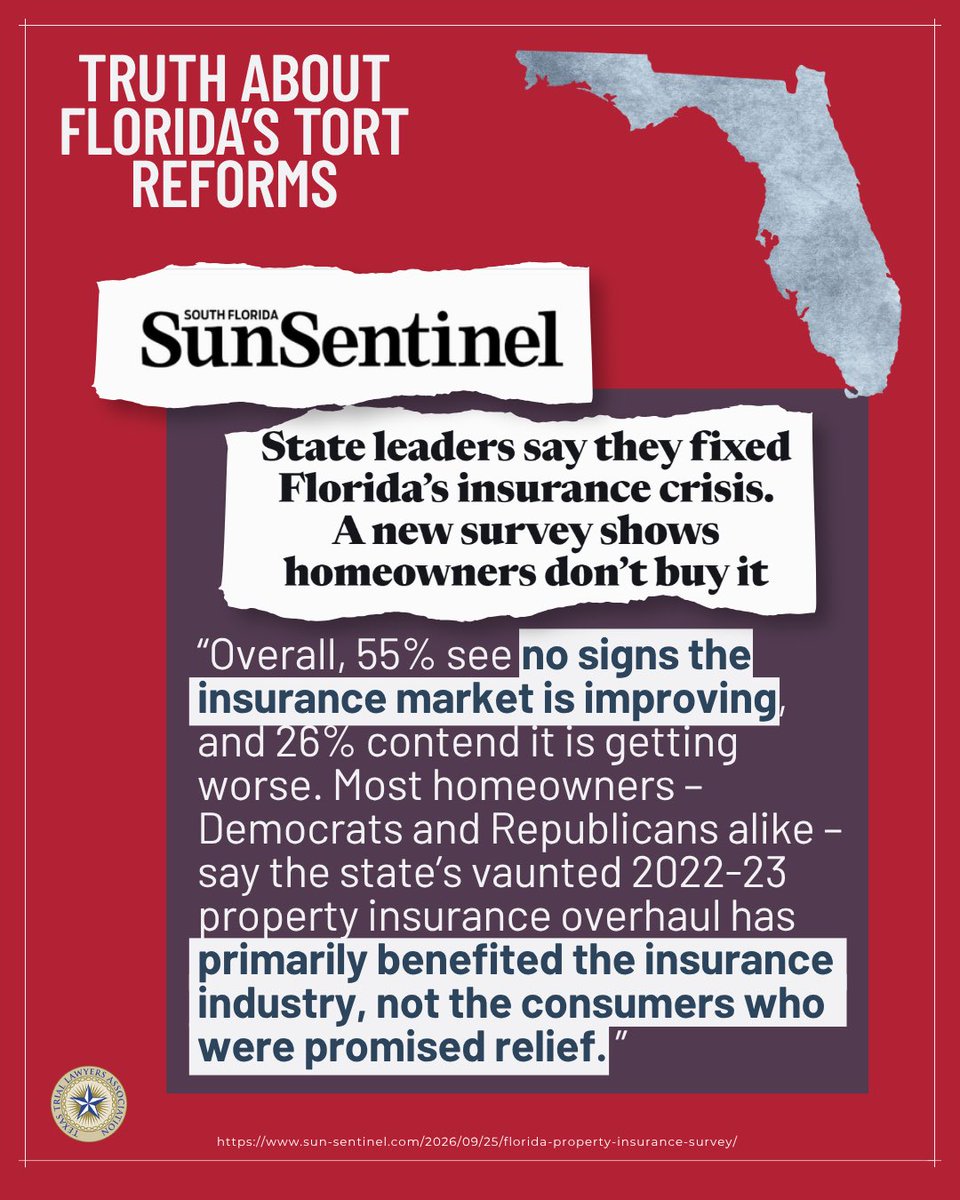
“All I can see is it’s helped the insurance companies.”
Just as we have seen in Texas for the last 30 years, Floridians are learning the truth about tort reform — it helps greedy insurance companies at the expense of ordinary families.
And yet, corporate interest groups are back pushing for more. Texans can't afford it.
Read the full report from the @SunSentinel here: https://t.co/XdIbyQ1HBK
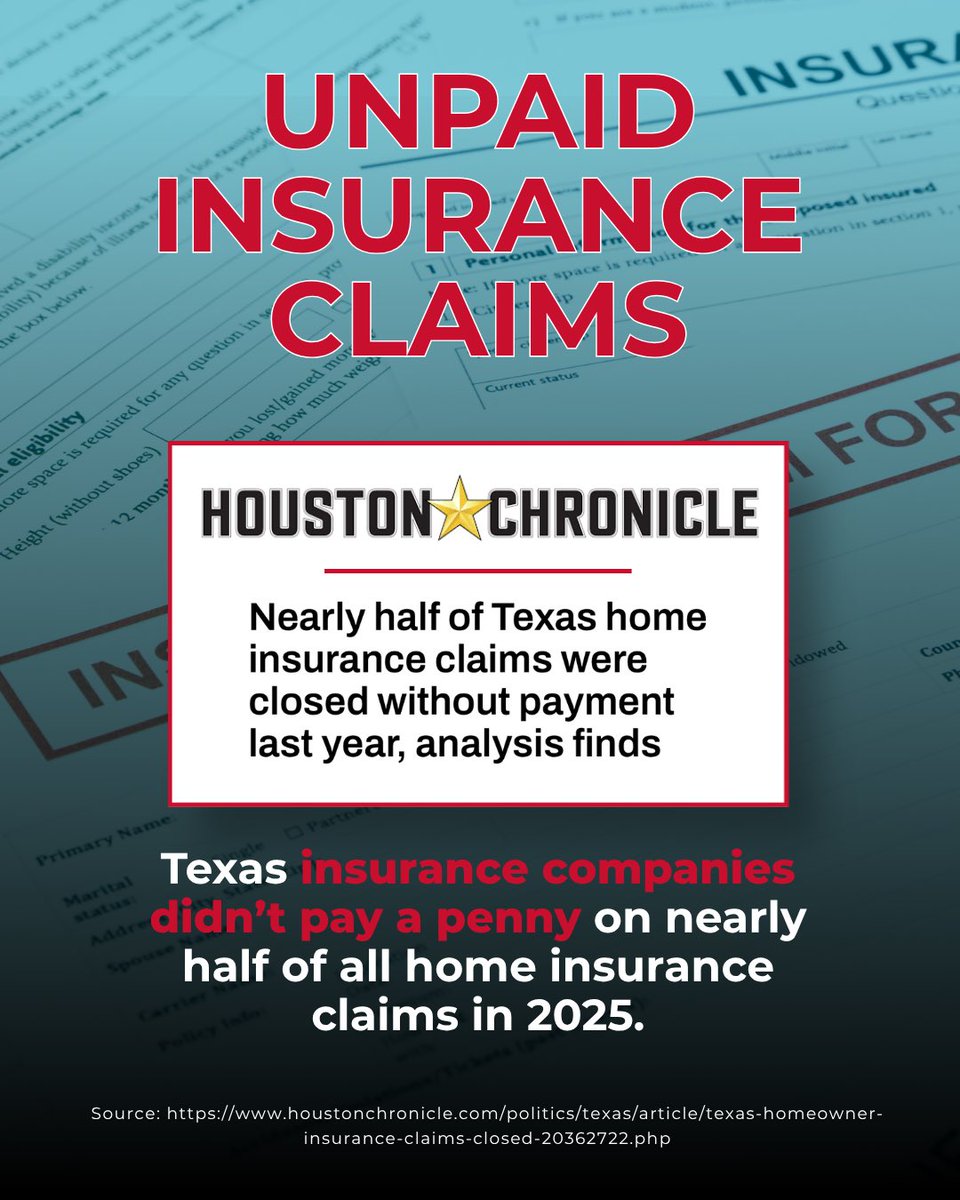
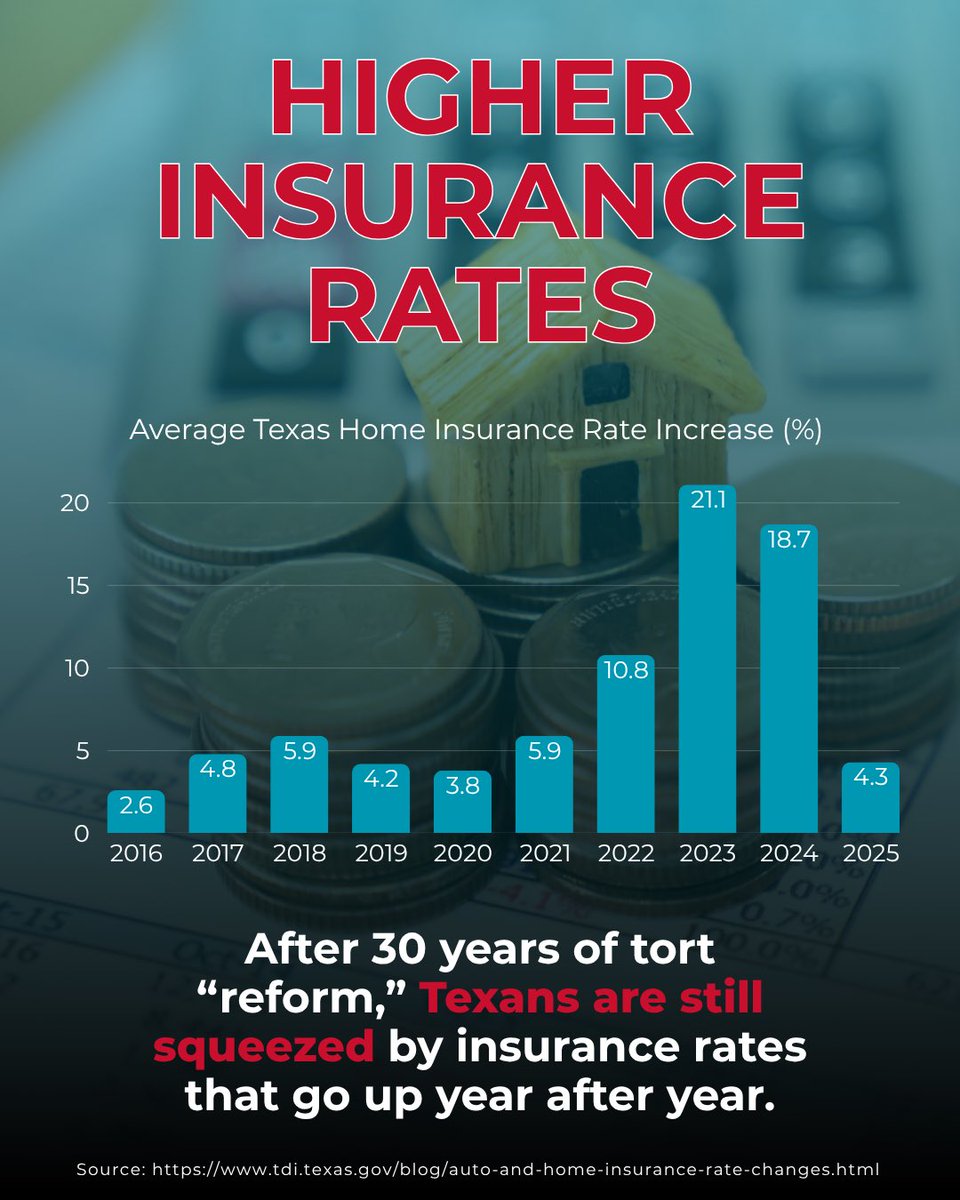
The record is clear. After 30 years of tort “reform,” Texans are struggling with an insurance cost-of-living crisis:
📈Higher insurance rates
❌More unpaid claims
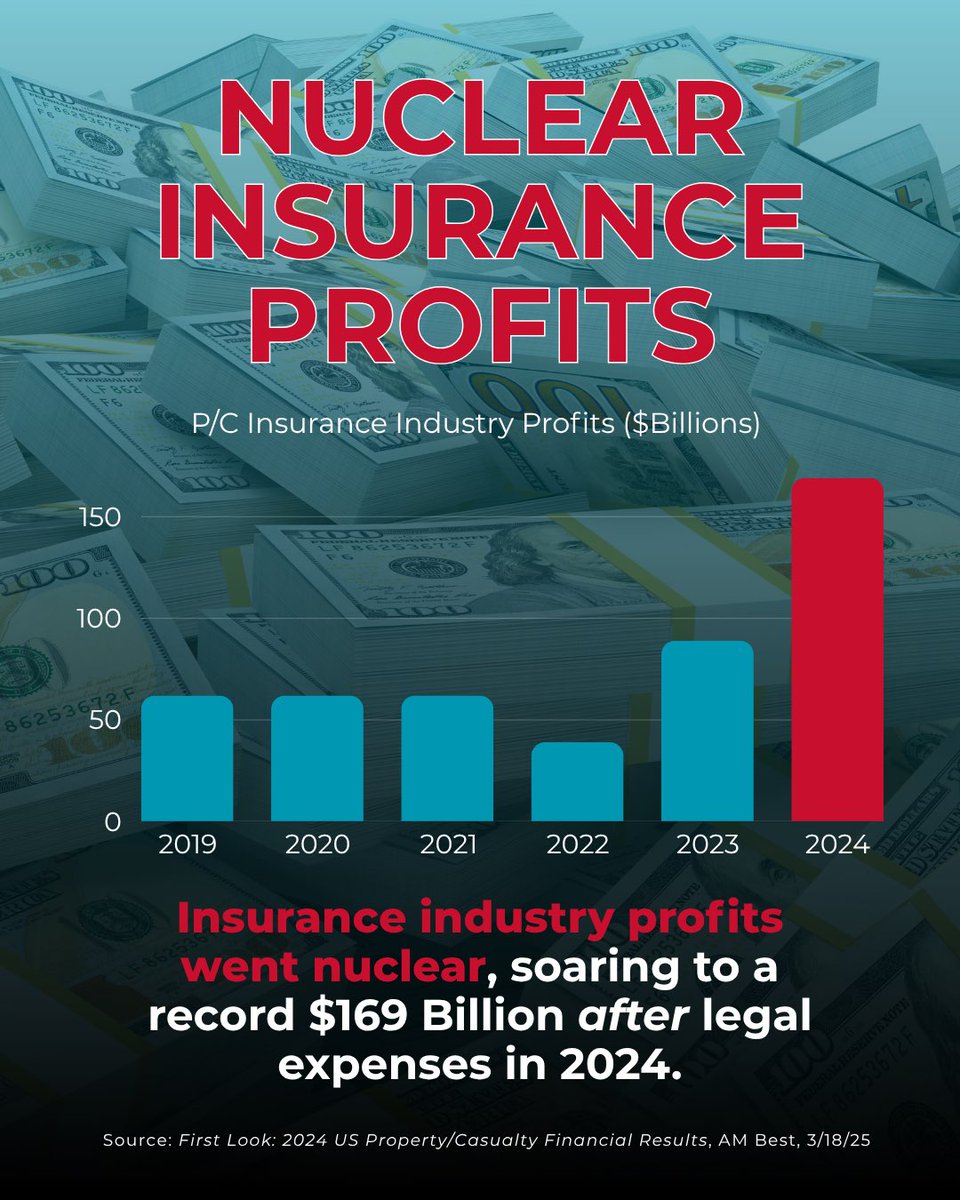
💰Nuclear insurance profits
Yet insurance-backed groups keep pushing their failed tort "reform" agenda.
Texans have seen this playbook before - they know how it ends: higher insurance inflation that pads insurance company profits while ordinary people are left paying higher premiums for less coverage.
Texans can’t afford more of the same.
#txlege
Corporate interests are talking a lot about Florida these days, but they aren’t telling the whole story.
Here’s the truth: After Florida tort “reform,” claims denials spiked 17% and profits skyrocketed. A separate decades-old law forced insurance companies to repay a portion of the excess premiums.
Texas has no similar law to guarantee rate relief for policyholders.
So, Florida-style tort reform would leave Texans stuck with more unpaid claims and no promise of lower costs.
#txlege
Texas homeowners were the guinea pigs in a scheme by the biggest insurance company in the nation to slash claims payments.
The company cheated its customers out of $1.4 Billion in one year, according to the trial lawyers who uncovered the scheme.
Meanwhile, insurance inflation keeps crushing Texas families as premiums keep rising, nearly half of all claims are never paid, and insurance companies reap record profits.
#txlege
This man was killed in a park near my home recently. It’s a park next to an elementary school where I used to play catch and do batting practice with my son, and where his team practiced some on our.
He deserves to be remembered as more than the victim of a deranged person.
Andrew Wimsatt spent his life figuring out how to make things last longer.
Roads, bridges, tunnels, pavement, friendships.
He held three civil engineering degrees from the University of Texas at Austin, spent 18 years at TxDOT, ten of them as Fort Worth District Pavement Engineer, and in 2006 joined the Texas A&M Transportation Institute, where he eventually ran the Materials and Pavements Division and its $9 million annual research program. He worked on ground-penetrating radar, nondestructive testing, asset management.
Describing the work once, he said the real challenge wasn't building new things; it was making what we already have last longer.
Andrew made what we already have last longer.
He was an obsessive live-music fan who would fly across the country to see a band. He loved Slowdive. In 2023 he was recommending "Souvlaki" and "everything is alive" to anyone who'd listen, singled out their cover of Syd Barrett's "Golden Hair," and admitted that when he heard them play it at FYF in 2014, he teared up. In 2016, when bad weather killed Levitation and Slowdive threw together a surprise show at the Scoot Inn, Andrew happened to be sitting at his computer and grabbed two $7.50 tickets in the roughly two minutes before it sold out. Then he recorded the entire set on his iPhone for a friend.
He made music too. He'd been in bands with Karl Rehn since high school, engineered their home cassette recordings in the early 1980s, and in 1990 released "Reflections" under the name the Andrew Wimsatt Ensemble, cut at Sixth Street Studio. He and Rehn made music videos that ran for years on Austin's ACTV, and contributed to the score of a 1994 documentary about Barton Springs.
Then there was the archiving, which is maybe the most Andrew thing about him. He clipped television. Constantly, expertly, for free, for people he admired. The Fifth Column crew (@wethefifth) called him "Busty Wimsatt" and, in their newsletters, "ever-alert," "indefatigable," and at least once "American hero." @MattWelch called him their most devoted cliphawker. Andrew painstakingly uploaded old episodes of "The Independents" so they wouldn't disappear. He clipped @KatTimpf's Fox appearances for her Locals community. He sent @walterkirn clips of Kirn's own jokes.
"Boy did I feel special," Kirn wrote today. "Not many strangers will go out of their way to give another that kind of encouragement."
He was not, for the record, employed by any of these people.
He contributed old photographs to @iowahawkblog's Dave's Car ID Service. He was a fixture in Austin's science fiction community and once drove Howard Waldrop home from Worldcon. He was an executive producer of Penn Jillette and Adam Rifkin's "Director's Cut," and appears in it, briefly, as "Greeting Cop." He hosted a regular libertarian beer gathering at the Johnny Cash-themed bar Mean Eyed Cat. He was, per @JTLonsdale, one of University of Austin’s (@uaustinorg) original small donors. He bought a camouflage "No Step on Snek" hat at a Texas gun show this summer and his friends heard about it.
The man lived.
He lived in Cambridge Towers, a 1965 midcentury modern building near the Capitol. Punk rock, pop surrealism, midcentury furniture, a gentle Southern manner. He loved salt to a degree his friends used as a unit of measurement.
He was, by every single account, one of the kindest people anyone had met.
@greggutfeld: supremely gentle, willing to do just about anything for another person.
@PlanetTyrus: always positive, physically slight, with a monster laugh.
@NancyRomm says he once gave her the jacket off his back when she was getting hypothermic.
A friend of 13 years and dozens of concerts tells me he never once heard Andrew say an unpleasant thing about anyone.
Both his parents were English professors. His father, James, was a Chaucer scholar at UT Austin who died in 2023 at 96. His mother, Mary, took her doctorate at Duke, ran the Society for the Study of Southern Literature, held an endowed chair as McClintock Professor of Southern Letters at South Carolina, wrote the first full-length study of a nineteenth-century novelist almost nobody remembered, and spent five years on a public radio project designed to get ordinary people reading Faulkner and Welty.
His parents spent their careers recovering things other people had stopped reading. They taught their son to make things last longer.
His mother now has Alzheimer's and lives in a nursing home in Round Rock. Andrew helped care for his father at the end, and then her. His routine was to drive out, walk with her, and then take a second walk alone.
He photographed what he saw on his walks. His Instagram is herons -- wading, fishing, one caught mid-wingspan over the water -- plus hawks in bare branches, a squirrel wedged in a tree hollow, a snail on a brick wall, bluebonnets, and a lot of Texas sky at the second it went orange.
Two days before he died, he was at a friend's house for movie night, watching Mystery Science Theater 3000 do "The Crawling Hand."
He spent his whole life trying to make things last longer, and he was good at it, and he was doing it right up to the end -- the second walk of the morning, until he sat on a park bench in the morning sun.
He is survived by his siblings, Alison Ross and David Joseph Wimsatt. And by his mother, who he walked with that morning, and who does not know he isn't coming back next week.
People love to complain about plaintiffs’ lawyers.
Oklahoma is suing State Farm over an alleged scheme to wrongfully deny or underpay homeowners’ claims.
The less an insurance company pays in claims, the more it makes.
Maybe holding them accountable isn’t such a crazy concept.