“I wrote this because I can’t speak about it.
I wrote this because I want you to know that I will make sure that you live on.”
@RBLeipzig and @equipenatciv winger Yan Diomande on the life of his sister, Roxane. https://t.co/6wQmpdWTSi
USD 1 billion.
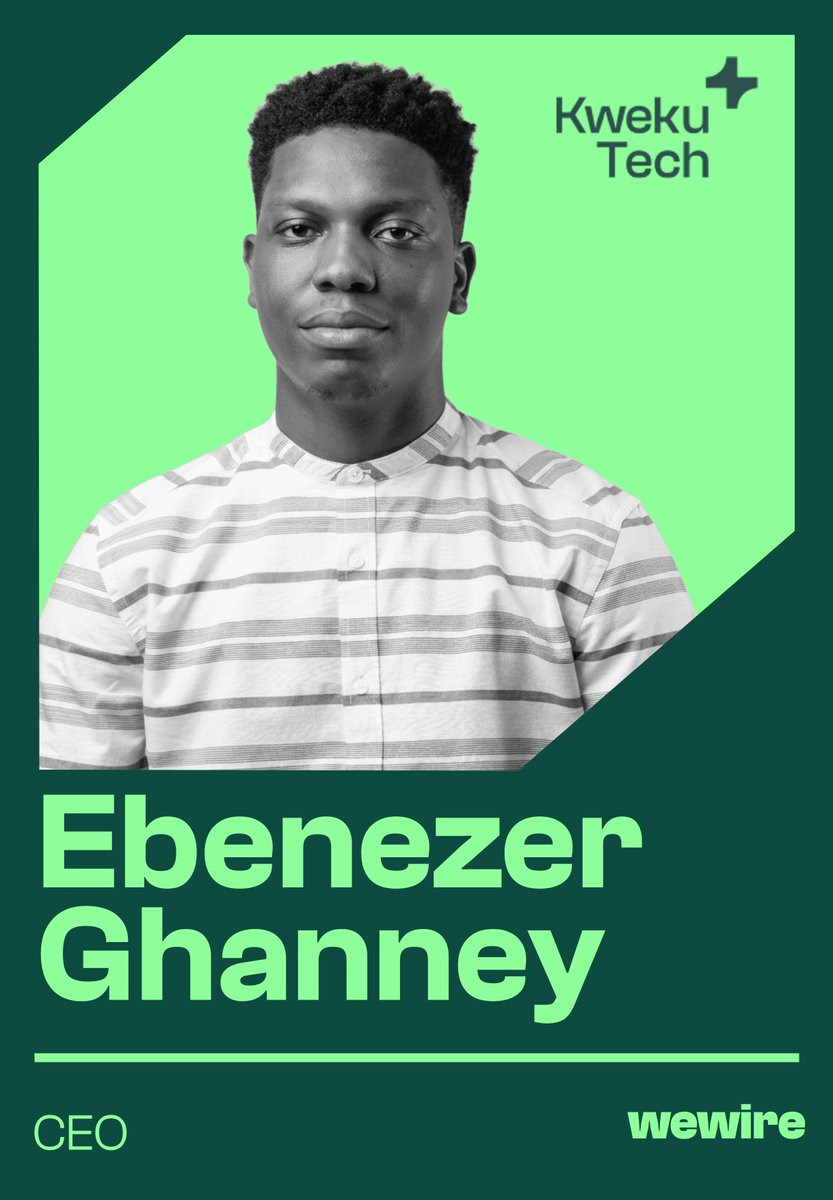
That is how much money has moved through Ebenezer Ghanney's(@_Iampkay) hands since 2021.
Not through a legacy bank. Not through a global payments institution. Through a company he built from a desk in Accra, four years ago, with the receipts from two companies that did not survive.
His company is @usewewire. And if you read our thread (link in cs) from yesterday, you already know exactly what problem he woke up every morning to solve.
The story starts at the @upsaccra, where Ebenezer studied accounting. Not code. Not product. Money. The movement of it. The mechanics of it. The gap between what a transaction should cost and what it actually costs when it crosses an African border.
From UPSA, he moved through @GetLiquidgh, first as an accounting clerk, then leading business development and campus activations at KNUST and Legon. He was learning how financial products actually get adopted. Not in a classroom. On the ground.
Then the startups. HostelMate: a student accommodation booking platform. He listed over a thousand beds across seven hostels in Accra. Could not find product-market fit. Closed.
Powrsale: built to solve social commerce fraud, a real problem with real victims. Did not survive. He does not hide these. He says they shaped how WeWire was built from the ground up.
In September 2020, @yellowcard_app brought him in to launch their Ghana operations. No users. No transaction history. Zero paid marketing budget.
By end of month one: USD 450,000 in transactions. By year one: 150,000 users. Over USD 20 million in volume.
That is not a statistic. That is a system built by someone who knew exactly what he was doing.
But running cross-border payments from inside a crypto platform showed him a different kind of gap.
Not the consumer remittance story. The business infrastructure story. The importer in Accra paying a supplier in Nairobi. The regional company with payroll in three currencies. The operation that loses margin every single time money crosses a border.
In April 2022, he left to build the answer.
WeWire is a B2B cross-border payments company. Banking and treasury services for businesses moving money across Africa and the world. Today it operates in Ghana, Nigeria, Kenya, Uganda, the UAE, the USA, and Canada. Seven markets. Four years.
Yesterday we asked why sending money from Accra to Lomé costs more than from Accra to London. Lomé is three hours away. London is six thousand kilometres.
Ebenezer did not wait for someone to answer that question. He built the infrastructure that makes it answerable.
Who else do you think is quietly building cross-border payment solutions Africa actually needs?
Drop their name below🔽.
Me to Claude:
Take your time to research on clean modern UI designs. Make that into a skill for consistent clean human friendly UI.
DO NOT use AI slop gradients. Before you start suggest some colors for primary and secondary in the range of blue-green (or whichever color). Use shades that are easy on the eye.
Make sure you build it in a way that takes dark mode into consideration.
Now write a full plan for the frontend when done so I approve.
Here. Consider this a technical rebuttal from someone in the field.
Clocks don't actually tick every nanosecond. The API returns a nanosecond field but the underlying resolution is way coarser. Windows defaults to about 15ms, Linux is usually microseconds, Java's https://t.co/I5lkaXEbwI() gives microseconds on most JVMs. Two events 50ns apart get the same timestamp. Even the example in the post gives it away: 20260419080313546650 has 6 digits after the seconds, which is microseconds not nanoseconds. Off by what, 1000x?
At scale, same-timestamp collisions happen constantly. Adding userID only saves you if a single user can never fire two requests in the same tick, but retries, parallel async calls, and replays do exactly that. Then you've got clock skew across nodes: NTP keeps machines within 5 to 100ms of each other, not nanoseconds, so two nodes will absolutely stamp the "same time." And clocks go backward (NTP corrections, leap seconds, VM pauses), which means a pure-timestamp scheme can reissue old IDs after a jump.
This is why nobody in production does timestamp + known-ID. Snowflake = timestamp + machine ID + sequence counter. UUIDv7 / ULID / KSUID = timestamp + large random suffix. UUIDv4 = 122 bits of randomness. DB sequences or Redis INCR when you need strict ordering. Google built TrueTime with atomic clocks and GPS because NTP alone wasn't tight enough. The counter or random suffix is doing the real work. It's there because timestamp + known-ID isn't collision-safe. If the simple version worked nobody would've built the complex ones.
"NIBSS does it this way" doesn't prove anything. Low per-endpoint throughput hides the bug for years, and if they do use timestamp + userID they're almost certainly backed by idempotency keys at the transaction layer that catch collisions before they cause real damage. For payment IDs, a collision means your unique key isn't unique, and everything built on top of that (reconciliation, refunds, dispute lookups) starts producing wrong answers. The fix isn't a cleverer timestamp, it's an idempotency key from the client enforced with a unique constraint at the DB, plus a proper ID generator.
Talking about Casio, there is an original Casio Outlet at the Achimota mall. You can check their website https://t.co/qJjTzRgKJo.
I have bought from them before so I know you can trust them
The blind state of the world only sees her waking up by 4:30AM to pack a lunch, they’re not concerned that her husband is going to work by 4:30AM and would be at work long enough that he’d have to eat his lunch there.
Around 2017 my roommate and I made an app we dubbed as "Town hall".
Which was to be operated regionally to gain it's own database and connected later to the national database to have way precise data collection....we were told to pay before they take a look at it wai🤣🤣🤣
@koboateng Bro this problem was solved the year I mastered mySQL not even any crazy thing, we created the app so all that they had to do was ask for the source code and perfect it. We were willing to do it for free.We only wanted credit for it, they said we should pay. Chale