Super interesting!
"The liquidity state dependence of monetary policy transmission" by Oliver Ashtari-Tafti, Rodrigo Guimaraes, Gabor Pinter, and Jean-Charles Wijnandts.
"Monetary policy shocks often have large effects on long-term interest rates, but the strength of this transmission varies considerably over time. We study how the liquidity of the Treasury market shapes the pass-through from short-term policy surprises to long-term yields. We show that monetary policy is most powerful when markets are liquid and arbitrageurs are well capitalised, and that it is weaker when liquidity is impaired."
https://t.co/XOLEq6GqWQ
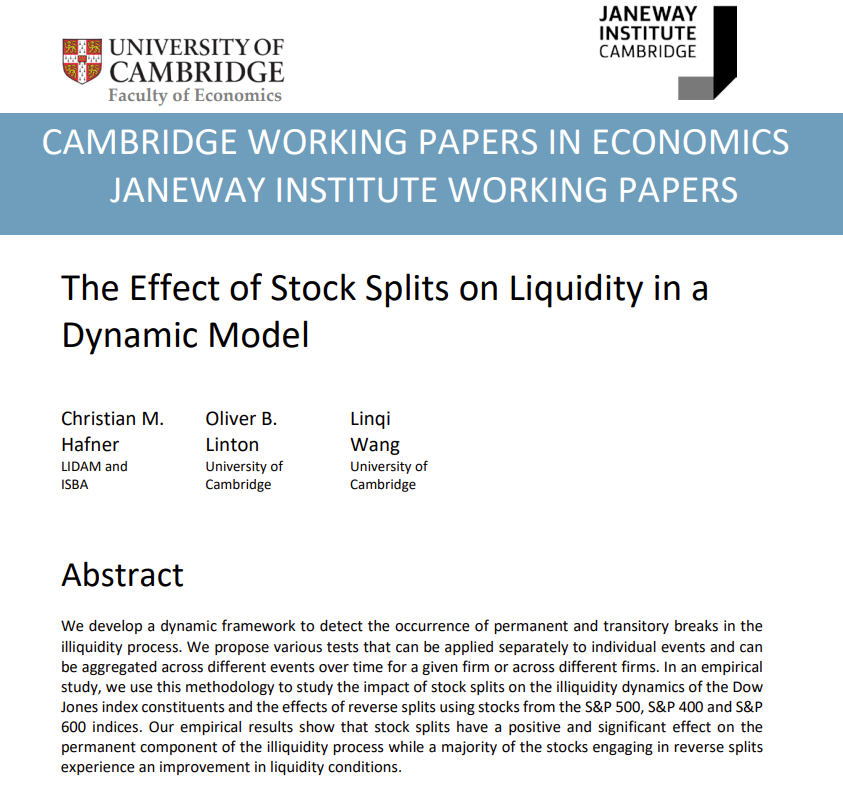
WATCH our 🎉new JI Video🎉 with JI Postdoc, Linqi Wang, @CamEcon discussing her research & recent JI Working Paper: ‘The Effect of Stock Splits on Liquidity in a Dynamic Model’ (read: https://t.co/iYvZcH4D3B)
https://t.co/VPSOafLRXz ... https://t.co/TvboDejYZh via @YouTube
📢New JI WP from Prof. Oliver Linton, Dr. Linqi Wang & Prof. C.M. Hafner: 'The Effect of Stock Splits on Liquidity in a Dynamic Model'
➡Download the paper here:
https://t.co/WyhMxe2Hx9
📈The dataset of high frequency monetary policy surprises from today's SWP is publicly available on the paper's webpage. Full details + data going back to 1997📉
https://t.co/zpFBlCyOUv
Shared by the authors as a public good for empirical monetary policy researchers. [Please RT]
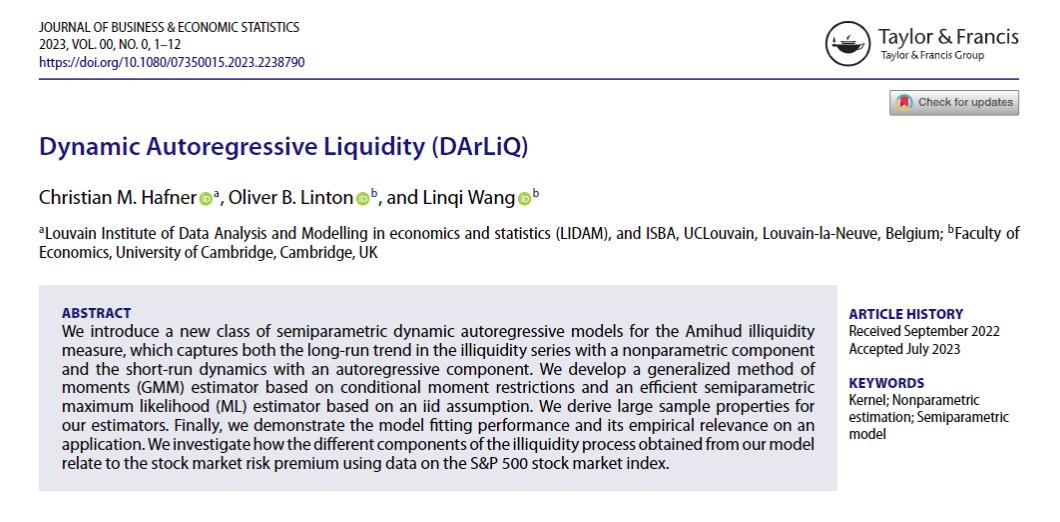
📢 NEW PUBLICATION by C.M. Hafner, O.B. Linton, L. Wang: 'Dynamic Autoregressive Liquidity (DArLiQ)'
Abstract below & read the paper here:
https://t.co/iVTi8BGcsf
🧵SWP 1045 by Rodrigo Guimaraes, Gabor Pinter + Jean-Charles Wijnandts (all BoE) explores how bond market liquidity affects how long-term treasury yields reacts to US monetary policy shocks.
https://t.co/mEEvwE7UNh
🚨The Global Credit Project is live!🚨
Tracking the allocation of credit across sectors for > 100 countries since 1940.
https://t.co/ocYzbomQ9o
Based on “Credit Allocation and Macroeconomic Fluctuations”, joint with @EmilVerner, forthcoming in the @RevEconStudies.
A thread.
A forthcoming publication by L. Wang (@CamEcon) & F. Vrins proposes a new short-rate process combining the advantages of the Vasicek and CIR dynamics which is flexible, tractable and displays positive skewness without imposing a strict lower bound.
https://t.co/A6z0UILJBI
https://t.co/IobazfF49P
@fang_leon
Many thanks to @nberpubs for featuring our work on inflation hedging properties of major asset classes. We show that separating energy from core inflation is crucial. Yesterday's market reaction to the surprise CPI print is case in point.
1/n
🧵We have several openings suitable for those who have just got or are close to getting their PhD! Come and join our team working in either the Monetary Analysis or International Directorates. [PLEASE RT]
I'm not objective, but Diego is objectively a star.
Solo AER macro time series, cool (if I may say) JME RR macro theory, widely cited EER w/ micro data during COVID.
Outstanding JMP blending all 3 lodes to address 2 hot issues, climate & inequality.
Talk to him, you'll see.
Paolo Gambetti will soon publicly defend his thesis entitled "New Perspectives on Recovery Rates Modeling and Prediction". Registration is open...
#LSM#EthicsLSM#ExcellenceLSM#SustainabilityLSM
https://t.co/7USRcdRYD6
Peer reviewers are often careless, but they’re not ignorant. Which means, if a referee misunderstands something crucial, you should assume it’s your fault. Your writing needs to be so clear that even a lazy reader doesn’t miss the point.
#EconTwitter#AcademicTwitter
I just learned something kind of cool about the NY Times. For many of their articles, they produce multiple headlines. They A/B test the headlines in the morning and then run with the winner for the rest of the day.
Après le Prof. Holmström (Prix Nobel Économie 2016), c'est le Prof. Diamonds (Prix Nobel Économie 2010) qui est à l'@UCLouvain_be@CORE_UCL#IMMAQ#LIDAM cette semaine. Conférence ce jeudi à Louvain-la-Neuve sur les réformes des pensions en Europe. https://t.co/MwPJfj5yJH