#Myanmar 🇲🇲: People's Defense Forces (#PDF) struck Burmese Mil Mi-17 military helicopter in #Magway.
Fighters seemingly used multiple FPV Kamikaze Drones; armed with possible MR-1/2 rocket warhead / HE MK II mortar bombs.
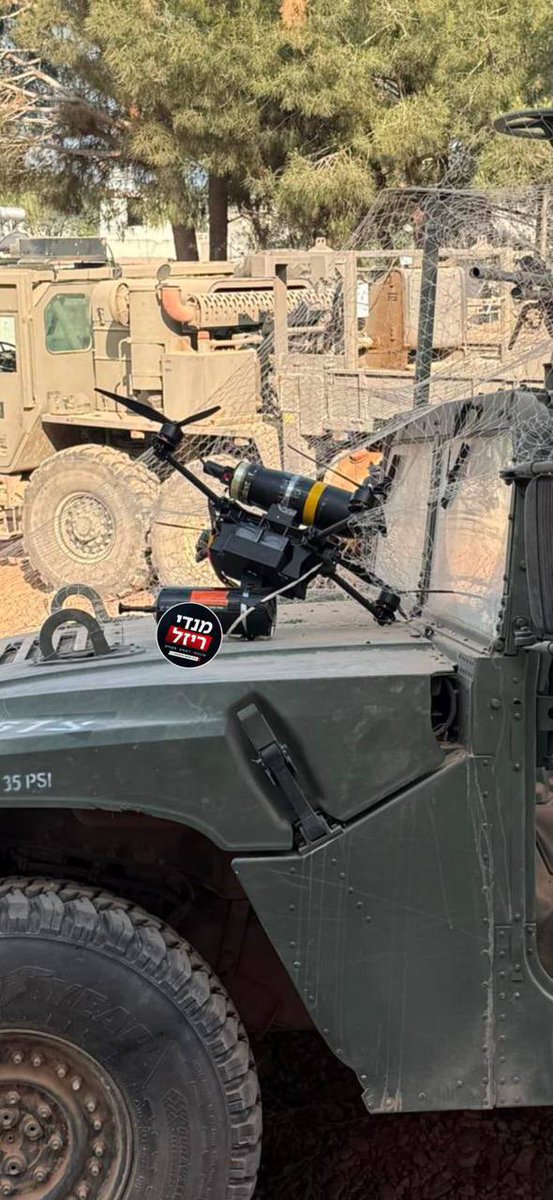
A Hezbollah fiber-optic FPV armed with the shaped-charge warhead removed from a Milan ATGM was stopped by the protective netting of an IDF armored vehicle.
Israel ordered more AI-assisted weapon stations that let soldiers shoot drones from behind cover. It's the second contract in under a month.
https://t.co/B0rQlwKMnw
#WATCH video shows the process of intercepting the Russian "Geran-2" UAV using two interceptor drones.
When attempting to approach the target, the American-made interceptor drone AS3 "Surveyor" flies past the "Geran" and heads toward the horizon without hitting the aircraft.
A Russian fiber optic FPV deployed as a “waiter” on a road is equipped with a second, rear-facing camera.
Ukrainian ground units that have eliminated these ambush FPVs by approaching from the rear aspect to shoot the FPV or cut the fiber cable must be wary of this development.
Assuming the reporting is correct, this could have been a freak accident, a failed shoot-down attempt, or an intentional attack.
Worth noting that Iran previously marketed an interceptor variant of the jet-powered Shahed for export.
Today is the fourth birthday of the kamikaze FPV!
The war changed on June 10, 2022, when soldiers of the Ukrainian “SIGNUM” battalion made the first FPV attack on a Russian position.
And keep in mind that today's small drones are the least lethal they will ever be.
Iranian outlets say authorities found electronic equipment in Lavasan, northeast of Tehran, allegedly used to assist Israeli air operations from within the country.
I looked into the U.S. Navy's Corsair drone boat that just rescued two American pilots in the Strait of Hormuz, and the engineering is remarkable.
Built by Texas-based Saronic Technologies, the Corsair is a 24-foot autonomous surface vessel powered by AI. It hits 40 mph, carries 1,000 pounds of payload, and can sail more than 1,000 miles without a human aboard. Each unit costs roughly $1 million to produce, which is a fraction of what comparable manned naval assets cost.
The platform runs on Saronic's autonomy stack, which fuses real-time sensor data, computer vision, and AI decision-making to navigate, identify targets, and execute mission objectives without remote piloting. It's part of the Navy's Task Force 59, the unit dedicated to AI-powered unmanned vessels operating in the Middle East.
Saronic stood this up in 12 months from prototype to production. The company is on track to build more than 20 vessels per year by 2027.
This is what American AI looks like in the field. 🇺🇸
The Russians recovered a Ukrainian FPV with a single digital frequency-hopping link for both control and video.
The video signals are spread over a wide spectrum and are therefore invisible to Russian drone detectors, as they are indistinguishable from jamming or EM noise.
🚨🇺🇸 🇮🇷 The full story of the downed Apache is even wilder than first reported, and it just revealed a secret U.S. mission...
The Iranian Shahed slammed directly into the helicopter's canopy, and its warhead-packed nose cone burned inside the aircraft without ever exploding.
The pilot ditched into the water fast enough for both crew members to jettison what was left of the canopy and climb out seconds before the $50 million aircraft sank.
The bigger reveal is why it was flying at all.
Trump disclosed the Apache was part of a covert operation running since last month to escort tankers through the Strait of Hormuz, using fighters and helicopters to shield ships from Iranian drones and missiles.
The results: more than 100 million barrels of oil and 200 commercial ships moved through the strait Iran claims to control.
The crew survived a drone to the cockpit by seconds.
The mission they were guarding stayed secret until the day after they hit the water.
Source: Wall Street Journal / Writers: Daniyal, Daniel
Trump called the Apache helicopter incident “a miracle,” saying an Iranian drone struck the aircraft and became lodged between the two pilots without exploding.
Despite the helicopter being on fire and the risk of detonation at any moment, the crew managed to ditch it at sea. About 2 hours later, they were rescued in what Trump said was the first U.S. military rescue conducted by an unmanned sea drone.
Press a button and the drone launches, finds the Shahed, and kills it — almost entirely on its own. Ukraine's MaXon Systems built it for $3,500.
https://t.co/pJUmmYcWkf
Ukrainian mid-range “Hornet” strike UAVs scouring Russian rear areas are becoming so numerous that they frequently see each other flying by.
These UAVs have both unjammable terrain-following AI autonomy and Starlink communications, and are operating to a depth of 150 km.
Exclusive 👀:
Inside Ukraine’s AI-Enabled Drone Campaign Targeting Russian Logistics Deep Behind The Lines
An officer assigned to the "mid-range" drone campaign gives unprecedented insights into its strikes at the heart of Russian logistics.
https://t.co/GMYX4Q5nh9
A Russian “Zala-16” reconnaissance UAV has a camera mounted on bottom of the fuselage.
This second camera for situational awareness pairs with a top-mounted camera that can automatically initiate evasive maneuvers on the approach of a Ukrainian interceptor FPV.