He’s dating Kim Kardashian, who has an estimated net worth of nearly $2 billion. He's worth nearly $500 million and lives in Monaco to avoid paying taxes in the UK.
Remarkable lack of self-awareness.
The IOC just announced their policy on DSD and trans athletes in the female category. Let's skip the outrage and go with the scientific facts:
The modern debate started almost 20 years ago with the rise of DSD athletes who were winning world/Olympics (See: Semenya and others).
It came to a head when DSD athletes swept the podium.
The had the single biggest performance boost we can get, androgenization. Something that none of their competitors could ever have.
So debates commenced...
It's important to put in context how big a boost males get from simply being males. It's a larger boost in performance than if you were Lance Armstrong or Barry Bonds and hopped up on all the performance enhancing drugs known to man.
That's how large it is. It's why from 100 meters to races hundreds of miles long, the performance differential is generally 10-15%. Even larger in some strength events.
Every male gets this boost. It doesn't men all men beat all women, of course.
There's significant overlap in performance. My wife is going to better than 99% of men in distance running.
But...that boost gives each male a 10+% jump in performance that no female ever gets. We can see it in the athletic data and the progressions of men and women at puberty.
So...governing bodies and experts debated what to do about it. Women were losing millions of dollars in total to folks who had a male androgenization advantage.
We went from doing nothing, not much of a real policy to eventually instituting testosterone rules.
THe thinking was, testosterone can be a surrogate marker. It also gave DSD athletes a venue to still compete in the male category. They could lower their T to typical female levels, and still race.
There were a few problems with this. First, it obviously only took into account CURRENT T levels. A large part of the boost comes from androgens through a lifetime.
Second, this was challenged in court by DSD athletes. It was a long process that led to some strange policies along the way (for instance, rules only applied to certain event groups). It was tricky to regulate and be fair, and telling someone they had to have a medical intervention to compete came with ethical issues.
So that was eventually scrapped. I'm simplifying and summarizing years long backs and forth, obviously.
Track and field moved to the policy the IOC just adopted a year ago. Using the SRY test as a screener.
Why? It was simpler, straightforward and applied to all females, so their wasn't a separate DSD and trans policy.
It also put the dividing line for segregating sports by sex instead of a surrogate marker.
It's a one time screener, and then with specific follow up if potential DSD.
There's an exception for CAIS athletes because androgenization has little to no effect on them. So they do not have an advantage.
So what? I've seen this policy framed as immoral, fascist, and even nazism...which is crazy...
But the point is...it's a result of 20 years of debate, research, and trying to figure out a solution to a tricky problem.
There's a lot of people who don't know or are ignorant to the decades this has been going on.
Why is it important to separate sports based on sex?
Because it's the biggest performance boost we could get. If we didn't, there would be zero professional women athletes in an open category.
That's how big the gap is. And I for one value and think women deserve the spotlight to compete and show off their hard work and talent.
I've spent my life coaching women at the elite level to do so.
You might here people say it's a ban. It's not.
Every athlete still has a place to compete. You can do so in the category that matches your biology, in open events, or recreational events that this does not apply to.
A rough analogy: Longevity guru Bryan Johnson can't compete in the under 18 category no matter what age score his crazy metrics say he is.
We have categories and classification to ensure everyone has a chance to compete.
Yes, we pick what categories are important. But it's hard to argue that sex isn't a very important one.
So there you have it. It's been 20 years in the making. It started with DSD athletes with an androgen advantage winning championships and has evolved from there.
It's not perfect. Nothing is. We've debated, shifted policies, etc. But lots of smart folks and researchers have been trying to figure out a just and fair solution for a long time.
That was probably my favourite celebration from Tadej Pogačar, ever.
No prepared salutation to the audience, no grandiose gesture, just a pure, authentic human reaction to winning the hardest-to-win monument in professional cycling. #MilanoSanremo
Nike PR staff: “We asked him to put on the spikes and show us some tricks. The very first thing he showed us was that famous scene of hitting the crossbar multiple times in a row. All we could say was, ‘Ronnie. Thank you. The commercial shoot is already over.’
Many elite distance runners have horrible flexibility.
They can't come close to touching their toes.
Why? A stiff spring can be beneficial.
Some research found the worse you do in the sit and reach test, the better your running economy.
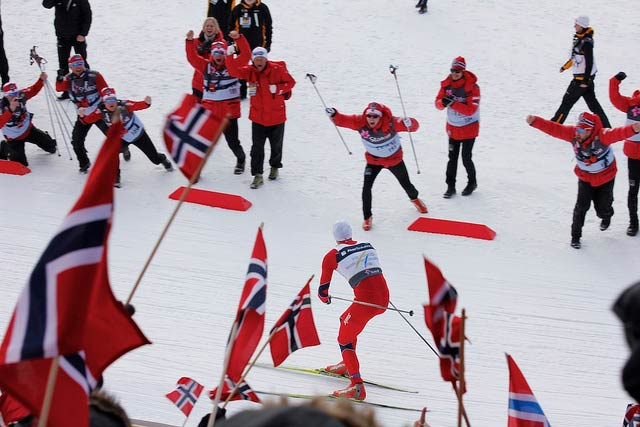
Norway consistently wins the most medals at the Winter Olympic Games, with a population of just 5.6 million people.
A big part of their success is how they treat youth sports—and it’s the opposite of what we do in the US. Here’s what we can learn from Norway:
1. Scorekeeping:
In the US: Youth sports tend to be hyper competitive even at early ages. Leagues almost always keep score.
In Norway: Scorekeeping isn’t even allowed until age 13.
Removing winners and losers keeps the focus on the process not outcomes. It keeps kids engaged longer because it minimizes pressure (and tears) and maximizes fun, learning, and growth. The goal isn’t to win a third grade championship. It’s to love sport and keep playing.
2. Trophies:
In the US: If you give everyone a trophy, you’re creating snowflakes who will never gain a competitive edge.
In Norway: Whenever trophies are awarded, they are handed out to everyone.
If getting a trophy makes young kids feel good, we should give them trophies. Maybe they’ll come back and play again next year!!
As for the creation of snowflakes with no competitive edge—Norway’s athletes are tough as nails and all they do is win.
3. Prioritizing Fun:
In the US: Far too often, the goal is to win.
In Norway: The national philosophy is “joy of sport.”
Youth sports in the US are driven by adults, ego, and money. Youth sports in Norway are driven by fun.
Only half of kids in the US participate in sports. The number one reason they drop out: because they aren’t having fun anymore. In Norway, 93% of kids participate in youth sports. Fun is the foremost goal.
4. Playing Multiple Sports:
In the US: There’s pressure to specialize early and play your best sport year round.
In Norway: Try as many sports as you can before specializing as late as college.
Norway encourages kids to try all types of sport. This reduces injury and burnout and increases all-around athleticism. It also helps promotes match quality, or finding the sport you are best suited for as your body develops, which is impossible if you commit to a single sport too early.
5. Affordability
In the US: There is increasingly a pay-to-play model with high fees for leagues, equipment, and travel. This excludes many kids from playing.
In Norway: It’s a national priority to keep youth sports affordable and therefore accessible for all.
Kids aren’t priced out, which creates opportunities for everyone to participate (and develop into athletes), regardless of their parents’ income level.
We could learn a lot from Norway:
In the US, 70% of kids drop out of youth sports by age 13. This not only diminishes an elite-athlete pipeline, but it also destroys an opportunity for healthy habits and all the character lessons kids can learn from sport.
In Norway, lifelong participation in sport is the norm. The goal isn’t to have the best 9U team. It’s to develop the best athletes. Those are two very different things. And Norway has the gold medals to prove it.
This view of Abbey Murphy's assist to Bella Fanale yesterday is ridiculous. The guts to try this at full speed, and skill to pull it off...she's a fun player to watch.
If you run a lot of volume, a shoe rotation is non-negotiable.
Let's say you run 50 km per week. That's 750 km in 15 weeks. Say you stretch the mileage on the shoes and use 3 pairs a year.
There is no point in buying a new pair every 17 weeks, get through them and buy a new pair.
You'll use 3 pairs in a year. So it's way better just use all 3 together and get all the benefits a shoe rotation provides.
Somehow people still believe having multiple shoes is a marketing trick or some sales strategy from running shops.
But you get real benefits from running in multiple shoes in a week!
When you try to lose weight, you avoid sugar, carbs, seed oils, do 24+ hour prolonged fasts, and go "Carnivore".
When you want your dog to lose weight, you put less food in his bowl and walk him more.