“design a RAG pipeline for 10M docs with zero hallucination”
apparently this was asked in a Google L5 interview round. came across it somewhere on the internet and honestly it’s a way more interesting system design problem than most classic distributed systems questions
1. ingest + normalize docs
- remove duplicates, standardize formats, extract metadata, maintain version history
2. hybrid retrieval (BM25 + embeddings)
- BM25 handles exact keyword matching while embeddings capture semantic meaning
- semantic search alone usually struggles with precision at massive scale
3. ANN retrieval + reranking
- ANN (Approximate nearest neighbor ) quickly pulls top candidate chunks from millions of docs
- then a reranker rescoring step improves relevance by deeply comparing query vs retrieved chunks
4. source confidence scoring
- every retrieved chunk gets scored based on freshness, trust level, overlap and retrieval consistency
- low-confidence context should never heavily influence generation
5. constrained generation
- the model is only allowed to answer using retrieved context (nothing new to be invented outside of the retrieved context)
6. citation-backed responses
- every major claim links back to exact chunks, documents or timestamps
7. hallucination fallback layer
- if retrieval confidence drops below a threshold: “insufficient evidence found”
8. continuous evals
- run adversarial queries, retrieval recall benchmarks and hallucination tests continuously
9. caching + memory layer
- cache high-frequency enterprise queries and retrieval paths (improves latency and output)
10. observability everywhere
- trace retrieval paths, chunk rankings, token attribution and failure points
Also at 10M docs, retrieval quality matters more than the frontier model itself.
GitHub acaba de solucionar el mayor problema del vibe coding.
Acaban de lanzar Spec Kit y en días ya tiene +95K estrellas.
¿La idea?
En vez de tirar prompts vagos y rezar para que el agente no rompa tu proyecto…
Spec Kit obliga a la IA a crear una especificación estructurada ANTES de tocar código.
La IA primero entiende lo que quieres construir, pregunta lo que falta, organiza el proyecto y después empieza a programar.
Eso significa menos tiempo arreglando errores absurdos, menos código inconsistente y resultados mucho más predecibles cuando trabajas con agentes.
El flujo es simple:
/constitution → reglas y estándares
/specify → qué quieres construir
/clarify → dudas antes de empezar
/plan → arquitectura y stack
/tasks → tareas ordenadas
/implement → ejecución
Compatible con Claude Code, Cursor, Copilot, Codex, Gemini CLI y +25 agentes.
95K estrellas.
8K forks.
Open source.
Publicado por GitHub.
Repositorio 👇
The guy who BUILT Claude Code is running 10–15 parallel AI agents like an engineering team.
Not prompts.
Systems.
His secret isn’t some hidden feature.
It’s a simple file:
CLAUDE.md
And it changes everything.
Every time Claude makes a mistake → it writes a rule.
Every correction → permanent memory.
Every session → smarter than the last.
> “Update your CLAUDE.md so you don’t make that mistake again.”
That’s the loop.
No repeated errors.
No wasted tokens.
No babysitting.
Just compounding intelligence inside your own codebase.
While most people:
Rewrite the same prompts
Fix the same bugs
Start from zero every time
He’s building a self-improving engineering system.
And it gets crazier:
• 10+ agents running in parallel
• Research, coding, testing — all split into sub-agents
• Clean context, zero clutter
• Complex problems = more agents, not more thinking
He hasn’t written SQL in 6+ months.
Claude just pulls from BigQuery via CLI.
This isn’t “AI-assisted coding.”
This is AI orchestration.
And the gap is already showing.
Claude Code is now contributing to ~4% of all public GitHub commits.
If you’re still using AI like a chatbot…
You’re not behind.
You’re playing a completely different game.
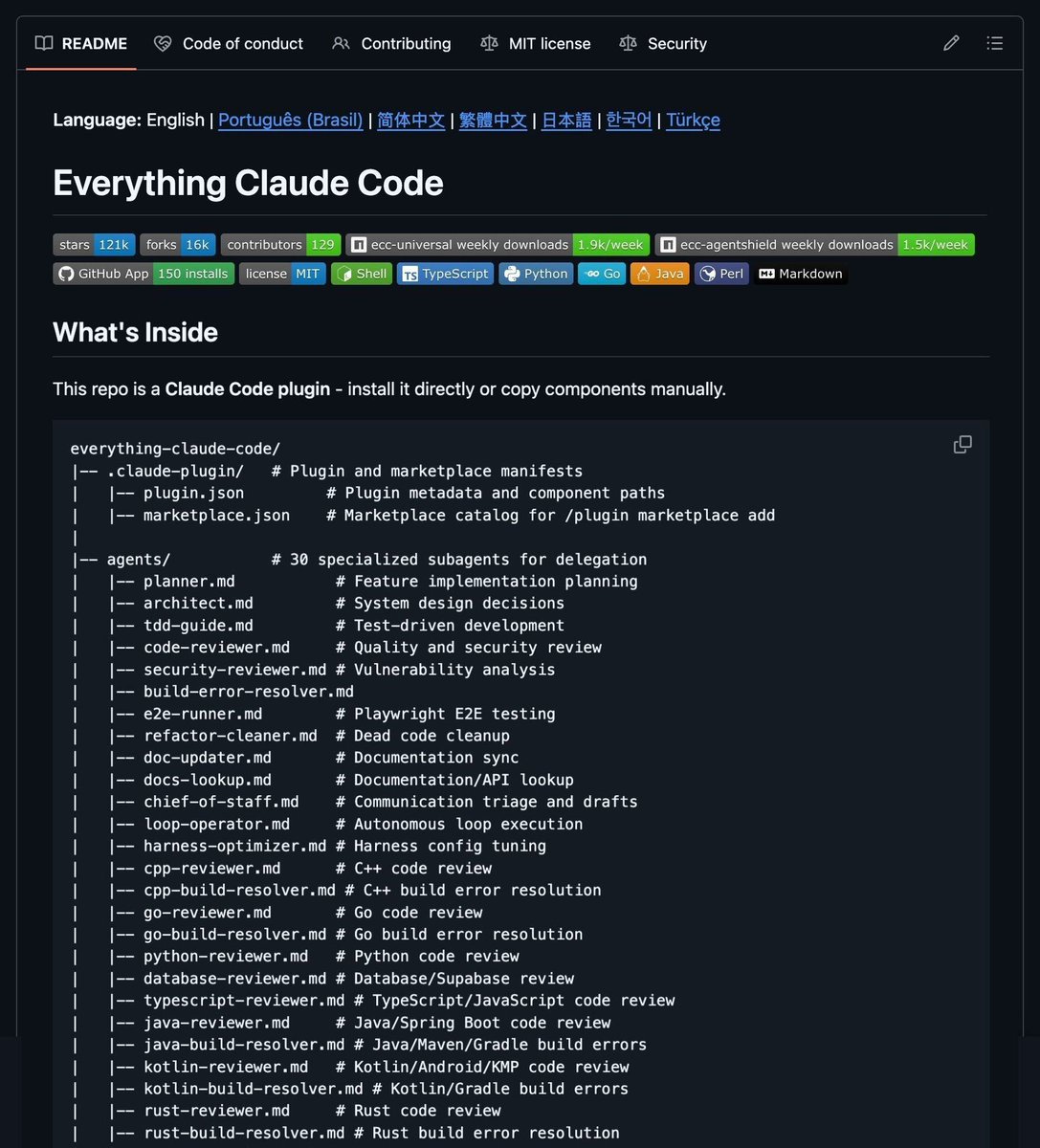
SOMEONE BUILT THE MOST COMPREHENSIVE CLAUDE CODE SYSTEM ON THE INTERNET AND OPEN SOURCED THE ENTIRE THING.
55 agents. 208 skills. 72 slash commands.
Built and won at the Anthropic x Cerebral Valley hackathon.
10 months of daily real-world use before it was ever published publicly.
This is not a collection of prompts someone threw together over a weekend.
This is a production-grade agent harness that has been stress-tested across thousands of real sessions and refined until it works reliably at scale.
Here is what you actually get when you install it.
55 specialized agents each built for a specific function. Not one agent trying to do everything. 55 agents each doing one thing exceptionally well.
208 skills covering every repeating workflow a serious builder runs. Research. Code review. Documentation. Testing. Deployment. Content. Analysis. Each one built once and callable forever.
72 slash commands that compress complex multi-step workflows into a single word.
A security scanner called AgentShield that audits your entire Claude Code configuration for vulnerabilities, misconfigurations, and injection risks across 5 categories before you deploy anything.
Cross-harness support for Claude Code, Codex, Cursor, OpenCode, and Gemini so the investment you make in this system is not locked to one tool.
A dashboard GUI with dark and light theme so you can monitor your entire agent operation from one screen.
Memory persistence that carries context across sessions so you never start from zero.
1,282 tests. 98% coverage. 102 static analysis rules.
This is the infrastructure layer most builders are trying to assemble piece by piece from 15 different repos.
Someone already built the complete version. Won a hackathon with it. Then gave it away for free.
The builders who install this this weekend will have a Claude Code setup that took 10 months of daily iteration to build.
Installed in one afternoon.
https://t.co/2Er9PREAih
Star it. Fork it. Build on top of it.
Bookmark this.
Follow @cyrilXBT for every Claude Code repo worth your weekend the moment it surfaces.
SOMEONE JUST KILLED THE REAL ESTATE INDUSTRY
A guy scanned an entire house with his phone. Uploaded it.
Now anyone on Earth can walk through it in a browser tab. No app. No VR. No agent. No appointment.
Click → you’re inside. Every room. Every angle. Every shadow. Photoreal.
The numbers are insane:
- Agent fee on a $500k home: $15,000
- Cost to make this scan: ~$200
- Time to “tour” 50 houses: one evening
- File size: smaller than a TikTok
The science is wild too:
It’s called 3D Gaussian Splatting instead of polygons (how games render), it uses millions of tiny glowing “splats” of color and depth.
AI reconstructs reality from your photos. The result loads on a phone and looks like you’re THERE.
The grift opportunity is even wilder:
Freelancers are already charging $300–$800 per scan for realtors, Airbnbs, venues, car dealers, museums.
One person + one phone + one weekend = a business.
Open source. Built on PlayCanvas.
Free GitHub: https://t.co/ew6Ql8Ad6u
@BitBenderBrink@GoGalaGames I lost huge amount of money by buying tons of gala nfts for the games while the results are just disappointments. It seems that gala is only just chasing hype and failing miserably. Promised AAA games down to music, film to tapper games 🤦 and now chasing meme lunching platform.
I built an AI system that automates product video creation for entire e-commerce catalogs.
(Saves $30K per collection shoot, increases conversion rates by 40% on sites)
Here's how the automation works:
→ Firecrawl scrapes product photos from any e-commerce product page
→ Nano Banana create 4 images showcasing each angle of the product
→ Google's Veo 3.1 animates a 360° motion video using the generated nano banana images
→ Each animation starts and ends with the original photo for seamless looping
→ Videos are automatically organized and stored in Google Drive
→ Everything processes in batches while you handle other business priorities
This system can transform how DTC companies showcase products and consistently drives higher engagement from potential customers.
Static product photos just don't cut it anymore. Customers want to see what a product looks and feels like before they buy.
Want the complete blueprint? Here are the steps:
1. Like & RT this post ✅
2. Follow me for more e-commerce automation insights
3. Comment "MOTION"
I'll send you the entire n8n workflow, all the prompts, and a full setup video for free.
No more expensive video shoots or wondering if your product photos are converting.





![zayleeai's tweet photo. 🔍Did anyone catch the detail? 👀
• Grok AI 🧚
Prompt:
{
"subject": {
"type": "young_adult_woman",
"ethnicity": "European",
"age": "early_20s",
"eye_color": "hazel_green_mix",
"skin_texture": "natural_with_visible_pores_and_imperfections_no_blur_or_smoothing",
"expression": "soft_neutral_with_gentle_coquette_vibe",
"makeup": {
"finish": "matte",
"blush": "light_pink",
"eyeshadow": "soft_pink",
"eyeliner": "thin_black",
"lashes": "defined",
"lip_color": "matte_dusty_pink",
"lip_shape": "medium_fullness_natural_look"
},
"hair": {
"color": "jet_black",
"length": "long_past_chest",
"texture": "smooth_with_soft_waves",
"bangs": "full_straight_lightly_piecey",
"crown_style": "braided_crown",
"side_sections": "long_face_framing_waves",
"accessories": ["lilac_pink_ribbon_bows_left_and_right"]
},
"nails": {
"style": "short_coquette",
"color": "pastel_pink"
},
"pose": {
"type": "mirror_selfie",
"camera_angle": "slight_downward_diagonal",
"head_angle": "very_subtle_tilt",
"body_position": "leaning_forward_slightly",
"right_arm": "holding_phone",
"left_arm": "resting_or_light_touch_on_furniture"
}
},
"apparel": {
"top": {
"type": "lime_green_cropped_ribbed_cardigan",
"pattern": "thin_vertical_teal_stripes",
"fit": "tight_and_form_fitting",
"closure": "single_center_clasp_firmly_secured",
"neckline": "deep_V_but_fully_covered",
"sleeves": "long_with_slight_flare",
"integrity": "top_stays_in_place_no_sliding_no_opening"
},
"undershirt": {
"type": "white_fitted_tank_top",
"material": "soft_ribbed_cotton",
"coverage": "fully_covers_chest_under_cardigan"
},
"necklace": {
"type": "minimalist_silver_chain",
"pendant": "tiny_simple_shape"
},
"bottoms": {
"type": "low_rise_black_denim_jeans",
"details": "contrast_stitching_silver_button_belt_loops"
}
},
"phone": {
"model": "iPhone_15_Pro_Max",
"held_in": "right_hand",
"case": {
"design": "green_3D_frog_case",
"details": {
"eyes": "raised_frog_eyes_on_top",
"face": "round_frog_face_with_blue_cheek_detail",
"edges": "wavy_inflated_style"
},
"inserted_photo": "Elon_Musk_passport_photo"
}
},
"environment": {
"setting": "cozy_bedroom_soft_evening_vibe",
"walls": {
"color": "soft_gray_beige",
"decor": {
"posters": [
"large_Lana_Del_Rey_portrait",
"Lana_Del_Rey_album_covers_collage",
"black_white_artistic_portraits",
"various_small_decorative_prints"
],
"garlands": "green_vines_with_pink_roses"
}
},
"bed": {
"sheets": "light_pink_with_line_pattern",
"pillows": "matching_pink_sets",
"plushies": ["small_brown_dog", "white_bear_with_pink_accents", "ribbed_pink_bunny"]
},
"room_items": ["pastel_handbag", "small_accessory_clutter"],
"vibe": "dreamy_coquette_bedroom_lana_del_rey_inspired"
},
"lighting": {
"type": "soft_indoor_front_light",
"reflections": "none_on_face_or_clothing",
"shadows": "very_soft",
"effect": "natural_even_skin_tone"
},
"image_rendering": {
"style": "natural_phone_snapshot",
"device": "iPhone_15_Pro_Max",
"no_beautify": true,
"skin_detail": {
"pores_visible": true,
"imperfections_visible": true,
"micro_shadows": true
},
"camera_artifacts": {
"grain": "light_natural",
"noise": "soft_iso_noise",
"sharpness": "medium_high_to_show_real_texture"
},
"ratio": "3:4"
}
}](https://pbs.twimg.com/media/G75K0scXoAExDgk.jpg)


