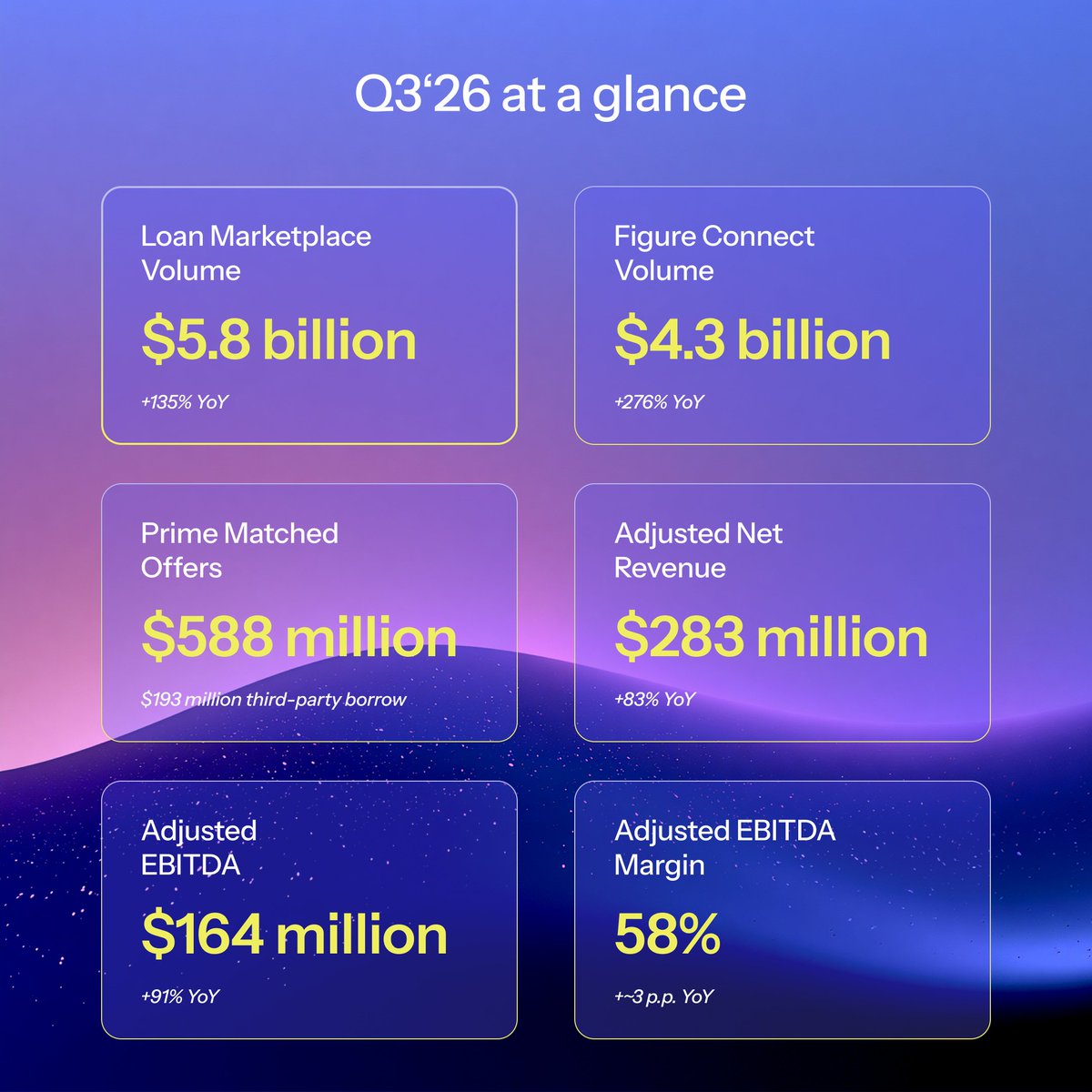
Another record quarter at @Figure.
83% top-line growth, 58% margins, meaning we’re again “Rule of 140” in the “Rule of 40” investor framework. It’s a rare stat to be able to share once, but this is our fourth straight quarter of Rule of 140. It’s rare air + staying power. Really proud of our team.
We added 100+ partners and are now at 612 on our marketplace, and 894 when including broker partners of Kiavi, which we closed on September 1. We’ve also expanded volume more than 40% with partners who have been with us for a year or more.
Much more in our full results here: https://t.co/7hY0aRwDsU
Not just great results coming from $FIGR, but also lots of (expected) changes.
The CLMV baseline has significantly changed, now with Kiavi included.
This also means enhanced diversification of the marketplace (DSCRs, RTLs)
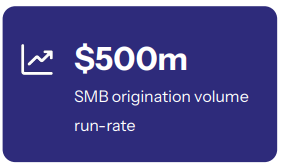
Also, seems like SMB is accelerating, earning its own reporting segment.
Heads down to get you all the numbers from the chain, as accurately as possible 🧑🏭
I hardly like to comment on stock prices, but $FIGR’s -9% move on Friday got me thinking.
It seems like a reaction, a sector-wide reaction, to the Binance hack on Oct 30th, one that also got $CRCL down 9%.
But why would investors bucket Figure as a crypto play just like those stocks?
Compare it to two neighbors: $SECZ which was down 10% and $SOFI which was down 5%.
Looks like Figure traded like Securitize, not like SoFi, meaning it’s suffering from a crypto “premium” (or de-premium).
I deep dived into this.
First, let’s look at language.
I did that just to understand how management markets Figure. Looking at the quarterly filings and counting the mentions of crypto-related terms, per 10,000 words:
$FIGR 10-Qs: Q3 2025: 90, Q1 2026: 75, Q2 2026: 68 - trending down
$SOFI 10-Qs: Q3 2025: 7, Q1 2026: 19, Q2 2026: 20 - trending up
$SECZ Q2 2026 results (its first public quarter): 170 - bigger, no trend yet
So Figure is talking less about crypto every quarter, while SoFi is talking more. Which may indicate that Figure’s management also understands it would be better not to be too tightly connected with crypto.
Now let’s look at the numbers themselves. How exposed is $FIGR to crypto?
There are a few points of exposure:
Crypto-backed loans: these are loans given in exchange for collateral that is a crypto asset. The assets are held by a third-party custodian (Anchorage, an OCC-chartered bank). Note that the crypto still belongs to the borrowers, not Figure. If BTC drops, so does the amount Figure owes back, so Figure takes no hit (unless borrowers also default on their loans at the same time the crypto takes the hit). The amount reported on the last quarterly filing: $52M of loans, backed by $21M of BTC and ETH.
Digital assets held on the BS: $42M excluding stablecoins.
That is 1.4% of total assets, under 1% of market cap. None of it sits on an exchange, it is self-custodied.
Stablecoins: $49M of USDC/USDT.
Stablecoins can be stolen like any other token, but these sit in Figure’s own wallets, not on an exchange, and the issuers can freeze stolen coins.
Revenue: Figure Exchange, the business closest to the hack, isn’t broken out in the 10-Q. Its trading volume was $692M in Q2, 14% of Figure’s total ecosystem volume.
The last time Figure put a number on it, in the 10-K, it said Exchange generated no material revenue in 2025.
Lastly, we get to what I consider the weakest link: Democratized Prime.
DP is essentially a funding channel that Figure uses as one of its various funding funnels. But a crypto-market freeze would hit it. It currently holds $545M of tokenized debt at June 30, up from $267M at December. But most of it (~$425M) comes from related parties, so the money that could actually run is closer to $120M.
So Friday wiped ~$430M off the market cap of a company with a much smaller exposure. Over punished? WDYT?
Figure Technology ($FIGR ) earnings at a glance
Executive Summary
🔹 Figure Technology Solutions reported Q3 FY2026 preliminary Consumer Loan Marketplace Volume of $5,119M, reaching the high end of its previously issued guidance range of $4,800M to $5,200M.
🔹 Consumer Loan Marketplace Volume grew 107.3% year-over-year in Q3 FY2026 compared to $2,469M in Q3 FY2025.
🔹 On-chain lend-borrow marketplace Democratized Prime saw its Matched Offers Balance expand 2,572.7% year-over-year to $588M at the end of Q3 FY2026 compared to $22M in Q3 FY2025.
🔹 End-of-period $YLDS in Circulation reached $504M in Q3 FY2026, up 2,300.0% year-over-year from $21M in Q3 FY2025 following its launch in February 2025.
🔹 Available Lender Supply on Democratized Prime increased 3,073.1% year-over-year to $825M at the end of Q3 FY2026 compared to $26M in Q3 FY2025.
🔹 Borrower Demand on Democratized Prime expanded 2,122.2% year-over-year to $600M at the end of Q3 FY2026 compared to $27M in Q3 FY2025.
🔹 The company completed its merger with Kiavi on September 1, 2026, though Kiavi loan volumes were excluded from reported Q3 FY2026 marketplace volumes and prior guidance.
Are we experiencing an uptick in the non-funded loans volume on $FIGR’s marketplace?
Well, it certainly might be interpreted that way at first glance.
Let me explain the data we’re looking at:
Daily breakdown of marketplace loan UPB, broken down by its current funding.
We have non-funded (not sold) loans,
We have warehousing,
ABS deals,
Loans that are sold into Democratized Prime pools and more.
The breakdown is read from the chain.
And obviously, as we see the non-sold portion of the loans increase, it’s a warning sign for the demand side.
So imagine when on-chain unassigned volume doubled overnight, jumping from $531M to $1.28B.
Sounds like a big alarm.
And in a rising interest rate environment this is almost expected by some.
So deep diving into the chain’s dynamics to find out whether this is indeed an issue, I found the following:
First - no alarm.
Second - this might even be a good signal.
I’ll explain.
Kiavi’s volume from Sept till now amounts to ~$850M (3,371 loans). There was no sign until now of buyers on the other side of the marketplace - no buyers, no securitization announced.
Then, a few days ago, Kiavi’s wallet holding those loans got labelled on chain as “Connect”.
Yet the loans haven’t been sold to anyone.
That label is what caused the dramatic surge - but it may also hint at an upcoming sale?
Either way, the upcoming quarterly results might show a momentary bump in Figure’s loans on balance sheet, likely coming from Kiavi’s volume (~$446M of Kiavi loans on chain at the Sep 30 quarter end).
Let's wait and see if those loans get sold anytime soon.
(full daily breakdown of the Connect book is in https://t.co/FbcPfLjzJD )
Sixty-two years and $22 trillion later, the U.S. poverty rate sits at roughly 11 percent, almost identical to where Lyndon Johnson found it in 1964. The government ran the most expensive social experiment in human history and produced nothing measurable. Bureaucracies perpetuate themselves, and this policy worked exactly as designed.
When Washington transfers purchasing power to the poor through SNAP, Medicaid, housing vouchers, and 126 other overlapping programs, it doesn't eliminate scarcity; it relocates decision-making from individuals to administrators. Those administrators develop career interests in perpetuating dependency, because a solved problem eliminates their department.
Free market thinkers identified this perverse incentive structure before Johnson signed the Economic Opportunity Act. Every dollar taxed from productive activity carries a deadweight cost before it reaches anyone's dinner table.
Capital formation lifts people out of poverty. You build wealth through savings, property rights, and voluntary exchange, none of which $22 trillion in redistributed spending actually produced.
In her latest sciolistic letter to me, @SenWarren made it clear that she knows even less about foreign exchange markets than she does about banking.
What is equally shocking, but not surprising: not a single member of the media mob has a rudimentary-enough level of financial market literacy to spot her remedial error.
To reiterate: under @POTUS, the United States delivers for America’s trusted partners.
For a fuller explanation, I recommend Senator Warren take any entry level course in international finance for her and her staff, or I can personally give her a tutorial on Foreign Exchange for Dummies. Although I am not holding my breath, I hope her next letter will demonstrate that she has learned the difference between a currency purchase and a swap or a loan.
Big news re: @Figure's $YLDS - it is now accepted collateral on @markets_edx. We appreciate the EDX team's leadership here.
I think more exchanges will follow suit. Traders sacrifice a lot in taking the cash drag from posting non-yielding stables as collateral.
The reason this has taken longer than we expected is that we didn't account for the fact that the other large stablecoin issuers pay the exchanges to take their coins as collateral. YLDS pays you, the trader. I think EDX as a first mover will open up this market more broadly to the benefit of all traders.
https://t.co/j9PvXjNmAT
Yesterday we crossed $100M in loan sale proceeds settled in $YLDS.
The old way: sell loans, wait 2 to 3 weeks for funding to hit. Now: 1 day. A 95% reduction in time to cash.
And because $YLDS pays interest, the money earns from the moment it lands. Our partners have collected over $100K in interest this year just by holding their own sale proceeds.
17 partners on board. Faster to cash, and the cash works while it sits.
This is the power of @Figure's marketplace.
@m0xt_ I wonder if the negative tone from some of the big bank analysts (like BofA) are due to their recognition of the serious competitive threat Figure poses?
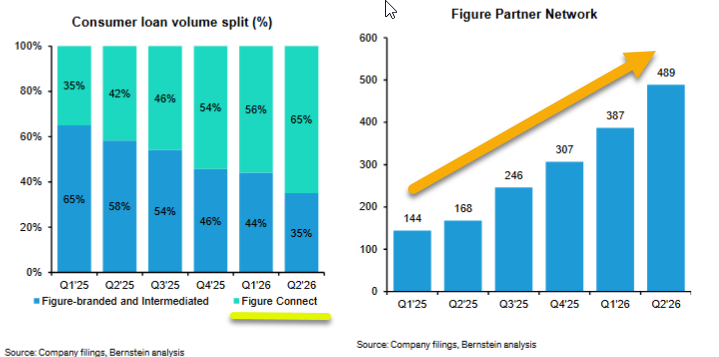
$FIGR is increasingly a network, not a lender.
>489 partners, up from 144 a year ago.
>Figure Connect (the marketplace) now drives 65% of consumer loan volume, up from 35%
>More partners --> more volume --> more liquidity --> more partners --> very profitable flywheel.
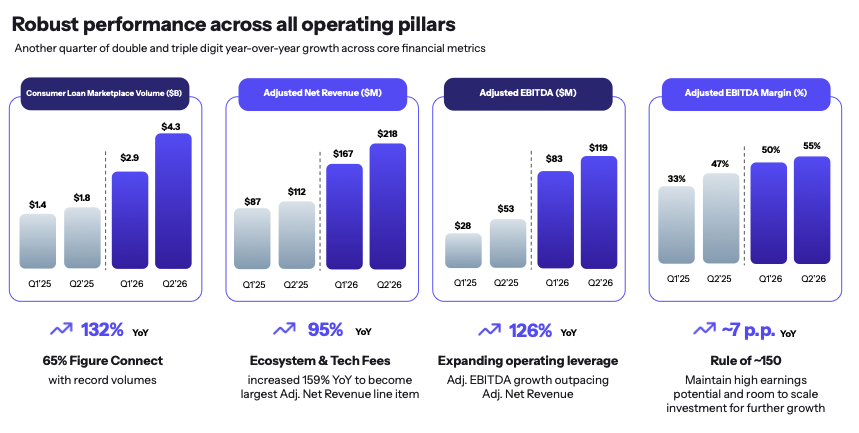
Consumer loan volume +132% y/y, ~50% margins and rising, sub-S&P 500 multiple.
$FIGR just posted a Rule of ~150. Only one software company scores higher: Palantir.
95% revenue growth, margins expanding to 55%, and a guide that says both keep going up.
It is now on the team to nail the earnings call, and this stock is going to rip.
Figure grew adjusted net revenue 95% to $218 million, ahead of the $207 million the Street wanted. I had called $223 million, so the top line was close, and the print beat my own EBITDA and margin numbers.
GAAP net revenue rose 113% to $225 million. Net income jumped 192% to $87 million.
Adjusted EBITDA hit $119 million, up 126%, growing faster than revenue.
This is called operating leverage, and it's often what leads to stock repricing.
Figure Connect is now 65% of marketplace volume, which pulls the take rate down (no issue), but the margin went up.
I said this morning most people read that backward, and the print settled it. This business is now capturing more dollars than ever before!
Now put it directly next to Palantir.
Palantir posted a Rule of 40 of 155 on 93% growth and 62% margins. Figure came in at ~150 on 95% growth and 55% margins. Figure actually grew faster.
The only thing keeping Palantir ahead is margin, and Figure guided toward 60% margins.
Figure guided Q3 marketplace volume to $4.8-$5.2 billion, up 102% year over year at the midpoint. The volume engine isn't slowing, and management just told you it keeps going. They also added over 100 partners this last quarter.
It is almost impossible to be bearish here.
Figure trades at ~31x forward earnings vs Palantir's ~86x, a third of the multiple for the same Rule of 40.
I will be joining the @milkroaddaily crypto podcast tomorrow, hosted by @BitcoinJesusETH, to talk about Figure. If you are interested, tune in.
You can also follow me @m0xt_ for more market insights, or you can join Milk Road PRO to see 5 analysts' portfolios and their moves in real-time for just $1: https://t.co/9VV5R1nB5R
Episode 2 of the @Figure Unblocked podcast is live.
I sat down with Nicholas Ambrosini, CEO of @ValleyStrong_CU in the Central Valley of California. There are 5,000 credit unions in the U.S., holding massive deposit bases but often hindered by legacy tech.
Valley Strong started as a loan buyer on Figure’s marketplace. Today, they originate directly on our rails and embed our tech straight into their customer interface. It’s the exact flywheel that proves how fintechs and depositories should partner.
Link to the full episode in the comments.
@ArtemisConsort Why don’t you show the full income statement. That’s revenue that was probably paid out directly for activities like providing support for people. Grant revenue in and grant expenditures out. Just showing the income lines is deceptive and misleading.