New: Family homelessness in Maricopa County has risen to its highest level in more than a decade. But shelters are full, and it can take months to get in, leaving parents with little to no help. https://t.co/YBtMcicBLX
Gospel of the Day (Luke 11,15-26)
When Jesus had driven out a demon, some of the crowd said: "By the power of Beelzebul, the prince of demons, he drives out demons."
Others, to test him, asked him for a sign from heaven.
But he knew their thoughts and said to them, "Every kingdom divided against itself will be laid waste and house will fall against house.
And if Satan is divided against himself, how will his kingdom stand? For you say that it is by Beelzebul that I drive out demons.
If I, then, drive out demons by Beelzebul, by whom do your own people drive them out? Therefore they will be your judges.
But if it is by the finger of God that I drive out demons, then the kingdom of God has come upon you.
When a strong man fully armed guards his palace, his possessions are safe.
But when one stronger than he attacks and overcomes him, he takes away the armor on which he relied and distributes the spoils.
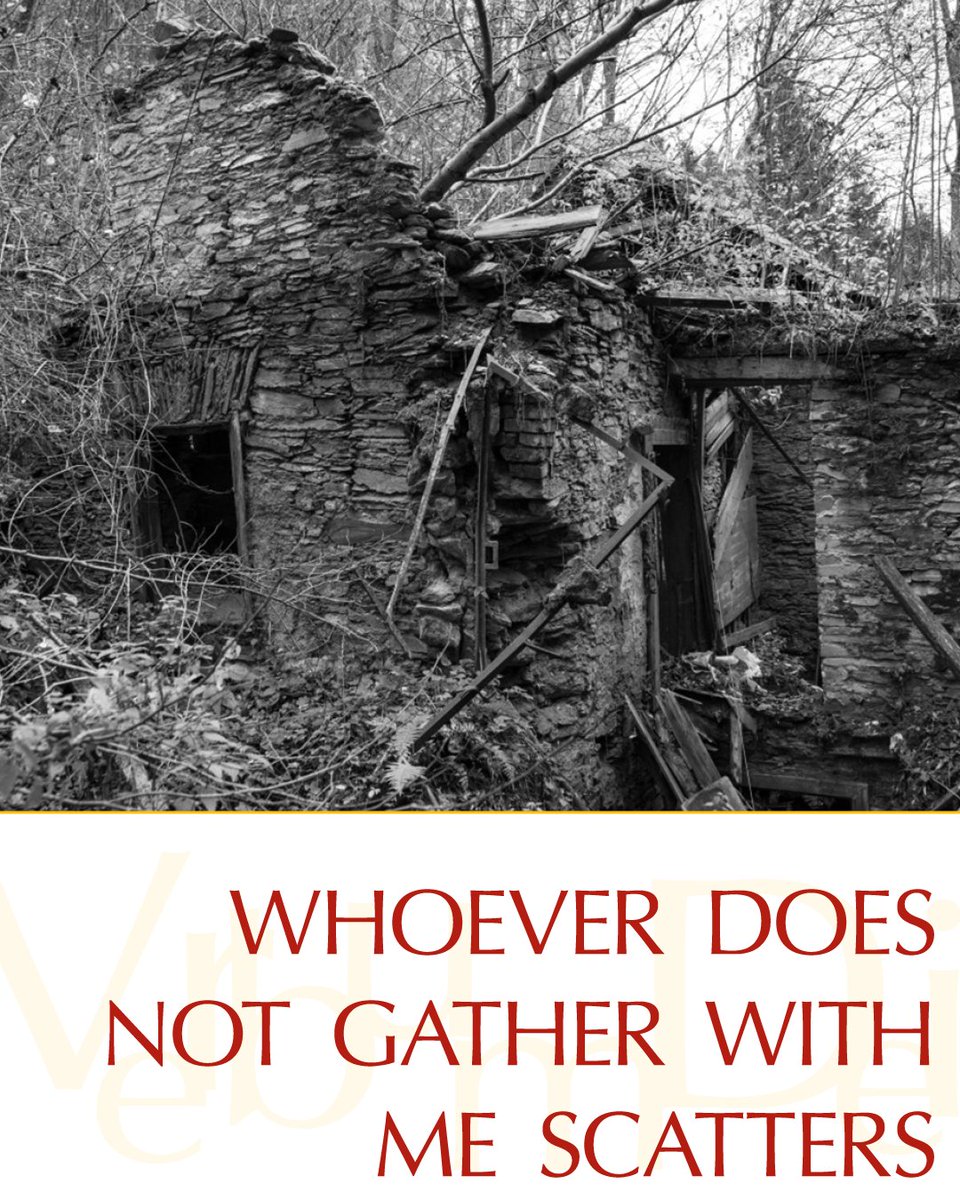
Whoever is not with me is against me, and whoever does not gather with me scatters."
When an unclean spirit goes out of someone, it roams through arid regions searching for rest but, finding none, it says, 'I shall return to my home from which I came.'
But upon returning, it finds it swept clean and put in order.
Then it goes and brings back seven other spirits more wicked than itself who move in and dwell there, and the last condition of that person is worse than the first."
https://t.co/TvtsG79Cf0
NEW: Government watchdog groups file for emergency restraining order in New York to halt Trump taxpayer-funded TV ads
"Despite public statements implying otherwise, defendants continue to run partisan political ads, funded by US taxpayers, in this midst of the ongoing.. federal election period"
So now the Trump administration is sending out one-time $500 checks to people who bought their health insurance through https://t.co/aT2oRibUoZ and paid the full price because they didn’t qualify for taxpayer subsidies.
In other words, people who’s income is roughly 400% above poverty and could already afford to pay full price for their health insurance are getting a $500 check from the president. And guess when those checks started showing up? October 1. Weeks before the midterm election.
The checks come with a letter from Trump lying about why you’re getting your $500. And here’s the really interesting part: this isn’t being distributed evenly across the country. Of the roughly $475 million being sent out, 71% of it, or $339 million, is going to people in just 13 states.
Those 13 states happen to be major midterm battlegrounds. They contain eight of the nine Senate races and 10 of the 12 governors’ races that nonpartisan analysts consider the most competitive.
Call it whatever you want. I’ll call it what it is: a bribe.
The Michigan Public Service Commission has approved special contracts between DTE and Google for the utility to provide electricity for a data center in Wayne County’s Van Buren Township. Full story at link in bio
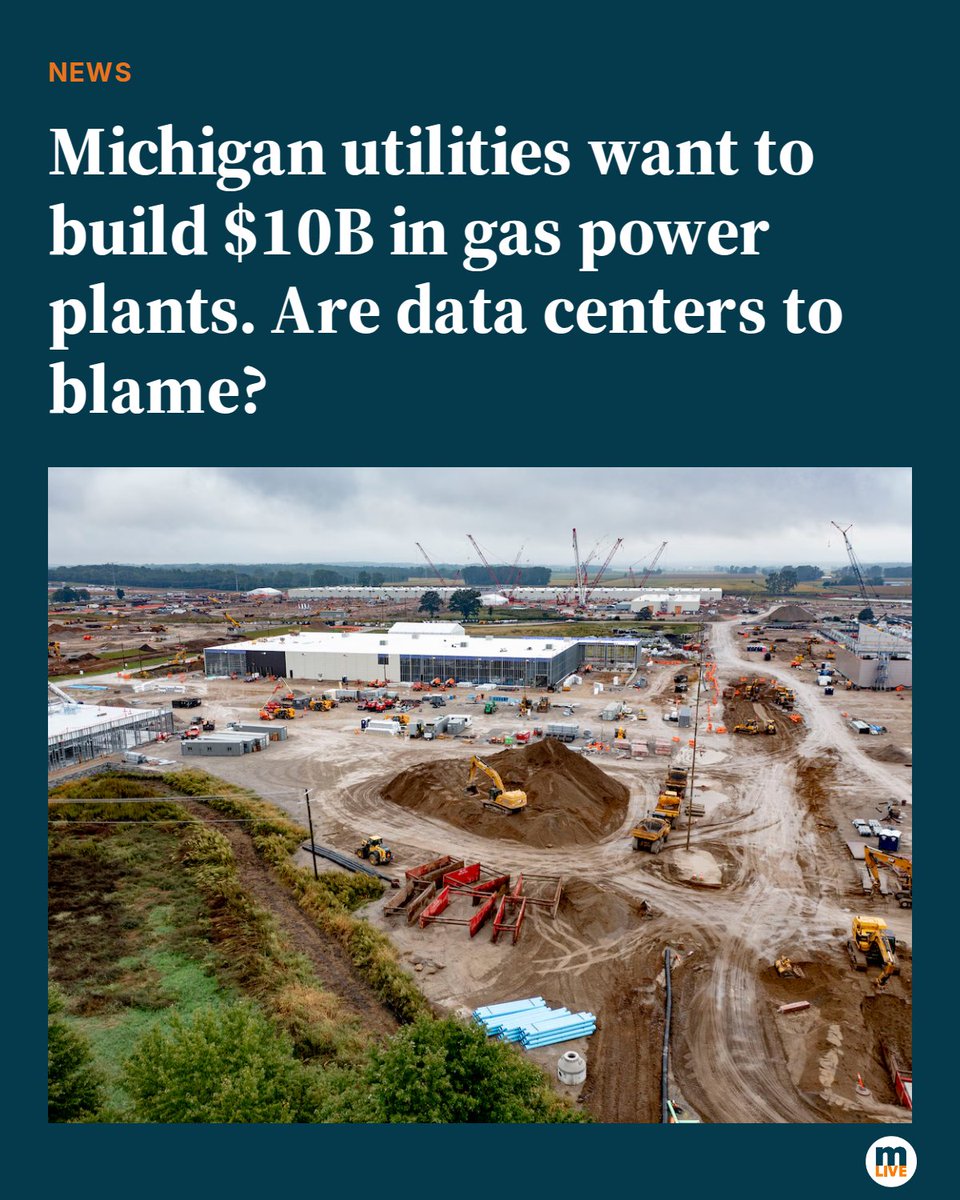
Both DTE and Consumers Energy plan to serve data centers drawing more power than entire cities, leading to scrutiny of their plans to build four new power plants. https://t.co/ixQxpDJVE5
The Michigan Public Service Commission on July 16 said it will investigate why DTE Energy customers experienced up to five days with no electricity after a July 3 storm.
Households and organizations that depend on Consumers Energy also faced delayed restoration times.
“Michigan utility customers deserve reliable service, prompt restoration after storm events, and accurate information on how long outages will last when they do happen,” said Dan Scripps, MPSC chair, in a press release.
“Getting the power back on quickly is especially critical when customers are facing extreme weather events, which are becoming increasingly common,” Scripps added.
Before Gov. Gretchen Whitmer appointed Scripps to the regulatory agency, he led the Michigan Energy Innovation Business Council, advocating for expanded renewable energy and clean-energy policies.
Scripps also advocated for a law that strips local governments of their zoning authority to determine if and how much land is allocated to solar and wind projects.
The state regulatory agency has paved the way for utilities to transition to wind and solar sources through granting billions in rate hike approvals for DTE and Consumers Energy over the past five years.
“We appreciate the MPSC’s work to help Michigan’s energy providers better serve customers after the July 4 weekend storm,” Katie Carey, director of media relations at Consumers Energy, wrote in an email to Michigan Capitol Confidential.
The company understands the frustration customers felt going through a holiday weekend without power because of several rounds of storms, Carey said.
Carey added that the company’s restoration team secured resources to prepare for the July 3 storm and mobilized nearly 500 crews to help communities restore power.
“We look forward to providing all requested information to support the investigation while monitoring and preparing for whatever severe weather might come our way,” Carey said.
DTE did not respond to a request for comment.
Michigan’s clean energy law will, according to some experts, exacerbate power outages and make energy bills more expensive.
The law, which Whitmer signed in 2023, requires utility companies to transition to 100% renewable energy by 2040.
Wind and solar energy sources, often touted as renewable or clean energy, are less reliable than natural gas, some analysts say.
”For years, monopoly utilities have poured billions into net-zero mandates while neglecting the basics — maintaining and hardening the grid,” said Jason Hayes, senior research fellow for environmental policy at the conservative Heritage Foundation.
The predictable result, he added, is a fragile system that routinely fails in heat, storms, and high winds, leaving hundreds of thousands without power.
If regional utilities and regulators had prioritized tree trimming, replacing or burying aging distribution lines, and strengthening infrastructure, these outages would be rare, he said.
“Reliability and affordability should come first for any utility,” Hayes said. “Instead, Michigan’s utilities have prioritized costly, unreliable ‘green energy’ agendas.”
The Citizens Utility Board of Michigan published a 2025 report that concluded in part:
“Overall, Michigan utilities’ reliability performance in 2023 was worse than in 2022, among the worst in the nation and a continuation of a long-standing problem. The five-year averages for Michigan utility reliability performance metrics continue to be among the worst in the country and the worst of any Great Lakes state.”
A report by the Progressive Policy Institute, a center-left organization, wrote that Michigan’s clean energy mandate is causing problems for energy reliability.
“Michigan has real climate progress to show for the last two decades, but holding onto mandates the grid cannot support is a recipe for blackouts, higher bills, and job losses,” wrote Neel Brown, a co-author of a report put out by the institute.
“The state has a legislative off-ramp available, and pragmatic policymakers should use it,” he added.
A spokesperson for state regulators called on utilities to improve their record. “The MPSC recognizes that there is still work to be done to improve the reliability of Michigan’s power grid, and the state’s utilities have to do better at reducing how often outages happen and how quickly service is restored,” Matt Helms, public information officer at the MPSC, wrote in an email to CapCon.
The commission is launching an investigation to focus on where the utility companies fell short after the early July storm, he said.
Energy companies have reduced the average number of annual outage minutes by nearly an hour between 2019 and 2025, Helms wrote. He said this improvement exceeds that seen in other states.
The commission remains committed to implementing the 2023 energy law, according to Helms.
USDA forecasts net farm income will fall 5.5% after inflation in 2026, while production expenses rise to $492.8 billion. Farmers are being squeezed from both sides: less income and higher costs to keep their operations running. https://t.co/KJ0h8dirW0
An overwhelming majority of America’s farmers who responded to a nationwide survey say they cannot afford to purchase enough fertilizer to get them through the year. A survey conducted by the American Farm Bureau Federation shows 70% of respondents say fertilizer is so expensive that they will not be able to buy all the fertilizer they need.
Read the full breakdown in the latest #MarketIntel: 📰 https://t.co/oMeZVzE6YQ
⛽️🧑🌾FARMER: “It’s crazy… we’re paying $75000 more per month for diesel… the economy can’t handle another year of this, or 2-3 months… I wish they’d get that (war) settled…”
Republicans stay silent as Trump’s pointless war of choice crushes farmers.
Diesel powers nearly every part of Craig Underwood's California farm. But as fuel prices hit record highs, the 84-year-old says the rising costs have become impossible to escape, keeping him awake at night and squeezing the economics of growing food
After key postal changes and legal back-and-forth over President Donald Trump’s attempts to restrict mail-in voting, you may be confused about what to do if you are planning to vote by mail this election.
In short: A new U.S. Postal Service rule regarding postmarks is in effect. But the Trump administration’s proposed mail voting restrictions are not after the Supreme Court struck them down.
The changes come amid repeated false claims by Trump around the security of mail-in voting, which seem to be denting confidence in this method of voting and the USPS.
PBS News’ Tim McPhillips breaks down what you need to know before mailing in your ballot, and what options you have if you’re concerned about voting by mail in the 2026 midterm elections.
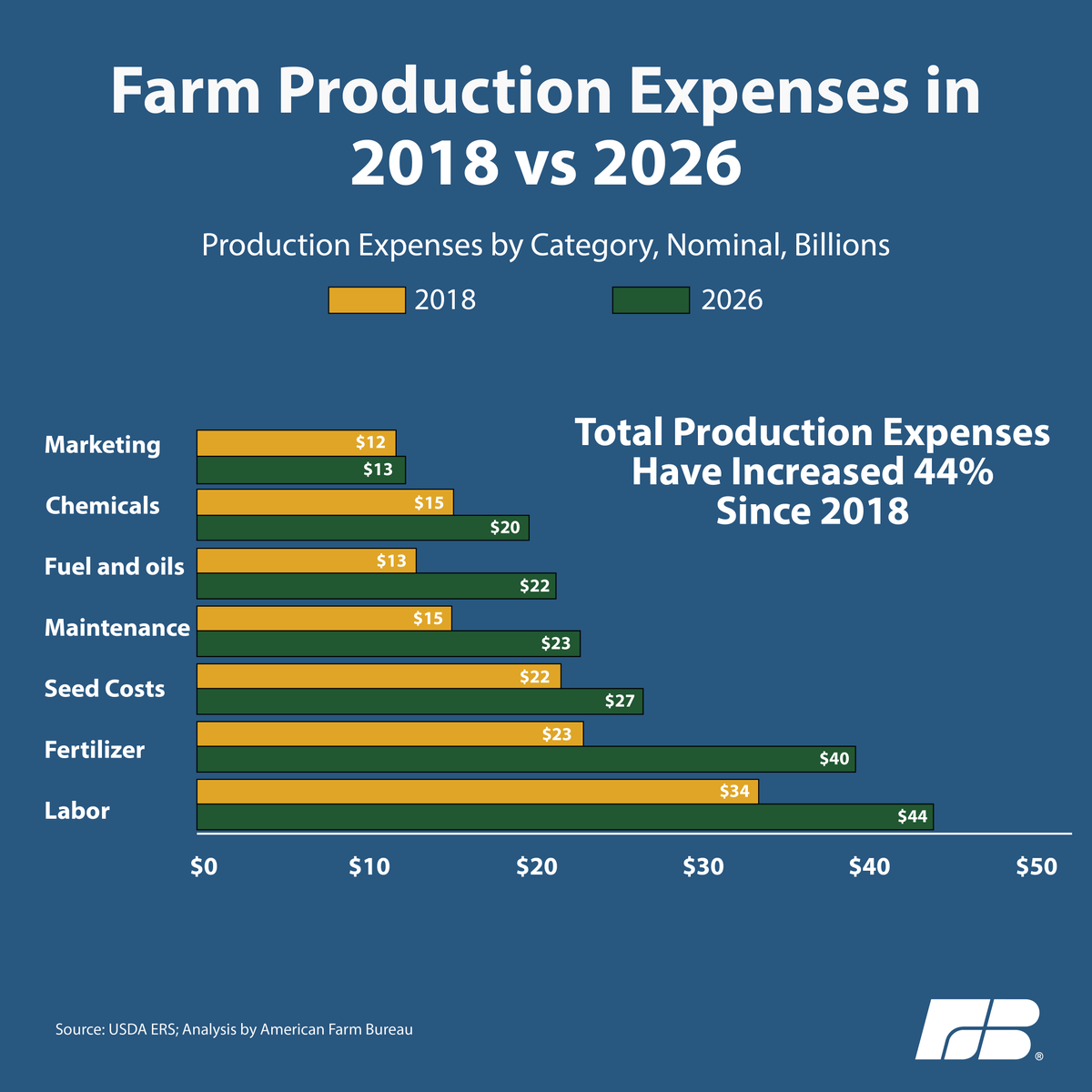
The overall cost of operating a farm has risen sharply since the 2018 #farmbill was enacted. Total U.S. farm production expenses increased from approximately $343 billion in 2018 to a projected $492.8 billion in 2026—that's an increase of nearly 44%, or about $150 billion. Learn more in the latest #FarmBureauIntel: 📰 https://t.co/X847CQvPyJ
America’s agriculture producers use derivatives markets to manage many of their financial risks, but they also face physical risks as they carry out the demanding work of feeding our country. This National Farm Safety and Health Week, @CFTC recognizes our nation’s farmers and ranchers and encourages them to take care of themselves and those working beside them. Learn more about #FarmSafety at https://t.co/wiURVkmbtZ. #NFSHW
This should be a bigger story.
More than 15,000 American farms shut down in 2025. The American Farm Bureau has warned that rising costs, falling margins, and policy decisions in Washington are pushing family farms to the brink.
At the same time, Republicans in Congress cut over $1 billion from programs that helped schools and food banks buy food directly from local farmers, strengthening local agriculture while feeding children and families.
The result is exactly what farmers feared: fewer buyers, less stability, and more farms disappearing.
This didn’t have to happen.
Mississippi lost 300 farms last year.
Trump’s trade wars and economic policies are making it even harder for our farmers to keep their operations running. When farmers struggle, rural communities struggle.
I will continue fighting to lower costs, strengthen markets, and protect Mississippi’s farm families and rural economy.