@healthapiguy The question will be who will the the trusted source of reconciling. Right now, we make patients jump through hoops to get their med list right in their patient portal, hence the continuation of self-made lists on sticky notes.
@healthapiguy nurse dream: Not having to select and enter 15 medications on a new patient who decided to pop into my ER for the 1st time and is well seen in another ER and health system. Can't a patient just bring me a QR code I scan and they load sourced into my team's EHR?
@healthapiguy 100% agree. there is data that we need patients and caregivers to reconcile and others that are truly "owned" by the system. You can prescribe all the things you want in your EHR, but if I ain't picked up my Rx and put it into my piehole, then it's not on my med list at home.
It was a nurse that led @rachelsuzhunt to a group of young cancer patients to make her journey less alone.
Keep using your voice, Rachel! A few mentors for you: @TheLizArmy and Adam Hayden’s TikTok and blog https://t.co/bViNNW1tnq to see how “normal scary” your journey is.
I try not to get too personal on this app for fear of being perceived™️, but I wanted to share a piece I wrote for The @washingtonpost
Cancer took my life by storm, and only now is it calming. I’m grateful I can shine some light on this growing issue https://t.co/w4FDty1xUG
@rachelsuzhunt@washingtonpost Your story matters. Get as personal as you need to & are comfortable doing. Never apologize for being honest & real. Never apologize for refusing to accept “bad luck” as you see the data and on the front lines with your “Still alive” posse. And be the owner of your health story!
2/ the waitlist of Hoosiers needing critical services
3/ reimbursement for services provided to children with complex health conditions.
I will tirelessly advocate for adequate healthcare coverage for the 2 million Hoosiers who rely on Medicaid to receive life saving services.
https://t.co/AgO75jjVOt
Hot off the presses! Jean Ross, MHA, BSN, RN, critical care nurse, former VP of the Indiana Nurses Foundation, Dementia Friends Champion, and long-time CARE supporter, shares lessons learned volunteering with CARE in her latest article.
I think #love is not just doing stuff you like for someone, it's doing something you hate, time after time because they need it and you love them. #als#mnd
@joshuapliu Just to educate, AI matching for nurse staffing would be huge. It’s way more than language. Nurses often are as specialized as doctors so there is a need to know years of experience, equipment checked off on, patient population trained in, certifications, age, etc.
@mickytripathi1 Thank goodness you only saw one doctor that day! Just imagine if you walked down the hall to a 2nd appointment with a different doctor in “the same health system”, and you were handed this packet again. That experience may have led to federal changes for all of us.
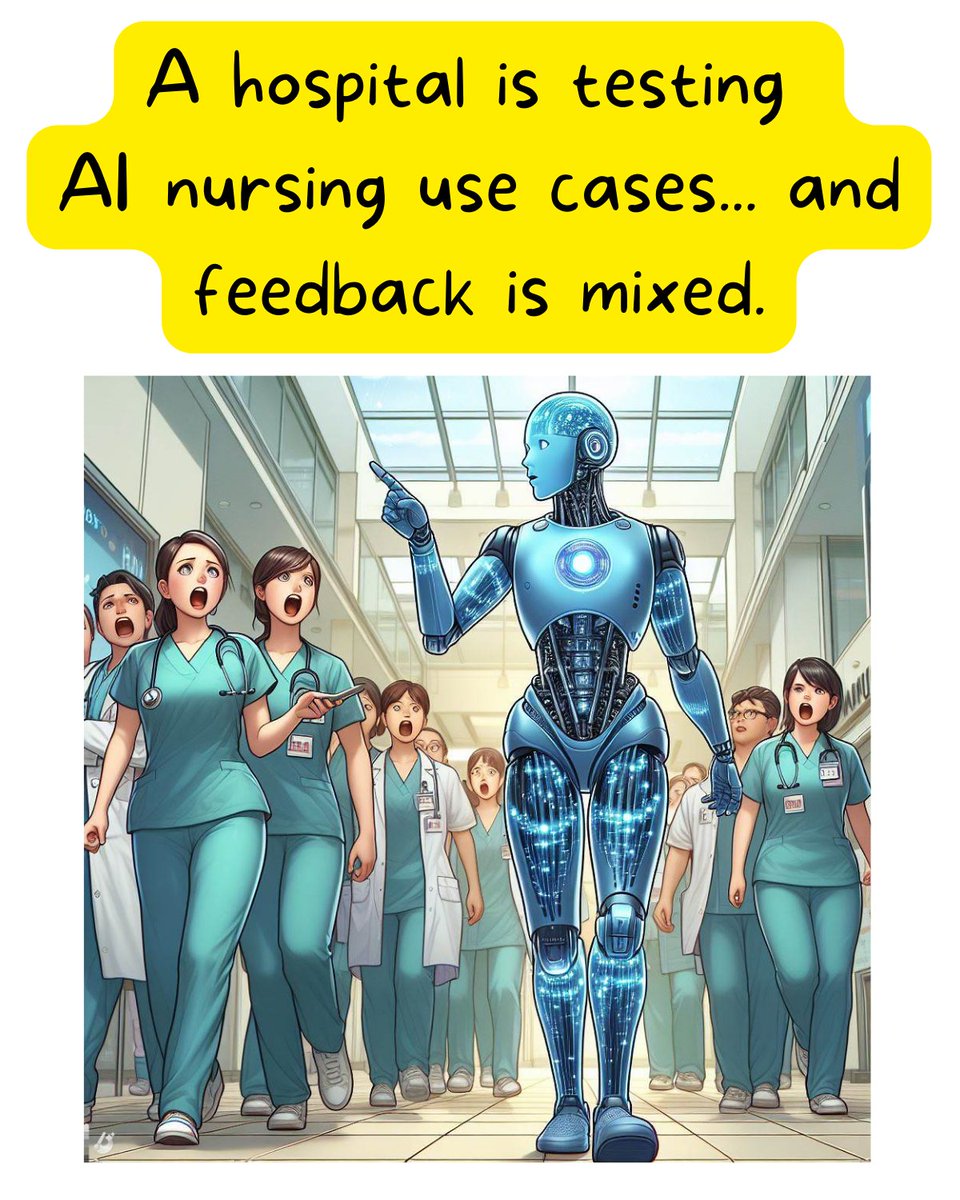
UCSF Health is in the early stages of testing various AI tools to tackle workforce burnout and staff shortages - with mixed feedback from nursing staff.
Use cases they are testing:
🔮 Predictive analytics to flag patients deteriorating in-hospital
The challenge with predictive analytics is always the “so what?”
Unless there is a clear protocol on how to respond to the outputs of a predictive analytics engine, it’s just an academic exercise.
We have clear protocols for when a patient suddenly develops a fever.
But what do we do if predictive analytics “warn” me that a patient has a 20% risk of mortality in the next 30 days but no other symptoms?
Until someone creates a protocol for these situations, it’s an insight with no action.
👩⚕️ AI matching engine to pair nurses with patients based on the nurse’s background, education and experience
I guess perhaps language is the obvious matching parameter. Maybe clinical areas of interest…?
But do we create a risk of frontline staff developing too narrow an experience of patient care if they end up treating a homogenous set of patients?
Is increased specialization of this type net beneficial for patient care?
I guess someone’s going to test it…
🏥 Predictive analytics for patient flow - recommending which patients should flow to which beds in the hospital
OK this I like and is probably universally accepted (and I’m pretty sure already exists as 3rd party solutions)
📚 Custom GPTs for staff to query training materials
E.g. asking the GPT “how to change a dressing” instead of needing to be taught live.
This I like and we will likely see an internal FAQ chatbot for every organization - even outside of healthcare.
While beneficial, this can’t be the killer use case… I mean, how much time does this actually save?
Meanwhile a local nursing union has raised concerns that AI will reduce the clinical workforce, de-personalize patient care, and increase risks of error (e.g. AI bias).
I think most of those concerns are largely addressable, especially with time and experience.
And actually, the workforce shortage is so bad, I doubt AI will reduce the clinical workforce anytime soon. One could also ask: if AI could reduce the required clinical workforce while improving access/quality of car, why is that bad?
That said I think this is a good example for getting the right initial use case - one that is high ROI and shows the potential of AI while being seen as universally beneficial by most parties - is so important for educating the healthcare system on the potential good for AI.
Help everyone experience the potential good for AI and then people will be more open-minded to new use cases.
What do you think?
What use cases would get the most nursing buy-in while driving a high ROI?
@mickytripathi1 I don’t know @mickytripathi1, I am pretty ecstatic you are among the near 40% who knows the general ingredients to egg salad AND what kind of store to find them. But, now that you realize your mistake, how do we make sure you can file a claim so grocery stores know to do better?
@joshuapliu I think about all the Googling families do when faced with a scary diagnosis. I know, as a wife & mom, I would want my hands on what that doctor is seeing, but not saying to us in the decisions they’re weighing about my family members care. These tools feel so one-sided.
Excellent piece. I cringe when I see new tech laser focused on wellness & health as if it’s all in our control. Sometimes it’s just bad luck and our words matter to ensure we do not isolate others:
How to navigate a chronic illness https://t.co/9mR99XgWiH via @voxdotcom