Sports & Lifestyle medicine physician. Rugby Doc. Olympian. Triathlete. Fitness professional. Low-carb real food crusader. Author of The Low-Carb Companion.
Morocco touts state-of-the-art technology center being built in Tan-TanMorocco touts state-of-the-art technology center being built in Tan-TanMorocco touts state-of-the-art technology center being built in Tan-TanMorocco touts state-of-the-art technology center being built in Tan-Tan.
I am going to tell you what HDL cholesterol actually does inside your body. Your doctor calls it “good cholesterol.” That label hides the real story.
HDL is not a type of cholesterol. It is a transport vehicle. A cleanup truck. It does five things that keep you alive.
It removes excess cholesterol from your artery walls and carries it back to the liver. It prevents LDL from oxidizing. Oxidized LDL is what damages arteries. Not LDL itself. It protects your entire lipid system from oxidative damage. It keeps your blood vessels flexible. It reduces dangerous clotting.
HDL is not just “good cholesterol.” It is the defense system of your cardiovascular health.
So why is yours low.
Insulin resistance. When insulin is high, your liver overproduces triglyceride-rich VLDL particles. Those VLDL particles swap their triglycerides for the cholesterol inside your HDL. HDL becomes triglyceride-loaded. Your body clears it from the blood too fast. Your HDL count drops.
This is why triglyceride to HDL ratio is the strongest metabolic marker on a standard lipid panel. High triglycerides plus low HDL equals insulin resistance. Low triglycerides plus high HDL equals insulin sensitive.
My HDL has risen from 48 to 75 over six years. Zero drugs. I fixed the upstream cause.
The truth heals
Nearly half the fat inside a human artery plaque is omega-6 from vegetable oil.
Somebody took the plaques out and weighed what was in them.
A London team pulled them from men who had died of heart disease, then compared each plaque against the fat on that man's own body, which is a decades-long record of what he had been eating.
The omega-6 in the body fat matched the omega-6 in the plaque.
The omega-6 in the blood matched the omega-6 in the plaque.
The saturated fat matched nothing at all.
Three years later the same group counted 668 plaques taken from thirty men dead of ischaemic heart disease.
Omega-6 came to between 44 and 46 per cent of all the fat in them.
Which is what you would expect, because of how a plaque is actually built.
An LDL particle has to oxidise before a macrophage will swallow it. The macrophage becomes a foam cell. The foam cell becomes the plaque. Every cardiologist on earth agrees on that sequence.
Oxidation starts by tearing a hydrogen off a fatty acid, and it can only tear one off a polyunsaturated fat. A saturated molecule offers nothing to grab. A monounsaturated molecule barely does.
So linoleic acid is the ingredient the disease requires. It is the thing that goes rancid, gets eaten, and gets left in the artery wall.
Saturated fat cannot perform that reaction. It has never been chemically capable of it.
The Lancet printed the first paper in 1994, and the authors wrote plainly that the push towards eating more polyunsaturated fat ought to be reconsidered.
Nobody reconsidered anything.
Butter has served thirty years for a crime the frying oil committed, and the evidence was on the slab the whole time.
This green sauce is dangerously addictive - simple ingredients, 10 minutes to make, and one secret ingredient that changes the final flavor. Make it once and you’ll put it on EVERYTHING.
Over the past week I showed you three numbers your doctor has probably never calculated.
HOMA-IR: 0.80. Optimal. Predicts heart disease better than glucose or insulin alone. 65 studies. 516,325 people.
Trig/HDL ratio: 0.83. Ideal. Gaziano showed a 16 fold increase in heart attacks at the other end of the scale. The strongest lipid predictor ever measured.
hs-CRP: 1.2. Moderate. The one I am still fighting. Outperformed LDL for 30 years in 27,939 women. The strongest inflammatory predictor in cardiology.
Every person who saw those posts asked the same question. “How did you get there?”
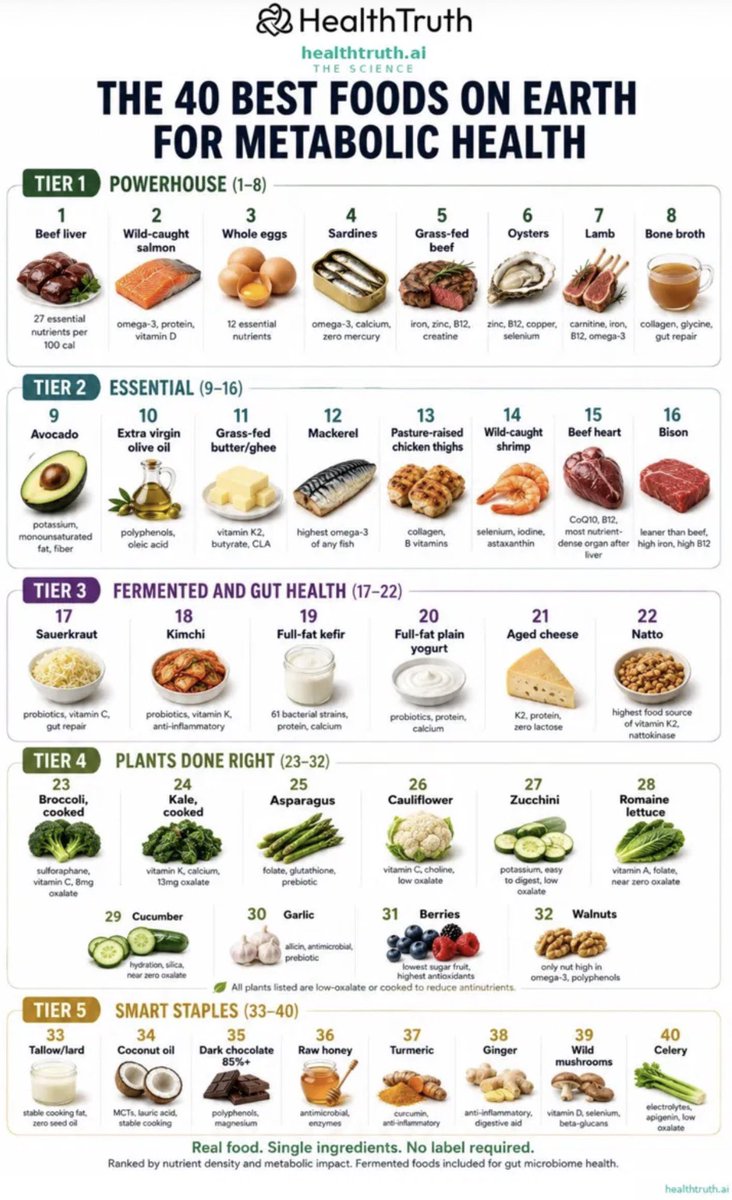
This is the answer. 40 foods. Ranked by nutrient density and metabolic impact. No prescription. No protocol. No diet with a name.
Tier 1 is what moved my HOMA-IR. Beef liver. Wild caught salmon. Whole eggs. Sardines. Grass fed beef. Protein and nutrient density that stabilizes insulin without spiking it. Dragon head number one goes quiet when you eat from the bottom of this list.
Tier 2 is what moved my trig/HDL ratio. Avocado. Extra virgin olive oil. Grass fed butter. Mackerel. These are the fats that raise HDL and keep triglycerides low. No drug has ever done what these foods do. Four pharmaceutical programs tried. Every one failed.
Tier 3 is what I am using to fight my hs-CRP. Sauerkraut. Kimchi. Full fat kefir. Natto. Fermented foods rebuild the gut. The gut controls inflammation. Inflammation is the marker I am still working on. 1.2 is not where I want to be. This tier is how I get there.
Tier 4 is plants done right. Broccoli. Kale. Asparagus. Garlic. Berries. Walnuts. Anti-inflammatory. Low oxalate. Cooked to reduce antinutrients.
Tier 5 is smart staples. Tallow instead of seed oils. Coconut oil. Dark chocolate 85 percent or higher. Turmeric. Ginger. Every one of these replaces something that feeds the dragon with something that fights it.
No seed oils on this list. No refined sugar. No ultra processed food. No artificial anything.
Three numbers. 40 foods. Zero drugs. Six years.
Your doctor checks your LDL and writes a prescription. I checked two hundred markers and changed what I ate.
The truth heals
Sleep is the most powerful medicine on Earth.
It boosts memory, recovery, fat loss, and even helps with anxiety.
Here’s how to improve it with 7 simple steps:
1. Don’t sleep 8 hours.
1979: fasting glucose over 140 makes you diabetic.
1997: lowered to 126.
Millions of new diabetics. Same blood.
1997: prediabetes starts at 110.
2003: lowered to 100.
A third of American adults, created by a footnote.
1984: high blood pressure is 160/95.
2017: lowered to 130/80.
American hypertension goes from 32 per cent of adults to 46. Thirty-one million new patients in a morning.
2001: the cholesterol target is 130.
2004: lowered to 100, and to 70 for the high risk.
Statin eligibility expands by millions.
Eight of the nine men who wrote that 2004 update were on the payroll of companies selling statins. They disclosed it only when forced.
1994: a WHO panel invents osteopenia. Bone that is not thin enough to break, given a name and a prescription. Half of older women qualify.
Nobody got sicker on any of those dates. A committee sat down and a number moved.
The threshold drops, the market widens, and the drug is already licensed and sitting in the warehouse.
Your grandfather was healthy at 145/92. You are ill at 132/81.
Nothing about the body has changed. Only the paperwork, and who profits from it.
Joe Rogan yells "Holy sh*t!" after Harvard professor of genetics David Sinclair says sudden blindness has DOUBLED because of GLP-1 drugs.
Then Rogan pulls up the data himself — and what he reads out loud is even worse.
SINCLAIR: "Glaucoma and also sudden blindness. It's called NAION, which is now twice as more prevalent because of the GLP-1 drugs."
ROGAN: "Really?!"
SINCLAIR: "It's not well known. Obviously companies don't want to talk about it. But yes, sudden blindness has doubled, seemingly because of these meds."
ROGAN: "Holy shit!"
SINCLAIR: "Careful."
ROGAN: "Sudden blindness has doubled because of GLP-1s?"
SINCLAIR: "Due to NAION, which is like a stroke in your eye, and then your other eye can go. Which is pretty scary. And there's nothing you can do about it. Hopefully our drug does work for those people."
ROGAN: "And, obviously correlation does not equal causation, but it seems to be."
SINCLAIR: "Yeah, there's a scientist at Harvard. You could look up his work. Joe Rizzo. It looks like it's repeatable across the planet."
ROGAN: "Wow, that's terrible. Terrible because there's so many people out there that are just telling everyone they should get on GLP-1s… Like online podcasters saying, 'Everyone should get on GLP-1s… It's going to transform society.' I'm like, 'We just started taking these! The f*ck are you saying?!'"
SINCLAIR: "Yeah, it's not risk free. Same with ED drugs."
ROGAN: "Here goes. Recent studies suggest that a potential risk — rare link between GLP-1 receptor agonist medications such as Ozempic, Wegovy, blah, blah, blah, and… an eye stroke [that] can cause sudden, painless loss of vision in one eye, while absolute risk remains very low."
ROGAN: "Well, very low is like… What does that mean?"
SINCLAIR: "One in 10,000 people."
ROGAN: "One in 10,000?"
SINCLAIR: "Oh no. Total of 10,000."
ROGAN: "Oh, total of 10,000 so far? How many people are taking this stuff?"
[Rogan continues reading]
"The drugs were 68.6 times more likely to develop this [eye stroke] and 8 times more likely to develop… diabetic retinopathy."
ROGAN: "Oh, my God. Then… Wow."
ROGAN: "Yeah, man. These things are just — they're just rolling out…"
1/12
I'm a cardiologist. Your annual physical lasts about 7 minutes and ends with four words that mean almost nothing:
"Everything looks normal."
Here's what that actually means: nothing crossed a threshold that triggered an automatic flag.
It doesn't mean you're healthy.
And here's the part nobody tells you — "normal range" was built from a population that is largely sick. It's the middle 95% of people who got tested. In a country where 40% of adults are obese and heart disease is the leading killer, being "in range" means you resemble a population that's dying of preventable disease.
You don't want normal. You want optimal.
Here are the tests nobody runs unless you ask.
1/12 I'm a cardiologist. After twenty years and thousands of patients, I've distilled everything that actually moves the needle on longevity into ten pillars.
Not biohacks. Not $2M protocols. Not supplements someone is selling you.
Ten levers, ranked by evidence, with exact targets, the labs to demand, and the words to say to your doctor.
Save this. It may be the most useful thing you read this year.
A single night of sleep deprivation is enough to impair muscle protein synthesis. (I’m a terrible sleeper, so I share this with some dismay.)
In a randomized crossover study of healthy young adults, one night of total sleep deprivation reduced postprandial skeletal muscle protein synthesis by 18% the following day (and lowered testosterone by 24%).
Unfortunately, this means a single bad night is therefore enough to create meaningful anabolic resistance. This immediate and acute drop in muscle protein synthesis helps explain why chronic sleep loss is linked to reduced muscle mass.
https://t.co/KLpJmG3x4t
1/10 I'm a cardiologist. I've recommended low-dose daily tadalafil for years — not for the bedroom, but for the blood vessels.
Most people think of these as sex drugs. I think of them as vascular drugs that happen to work below the belt.
And a study published two weeks ago suggests they may do something nobody predicted: make it harder for cancer to spread.
Here's the complete picture — the mechanism, the evidence, who should consider them, who absolutely shouldn't, and what I actually do.
8/10 — WHO SHOULD CONSIDER IT, AND WHEN
Men 40-50 with new ED — get the cardiac workup first. Don't just treat the symptom. The ED may be your earliest warning of vascular disease, and finding that at 45 is a gift.
Men 50-70 — this is the sweet spot for daily low-dose tadalafil in my practice. ED, BPH symptoms, and endothelial protection addressed together with a well-tolerated, inexpensive generic.
Men over 70 — still reasonable, but the calculus shifts. Check for orthostatic hypotension, review the full medication list for interactions, and start at the lowest dose. Falls become a real consideration.
Men with diabetes — arguably the group with the strongest signal, since diabetic vascular disease and ED travel together and the endothelial benefit may matter most.
And women: PDE5 inhibitors are not approved for female sexual dysfunction and the evidence is weak. Sildenafil is used in women for pulmonary hypertension. For female desire and arousal, the tools are different — vaginal estrogen, testosterone, flibanserin, bremelanotide.
Five ingredients, one dish, 145g of protein and not a single carb.
The carnivore cheeseburger casserole takes five minutes of prep and thirty one in the oven. Americans call it hamburger casserole. Same tray, same cheese, different passport.
Everything that goes in:
- 1kg beef mince, 20% fat.
- 300g bacon.
- 200g mozzarella.
- 2 eggs.
- 50ml double cream.
That is the list. No tinned soup, no pasta, no breadcrumbs smuggled in to make the beef go further. Nobody has to chop an onion and pretend it was for the flavour.
Brown the bacon, take it out, chop it. Brown the mince in the same pan with most of the cheese going in as it cooks. Whisk the eggs and cream, fold it through the beef with most of the bacon, press it into a dish and lay the rest of the cheese and bacon on top. Foil on, 200C, fifteen minutes. Foil off, five more. Rest it five before you go near it.
What comes out is a tray of beef and bacon set under a cheese lid that has gone brown and slightly crisp at the corners, sitting in its own rendered fat, and it slices like a proper bake.
Then look at what you have actually eaten. 145 grams of protein. 170 grams of fat. Zero carbs. Every fat soluble vitamin, all the B12 you need for a week, heme iron your body absorbs on the first attempt, and creatine and taurine you will not get from a plant at any dose.
Complicated cooking exists because somebody needs to justify a shopping list.
Five things in a dish. Feeds you twice. What exactly is anyone else doing.
The year is 1925. Your doctor says you look run down and writes down the name of a tonic, and you drink it the way you drink anything a doctor names, a bottle a day, feeling marvellous. It is radium in distilled water. Four hundred thousand bottles are sold on medical endorsement, and the steel magnate who got through fifteen hundred of them is buried in 1932 in a lead-lined coffin.
The year is 1948. Your baby is screaming with teething, so you do what the health visitor says and work a fingertip of powder into his gums, morning and night, for months. Then his hands and feet go raw and pink, daylight becomes unbearable, and the child who was babbling in the spring stops speaking. The powder is mercury, a fifth of the babies it does this to die, and it stays on the shelf until 1954.
The year is 1958. Your wife is seven months gone and they send her down the corridor for the routine X-ray, and she lies on the cold plate with her coat over the chair and thinks nothing of it. An Oxford epidemiologist has just shown that one abdominal X-ray in pregnancy roughly doubles the child's chance of dying of cancer before adolescence. The profession declines to believe her, her funding dries up, and the radiographers carry on for twenty years.
The year is 1983. Your son has haemophilia, and the new treatment means no more nights in hospital, just a vial from the fridge and a needle at the kitchen table before school. The vial is pooled from thousands of paid American donors, some of them prisoners. Around twelve hundred and fifty British haemophiliacs are given HIV this way, and the inquiry that finally says so out loud reports in 2024.
The year is 1989. You are on a ward after your heart attack watching the monitor throw an extra beat, and they start you on a tablet to stop it doing that, because obviously a heart that skips is a heart about to stop. Somebody finally tests the tablet against a placebo. Seven point seven per cent dead within ten months on the drug, three per cent on the dummy, and the trial is halted early.
The year is 1995. Your sister takes the high-dose chemotherapy with the bone marrow transplant because her oncologist calls it her best chance, and you sit in that corridor for four weeks while it takes her hair, her gut lining and two stone. Forty thousand American women go through it. In 1999 the trials find no survival advantage over ordinary treatment, and in 2000 the data that convinced everybody turns out to have been invented.
The year is 2016. Your daughter is epileptic and pregnant and stays on the medicine that has kept her seizure-free since she was nineteen, because nobody at any appointment has ever told her otherwise. That is the year the warning finally reaches the box. The risk had been in the literature since the seventies, and roughly twenty thousand British children were born into it while the paperwork caught up.
Now it is today.
Your doctor has new drugs, new numbers and a fresh consensus, and he can tell you exactly what the evidence shows.
So could every doctor on this list.
None of it was quackery. All of it was the standard of care, taught in the schools, printed in the guidelines, paid for by the state.
That is what a wrong answer looks like from the inside, and you are standing in one now.
Here’s the story of how the Community defeated the latest invasion of Monavale Wetland (one of Harare’s primary water sources) on Thursday this week (30 July 2026) using the community’s secret weapon: Gogo Power - a group of elderly women who have an uncanny fearlessness to stand down bulldozers. Their courage inspires others and this week I had an opportunity to walk in their footsteps and stand down a bulldozer charging at me.
For decades, the Community living around Monavale Wetland has defended it from invaders. The Community quickly responded with reinforcements — including some serious Gogo Power — and the illegal bulldozing on the wetland was stopped.
The City of Harare and the Environmental Management Agency showed up and fined those involved in the illegal bulldozing of the wetland and the community chased them away!
This is an inspiring story about how when communities stand together and fight for their future, they can defeat those who put profit over people.
This is just one battle in a long battle to save our wetlands, which means saving our water sources. Join the fight by speaking up, spreading the word, and standing together with your community for a better future.
#PeoplePower #WetlandsMatter
David Sinclair has spent decades at Harvard studying how to slow and reverse aging.
He revealed 10 things you can start doing today to actually live longer (THREAD):
1) Fasting turns on your longevity genes
TLDR:
1. Fasting turns on your longevity genes
2. Fifteen minutes of movement adds years
3. Fish beats meat for longevity
4. Cold exposure builds a fat that helps you
5. Sauna use protects your heart
6. Stressed plants make you healthier
7. A cheap diabetes drug does more than expected
8. Bad sleep ages your brain fast
9. Strength training grows new brain cells
10. Omega-3s insulate your nerves