1/
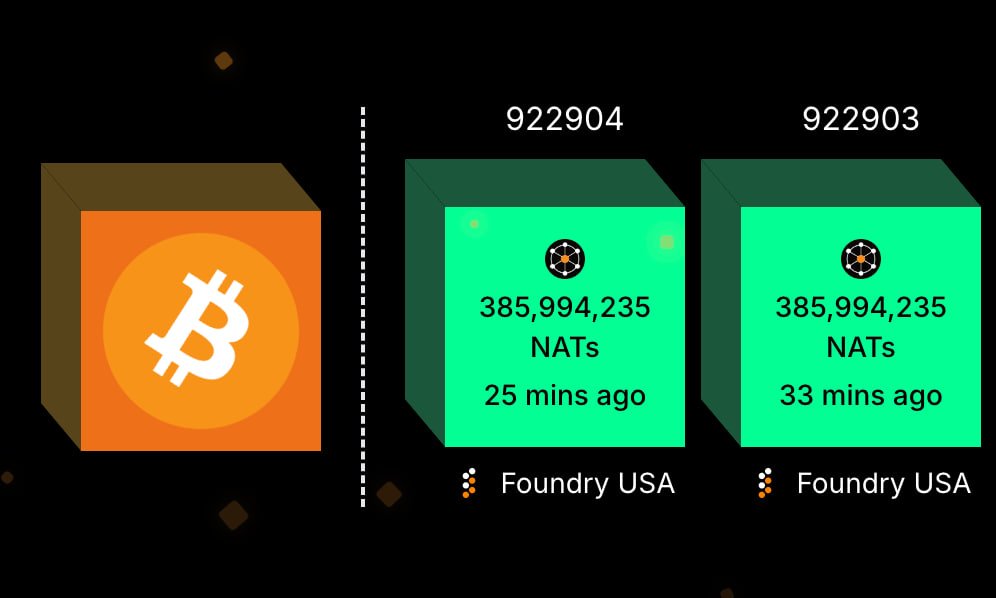
Wanna know everything about $NAT but too lazy to dig through docs and sites?
This thread’s for you 🧵
We’ll break down what $NAT is, how it ties to Bitcoin itself, and why it might redefine miner incentives forever
And for everyone screaming “but miners will just dump it!” — stick around till the end
You might be surprised 😉👇
learned this the hard way these last couple months
february to june of this year i was annihilating when many others weren't - market really fit my style, so much to a degree where I actually got away with a ton of sloppiness (the infamous fat finger was probably a coyote top signal) and subsequently formed a lot of bad habits. ego grew so big from winning so hard i rationalized the tide turning as "variance" and kept it pushing. not only did i end up giving back most of what i gained in the mini-heater, i entirely eroded my confidence to a point that when better conditions arose - i wasn't on the nose and missed almost all of the rotations which compounded the drawdown.
one thing they don't tell you about the plight of the ape is that it can quickly become "win big lose bigger" if cockiness and complacency begin to seep into your wallets. when this happens, the absolute worst thing you could do is keep clicking - the market will still be there when you aren't crashing out.
in the grand scheme, just a minor setback. but if you fight these moments of forced humility - that is how you blow up
cockroach mode // Still In The Game
Why You Never Take Profit
You don’t fail because you can’t find winners. You fail because you never close them.
Most traders don’t fail at entries, they fail at endings. The exit is tied to a number, and a number has no boundary.
As price rises, the brain updates the goal in real time. That update loop is built in: dopamine prefers variance, social proof lifts expectations, and the “goal-gradient” pushes you to stretch the target the closer you get.
A number does two things to your psychology.
First, it creates a moving threshold: any level can be justified as “almost there,” so decisions are perpetually deferred.
Second, it protects ego: raising the target lets you preserve the identity of the brilliant holder a little longer. Both forces bias you toward indefinite postponement.
Nothing in your life actually changes at a price on a screen, so the mind finds no reason to stop.
Purpose breaks that loop because it introduces a state change your brain can recognize.
Paying off a liability, buying time, funding runway, securing an asset....these are discrete outcomes.
They flip your environment from one state to another, which gives the brain closure. Closure reduces the tension to keep negotiating with the future. You convert “maybe more” into “definitely mine,” and the decision holds.
Purpose also rewires regret.
Numbers anchor you to the counterfactual of “what if I held longer,” which is unbounded and will always win the argument. Purpose anchors you to certainty: the debt is gone, the runway exists, the asset is owned.
Humans regret lost certainty far less than missed extra upside. That asymmetry is what makes purpose durable under pressure.
There’s a second-order effect people miss: profits with purpose improve the next round.
Lower stress, fewer forced trades, more patience, clearer time horizons. Capacity goes up, error rate goes down.
You didn’t just take money out; you increased the quality of your future decisions. In a game with infinite rounds, that compounding edge matters more than squeezing the last leg of a single move.
Numbers drift; purposes hold.
Give your wins an outcome that exists outside the market, and the exit stops feeling like betrayal of opportunity. It reads as completion, and it funds a stronger next hand.