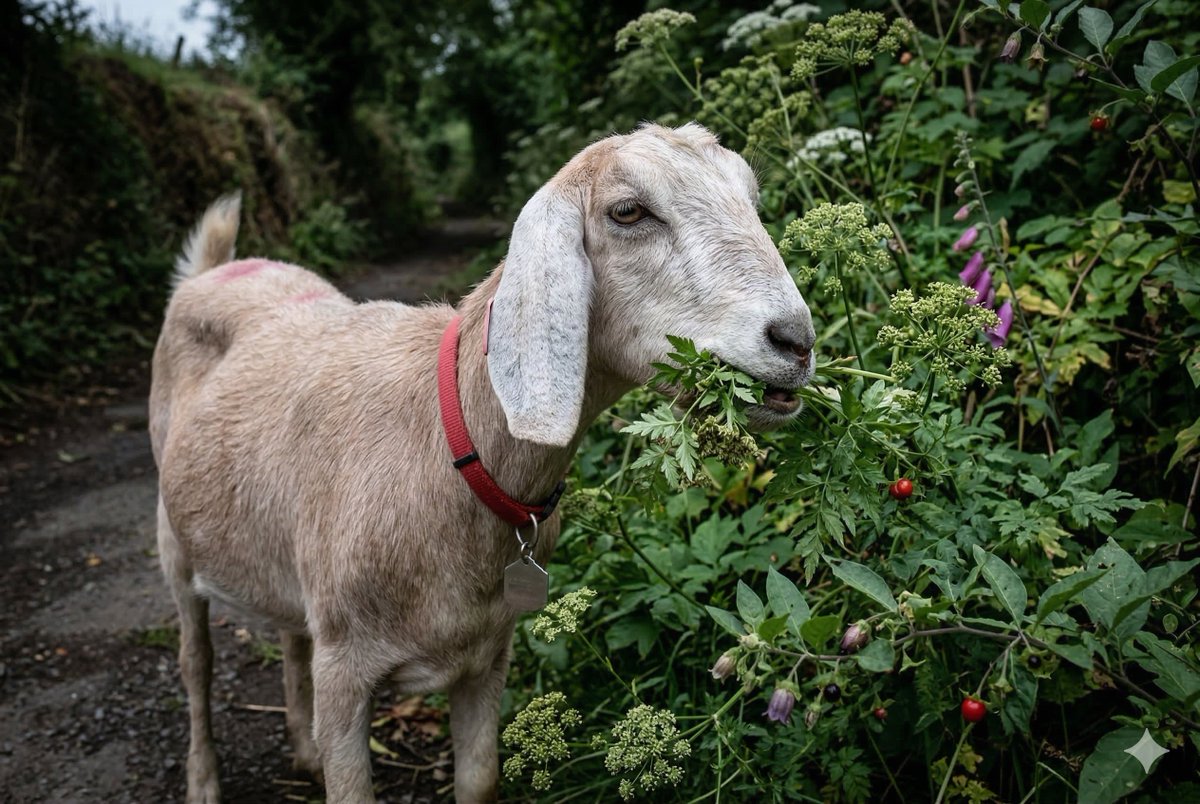
Keith eats things that will kill you.
Literally. Several of the plants Keith eats routinely contain compounds that, in sufficient quantity, are toxic to humans and most other mammals. Tannins at concentrations that would cause liver damage in a dog. Oxalates that would crystallise in a human kidney. The irritant compounds in dock and nettle that produce the specific burning sensation familiar to anyone who has walked through a field in shorts.
Keith eats all of it. Keith converts all of it. Keith has a rumen containing a microbial population that evolved in the Zagros Mountains of Iran over ten thousand years specifically to handle these compounds. The microbes detoxify as they ferment. The tannins are neutralised. The oxalates are broken down before they reach the bloodstream. The irritants are processed. The cheese that comes out the other end contains none of them.
This is not unusual for Keith's species. It is the mechanism by which goats became the premier scrub management tool in pre-industrial land management across the entire Middle East, North Africa, and Mediterranean. The landscape of Provence, the Andalusian dehesa, the Lebanese cedar-and-scrub hillsides: all of them shaped by goat browse. The goat eats the things that defeat every other grazing animal and converts them into a stable, diverse, open landscape that nothing else could produce.
In Britain, we lost this.
When large-scale goat keeping declined, the browse pressure on upland and marginal scrub went with it. The bramble advanced. The blackthorn thicketed. The Japanese knotweed, introduced in the nineteenth century and now legally classified as controlled waste, established itself in the margins and ditches and riverbanks where nothing would eat it because nothing in Britain's current agricultural system can handle it.
Nothing except Keith.
Keith handles knotweed with the serenity of an animal that has been handling worse since before knotweed arrived in the British Isles. The rhizomes, which contain resveratrol and oxalic acid at concentrations that deter everything else, are, from Keith's rumen's perspective, fine. Keith ate 60% of Dave's knotweed stand in a single season. The Environment Agency's recommended chemical treatment for the same area: £4,000 and three years of application, with a risk of groundwater contamination.
Keith's fee: some bramble, access to the east ditch, and the continued tolerance of Dave's gate budget.
Keith is currently on the barn roof.
The lichen up there contains compounds that are, in theory, mildly toxic to most browsers.
Keith is fine.
Keith has always been fine.
The Zagros Mountains prepared Keith for everything Devon has.
You lost our custom.
We didn't mind occasionally hearing that our heritage was, in part, made using slavery. Although it did annoy us that you forgot to mention how we outlawed it.
We did mind getting sent BLM shite, and see you sack old people for having the wrong views.