One reason I think physical-world industries are surprisingly well suited to AI is that there's a pretty bright line around where you can hand off decision-making power.
In knowledge work, that line is blurry. If a client emails their accountant, the reply might be the work product. It might contain actual accounting advice.
If a client emails their contractor, the reply can move the job along, but it can't actually be the work. You still have to build the deck. Same goes for the electrician, the HVAC tech, the mechanic.
And there are a million little decisions when you're doing physical work. Do you need to keep sanding the edge? How do you lay out the brick when there isn't enough room for the pattern to repeat? That's the craft, and it stays with the person doing it.
That leaves everything around the work: the calls, the scheduling, the paperwork. So when should there be a human in the loop? I'd ask two questions: What does it cost to have a human in the loop? And what does it cost if the AI gets it wrong?
I think most products should follow a "staged autonomy" framework for each user journey. IE..start off only allowing AI handle low-stakes work that's easy to unwind. For the middle cases, start with a human in the loop and back off as you get evidence that it works. And when a wrong call is hard to undo, keep the person who understands the work in the decision until deep and explicit trust is built.
I think a lot of physical-world industries have looked artificially small to tech.
If your product only works for the enterprise, some huge industries can look like small software markets.
In some markets, SMB isn’t that interesting because the economies of scale are so big. But in a lot of physical-world services, there are real diseconomies of scale. Landscaping in Minnesota can have a whole snow business bolted onto it. Running lots of crews is super tough. Local reputation is extremely important when you’re working in and around somebody’s house. You end up knowing the customer pretty intimately. A lot of that gets *harder* to do well as you get bigger.
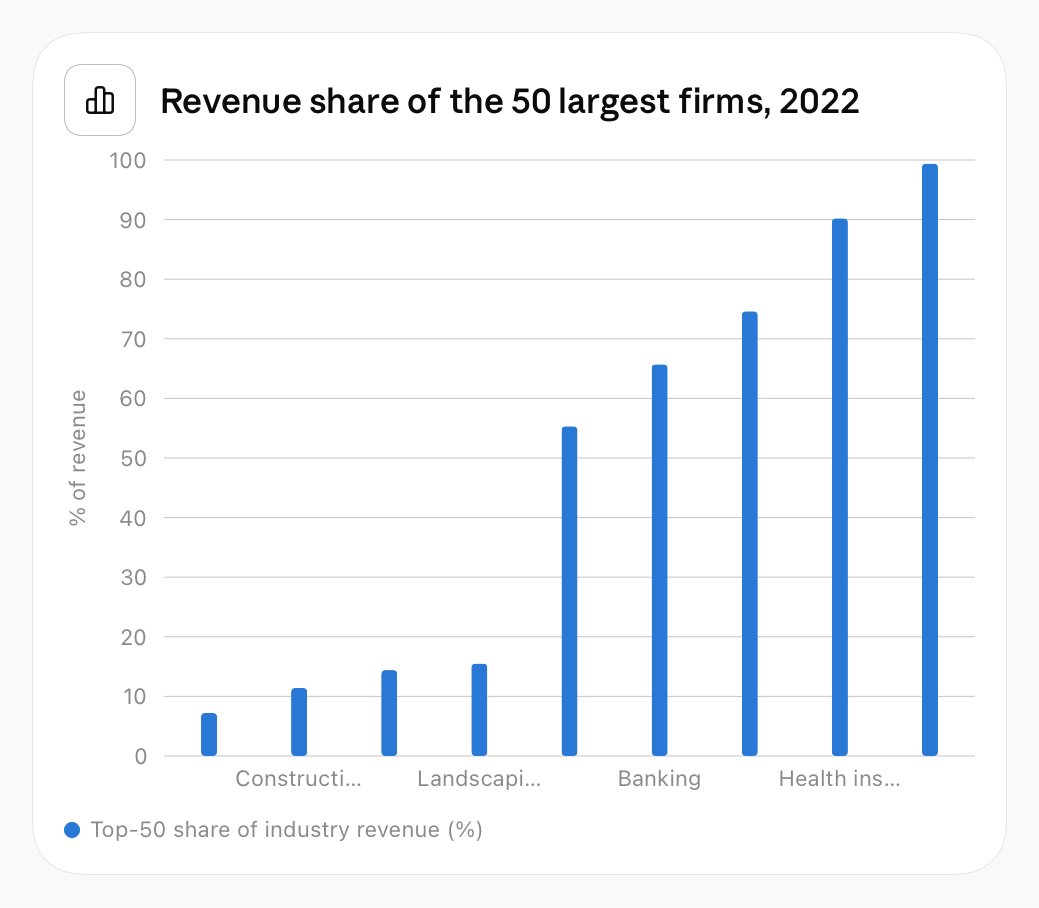
That’s why these industries stay so fragmented. The 50 biggest firms accounted for ~11% of employer revenue in the $3T construction sector, ~14% in the trades (and this even include solo operators). In software, the 50 biggest accounted for ~55%. Banking, 66%. Grocery, 75%.
There has been some technology success in construction and the trades (Procore, ServiceTitan, etc). And there’s a newer wave of AI products that seem to be working too (Avoca, Elise). But talk to ten small contractors and you get a very different picture: ~zero software penetration.
Some have QuickBooks, there’s some smattering of CRM, but that’s about it.
I’ve been doing SMB for a while now. It’s very different. It’s not consumer and it’s not enterprise. It’s its own thing. The owner-operator I’m talking about isn’t getting on a call with a sales rep to discuss how to port their existing sales script into an AI receptionist. They’re probably the one answering the phone.
Talk to a small contractor about what they need and it gets pretty concrete. They want help with basic marketing. They want help managing inbound leads and replying to them quickly. They want help with payments, collections, and finances. These are all things software can help with! But it’s pretty tough to learn, set up, and maintain all that software if you spend 14 hours a day away from a desk.
What they want is a person they can call who’s going to implement these processes.
I think AI can finally give them a kind of software that makes sense for them. Software, so to speak. You can just talk to it or call it. It can help set up the process and then do the work. I suspect it’ll surprise people how big these markets are once the smaller businesses start adopting something like that.
And I’d much rather have more small businesses than a few big conglomerates. I think competition is good. There’s something charming about working with a small business, but we can all feel it sometimes: it’s a little hard to get stuff done. If AI makes those businesses easier to work with without making them any less local or personal, I think that’s a really good outcome.
The internet is filled with scammy offers to “get you more leads" because that’s what has worked in SMB. But getting more leads isn’t even that helpful to business owners on its own.
If you're an owner-operator, you're often the salesperson, customer support, and manager at the same time. Answering the phone for new leads and watching Thumbtack like a hawk can get chaotic. Part of the reason one loses business is that it's hard to keep up.
More leads are great, but if those leads stink, I'm probably not coming back. Help me qualify them and decide what's worth spending my time on.
For the ones worth it, can you make my response time to leads much faster? Can you make it so I can turn around estimates faster? Now I’m closing more quality customers.
Then help me project manage and communicate with customers so the growth doesn't cause more stress. Help me get more reviews from those customers. Now I'm getting better quality customers and it's actually easier to serve them.
Then, can I grow and serve more of them? That's when hiring people and establishing processes become important. All of a sudden, I find myself running a more professional, more valuable, lower stress, business.
This is the B2B assistant opportunity imo.
Critically, though, it has to feel easy. It has to be “socially intelligent”. For example, contractors rarely have much uninterrupted time. If you're going to ask someone to set up a login, it has to be quick enough to do while they're filling up their truck with gas.
I often come back to this Alex Hormozi comparison. If you hired him, he wouldn't say, "So, what do you want me to do today in the business?" He'd ask you a bunch of questions to figure out how to improve the business, then get to work.
That would be extremely valuable! Most business owners would probably trade a percentage of their business for that offer, and it would be a great deal for them. It is a very differently shaped product than “give you more leads” …and a very different assistant than Instinct/Muse/Dot/etc.
I think the AI economy is going to monetize through financial rails. And I think that’s a good thing for small businesses.
With a piece of software, I pretty much know what I’m buying. I know the inputs and outputs, and it’s up to me to decide if I’ll get $100 of value out of it every month.
With an assistant, it’s really hard to know exactly what it’s going to do for you. You don’t know where it’s going to screw up. It’s also constantly getting better in ways you can’t even see.
So how do you price it?
Paying for tokens makes sense close to the model. But if I’m a business owner signing a contract, how many tokens am I going to use?
Paying for outcomes sounds cleaner. Then you have to decide what “resolved” means for a support ticket. And what happens when the same assistant is doing outbound sales, claiming rebates, and automating fifty different things? Are we going to agree on a price and a quality bar for every one of them?
I think there’s room for something closer to profit sharing. You get paid more if performance is good, less if it’s not. If a small business owner sees their overall take-home pay going up substantially, it makes sense for the assistant to get a cut of the value it helped create.
But profit sharing only works if you can see the money. That’s what makes the financial rails especially interesting.
Take a contractor who has to float $50,000 in materials before a customer’s next payment. An assistant that knows the job, the material bills, and when the customer is supposed to pay has context that a transaction alone can’t give you. That can help with everything from job costing to figuring out how to finance the work.
That’s why I’d give up my half a percent in interchange if I could get more of the data. If you can feed an assistant every dollar that flows through a business, with context around what the company spent and what it took in, I think you can create a lot more than half a percent of transaction volume in value.
I think we can design the financial products around the assistant. The same information that makes it more useful to the business can also make it easier to get paid for the value it adds.
I sometimes feel silly toggling between my AI assistants. They know a lot of the same things about me, but I can’t remember which ones are connected to which services.
I don’t want to set up the same integrations 50 times. I don’t want every assistant sending stuff from a different email.
That’s what a marketplace could offer: shared context and a shared way to act.
AI could change the economics of building for small businesses.
An assistant should be able to sell, onboard and support itself. And by spanning more of the business, it can add more value than a single software tool.
Lower cost to acquire and serve; a path to much higher LTV.
Building an AI assistant feels more like designing a great employee than a normal software product.
It’s not enough to nail a checklist. It has to infer what you want, know what matters, and give you what you need and a little bit more.
We've been having a lot of fun building a user simulation environment for our assistant product.
We did it because every experience a user has with an AI assistant is extremely path dependent.
If I add a calendar scheduling widget to a form, I know what it is and what it does. Users might find it confusing, but there’s often a familiar UI pattern.
Assistants don’t work like that.
You can make a major change to how memory works, and how every user experiences that change is totally different.
It depends on the context of that specific user and that conversation. What’s missing? What’s stale? What systems are connected?
That changes how you investigate a bad experience, too.
You find a conversation where something went wrong. But it’s probably not just that one very specific conversation that produces the friction. There are a number of different ways to get there. And because an assistant can do so many different things, these is happening across the product all the time.
How do you figure those out? We've built an environment to simulate our users and it's been extremely helpful in finding possible failures across different situations.
There’s no competitive advantage in automating workflows. They’re all going to get automated.
So what differentiates software? One frame is to view it as an employee: How high is the quality of its work? Does it take initiative? Can it figure out how to make the business better?
All this extra communication that AI enables adds a ton of noise. I’m more and more bullish on channel partners and referrals. Surprisingly, I would guess ads in social feeds will be resistant too: they’re filtering signal from noise, and placement costs money.
Higgsfield is like “this cost 964 tokens and u have 742, so you need to buy our extra jumbo pack of 6,000 tokens for 14.99 or you can upgrade to the super tier for 9.99/month and get 15% off the extra jumbo pack”
And fal is like “that video costs $2.10”.
Living somewhere slightly rural has a lot of appeal. I think it would be really lonely to do alone. But if you did it with a micro-community, in our case family, all of a sudden it gets way more appealing. You can make your world a little smaller.
Every customer-facing voice agent should use the CEOs voice imo. The CEO should be the expert on how to talk to their customers. The CEO should be marketing directly to customers so it makes sense as a brand voice. And it’s just cool — imagine calling Amazon support and talking to AI Jeff Bezos.
It also would enable a really fun way to stay close to customers — CEOs could just “drop in” to those calls themselves whenever they want. Imagine you call Amazon support and this time the real Jeff Bezos picks up. So much word-of-mouth could sprout from that (eg imagine Jeff always gives $10k as thank you for being a customer). Every time Amazon picked up I’d be listening more intently just in case it was the real Jeff Bezos.
What could be the counter argument? That customers might not like the CEO’s persona? That customers might expect more accountability if they’re talking to the CEO? Those do sound like problems, but solving them by using random voices for your agents is a horrible and silly solution, right?
Or maybe it just feels too weird for the mainstream…on the other hand…if this starts to become the norm at all, won’t it feel disrespectful or cowardly if the CEO doesn’t put in the work to create great clones of their voice?
Shipping an AI assistant changed my mind about moats. Serving a specific user takes more earned secrets than ever: how to guide them through and sell them on each capability and integration. Like a great sales script, getting that right takes many iterations. Even would be extremely hard to distill given how much agents interact with external services.