100% agree sir. The discourse should get more constructive. All stakeholders are mature- IAF, HAL, ADA, MoD and even NDTV. It is simple to 5-Whys on the concerns, before sweeping comments. The gaps are staring in front of us, we just need to look. Some of these are systematic issues we choose not to speak about. It is well beyond 1 or 2 parties who get targetted. Do we have the willingness to confront hard truths?
@zone5aviation ~49:00 Re all the bloodletting- there’s plenty of blame to go around. No need to keep score. Instead, the discourse needs to focus on “so what next?” ~51:00 We can clearly see the “squeeze” being applied via 404. So why unable to see the threat of the whole a/c becoming hostage!
@zone5aviation ~42:00 Why are options limited only to License prodn,ToT, JV etc. Are we as a nation fundamentally incapable? I personally learnt calculus only when I came across a book which began with “what one fool can do, another can!” I personally think we are “unwilling”!
My belief-indigenous is existential.People promising otherwise end up espousing “we will fight with what we have” rather than “we’ll ensure we have what we need to fight with” or best of all “we will adapt how we fight to what we can afford and build what we need to fight with!”
@PrasadSatya10@alpha_defense Most countries do that. That requires planning & coordination between all stakeholders. We still are bidding 2-3 players (even DcPP) in a L1 system. No one knows what qty & timelines.
@PrasadSatya10@alpha_defense I hope so. Hope we dont under estimate the complexities - from sensors, actuators to material.. in today's heavily constrained global defense supply chains.
One reason why Tamil Nadu can’t get a fab.
TN rejected 12 hr work shifts and semi fabs can’t run without them. Fabs don’t stop. They run 24*7*365 days. You can’t do 3 shift changes per day and be productive enough. 12 hr shifts overlapping are key. My friend working in an Intel lab used to do like 36 hr shifts being “on-call” at the fab as a process engineer.
"Memory prices up 500% in 12 months and 10x the lowest level"
Memory prices, along with AI token prices have made business very difficult. We have held back from raising prices but it is becoming hard.
A techncial note: for a long time, programming languages were designed with the assumption that memory is "free". That era has now ended. We need highly memory efficient languages and smarter compilers, even for AI to use.
Safety of code snd productivity in writing code cannot come at the expense of memory bloat. That is my area of research.
https://t.co/zm7gGwcZf4
This pic helped change the air war over Kargil. An IAF MiG-25 Foxbat took it in the third week of June 1999. And there is a reason to tell that story today. On 17 Aug 1981, 45 years ago, No. 102 Sqn was raised, beginning the MiG-25’s career in the IAF.
18 years later, the Foxbat was called upon to solve one of the most critical problems confronting the IAF in Kargil: accurately finding targets. It is also an important part of Safed Sagar that @NetflixIndia largely ignored.
Identifying Pakistani positions and fixing their precise coordinates had become a serious problem. The Army’s maps were dated and inadequate for extracting accurate coordinates. Newer Survey of India maps would only reach the troops towards the end of June.
The IAF therefore needed vertical aerial photography. It had the Avro 748, Jaguar, Canberra and MiG-25 available, but each had limitations.
The Avro was unsuitable for a hostile environment. Jaguars with Vicon cameras produced excellent low-level imagery, but operating low over Kargil meant exposure to SAMs. A No. 106 Sqn Canberra had already been struck by an Anza missile on its first reconnaissance sortie.
That left the MiG-25.
The Foxbat normally operated above 20 km at around Mach 2.4. Its 72-inch focal-length cameras offered enormous photographic coverage, while its Peleng-DM navigation system could associate accurate positional information with the imagery.
But at its normal altitude, the resolution was insufficient to identify small bunkers, sangars and concealed positions in Kargil. The Foxbat had to come down.
At around 8 km, the imagery was superb, but the aircraft would be dangerously exposed to shoulder-fired missiles. A 13–14 km profile offered greater safety, but required minimum reheat and pushed the aircraft to about Mach 1.3.
The eventual compromise was remarkable for a Foxbat: around 10 km and Mach 0.9. It gave roughly 5 km of vertical separation from the missile belts while allowing an effective fighter escort. The MiG-25 had no RWR, flares or chaff.
Two MiG-29s provided top cover, with two Mirage 2000s accompanying it. If seriously threatened, the escape plan was pure Foxbat: maximum afterburner, climb to 20 km, accelerate to Mach 2.4 and get out.
Navigation accuracy was equally critical. The Peleng-DM, like any inertial system, could drift. Its feed was integrated with the RSBN beacon system, and Wg Cdr P.J. Thakur went a step further, borrowing a handheld GPS from No. 7 Sqn to verify that the positions being generated were accurate.
The MiG-25 was ferried to Adampur on 18 June. Weather ruled out operations on 19 and 20 June. On 21 June 1999, Wg Cdr P.J. Thakur flew the first operational photo-reconnaissance mission over the Drass–Kargil sector.
Mirage 2000s flown by Wg Cdr S. Chhabra and Wg Cdr Rohit Verma accompanied the mission, while MiG-29s led by Wg Cdr S. Harpal Singh provided top cover.
Two Pakistani F-16s approached during the photographic run. The MiG-29s deterred them, and the Foxbat stayed on task.
The exposed film was then flown back to Bareilly for processing. When the photographs reached Western Air Command and Air HQ, the impact was evident. Tololing. Muntho Dhalo. Tiger Hill.
Positions that had been difficult to locate with confidence were now clearly visible. Enlargements revealed bunkers, sangars and camouflaged positions. Crucially, the imagery could be tied to accurate coordinates.
Strike crews could now study their targets before take-off, see how they would appear from release height, fix their coordinates and plan the direction of attack.
Look again at the photograph. In the Kargil mountains, where locating a small position could be almost as difficult as attacking it, imagery of this quality mattered enormously.
The MiG-25 went on to fly four more missions over Kargil–Drass, besides reconnaissance over Rajouri–Poonch and a sortie to establish the situation around Gultari.
The Foxbat is remembered for Mach 2.4 and the stratosphere. Over Kargil, it made a critical contribution by doing almost the opposite: coming down to 10 km and slowing to Mach 0.9 so its cameras could see what mattered.
Happy birthday, No. 102 Squadron! #IAFHistory @IAF_MCC
Important piece by CEA Anantha Nageswaran on the E20 debate where he addresses the need for a ‘cost-benefit’ analysis before committing to higher Ethanol blending, while also allowing a lower blend to be sold for pre BS4 vehicles. An excerpt👇
“Bring back a lower blend, such as E10, for the older fleet of vehicles. Fix the price and water distortions that unintentionally favour maize over other crops, relook at the import duty on edible oil to support the push towards domestic self-sufficiency, and hold at E20 until India has thoroughly costed the food-versus-fuel trade-off, rather than assuming it away. The engine row we witnessed was never the real argument. The real one is about what we choose to grow, and what we will not be able to take back” @CNBCTV18Live@CNBCTV18News #E20 #Ethanol
Much of the talk about the US having "denied GPS" to India during Kargil is simply incorrect.
At the time, the IAF was only just beginning to induct civilian GPS-equipped fighters. On 21 May 1999, 101 Squadron at Awantipur received MiG-21s fitted with GPS through a swap with 37 Squadron. More civilian GPS sets followed in June.
But these were civilian-grade receivers operating under Selective Availability, a US policy from the early 1990s that degraded civilian GPS accuracy worldwide. India was not being singled out. The limitations faced were part of a global restriction, not a Kargil-specific denial.
Those constraints did matter, particularly for precision work at altitude. But that is very different from claiming that GPS was "denied" for India. Selective Availability itself was discontinued only in May 2000 under President Clinton.
What Kargil really exposed was India’s dependence on a foreign-controlled navigation system. The need for sovereign control, flexibility, and secure access.
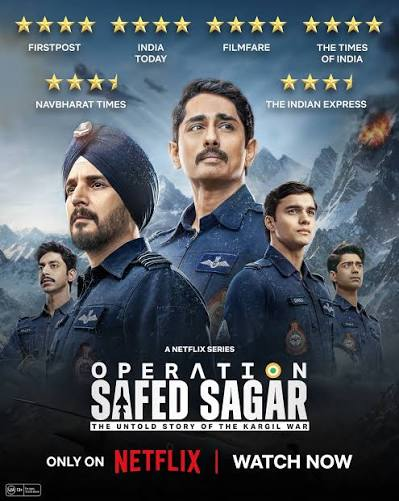
Just finished @netflix SafedSagar. The first attempt to put the IAF’s Kargil story on a mainstream screen, and it is superb. It deserves cult classic status like Border. Yet it left me uneasy coz it risks repeating one of Border’s most consequential mistakes. Let me explain.
What makes SafedSagar exceptional is the extraordinary attention to historical detail. The names of officers, air bases, briefing rooms, charts, uniforms, vehicles, signboards and operational settings are deeply rooted in the reality of 1999. Much of what you see has clearly been reconstructed from the actual people, places and events of the Kargil War. Even several of the officers retain their real or nicknames. Where names have been changed, I assume there were reasons of consent or dramatic necessity.
A caveat: the aircraft depictions (types, serial numbers) and CGI could have been much, much better, but recreating military aviation convincingly is hard for any filmmaker.
But the real achievement of the series is not merely visual authenticity. It is how simply it explains some very difficult aspects of air operations over Kargil.
High-altitude bombing in 1999 was not a straightforward problem. Aircraft, weapons and procedures designed for very different conditions suddenly had to be adapted to targets at extraordinary elevations, in difficult terrain, with limited time and technology and Govt imposed restrictions. The IAF had to learn, improvise and find solutions while the war was underway.
Explaining all this to a general audience without turning the series into a lecture is extremely difficult. SafedSagar manages it beautifully. Whoever was responsible for translating that operational complexity into cinema deserves enormous credit.
It also gets something else right: the texture of IAF life.
The squadron is not presented as a collection of larger-than-life superheroes. You see professional pride, rivalry, frustration, humour, families, friendships, uncertainty and the support system that surrounds flying operations. There are creative liberties, inevitably, but the people mostly remain recognisably human.
That, to me, is one of the series’ greatest strengths. And it is precisely because SafedSagar is so good that the liberties it takes with history matter.
The biggest is the concentration of a very large part of the air war into No. 17 Squadron. No. 17 Squadron absolutely had an important role in the conflict. It flew fighter reconnaissance missions and, later in June, was involved in effective GPS-assisted night bombing. But it was one part of a much larger IAF effort involving several squadrons, aircraft types, bases, commanders and streams of innovation.
The series, understandably, needs a central unit around which to build its story. The danger is that cinematic compression gradually becomes historical attribution.
The handheld-GPS bombing solution is one example. The series appears to place its development very firmly within the world of No. 17 Squadron. The real history of how these innovations emerged across the IAF was more complex, and I would be very careful about attributing such developments to a single unit or group unless the documentary record supports it.
There are other moments where dramatic licence and historical memory sit uneasily together.
The sequence surrounding Sqn Ldr Ajay Ahuja is one. The essential truth must never be diluted: Ahuja ejected and was killed after coming down, and the evidence surrounding his death has long indicated brutal treatment. But the series adds considerable drama to the episode. It makes for powerful cinema, but invented detail around real officers and events can quickly become accepted as documented fact.
Likewise, the suggestion that GPS problems or delays resulted from a deliberate American act goes much further than the historical basis appears to support.
Normally, one might shrug and say: this is cinema. But SafedSagar is not an ordinary Bollywood war drama.
It is extraordinarily well made. It takes its history seriously. It uses real names, real units and real events. It has been received with considerable warmth and support from the IAF community. And because it feels so authentic, audiences will naturally assume that what they are watching is, in substance, what happened.
That gives the series enormous historical power.
Border did something similar for an earlier generation. It ensured that millions of Indians would remember Longewala. That was an extraordinary achievement. But it also fixed a particular cinematic version of the battle so deeply in popular memory that, for many people, separating the film from the actual course of events became almost impossible.
My fear is that SafedSagar could do the same. Not because it is careless with history. Almost the opposite.
None of this diminishes what the series has achieved. I hope and I encourage every Indian watches it. For once, a large audience will see the IAF’s role in Kargil not as a footnote to the ground war, but as a complex campaign fought by aircrew, engineers, controllers, planners, technicians and families confronting problems for which there were no ready-made answers.
That story deserved to be told. SafedSagar tells it brilliantly.
I only wish that a series with this much power to become our collective memory had been just a little more careful about where history ended and cinema began. Perhaps I am asking too much of a television series. But when a work is this good, and this important, it becomes worth asking.
This frame from @NetflixIndia Safed Sagar looks ordinary. It isn’t. There is far more history in it than is immediately apparent. And, by a remarkable coincidence, that history leads back exactly 75 years, to 16 August 1951.
What we see on screen is simple: an Army officer briefing IAF on targets for which the Army needs air support. In military terminology, this is Close Air Support, the employment of air power in direct support of the land battle.
But aircraft and troops do not become “joint” merely because they are fighting the same war.
Someone has to translate an Army formation’s requirement into an air task, establish priorities, coordinate targets, prevent duplication and fratricide, and connect commanders on the ground with the air force that will actually deliver the weapon.
The IAF and Indian Army learnt this very early.
The experience of the 1947-48 Jammu & Kashmir operations exposed deficiencies in coordinating land and air operations. The answer was to build a permanent organisation for Air/Land warfare, with Air Force elements embedded alongside Army formations.
At Corps level came the "Air Task Force", an IAF organisation working alongside the Army Corps. At the higher Army Command level sat the "Advance Headquarters", headed by a senior IAF officer and co-located with the Army command headquarters.
It is this machinery that one repeatedly glimpses in Safed Sagar.
The officer repeatedly seen in the series, identified as “Oak”, and the briefings around him are not incidental background. They represent the Advance HQ system in J&K at work. He was Air-1 at HQ J&K, working with Army Northern Command at Udhampur
And the institutional ancestor of that system dates to this day.
On 16 August 1951, No. 1 Air Task Force was established to operate in conjunction with XI Corps, the first Corps of the Indian Army.
Its first Commanding Officer was Group Captain Hari Chand Dewan, who would two decades later command Eastern Air Command during the 1971 War. At a time when the entire IAF had barely a dozen Group Captains, putting an officer of that rank in command says something about the importance attached to the new organisation.
No. 1 ATF was the first Indian formation specifically created for joint Air/Land warfare.
An interesting aside: the idea of permanently embedding one Service alongside another had actually appeared a little earlier with the Navy, in March 1950 (No. 2 ATF). The Army-facing organisation followed the next year. Jointness, at least institutionally, is therefore hardly a recent discovery in the Indian armed forces.
No. 1 ATF itself evolved with experience. It became No. 1 Tactical Air Support Group in January 1955 and finally No. 1 Tactical Air Centre on 1 March 1957. IAF now has Twelve Tactical air Centres spread across the country colocated with Army Corps.
A detachment from it also manned the embryonic Advance HQ, Western Air Command, alongside Western Command, until that headquarters was formally established in 1959. IAF now has an Advance HQ with every Army Command HQ.
What had begun as a lesson from Kashmir would prove its worth repeatedly. Perhaps nowhere more dramatically than in 1971.
At Jullundur, a remarkably small group under Air Commodore John Francis Lazaro, AOC Advance HQ Western Air Command, sat alongside Army Western Command and coordinated the air effort supporting the land battle across Punjab and Jammu & Kashmir.
In just 12 days, they directed nearly 900 fighter sorties in support of the Army.
Lazaro was awarded the PVSM. His citation is worth reading because it describes exactly what this obscure joint machinery was meant to achieve.
It credited him with the joint planning and execution of Army-Air operations in the Western Sector, noted that close air support had been provided “most effectively”, and recorded attacks on enemy lines of communication, ammunition and fuel dumps and headquarters.
More importantly, the citation observed that under him, “air operations in aid of the army achieved a new dimension.”
That was the Advance HQ doing its job.
Behind the aircraft histories, squadron narratives and individual gallantry of 1971 sits this much less remembered story: a handful of men inside an Army headquarters, continuously matching battlefield requirements with available air power and directing the effort as the land battle changed.
Nearly three decades later, the same institutional logic lay at the heart of Operation Safed Sagar.
Kargil was an unusual air campaign. The IAF’s offensive effort was overwhelmingly directed towards targets generated by the land battle, while operating under the extraordinary restriction that its aircraft were not to cross the Line of Control.
That made Army-IAF coordination central to it. So this frame is not simply an Army officer talking to an IAF crew.
It captures a system born from the experience of the 1947-48 Kashmir War, formally institutionalised with No. 1 Air Task Force on 16 August 1951, tested in subsequent wars, spectacularly employed in 1971, and still doing precisely what it had been created to do over the mountains of Kargil in 1999.
There is another, rather sobering, thread running through this story.
Some of the IAF’s heaviest losses of aircraft and aircrew in 1965, 1971 and 1999 came while flying precisely these Close Air Support missions. Supporting troops in contact has always demanded flying low, close to the battlefield and often directly into concentrated enemy fire.
That is perhaps why this otherwise unremarkable frame stayed with me. In many ways, it is the heart of Safed Sagar.
And on 16 August, it is also a small window into 75 years of organised Indian Air/Land joint warfare.
#IAFHistory @IAF_MCC
When India accidentally wiped out its vultures, half a million people died in five years.
The bird doing zoomies in this video runs the most extreme digestive system in the animal kingdom. Vulture stomach acid sits near pH 1, strong enough to destroy anthrax, rabies, and botulism in the carcasses they eat. A flock strips a cow to bone in about 45 minutes.
India had 50 million of them. Free sanitation at national scale, in a country where religious custom means most cattle die natural deaths and every dead cow becomes a carcass someone has to deal with.
Then the patent on diclofenac expired in 1994. Farmers started using the cheap painkiller on livestock. Trace amounts left in a carcass cause kidney failure in vultures. Within a decade, 50 million birds fell to a few thousand. The fastest collapse of any bird species since the passenger pigeon.
The carcasses didn't disappear. Feral dogs took the vultures' place and brought rabies with them. Rotting remains leached into waterways. In districts where vultures once thrived, human death rates rose more than 4 percent. Economists at Chicago and Warwick put the toll at 100,000 extra deaths a year and $69 billion in annual damages.
So yes, the goofy bird sprinting down the walkway is adorable. It's also a disease firewall that evolution spent millions of years building and one generic painkiller nearly erased in ten.
At approximately 15:28 IST, the IndiGo Hyderabad–Chennai arrival was on final approach and was approximately 1 NM from touchdown.
At that time, the preceding IndiGo arrival operating from Port Blair to Chennai had landed at 15:25 IST and subsequently reported a suspected bird strike while on taxiway.
In view of the reported suspected bird strike, a runway inspection was required to ensure that the runway and associated movement area were safe for continued aircraft operations.
To facilitate the runway inspection, the Hyderabad–Chennai arrival was instructed to go around.
The go-around was therefore undertaken as a precautionary safety measure and to allow the necessary runway inspection to be completed.
The Hyderabad–Chennai flight subsequently continued its approach and landed safely at approximately 15:45 IST.