Brasileiro em Charlotte, NC.
Explico a B3 sem jargão.
Análise diária do mercado + guia para iniciantes.
Ex-empreendedor.
Pai.
Nada aqui é recomendação.
Todo mundo diz para o iniciante "invista na bolsa", ninguém explica o caminho. E aí a pessoa abre o primeiro relatório, lê "o papel negocia a 9x P/L com upside de 25% e sinistralidade pressionando a margem" e desiste na terceira linha.
Então aqui está o passo a passo completo, na ordem certa, com cada palavra difícil traduzida para português de gente. Sem curso, sem link de afiliado.
A ETAPA ZERO QUE QUASE TODO MUNDO PULA
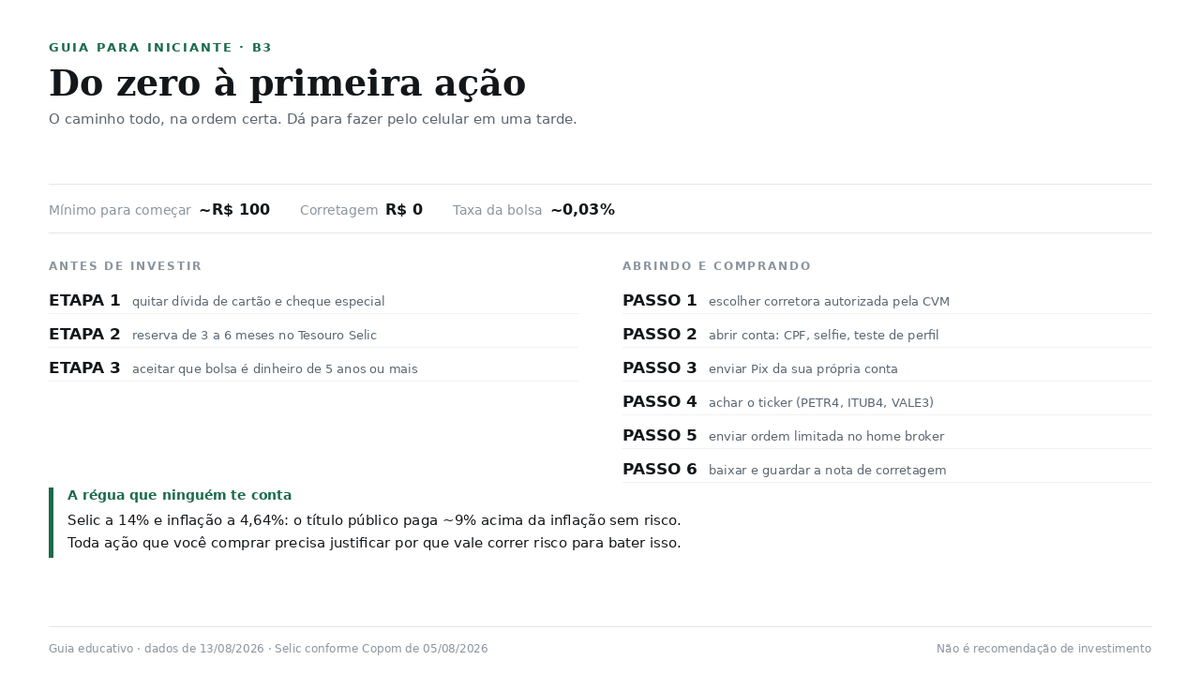
Antes de abrir conta em corretora, três coisas.
Primeira: quitar dívida caríssima. Cartão de crédito no rotativo e cheque especial cobram, no Brasil, juros muito acima de qualquer retorno realista de bolsa. Pagar uma dívida dessas é o melhor investimento disponível para você hoje, e é o único com retorno garantido. Investir com dívida de cartão é encher um balde furado.
Segunda: reserva de emergência. De três a seis meses das suas despesas em algo que você saca hoje e que não perde valor, tipo Tesouro Selic ou CDB de liquidez diária. Isso não é para ficar rico. É o colchão que evita você ter que vender ação no pior dia possível porque a geladeira quebrou. Quem investe sem reserva vira vendedor forçado, e vendedor forçado sempre vende no fundo, porque a emergência não escolhe o dia.
Terceira: aceitar a regra do jogo. Dinheiro que você vai precisar em menos de cinco anos não deveria estar em ação. A bolsa cai 30% de tempo em tempo, sem avisar. Se você não conseguir olhar a tela vermelha e não fazer nada, o problema não é a ação que você escolheu, é o prazo.
E tem uma régua que quase nenhum conteúdo de iniciante te dá. Hoje a Selic está em 14% ao ano e a inflação em 4,64% nos últimos 12 meses. Ou seja: o título público do governo paga cerca de 9% acima da inflação, sem risco nenhum. Esse é o número que qualquer ação precisa superar para valer a pena. Se alguém te promete 20% ao mês, você já sabe o que é.
DO ZERO À PRIMEIRA AÇÃO EM SEIS PASSOS
1. Escolher a corretora. Corretora é a loja onde você compra ação, porque você não compra direto da bolsa, do mesmo jeito que não compra refrigerante direto da fábrica. As grandes hoje cobram zero de corretagem para ações, então não pague taxa por operação. Confira se ela é autorizada pela CVM.
2. Abrir a conta. É igual banco digital: CPF, documento, selfie e um questionário chamado suitability, que é só um teste para saber se você é conservador ou arrojado. Sai em algumas horas.
3. Transferir o dinheiro. Pix ou TED da sua própria conta, no seu nome. Dinheiro de terceiro é bloqueado. E não precisa ser muito: com R$ 100 já dá para comprar ação de várias empresas grandes.
4. Achar o ticker. Ticker é o apelido da ação na bolsa. PETR4 é Petrobras, ITUB4 é Itaú, VALE3 é Vale. O número no fim diz o tipo: 3 é ordinária (tem voto na assembleia), 4 é preferencial (não vota, mas costuma estar na frente na fila do dividendo) e 11 é unit, que é um pacotinho com mais de um tipo de papel junto.
5. Enviar a ordem no home broker. Home broker é só o nome pomposo da tela de compra e venda do aplicativo. Você tem duas opções: ordem a mercado, que é "compre agora, no preço que estiver", e ordem limitada, que é "compre só se sair a R$ 38 ou menos". Para quem está começando, use limitada. Evita a surpresa de pagar mais caro do que você viu na tela.
6. Guardar a nota de corretagem. É a nota fiscal da operação. Baixe todas e jogue numa pasta. É esse documento que prova quanto você pagou, e você vai precisar dele para calcular imposto e declarar. Quem não guarda sofre depois.
Duas palavras que vão aparecer e assustar. Lote fracionário: ações são vendidas em pacotes de 100, então se você quer comprar 7 em vez de 100, use o fracionário colocando F no fim do ticker (PETR4F). E D+2: quando você vende, o dinheiro só cai na conta dois dias úteis depois. Não é a corretora te enrolando, é o prazo padrão da bolsa.
O QUE COMPRAR QUANDO VOCÊ AINDA NÃO SABE NADA
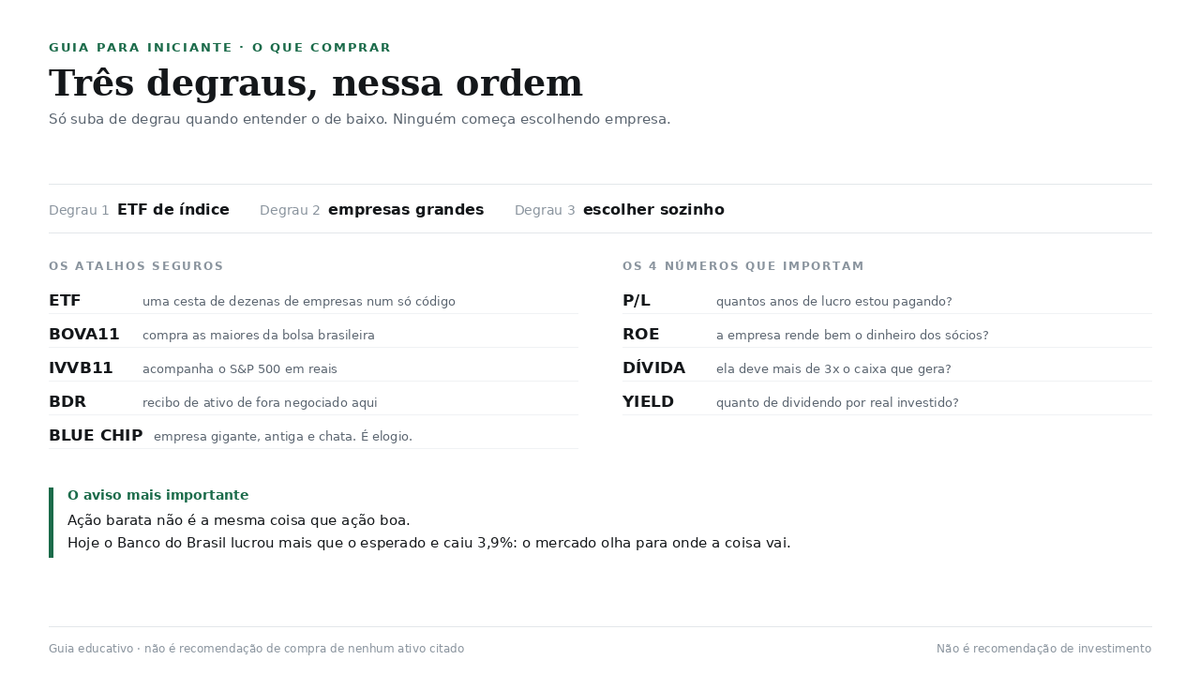
Aqui é onde o iniciante trava, porque a internet grita mil nomes ao mesmo tempo. A resposta honesta é chata: comece pelo mais simples e só suba de degrau quando entender o de baixo.
Degrau 1, um ETF de índice. ETF é uma cesta de ações que você compra como se fosse uma única ação. O BOVA11 compra para você um pedacinho das cerca de 80 maiores empresas da bolsa de uma só vez. Vantagem enorme para quem está começando: você não precisa acertar a empresa. Se uma quebrar, as outras 79 seguram o tranco. Se quiser exposição ao exterior, o IVVB11 acompanha o S&P 500 em reais, e a SPCX34 é um BDR, que é um recibo negociado aqui representando ativo de fora. Nos dois casos você ganha ou perde por dois motivos ao mesmo tempo: as empresas americanas e o dólar.
Degrau 2, empresas grandes e entediantes. As blue chips: gigantes, antigas, lucrativas, que você conhece do dia a dia. Banco, energia, saneamento, mineração. Não vão te dar 300% em um ano, e é exatamente esse o ponto. Costumam pagar dividendo, que é a parte do lucro que a empresa deposita na sua conta só por você ser sócio, sem precisar vender nada.
Degrau 3, escolher empresa sozinho. Só chegue aqui quando estes quatro números fizerem sentido sem consulta. Eles são só quatro perguntas:
P/L: quantos anos do lucro atual eu estou pagando pela empresa?
ROE: quanto de lucro ela gera com o dinheiro dos sócios?
Dívida sobre Ebitda: ela deve mais do que três vezes o caixa que gera?
Dividend yield: quanto de dividendo eu recebo por real investido?
E o aviso mais importante desta parte: ação barata não é a mesma coisa que ação boa. A bolsa brasileira está cheia de empresa barata por um bom motivo. Exemplo real de hoje, 13 de agosto: o Banco do Brasil divulgou lucro de R$ 3,9 bilhões, acima do consenso de R$ 3,5 bilhões que o mercado esperava, e a ação caiu 3,9%. Motivo: a inadimplência do agronegócio continuava subindo. O mercado não olha onde a empresa está, olha para onde ela está indo.
Sobre day trade, que é comprar e vender no mesmo dia: é a atividade mais divulgada da internet e a que mais destrói iniciante. Você paga imposto maior (20% contra 15%), perde o direito à isenção, opera contra profissional com máquina melhor e transforma investimento em cassino. Se a proposta chegou por anúncio com foto de carro importado, é publicidade, não estratégia.
IMPOSTO SEM SUSTO: TRÊS REGRAS
Essa parte assusta mais do que deveria. Para quem investe pouco e não faz day trade, o resumo é: você provavelmente não vai pagar nada, mas ainda assim precisa declarar.
Regra 1, a isenção dos R$ 20 mil. Se o total vendido em ações no mês ficar abaixo de R$ 20.000, o lucro é isento. Repare bem: o limite é sobre o valor vendido, não sobre o lucro. Vendeu R$ 15.000 e lucrou R$ 5.000? Imposto zero. Passando disso e havendo lucro, são 15% sobre o lucro, que você mesmo calcula e paga com uma guia chamada DARF até o último dia útil do mês seguinte. A corretora não faz isso por você. A isenção não vale para day trade, nem para ETF, nem para fundo imobiliário.
Regra 2, e aqui muita gente foi confundida. A partir de janeiro de 2026 a Lei 15.270/2025 passou a cobrar 10% na fonte sobre dividendos, mas só na parte que passar de R$ 50.000 pagos no mesmo mês pela mesma empresa para a mesma pessoa. Traduzindo: se você recebe R$ 80 de dividendo do Itaú, nada muda, continua caindo integral na sua conta. Está circulando muito post dizendo que "agora todo dividendo é tributado", e isso está errado para o investidor pequeno.
Regra 3, declarar não é a mesma coisa que pagar. Você é obrigado a entregar a declaração se vendeu mais de R$ 40.000 em bolsa no ano somando tudo, ou se teve lucro tributável em qualquer valor. E a B3 informa todas as suas operações à Receita, então não existe operação invisível. A maioria das multas de iniciante vem de esquecer de informar algo isento, não de sonegar.
Ah, e aquela retenção minúscula de 0,005% que aparece na nota não é taxa nova nem erro. É o apelidado imposto dedo-duro, que serve só para avisar a Receita de que você operou. Depois você desconta do imposto devido.
OS SETE ERROS QUE QUEBRAM O INICIANTE
1. Investir sem reserva de emergência, e virar vendedor forçado no pior dia.
2. Colocar tudo de uma vez em vez de aportar todo mês. Aportando aos poucos, você compra caro em uns meses e barato em outros, e para de tentar adivinhar o dia certo.
3. Comprar por dica de rede social. Quem te deu a dica comprou antes e vai vender quando você entrar. Se a tese não cabe em três frases que você mesmo entenda, não é sua tese.
4. Concentrar tudo em uma ação. Empresa boa também quebra, muda de dono ou perde o setor.
5. Confundir dividendo alto com empresa boa. Às vezes o yield está alto porque a ação despencou, o que é a definição de armadilha.
6. Vender no pânico e comprar na euforia, que é exatamente o oposto do que a matemática pede.
7. Não guardar as notas de corretagem.
O único atalho que existe: aporte constante, custo baixo, prazo longo e o mínimo de mexida possível. É entediante, não vende curso, e é o que funciona.
TRADUZINDO O ECONOMÊS
Ticker: o apelido da ação.
Home broker: a tela de compra e venda.
Liquidez: facilidade de vender rápido e no preço justo.
D+2: o dinheiro da venda cai em dois dias úteis.
Dividendo: o lucro que cai na sua conta sem você vender nada.
JCP: dividendo com outro nome e 15% de imposto retido.
Ebitda: o caixa que a operação gera, antes de juros e impostos.
Margem: quanto sobra de cada R$ 100 vendidos.
Alavancagem: o tamanho da dívida frente ao caixa que a empresa gera.
Upside: o espaço entre o preço de hoje e o preço-alvo do analista.
Consenso: a média do que os analistas esperam.
Impairment: admitir que um bem valia menos do que estava no papel.
Faca caindo: tentar comprar no meio do tombo.
Montei um dicionário com 84 termos desses. Se você quer que eu poste a lista completa aqui em partes, me diz nos comentários qual palavra travou você e eu começo por ela.
Nada aqui é recomendação de investimento nem consultoria tributária. Regras de imposto mudam: confirme no portal da Receita Federal antes de declarar. Dados macro de 13 de agosto de 2026, Selic conforme o Copom de 5 de agosto.
BRAZIL MARKET REVIEW · WEEK OF AUG 17–21, 2026
The Ibovespa closed Friday at 171,032, up 2.45% for the week in reais and 3.67% in dollars. The S&P 500 lost 1.43% over the same five sessions. Brazil beat the US by 5.1 points in one week, and the thing that caused it was American.
This recap is late — it covers Aug 17–21 as it closed, not the current tape.
THE SCOREBOARD
Ibovespa: 171,032 on Friday, +4,098 points, +2.45% in reais, +3.67% in dollars.
Month to date through Aug 21: −3.91% in reais, −5.50% in dollars — a good week inside a bad month.
USD/BRL: 5.1625 at Friday's close, down 1.17%. The real gained 1.18%. Every conversion here uses the official PTAX closing rate from Brazil's central bank: 5.2236 on Aug 14, 5.1625 on Aug 21.
Best in the portfolio: KLBN11, +5.36% in reais, +6.60% in dollars. Worst: SPCX34, −3.39% and −2.24%.
Selic, Brazil's policy rate, held at 14.00% all week against Fed funds at 3.50%–3.75%.
WHAT THE MARKET EXPECTED
The Monday agenda, from the weekly calendars InfoMoney and Seu Dinheiro published Aug 16, pointed in three directions.
One, IBC-Br on Monday morning, the central bank's monthly activity index and the closest thing Brazil has to a monthly GDP print. Itaú, quoted by InfoMoney, looked for −0.6% on the month against +2.2% on the year.
Two, the FOMC minutes Wednesday at 3pm Brasília, 2pm ET, billed as the external event of the week: the detail behind the July 28–29 decision to hold at 3.50%–3.75%.
Three, flash PMIs from the US, euro area, Germany and UK on Friday.
No meeting of Copom, the central bank's rate-setting committee and Brazil's FOMC. No Fed decision. No earnings from any of the eleven names I track. One corporate event on the whole calendar, and it was a record date.
WHAT ACTUALLY MOVED IT
Monday and Tuesday finished the drought: −0.09% then −0.27%, the tenth and eleventh consecutive losing sessions. IBC-Br came in soft. Foreign investors had pulled 15.6 billion reais out of Brazilian equities in August alone, the heaviest monthly outflow since January 2022 per InfoMoney. Citi dropped the real from its carry-trade basket in favor of the South African rand, and Goldman Sachs and Itaú BBA flagged a rising risk premium tied to the October election.
Wednesday broke it, and not for a Brazilian reason. The US Treasury said it would at least double its buybacks of 10 to 30-year paper. Long yields fell, the dollar sagged worldwide, money rotated into emerging markets. The Ibovespa rose 0.90%, its first up day of the month, the dollar fell 0.87% against the real, and Brazilian rate futures fell with it. The FOMC minutes landed the same afternoon and were genuinely hawkish, several officials open to hiking and three dissents for a 25bp increase. The market shrugged. The buyback headline was bigger.
Thursday ended a draw, up 0.06%. The 30-year Treasury yield pushed above 5.3%, its highest since 2007, with US federal debt through $40 trillion. Banks took it on the chin: Itaú −2.24%, Bradesco −1.69%. Commodities carried the index instead, Vale +2.62% and Petrobras +2.81%.
Friday did the week's work, +1.85%. Lula and Trump spoke by phone for an hour and twenty minutes about trade, organized crime and the wars, which the market read as negotiations restarting. Wall Street was up. Brazilian financials led the way back: exchange operator B3 +5.23%, Itaú +2.91%, Bradesco +3.11%, Banco do Brasil +2.16%. The dollar fell another 0.93% to about 5.14, the dollar index closed near a three-month low, and the real was the best-performing liquid emerging currency of the day.
EXPECTED VS DELIVERED
IBC-Br: expected soft, delivered soft. No repricing.
FOMC minutes: expected to be the week's main event, delivered hawkish, and did not matter. Wednesday was the best day of the month to that point, and the reason was a Treasury debt-management announcement that was not on the Monday calendar.
Flash PMIs: expected to close the week, delivered a 52-month high on the US composite. Friday was indeed the big day, but the driver was a phone call between two presidents and a sliding dollar, not a purchasing managers' survey.
Not on anybody's Monday list, and responsible for the entire week: the Treasury buyback plan Wednesday and the Lula–Trump call Friday. Also unscheduled, Citi cutting the real from its carry basket Tuesday. The calendar tells you when to pay attention, not what will happen.
THE PORTFOLIO, NAME BY NAME
PETR4 (ADR: PBR.A, the preferred share; plain PBR is the voting class), +5.25% in reais, +6.50% in dollars. Brent went from $88.52 to $94.39, up 6.63%, on the US–Iran standoff and reduced traffic through the Strait of Hormuz. Friday was also the record date for a 17.4 billion-real payout approved Aug 6: 0.67407131 reais per share of interest on equity payable Nov 23, plus a 0.47156696 dividend and 0.20250435 more of interest on equity, both payable Dec 21. Total 1.34814262 reais per share, 3.04% of Friday's close, roughly 0.52 dollars per ADR at Friday's rate since one Petrobras ADR equals two shares. The stock went ex Monday Aug 24 and fell 4.94%. Read that carefully: 3.04 points of it was the payout leaving the price mechanically, and the rest was Brent giving back 2.35%. Nothing broke.
VALE3 (ADR: VALE), +5.23% in reais, +6.48% in dollars, and this one was not iron ore. The 62% Fe seaborne benchmark sat around $95 a tonne and the SunSirs index slipped 0.49% on the week. Vale rose on the weak dollar and the emerging-market rotation.
KLBN11, +5.36% in reais, +6.60% in dollars, the week's best. Klabin is a pulp, paper and packaging producer and a dollar earner, so a weak-dollar week is not the obvious explanation. I could not find a single piece of Klabin news dated inside Aug 17–21, and I am flagging that gap rather than inventing a cause.
ITUB4 (ADR: ITUB), −1.03% in reais and +0.15% in dollars — the only name where the two currencies disagree on direction, which is the whole point of tracking both. Itaú fell 2.24% Thursday with the rest of the banks as long US yields spiked, then recovered 2.91% Friday when financials led the rally. No record date, no earnings: the next monthly interest-on-equity cutoff is Nov 30.
SPCX34, −3.39% in reais, −2.24% in dollars, the week's worst, and worth the arithmetic because depositary receipts get hit twice. It is a Brazilian depositary receipt for SpaceX at 15 receipts per share. At 48.70 reais and a 5.2236 rate, the implied share price was $139.85; at 47.05 and 5.1625, $136.71. So the US-listed stock did about −2.24% and the stronger real took another 1.2% off the receipt.
The rest tracked the index with no company-specific news I could verify: AXIA3 +4.05%, WEGE3 +3.73%, EQTL3 +2.49%, AURE3 +1.79%, SMFT3 +1.11%, BRSR6 +0.53%. In dollars, add roughly 1.2 points to each.
WHAT A US INVESTOR SHOULD TAKE FROM THIS
The 5.1-point gap between Brazil and the S&P was manufactured in Washington: a Treasury buyback announcement pushed long yields down, the dollar weakened, money moved into emerging markets. If you hold EWZ or FLBR, you owned the 3.67%, not the 2.45%, because those funds are priced in dollars. That cuts both ways, and it cut the other way earlier in the month: −3.91% in reais against −5.50% in dollars.
The carry story behind all of it: Selic at 14.00% against 4.44% inflation over the twelve months through July, per IBGE, is about 9.1% real. Fed funds at 3.50%–3.75% is not close. That spread is why a soft dollar pulls money in this fast and a hard dollar pushes it out just as fast.
On taxes, one thing changed this year and it applies directly to that Petrobras payout. Since Jan 1, 2026, Brazil withholds 10% on dividends remitted abroad, under Law 15.270/2025 — no floor, and no treaty relief, because Brazil and the United States have no tax treaty in force. The interest-on-equity portion is a Brazil-only instrument taxed at source; sources disagree on the non-resident rate, so I will not publish a number I have not locked down. Also: ADRs and US-listed ETFs like EWZ and FLBR are not PFICs, while Brazilian funds, listed property funds and locally listed ETFs generally are, which means Form 8621. Nothing here is investment advice, and nothing here is tax advice.
WHERE IT STANDS NOW
Since that Friday close the index has run further, to 174,577, another 2.07% in reais and 2.34% in dollars. Jackson Hole runs Aug 27–29 and Fed chair Kevin Warsh speaks Friday Aug 28 at 10am ET, his first at the symposium. IPCA-15, the mid-month reading of IPCA, Brazil's CPI, is out Wednesday Aug 26. The next week-ahead post covers Aug 31 – Sep 4 and goes up Sunday Aug 30.
Which of these names are you watching?
Data as of the Aug 21, 2026 close. Sources: prices from Yahoo Finance; official FX and Selic from Brazil's central bank; daily drivers from InfoMoney's live blog; FOMC minutes from Reuters and Valor; PMIs from S&P Global; inflation from IBGE; payout details from statusinvest and Estadão; iron ore from SunSirs. Nothing here is investment advice.
@StrongEconomics The answer showed up on the exchange today: Braskem, Brazil's biggest petrochemical company, fell 13.1% and left the Ibovespa after the close while in an US$ 11 billion out-of-court restructuring, and it was Vale, the raw-material exporter, that led the index up.
EPISODE 5 — BRAZIL PAYS DIVIDENDS TWELVE TIMES A YEAR. ELEVEN OF THEM BARELY MATTER.
This Friday, August 28, Itaú Unibanco — Brazil's largest private bank — pays out R$ 7.84 billion, roughly US$ 1.52 billion, in one shot. If you bought the ADR in July, you get none of it. And ITUB will not drop on Friday.
Both facts come from one date that had already passed before you clicked buy.
Everything below is jargon from the Brazilian stock exchange, called B3. Portuguese term first, plain English right after.
TWO PAYOUT TYPES, AND ONE HAS NO US EQUIVALENT
Dividendo is the dividend you already know: after-tax profit distributed to holders.
JCP — juros sobre capital próprio, best translated as interest on equity — has no analogue in the US code. The company books the payment as an expense and deducts it from its own income tax. In exchange, the tax is collected from the holder at the source.
That deduction is the whole reason Brazilian banks distribute so aggressively. A US company gets no tax benefit for paying a dividend. A Brazilian company paying JCP does. The pie gets bigger before it is sliced, so the slice arrives with a bite taken out and is still worth more.
Domestic withholding on JCP is 17.5%, up from 15% under Complementary Law 224 of 2025. Itaú's filings show it plainly: gross R$ 0.36188 per share, net R$ 0.298551.
THE CALENDAR WORDS ARE NOT YOUR CALENDAR WORDS
In the US, T+1 settlement collapsed the ex-date and the record date into effectively one event, and your broker shows you a single line. Brazil splits it, and the announcement is explicit about it.
Data-com, also called data-base: the last session in which buying still gets you the payout. Own it at that close and you are on the list.
Data ex: the very next session. Buy here and you own the company without the check.
For Friday's payment, the board approved on May 28, the data-com was June 18, the stock went ex on June 19, and the cash lands 71 days after the list closed.
That gap is where foreign holders get burned. You read an August headline about a billion-dollar payout, buy in August, and you are eleven weeks late.
THE PART THAT ONLY MATTERS TO YOU
Itaú's payout calendar has four date columns, not two: a Brazilian record date, a US record date, a Brazilian payment date, and a US payment date.
Take the monthly JCP for September. Brazilian record date, August 31. US record date, September 2. Paid in Brazil October 1. Paid in the US October 8.
The deadline that applies to your ADR is not the one quoted in the Brazilian press. And the depositary, BNY Mellon, passes the cash through an average of ten days after the Brazilian payment date. Net effect: you are paid later than a local holder, in dollars at a rate set on someone else's schedule, off a record date on a different calendar day.
THE FX IS NOT A FOOTNOTE, IT IS HALF THE PAYOUT
The monthly JCP is R$ 0.015 net per share. At Tuesday's official central bank rate of R$ 5.1490 to the dollar, that is US$ 0.0029 per ADR. Just under a third of a cent.
If the real weakens 10% between the record date and the day BNY Mellon converts, your payout shrinks 10% in dollars while nothing at all happens at the bank. The reverse is equally true.
THE ARITHMETIC, SO YOU CAN CHECK ME
Unlike Petrobras, Itaú's ratio is one to one: 1 ADR equals 1 preferred share, ITUB4.
ITUB4 closed Tuesday at R$ 39.44. Divide by 5.1490 and you get US$ 7.66. ITUB closed at US$ 7.66 in New York.
Exact to the cent, no adjustment needed. The ADR price is a calculation, not an opinion about Brazil.
NOW THE NUMBER THAT CHANGES THE THESIS
"A bank that pays every month" is a great line. Here is what it is worth.
Eleven monthly payments land inside 2026, totalling R$ 0.165 net per share.
Friday alone, across two special JCP declarations, pays R$ 0.586377 net per share. More than three times the entire year of monthly payments, in one deposit.
Everything Itaú has declared with a 2026 payment date comes to about R$ 1.0657 net per share, 2.70% on Tuesday's close. The eleven monthly deposits are 15% of that; three dates carry the other 85%. And December's complementary payout is not declared yet — last year that one record date carried a R$ 1.868223 dividend plus R$ 0.369750 gross of JCP.
So the yield is not smooth income. It is one or two large events a year with a rounding error sprinkled between them. Model ITUB as a monthly payer and you are watching 15% of the money.
Context: ITUB trades near 9.7 times trailing earnings against roughly 23 for the S&P 500. Brazil's policy rate, the Selic — the equivalent of Fed funds — is 14.00% against 4.44% inflation over twelve months, about 9.15% real and risk-free in local currency. That bar is why the multiple is 9.7 and not 23.
TAX, WITH ONLY THE NUMBERS I CAN PROVE
Dividends paid out of Brazil to a non-resident carry 10% withholding since January 1, 2026, under Law 15,270 of 2025. There is no income tax treaty between Brazil and the United States, so you rely on the foreign tax credit, not a treaty rate. Transition rules preserve the old exemption for profits approved through the end of 2025 and paid by 2028.
For the rate withheld on JCP paid to a non-resident, published sources disagree after the 2025 change. I will not quote a number I cannot pin to primary law. Check the 1042-S you actually receive.
One structural note worth more than any rate: an ADR is a depositary receipt, not a fund, so it is not a PFIC. A Brazilian mutual fund, an FII — the REIT equivalent — or a locally listed Brazilian ETF generally is, which means Form 8621. EWZ and FLBR, being US-listed, are not.
THE MISTAKES I SEE MOST
Buying the week of the payment: the list closed months earlier.
Reading the ex-date drop as a discount: the stock is worth less because a claim left it. Nothing is on sale.
Buying for the payout and selling after: neutral by construction before costs, negative after withholding and commissions.
Comparing a dividend payer's gross yield to a JCP payer's. JCP lands 17.5% lighter. Net to net only.
TOMORROW, EPISODE 6
Cheap or a trap: reading P/E, price to book, ROE and dividend yield on B3. Why the Brazilian index sits near 9 times earnings while the S&P sits near 23, and the specific cases where that gap is a discount rather than a warning.
If you hold ITUB, EWZ or any Brazilian ADR: did your broker ever show you the Brazilian record date, or only the US one? I suspect most of you have never seen the second column.
Nothing here is investment advice, and nothing here is tax advice.
Data as of the close on August 25, 2026: ITUB4 at R$ 39.44, ITUB at US$ 7.66, Ibovespa at 174,576.80, central bank selling rate R$ 5.1490. Sources: payout calendar, per-share amounts and ADR ratio from Itaú Unibanco investor relations and board minutes; Complementary Law 224 of 2025 and Law 15,270 of 2025 via Planalto, plus the August 2026 guidance from Receita Federal, the Brazilian tax authority; prices via statusinvest, stockanalysis and InfoMoney; FX, Selic and inflation from the Brazilian central bank and IBGE.
THE BRAZILIAN STOCK MARKET, EXPLAINED IN ENGLISH: EVERY TERM YOU NEED TO READ B3 LIKE A LOCAL
Everything below is jargon from the Brazilian stock exchange, which is called B3 — short for Brasil, Bolsa, Balcão. It is the only stock exchange in Brazil: one exchange, one clearinghouse, one central depository for the whole country. If you have ever opened a Brazilian broker's screen, a Petrobras earnings release or an InfoMoney headline and given up three lines in, that was not you. It was the vocabulary.
I'm a Brazilian living in Charlotte, NC. I invest on B3 and I earn in dollars, so I spend a lot of time translating this market for people who only know the American one. Here is the whole vocabulary, in order, with the Portuguese term next to the plain English meaning.
Where the numbers come from: the close of August 13, 2026. Ibovespa at 167,098 points, the dollar at R$ 5.1859 by the Brazilian central bank's official rate, and the Selic at 14.00% a year.
PART 1 — THE BASICS
B3 is the exchange itself. Roughly 400 listed companies, versus about 4,000 in the US. Regular trading runs 10:00 to 17:00 São Paulo time, which right now is 9:00 to 16:00 Eastern. Almost the same clock as the NYSE, which is why the two markets react to each other in real time.
Ibovespa (or IBOV) is the main index, the local S&P 500. It is weighted by traded volume and liquidity rather than purely by market value, so it leans heavily on a handful of very liquid names: Vale, Petrobras and the big banks.
Home broker is what Brazilians call the brokerage trading screen. Not a person. Not a service. Just the app or web platform where you place orders.
Corretora is the broker. Custódia is custody — the record of who owns what. Your shares are not held "inside" the broker: they are registered under your CPF (the Brazilian tax ID for individuals, like a Social Security number) in B3's Central Depositária, the country's single central depository. The broker is merely the agente de custódia, the custody agent that routes your orders.
CVM — Comissão de Valores Mobiliários — is the Brazilian SEC. BSM is the exchange's own supervisory arm, which polices brokers.
PART 2 — HOW TO READ A TICKER
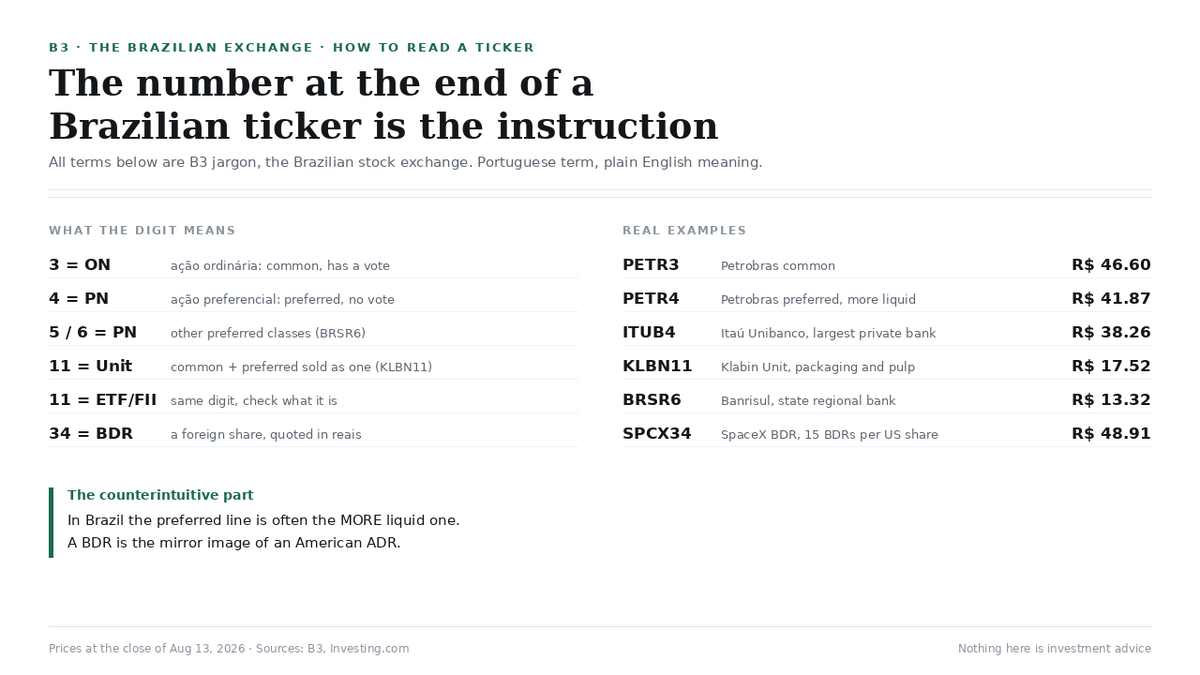
Brazilian tickers carry information in the number, which trips up every foreigner. Four letters, then a digit.
3 means ON — ação ordinária, a common share with voting rights. PETR3 is Petrobras common.
4 means PN — ação preferencial, a preferred share: usually no vote, but priority on dividends. PETR4 is Petrobras preferred. In Brazil the PN is often the more liquid line, the opposite of what an American expects. Petrobras preferred closed at R$ 41.87, about US$ 8.07.
5 and 6 are also preferred, different classes. Banrisul, a state-owned regional bank, trades as BRSR6.
11 means a Unit or a fund. A Unit is a bundle of common and preferred shares sold as one instrument — Klabin trades as KLBN11. The same 11 also marks ETFs and FIIs, so you check what the thing is, not just the number.
31, 32, 34, 35 mean a BDR — Brazilian Depositary Receipt, the mirror image of an American ADR: a foreign company's shares wrapped in a Brazilian certificate, quoted in reais, bought without sending money abroad. SPCX34 is the SpaceX BDR, listed on B3 on June 12, 2026, the same day as the Nasdaq IPO, at 15 BDRs per US share. It closed at R$ 48.91, about US$ 9.43.
PART 3 — THE THREE RATES THAT GOVERN EVERYTHING
You cannot understand any Brazilian stock without these, and they are the single biggest difference from the US market.
Selic is the policy rate, Brazil's Fed funds. It is set by the Copom, the central bank's rate-setting committee, which is the FOMC. On August 5, 2026 the Copom cut it for the fourth consecutive time, by 0.25 point, to 14.00% a year. The Fed funds rate is 3.50%–3.75%.
CDI is the interbank rate, which shadows the Selic. It is the benchmark every conservative Brazilian investment is quoted against: "this CDB pays 105% of CDI" means 105% of roughly the policy rate. There is no real American equivalent — think of it as "percent of the risk-free rate" being the standard unit of return.
IPCA is the official inflation index, the local CPI. It is running at 4.64% over twelve months.
Put those together and you get juro real, the real interest rate: about 9% a year, risk-free, in local currency. That number is the whole story of Brazilian equities. A stock in Brazil does not compete against a 4% Treasury, it competes against a government bond paying 14% nominal and roughly 9% after inflation. That is why the Ibovespa trades near 9 times earnings while the S&P 500 trades near 23. The multiple is not a bargain bin, it is the price of a brutal discount rate.
PART 4 — THE INSTRUMENTS, ONE BY ONE
Ações — stocks. Bought in any quantity now; the old 100-share round lot is history.
FII — fundo de investimento imobiliário, the Brazilian REIT. Ticker ends in 11. Pays monthly, and the income is tax-exempt for Brazilian residents who meet the rules. For a US person this is a trap, and I'll come back to it.
ETF — same idea as in the US. BOVA11 tracks the Ibovespa.
Tesouro Direto is the retail platform for buying government bonds directly, like TreasuryDirect. Three flavors: Tesouro Selic floats with the policy rate and barely moves in price, which makes it the standard emergency-fund asset; Tesouro IPCA+ pays inflation plus a fixed spread, the local TIPS; Tesouro Prefixado is a fixed nominal rate.
CDB is a bank certificate of deposit. LCI and LCA are bank notes backed by real estate and agriculture lending, and they are income-tax-free for Brazilian residents. Debênture is a corporate bond. CRI and CRA are securitized real estate and agri receivables.
Renda fixa means fixed income, renda variável means equities and anything else that moves.
PART 5 — DIVIDENDS, AND THE ONE RULE THAT CHANGED IN 2026
Dividendos work as you'd expect, except Brazilian companies pay them far more often and far more generously than American ones — quarterly, monthly, sometimes irregularly, and utilities and state-controlled companies have paid double-digit yields.
JCP — juros sobre capital próprio, "interest on own capital" — is a Brazilian oddity with no US equivalent. It is a distribution that is deductible for the company but has 15% withheld at source from the investor. Economically it is a dividend with a tax coat on.
Dividend Yield and P/L are used exactly as DY and P/E.
The 2026 change matters to anyone reading this from the US. Under Lei 15.270/2025, from January 2026 Brazil withholds 10% on the portion above R$ 50,000 paid in the same month by the same company to the same individual. Small holders are untouched. The rule reaches residents and non-residents alike, so if you hold Brazilian shares directly, that withholding is generally creditable against US tax on Form 1116. There is no income tax treaty between Brazil and the United States, which is exactly why the credit mechanism, not the treaty, is what you rely on.
PART 6 — WHO PROTECTS WHAT
FGC — Fundo Garantidor de Créditos — is the deposit insurance, the FDIC equivalent. It covers banking products only: checking, savings, CDB, RDB, LCI, LCA, up to R$ 250,000 per taxpayer ID per institution or conglomerate, with a global cap of R$ 1,000,000 if more than one associated institution fails within four years. It does not cover stocks, FIIs, ETFs, funds, debentures, CRI or CRA. Tesouro Direto is not FGC either — it is guaranteed by the National Treasury itself.
MRP — Mecanismo de Ressarcimento de Prejuízos — is the loss reimbursement mechanism, maintained by B3 and run by BSM under article 124 of CVM Resolution 135 of June 10, 2022. It pays up to R$ 200,000 per claim when your loss came from a broker's action or omission: an order not executed, executed wrong, misuse of your assets, custody failure. It does not cover the market going against you. The 2024 numbers are worth knowing before you count on it: 299 claims, R$ 820,000 actually paid, and 53% of judged cases denied.
The line to remember: a registered asset is yours even if the broker is liquidated. Idle cash sitting in a broker account is a promise, not an asset.
PART 7 — TAXES, THE SHORT VERSION
For Brazilian residents, and useful context for anyone reading Brazilian filings:
Stock sales are exempt if total sales in a month stay under R$ 20,000. Above that, 15% on the gain, paid by the investor through a form called DARF by the last business day of the following month. Day trade is 20% with no exemption. The exemption never applies to day trades, ETFs or FIIs. A token 0.005% is withheld at source on sales — nicknamed the imposto dedo-duro, the "snitch tax", because its only real job is to tell the tax authority you traded. Annual filing is mandatory if you sold more than R$ 40,000 in the year or had taxable gains.
PART 8 — IF YOU INVEST IN DOLLARS
You do not need a Brazilian account to own this market. ADRs trade in New York: PBR for Petrobras, ITUB for Itaú, VALE for Vale, ABEV for Ambev. EWZ and FLBR are US-domiciled Brazil ETFs. I'm describing what exists, not recommending any of it.
Two things a US person should know before buying anything local:
First, PFIC. Brazilian funds, FIIs and locally listed ETFs are generally treated as passive foreign investment companies by the IRS, which drags you into Form 8621 and a punitive tax regime. ADRs and US-domiciled ETFs are not PFICs. This single distinction is worth more than any stock pick.
Second, the currency is half your return. A Brazilian stock can gain 10% in reais and hand you nothing in dollars if the real weakens 10% in the same stretch. Any Brazilian number you read has to be read twice: once in reais, once in dollars.
THE 30-SECOND GLOSSARY
B3 = the Brazilian exchange. Ibovespa = the main index. Selic = policy rate. Copom = the FOMC. CDI = interbank benchmark. IPCA = CPI. Juro real = real interest rate. Ação ON = common. Ação PN = preferred. Unit = bundled share, ticker ends 11. BDR = the mirror of an ADR. FII = REIT. Tesouro Direto = TreasuryDirect. CDB = bank CD. FGC = deposit insurance. CVM = the SEC. BSM = the exchange's enforcement arm. Custódia = custody. Corretora = broker. Home broker = the trading screen. JCP = a dividend with 15% withheld. DARF = the tax payment slip. CPF = individual tax ID.
Save this one. Every Brazilian market headline you read from now on is built out of these twenty-odd words.
If a term is missing, ask in the replies and I'll add it. I post a daily read on the Brazilian close in English, and the full beginner guide in Portuguese is pinned to my profile.
Nothing here is investment advice, and nothing here is tax advice.
Data as of the close on August 13, 2026. Sources: B3, the Brazilian central bank (Selic and the official exchange rate), FGC, BSM Supervisão de Mercados, CVM Resolution 135, Lei 15.270/2025, and https://t.co/mznUzhFIX3 for prices.
EPISODE 4 — PETROBRAS HAS TWO PRICES ON THE NYSE. NEITHER IS A TYPO.
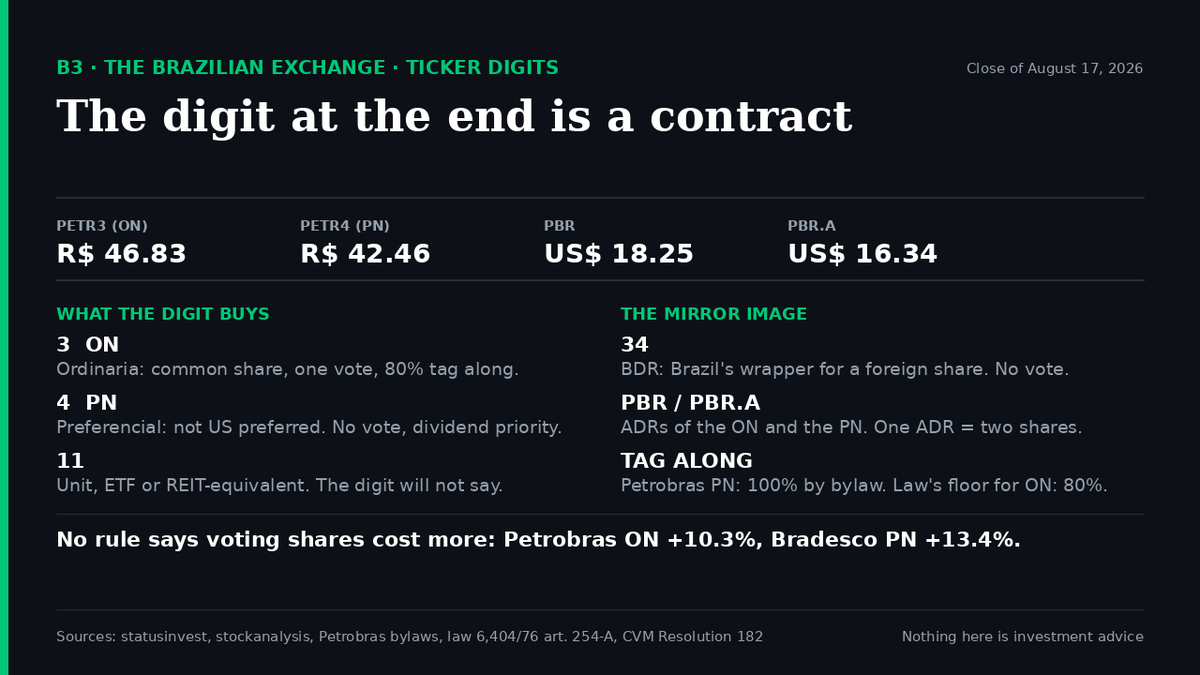
At Monday's close, PBR was US$ 18.25 and PBR.A was US$ 16.34. Same company, same exchange, same session, 11.7% apart.
Pull it up on your own broker. Most Americans who look at Brazil hit those two tickers, assume one is a data error, buy whichever is cheaper, and never find out what they actually bought.
Everything below is jargon from the Brazilian stock exchange, called B3. Portuguese term first, plain English right after.
TWO CLASSES, NOT ONE
Ordinária, abbreviated ON, is the common share. One share, one vote.
Preferencial, abbreviated PN, is where the mis-mapping happens. It translates as "preferred," and it is not US preferred stock. No coupon, no par value, no fixed place in a liquidation stack. It is common equity that trades on the same screen, moves with the same earnings, and carries two differences: priority in the dividend line, and usually no vote.
If you have been modeling PBR.A as a fixed-income-ish instrument because the name says preferred, delete that. It is equity.
THE DIGIT AT THE END OF A B3 TICKER IS A CONTRACT
3 is ON, the voting share. PETR3.
4 is PN, the non-voting share with dividend priority. PETR4.
5, 6, 7, 8 are classes of PN, each with its own terms written into the company bylaws.
11 is the ambiguous one: it can be a unit, an ETF, or a REIT-equivalent. The digit alone will not tell you.
33 and 34 mark a BDR, which is the mirror image of your ADR: Brazil's wrapper for a foreign share, quoted in reais. ROXO34 is the Nubank BDR on B3.
There is no US analogue to any of this. One company, one class of common, is the American default.
WHAT THE VOTING SHARE ACTUALLY BUYS
Beyond the vote, Brazilian law hands ON holders something the US does not have: tag along, under article 254-A of the corporations law. If a controlling shareholder sells control, the buyer must offer holders of voting shares at least 80% of the per-share price paid to the controller.
That is a statutory minimum price for minority holders in a control sale. In the US, minority protection in a change of control runs through fiduciary-duty litigation and appraisal rights — not a mandated percentage.
NOW THE PART THAT INVERTS THE INTUITION
Petrobras is listed on B3's Nível 2 segment, and its bylaws, article 5, paragraph 4, give the PN the right to join a control-sale tender offer at the same price and the same terms as the controller.
Read that against the paragraph above. On Petrobras, the non-voting share has 100% tag along. The law's floor for the voting share is 80%.
And the vote you are paying up for on PBR is close to decorative. The bylaws require the federal government to hold at least 50% of voting capital plus one share. As of the December 2025 balance sheet there were 7.44 billion common shares and 5.45 billion preferred. The majority in that shareholder meeting is settled before you arrive.
So: PBR gives you a vote you cannot use plus the deeper ADR liquidity. PBR.A gives you dividend priority and, by bylaw, the better tag along. I am describing what exists, not telling you which to own.
THERE IS NO RULE THAT VOTING SHARES COST MORE
Same close, Monday, on B3:
Petrobras — ON R$ 46.83, PN R$ 42.46. Voting share 10.3% higher.
Bradesco, the private-sector bank — ON R$ 14.30, PN R$ 16.22. Non-voting share 13.4% higher.
Opposite signs, same day. The premium is set by liquidity, index membership, and how much the vote is worth at that specific company — never by the digit.
THE ARITHMETIC, SO YOU CAN CHECK ME
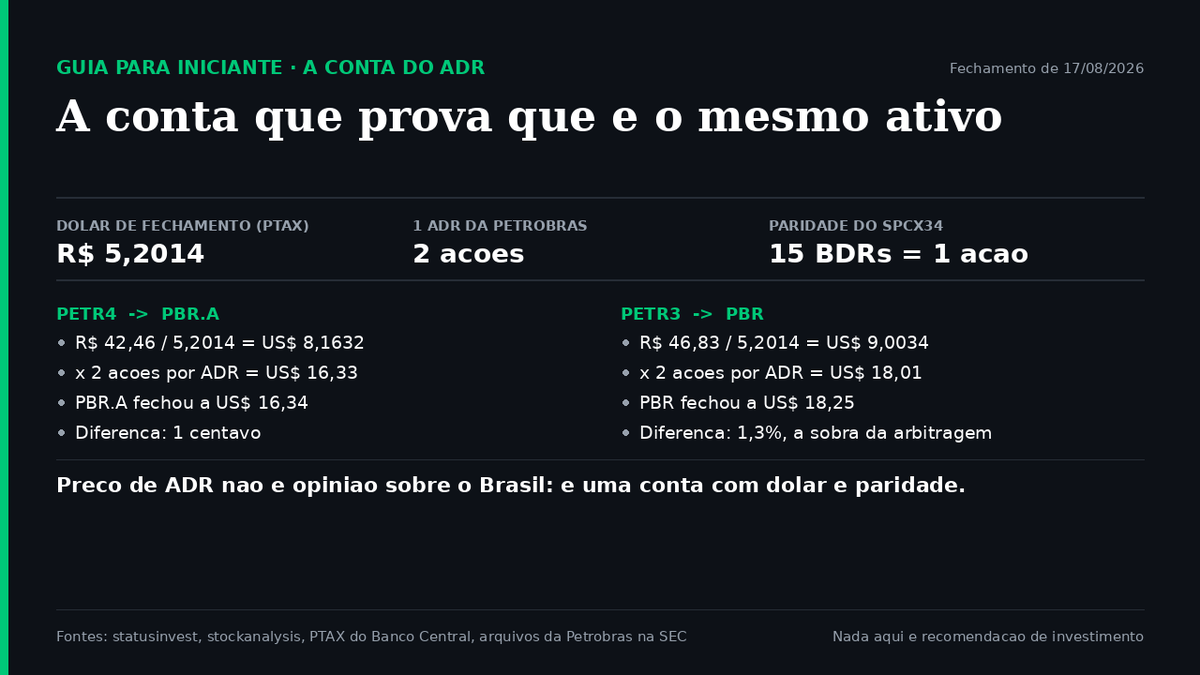
One Petrobras ADR represents two ordinary shares. Monday's official central bank rate was R$ 5.2014 to the dollar.
PETR4 at R$ 42.46 divided by 5.2014 is US$ 8.1632 per share.
Times two: US$ 16.33.
PBR.A closed at US$ 16.34.
One cent. Two countries, two currencies, one asset.
Run the voting share: R$ 46.83 divided by 5.2014, times two, is US$ 18.01. PBR closed at US$ 18.25 — a 1.3% premium to its own underlying. That gap is the arbitrage desks' lunch, and for you it is the reminder that an ADR price is a calculation, not an independent opinion about Brazil.
ONE MORE STRUCTURE YOU WILL HIT: THE UNIT
A unit is a bundle sold as a single ticker. Klabin's KLBN11 is 1 ON plus 4 PN, and one ADR equals two units. The bundle exists because a 2001 law capped preferred shares at 50% of total shares, down from two thirds — so companies package voting and non-voting stock together instead.
TAX, FOR A US HOLDER, WITH THE NUMBER I CAN PROVE
Since January 1, 2026, dividends paid out of Brazil to a non-resident carry 10% withholding, under Law 15,270 of 2025. There is no income tax treaty between Brazil and the United States, so you rely on the foreign tax credit, not a treaty rate. Transition rules preserve the old exemption for profits approved through the end of 2025 and paid by 2028.
Brazil also pays shareholders through JCP, juros sobre capital próprio, best translated as interest on equity: a deductible payout at the company level that is taxed at the source in the investor's hands. The domestic withholding rate on it rose to 17.5% in 2026. For the rate applied to a non-resident, published sources disagree, so I am not going to quote you a number I cannot pin to primary law.
Worth knowing: a depositary receipt like an ADR is not a fund, so it is not a PFIC. A Brazilian mutual fund, FII (the REIT equivalent) or locally listed ETF generally is, which means Form 8621. EWZ and FLBR, being US-listed, are not.
TOMORROW, EPISODE 5
Dividends, JCP and data-com, the record date. Why a Brazilian stock drops the morning after a payout without anyone getting poorer, why two holders of the same share receive different net amounts, and how to tell whether buying today still gets you paid.
If you hold PBR or PBR.A, tell me in the replies which one and why you picked it. I want to know how many people chose on purpose.
Nothing here is investment advice, and nothing here is tax advice.
Data as of the close on August 17, 2026. Sources: B3 prices via statusinvest, PBR and PBR.A via stockanalysis, the exchange rate from the Brazilian central bank PTAX series, share counts and preferred-share rights from Petrobras bylaws and the 2025 financial statements filed with the SEC, ADR ratio from the Petrobras Exchange Act securities description, unit composition from Klabin investor relations, article 254-A and the 2001 preferred-share cap from Planalto, B3 for the Nível 2 listing rules, and Complementary Law 224 of 2025 for the interest-on-equity withholding increase.
EPISÓDIO 5 — DIVIDENDO, JCP E DATA-COM: QUEM RECEBE, QUANTO SOBRA E POR QUE A AÇÃO "CAI"
Nesta sexta-feira, 28 de agosto, o Itaú deposita R$ 7,84 bilhões na conta dos acionistas. Se você comprou ITUB4 em julho, não recebe um centavo desse dinheiro. E a ação não vai cair na sexta.
Os dois fatos têm a mesma causa, e ela tem nome: data-com.
Hoje eu percorro a linha do tempo de um provento de verdade, com as datas exatas de um comunicado que está publicado e pode ser conferido. É o episódio que separa quem recebe de quem só assiste.
A LINHA DO TEMPO, DATA POR DATA
Peguei o JCP que o Itaú anunciou em maio. Cinco datas, na ordem em que aconteceram.
28 de maio de 2026 — ANÚNCIO. O conselho de administração aprova o pagamento de R$ 0,36188 bruto por ação, R$ 3,99 bilhões no total. É só aqui que o número existe. Antes disso, era expectativa.
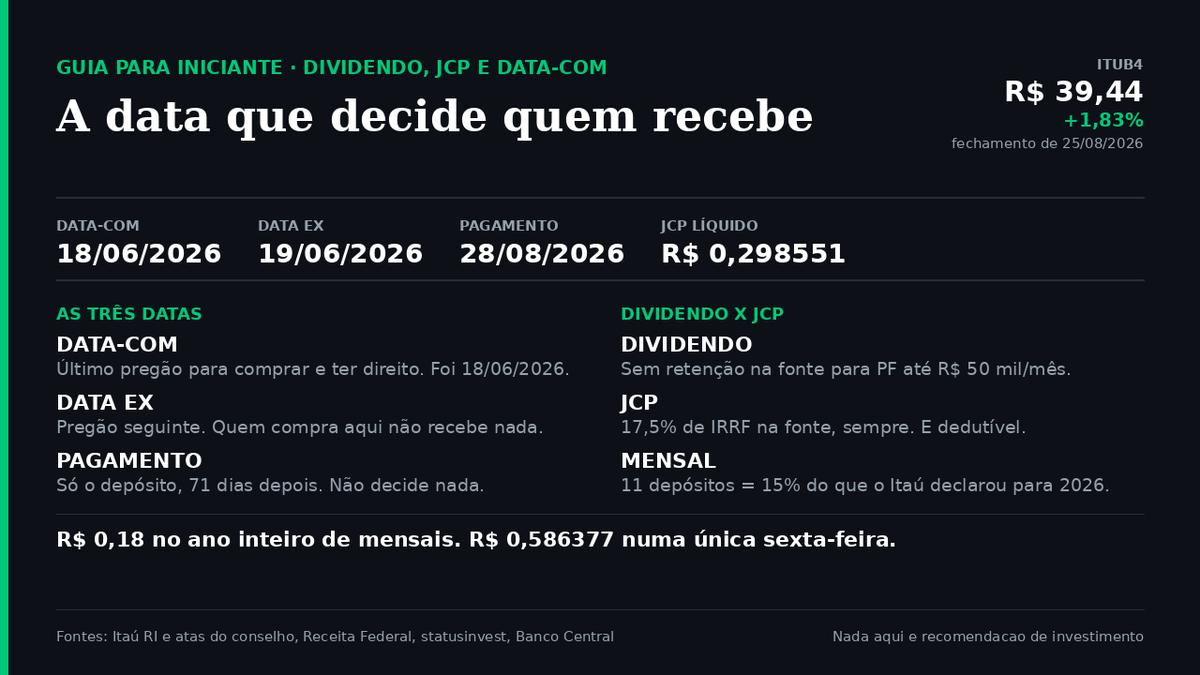
18 de junho de 2026 — DATA-COM (ou data-base). Este é o dia que decide tudo. Quem tinha a ação no fim deste pregão entrou na lista. Comprou nesse dia? Entrou. Vendeu nesse dia? Saiu.
19 de junho de 2026 — DATA EX. A partir daqui a ação é negociada "ex-direito". Quem comprou no dia 19 comprou a empresa sem o cheque. A lista já estava fechada.
29 de junho de 2026 — CRÉDITO CONTÁBIL. O banco reconhece a dívida com você no balanço. Você já é credor, mas o dinheiro não chegou.
28 de agosto de 2026 — PAGAMENTO. Dois meses e dez dias depois da data-com, o dinheiro cai na conta.
Guarde a distância entre a segunda e a última linha. Setenta e um dias. É nesse buraco que o iniciante se perde: ele vê a notícia do pagamento em agosto, compra em agosto e não recebe nada, porque a fila fechou em junho.
POR QUE A AÇÃO "CAI" NO DIA EX SEM NINGUÉM EMPOBRECER
Antes da data-com, a ação carrega duas coisas: a empresa e o direito a um pagamento futuro. Depois da data-com, carrega só a empresa. O direito virou seu, separado do papel.
Então o preço se ajusta para baixo, mais ou menos pelo valor do provento. Não é queda, é troca de bolso: saiu do preço da ação, entrou na sua conta a receber.
Quem tinha a ação: patrimônio igual. Um pouco menos em ação, o resto a receber em dinheiro.
Quem comprou no dia ex: pagou menos e não tem direito. Também justo.
Aqui está o detalhe prático que quase ninguém conta. O JCP mensal do Itaú é de R$ 0,018182 bruto por ação. Contra os R$ 39,44 do fechamento desta terça-feira, isso é 0,046% do preço. O ajuste existe, mas ele desaparece dentro da variação normal do dia — a ação subiu 1,83% nesta terça. Procurar a "queda do dividendo" no gráfico de uma ação que paga R$ 0,018 é procurar uma moeda no fundo de uma piscina agitada.
Quando o provento é grande, aí você vê. Em dezembro de 2025 o Itaú declarou, na mesma data-com de 9 de dezembro, dividendo de R$ 1,868223 e JCP de R$ 0,369750 bruto por ação. Somados, mais de 5% do preço de hoje numa única data. Esse ajuste ninguém confunde com ruído.
DIVIDENDO E JCP NÃO SÃO SINÔNIMOS
Os dois são jeitos de a empresa te mandar dinheiro. A diferença está em quem paga o imposto.
DIVIDENDO é lucro depois do imposto da empresa. Para pessoa física residente no Brasil, continua sem retenção na fonte — com uma novidade de 2026 que você precisa saber: pela Lei 15.270 de 2025, a empresa retém 10% quando paga mais de R$ 50 mil a uma mesma pessoa física em um único mês. E, segundo a orientação da Receita Federal publicada em agosto, quando esse limite é ultrapassado o rendimento tributável é o valor total distribuído, não só o excedente. Ou seja, não é uma alíquota que sobe devagar: é um degrau. Se isso te alcança, é conversa para contador, não para post.
JCP é "juros sobre capital próprio", e é uma invenção brasileira. A empresa trata o pagamento como despesa e abate do próprio imposto de renda. Em troca, o Fisco cobra na sua ponta: IRRF de 17,5% retido na fonte, sempre, sem faixa de isenção. A alíquota era 15% e subiu com a Lei Complementar 224 de 2025, em vigor desde janeiro de 2026.
Por isso banco brasileiro adora JCP: o desconto no imposto da empresa é maior do que o imposto que sai do seu bolso. O bolo total aumenta, mesmo que a sua fatia venha com uma mordida.
O EXEMPLO NUMÉRICO: DOIS DONOS DA MESMA AÇÃO, VALORES DIFERENTES
Mesmo papel, mesma data, mesmo provento de R$ 0,36188 bruto por ação. Dez mil ações de ITUB4.
Você, pessoa física: R$ 0,298551 líquido por ação. Total de R$ 2.985,51.
Uma fundação comprovadamente imune ou isenta: recebe o bruto, R$ 0,36188. Total de R$ 3.618,80.
Diferença de R$ 633,29 no mesmo dia, pelo mesmo papel. A ação não sabe quem é o dono; a alíquota sabe.
O QUE ISSO RENDE DE VERDADE, EM NÚMERO
Aqui vai a conta que desmonta o marketing de "ação que paga todo mês".
O Itaú paga R$ 0,015 líquido por ação por mês. Em 2026 são onze desses depósitos com pagamento dentro do ano: R$ 0,165 por ação.
Só na sexta-feira que vem, entre os dois JCP extras, saem R$ 0,586377 líquidos por ação — mais de três vezes o ano inteiro de mensais, numa tacada.
Somando o que o banco já declarou com pagamento em 2026, dá cerca de R$ 1,0657 líquido por ação, ou 2,70% do preço de fechamento desta terça. Os onze depósitos mensais são 15% desse total. Os outros 85% vêm de três datas. E a distribuição complementar de dezembro ainda não foi declarada.
Leitura: o pagamento mensal é conforto psicológico, não é a fonte do retorno. Quem constr��i tese em cima do "pinga todo mês" está olhando 15% do dinheiro.
O ERRO CLÁSSICO DESTE TEMA
Comprar na véspera do pagamento. Não existe. A data que importa passou semanas antes.
Achar que a queda do dia ex é oportunidade. Você está comprando algo que vale menos porque um direito saiu de dentro dele. Não há desconto nenhum.
Comprar só para pegar o provento e vender depois. Antes de custos e imposto, o resultado é neutro por construção: você recebe o dinheiro e perde no preço. Depois de corretagem e IRRF, é negativo.
Comparar dividend yield de uma empresa que paga dividendo com o de outra que paga JCP usando o valor bruto nos dois casos. O JCP chega com 17,5% de desconto. Compare líquido com líquido.
Confundir dividend yield passado com promessa. O número que você vê no site é o que já foi pago. Provento não é cupom de renda fixa: depende de lucro e de decisão de conselho.
AMANHÃ, EPISÓDIO 6
Cara ou barata: como ler P/L, P/VP, ROE e dividend yield sem decorar fórmula. Por que o Ibovespa negocia perto de 9 vezes lucro enquanto a bolsa americana negocia perto de 23, e em que caso "barato" é armadilha em vez de oportunidade.
SUA VEZ
Olhe o extrato de proventos da sua corretora e procure a linha mais recente. Ela diz "dividendo" ou "JCP"? Comenta aqui o ticker e o tipo, que eu te digo quanto de imposto ficou pelo caminho e se o valor que apareceu já é líquido.
Nada aqui é recomendação de investimento nem consultoria tributária. Regras de imposto mudam: confirme no portal da Receita Federal antes de decidir. Cotações do fechamento de 25 de agosto de 2026: ITUB4 a R$ 39,44 e Ibovespa a 174.576,80 pontos, com dólar PTAX de venda a R$ 5,1490. Selic em 14,00% ao ano e IPCA de 4,44% nos 12 meses até julho, o que dá juro real de cerca de 9,15%. Fontes: calendário e valores de proventos na área de relações com investidores do Itaú e nas atas do conselho de administração; alíquota do JCP na Lei Complementar 224/2025 e a regra de dividendo na Lei 15.270/2025, com a orientação de agosto de 2026 da Receita Federal; cotação de ITUB4 pelo statusinvest; fechamento do Ibovespa pelo InfoMoney; dólar, Selic e IPCA pelas séries do Banco Central e pelo IBGE.
Todo mundo diz para o iniciante "invista na bolsa", ninguém explica o caminho. E aí a pessoa abre o primeiro relatório, lê "o papel negocia a 9x P/L com upside de 25% e sinistralidade pressionando a margem" e desiste na terceira linha.
Então aqui está o passo a passo completo, na ordem certa, com cada palavra difícil traduzida para português de gente. Sem curso, sem link de afiliado.
A ETAPA ZERO QUE QUASE TODO MUNDO PULA
Antes de abrir conta em corretora, três coisas.
Primeira: quitar dívida caríssima. Cartão de crédito no rotativo e cheque especial cobram, no Brasil, juros muito acima de qualquer retorno realista de bolsa. Pagar uma dívida dessas é o melhor investimento disponível para você hoje, e é o único com retorno garantido. Investir com dívida de cartão é encher um balde furado.
Segunda: reserva de emergência. De três a seis meses das suas despesas em algo que você saca hoje e que não perde valor, tipo Tesouro Selic ou CDB de liquidez diária. Isso não é para ficar rico. É o colchão que evita você ter que vender ação no pior dia possível porque a geladeira quebrou. Quem investe sem reserva vira vendedor forçado, e vendedor forçado sempre vende no fundo, porque a emergência não escolhe o dia.
Terceira: aceitar a regra do jogo. Dinheiro que você vai precisar em menos de cinco anos não deveria estar em ação. A bolsa cai 30% de tempo em tempo, sem avisar. Se você não conseguir olhar a tela vermelha e não fazer nada, o problema não é a ação que você escolheu, é o prazo.
E tem uma régua que quase nenhum conteúdo de iniciante te dá. Hoje a Selic está em 14% ao ano e a inflação em 4,64% nos últimos 12 meses. Ou seja: o título público do governo paga cerca de 9% acima da inflação, sem risco nenhum. Esse é o número que qualquer ação precisa superar para valer a pena. Se alguém te promete 20% ao mês, você já sabe o que é.
DO ZERO À PRIMEIRA AÇÃO EM SEIS PASSOS
1. Escolher a corretora. Corretora é a loja onde você compra ação, porque você não compra direto da bolsa, do mesmo jeito que não compra refrigerante direto da fábrica. As grandes hoje cobram zero de corretagem para ações, então não pague taxa por operação. Confira se ela é autorizada pela CVM.
2. Abrir a conta. É igual banco digital: CPF, documento, selfie e um questionário chamado suitability, que é só um teste para saber se você é conservador ou arrojado. Sai em algumas horas.
3. Transferir o dinheiro. Pix ou TED da sua própria conta, no seu nome. Dinheiro de terceiro é bloqueado. E não precisa ser muito: com R$ 100 já dá para comprar ação de várias empresas grandes.
4. Achar o ticker. Ticker é o apelido da ação na bolsa. PETR4 é Petrobras, ITUB4 é Itaú, VALE3 é Vale. O número no fim diz o tipo: 3 é ordinária (tem voto na assembleia), 4 é preferencial (não vota, mas costuma estar na frente na fila do dividendo) e 11 é unit, que é um pacotinho com mais de um tipo de papel junto.
5. Enviar a ordem no home broker. Home broker é só o nome pomposo da tela de compra e venda do aplicativo. Você tem duas opções: ordem a mercado, que é "compre agora, no preço que estiver", e ordem limitada, que é "compre só se sair a R$ 38 ou menos". Para quem está começando, use limitada. Evita a surpresa de pagar mais caro do que você viu na tela.
6. Guardar a nota de corretagem. É a nota fiscal da operação. Baixe todas e jogue numa pasta. É esse documento que prova quanto você pagou, e você vai precisar dele para calcular imposto e declarar. Quem não guarda sofre depois.
Duas palavras que vão aparecer e assustar. Lote fracionário: ações são vendidas em pacotes de 100, então se você quer comprar 7 em vez de 100, use o fracionário colocando F no fim do ticker (PETR4F). E D+2: quando você vende, o dinheiro só cai na conta dois dias úteis depois. Não é a corretora te enrolando, é o prazo padrão da bolsa.
O QUE COMPRAR QUANDO VOCÊ AINDA NÃO SABE NADA
Aqui é onde o iniciante trava, porque a internet grita mil nomes ao mesmo tempo. A resposta honesta é chata: comece pelo mais simples e só suba de degrau quando entender o de baixo.
Degrau 1, um ETF de índice. ETF é uma cesta de ações que você compra como se fosse uma única ação. O BOVA11 compra para você um pedacinho das cerca de 80 maiores empresas da bolsa de uma só vez. Vantagem enorme para quem está começando: você não precisa acertar a empresa. Se uma quebrar, as outras 79 seguram o tranco. Se quiser exposição ao exterior, o IVVB11 acompanha o S&P 500 em reais, e a SPCX34 é um BDR, que é um recibo negociado aqui representando ativo de fora. Nos dois casos você ganha ou perde por dois motivos ao mesmo tempo: as empresas americanas e o dólar.
Degrau 2, empresas grandes e entediantes. As blue chips: gigantes, antigas, lucrativas, que você conhece do dia a dia. Banco, energia, saneamento, mineração. Não vão te dar 300% em um ano, e é exatamente esse o ponto. Costumam pagar dividendo, que é a parte do lucro que a empresa deposita na sua conta só por você ser sócio, sem precisar vender nada.
Degrau 3, escolher empresa sozinho. Só chegue aqui quando estes quatro números fizerem sentido sem consulta. Eles são só quatro perguntas:
P/L: quantos anos do lucro atual eu estou pagando pela empresa?
ROE: quanto de lucro ela gera com o dinheiro dos sócios?
Dívida sobre Ebitda: ela deve mais do que três vezes o caixa que gera?
Dividend yield: quanto de dividendo eu recebo por real investido?
E o aviso mais importante desta parte: ação barata não é a mesma coisa que ação boa. A bolsa brasileira está cheia de empresa barata por um bom motivo. Exemplo real de hoje, 13 de agosto: o Banco do Brasil divulgou lucro de R$ 3,9 bilhões, acima do consenso de R$ 3,5 bilhões que o mercado esperava, e a ação caiu 3,9%. Motivo: a inadimplência do agronegócio continuava subindo. O mercado não olha onde a empresa está, olha para onde ela está indo.
Sobre day trade, que é comprar e vender no mesmo dia: é a atividade mais divulgada da internet e a que mais destrói iniciante. Você paga imposto maior (20% contra 15%), perde o direito à isenção, opera contra profissional com máquina melhor e transforma investimento em cassino. Se a proposta chegou por anúncio com foto de carro importado, é publicidade, não estratégia.
IMPOSTO SEM SUSTO: TRÊS REGRAS
Essa parte assusta mais do que deveria. Para quem investe pouco e não faz day trade, o resumo é: você provavelmente não vai pagar nada, mas ainda assim precisa declarar.
Regra 1, a isenção dos R$ 20 mil. Se o total vendido em ações no mês ficar abaixo de R$ 20.000, o lucro é isento. Repare bem: o limite é sobre o valor vendido, não sobre o lucro. Vendeu R$ 15.000 e lucrou R$ 5.000? Imposto zero. Passando disso e havendo lucro, são 15% sobre o lucro, que você mesmo calcula e paga com uma guia chamada DARF até o último dia útil do mês seguinte. A corretora não faz isso por você. A isenção não vale para day trade, nem para ETF, nem para fundo imobiliário.
Regra 2, e aqui muita gente foi confundida. A partir de janeiro de 2026 a Lei 15.270/2025 passou a cobrar 10% na fonte sobre dividendos, mas só na parte que passar de R$ 50.000 pagos no mesmo mês pela mesma empresa para a mesma pessoa. Traduzindo: se você recebe R$ 80 de dividendo do Itaú, nada muda, continua caindo integral na sua conta. Está circulando muito post dizendo que "agora todo dividendo é tributado", e isso está errado para o investidor pequeno.
Regra 3, declarar não é a mesma coisa que pagar. Você é obrigado a entregar a declaração se vendeu mais de R$ 40.000 em bolsa no ano somando tudo, ou se teve lucro tributável em qualquer valor. E a B3 informa todas as suas operações à Receita, então não existe operação invisível. A maioria das multas de iniciante vem de esquecer de informar algo isento, não de sonegar.
Ah, e aquela retenção minúscula de 0,005% que aparece na nota não é taxa nova nem erro. É o apelidado imposto dedo-duro, que serve só para avisar a Receita de que você operou. Depois você desconta do imposto devido.
OS SETE ERROS QUE QUEBRAM O INICIANTE
1. Investir sem reserva de emergência, e virar vendedor forçado no pior dia.
2. Colocar tudo de uma vez em vez de aportar todo mês. Aportando aos poucos, você compra caro em uns meses e barato em outros, e para de tentar adivinhar o dia certo.
3. Comprar por dica de rede social. Quem te deu a dica comprou antes e vai vender quando você entrar. Se a tese não cabe em três frases que você mesmo entenda, não é sua tese.
4. Concentrar tudo em uma ação. Empresa boa também quebra, muda de dono ou perde o setor.
5. Confundir dividendo alto com empresa boa. Às vezes o yield está alto porque a ação despencou, o que é a definição de armadilha.
6. Vender no pânico e comprar na euforia, que é exatamente o oposto do que a matemática pede.
7. Não guardar as notas de corretagem.
O único atalho que existe: aporte constante, custo baixo, prazo longo e o mínimo de mexida possível. É entediante, não vende curso, e é o que funciona.
TRADUZINDO O ECONOMÊS
Ticker: o apelido da ação.
Home broker: a tela de compra e venda.
Liquidez: facilidade de vender rápido e no preço justo.
D+2: o dinheiro da venda cai em dois dias úteis.
Dividendo: o lucro que cai na sua conta sem você vender nada.
JCP: dividendo com outro nome e 15% de imposto retido.
Ebitda: o caixa que a operação gera, antes de juros e impostos.
Margem: quanto sobra de cada R$ 100 vendidos.
Alavancagem: o tamanho da dívida frente ao caixa que a empresa gera.
Upside: o espaço entre o preço de hoje e o preço-alvo do analista.
Consenso: a média do que os analistas esperam.
Impairment: admitir que um bem valia menos do que estava no papel.
Faca caindo: tentar comprar no meio do tombo.
Montei um dicionário com 84 termos desses. Se você quer que eu poste a lista completa aqui em partes, me diz nos comentários qual palavra travou você e eu começo por ela.
Nada aqui é recomendação de investimento nem consultoria tributária. Regras de imposto mudam: confirme no portal da Receita Federal antes de declarar. Dados macro de 13 de agosto de 2026, Selic conforme o Copom de 5 de agosto.
EPISÓDIO 4 — POR QUE A PETROBRAS TEM DOIS PREÇOS: ON, PN, UNIT E BDR
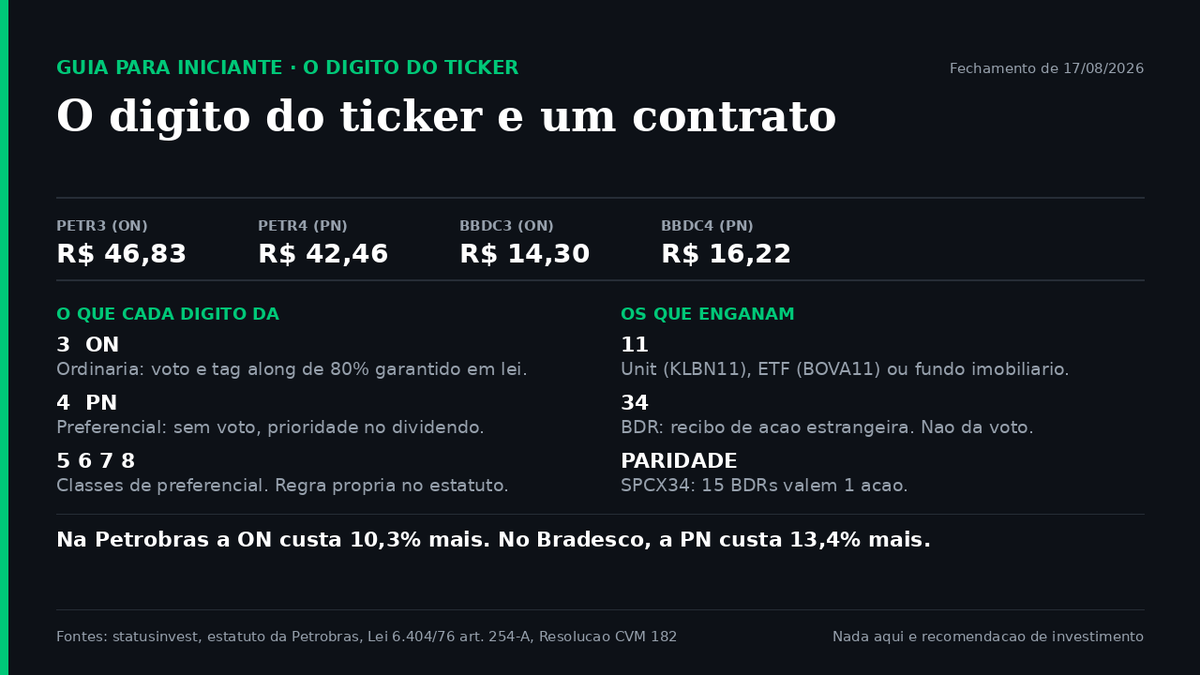
No fechamento desta segunda-feira, 17 de agosto, a Petrobras valia duas coisas ao mesmo tempo na B3: PETR3 a R$ 46,83 e PETR4 a R$ 42,46. Mesma empresa, mesmo dia, mesmo pregão, 10,3% de diferença.
Não é erro do aplicativo, e não é promoção. O número no fim do ticker não é enfeite: é a descrição do contrato que você assina ao apertar o botão de compra.
Hoje eu respondo as cinco perguntas que todo iniciante faz diante dessa tela.
PERGUNTA 1 — O QUE CADA DÍGITO SIGNIFICA?
3 é ON, ação ordinária. Dá voto na assembleia, um voto por ação.
4 é PN, ação preferencial. Em geral não dá voto e, em troca, entra na frente na fila do dividendo.
5, 6, 7 e 8 são classes de preferencial (PNA, PNB e assim por diante). Cada classe tem regra própria escrita no estatuto da empresa. BRSR6, do Banrisul, é PNB.
11 é o dígito que mais engana, porque não diz o que você está comprando. Pode ser unit (KLBN11), pode ser ETF (BOVA11), pode ser fundo imobiliário (HGLG11). Só olhando o nome do papel você sabe.
33 e 34 no fim indicam BDR, o papel que embala ação estrangeira para ser negociada aqui em real.
PERGUNTA 2 — O QUE O 3 COMPRA QUE O 4 NÃO COMPRA?
Duas coisas. A primeira é o voto, e você já sabia.
A segunda quase ninguém explica: o tag along do artigo 254-A da Lei das S.A. Traduzindo tag along, que significa "direito de ir junto": se o dono do controle vender a empresa, o comprador é obrigado a fazer uma oferta ao dono de ação ordinária por, no mínimo, 80% do preço por ação que pagou ao controlador.
Ou seja, quem tem ON não fica vendo o dono sair rico pela porta da frente. Tem direito de sair também, a um preço próximo.
Para a preferencial, a lei não garante nada disso. Só o estatuto da empresa ou o segmento de listagem em que ela está podem dar.
PERGUNTA 3 — E O QUE O 4 COMPRA?
Preferência no dinheiro, escrita em papel. No caso da Petrobras, o artigo 5º do estatuto dá à PN prioridade no recebimento de dividendo de, no mínimo, 5% calculado sobre a parte do capital representada por essa espécie, ou 3% do valor do patrimônio líquido da ação, prevalecendo sempre o maior. Acima desse mínimo, a PN participa em igualdade de condições com a ON.
E tem mais, que é o detalhe que inverte a intuição de muita gente: a Petrobras está listada no Nível 2 da B3, e o parágrafo 4º do mesmo artigo 5º garante à PN o direito de entrar na oferta pública de alienação de controle ao mesmo preço e nas mesmas condições oferecidas ao controlador.
Leia de novo. Na Petrobras, a preferencial tem tag along de 100%, e o mínimo que a lei garante à ordinária é 80%.
PERGUNTA 4 — ENTÃO POR QUE A ON CUSTA 10% MAIS?
Aqui está o ponto do episódio: não existe a regra "ON vale mais que PN". No mesmo fechamento de hoje, a B3 mostrou os dois sinais opostos.
Petrobras: ON a R$ 46,83, PN a R$ 42,46. A ordinária custa 10,3% mais.
Bradesco: ON (BBDC3) a R$ 14,30, PN (BBDC4) a R$ 16,22. A preferencial custa 13,4% mais.
Duas empresas, dois resultados contrários, no mesmo dia. O que define o prêmio não é o dígito: é liquidez (a facilidade de vender rápido, em volume, sem derrubar o preço), presença nos índices que os fundos são obrigados a seguir, e quanto o voto realmente vale naquela empresa específica.
E na Petrobras o voto vale menos do que parece. O estatuto exige que a União mantenha no mínimo 50% do capital votante mais uma ação. São 7,44 bilhões de ordinárias e 5,45 bilhões de preferenciais em circulação, conforme o balanço de dezembro de 2025. Comprar PETR3 é comprar voto numa assembleia cuja maioria já está decidida antes de você chegar.
Isso não faz da PETR3 uma ação ruim. Faz do prêmio de 10% uma coisa que você deveria pagar sabendo o que está pagando.
PERGUNTA 5 — E A UNIT E O BDR?
Unit é um pacote de ações vendido como papel único. A unit da Klabin, KLBN11, é formada por 1 ação ordinária e 4 preferenciais. Você compra um papel e leva cinco ações, com um voto dentro.
Por que existe: a Lei 10.303, de 2001, limitou as preferenciais a 50% do total de ações da companhia. Antes eram dois terços. A unit é a forma que o mercado achou de empacotar voto e preferência no mesmo produto.
BDR é um certificado emitido no Brasil, negociado em real, lastreado em ação que fica custodiada no exterior. A regra atual é a Resolução CVM 182, de 2023.
O que o BDR não dá: voto na empresa lá fora. Você tem um recibo de depósito, não a ação.
E paridade é tudo. No SPCX34, o BDR da SpaceX, são 15 BDRs para 1 ação. Não confunda o preço do BDR com o preço da ação. O BDR do Nubank na B3 é o ROXO34, nível I. O NUBR33 era o programa nível III, descontinuado em dezembro de 2022: se você vê alguém citando NUBR33 hoje, está lendo informação velha.
O EXEMPLO NUMÉRICO QUE AMARRA TUDO
O ADR é o espelho do BDR: é o papel que embala ação brasileira para ser negociada em Nova York. Na Petrobras, 1 ADR equivale a 2 ações.
Faça a conta com o fechamento de hoje. PETR4 a R$ 42,46, dólar de fechamento a R$ 5,2014, a taxa oficial do Banco Central.
R$ 42,46 dividido por 5,2014 dá US$ 8,1632 por ação.
Vezes 2, porque o ADR vale duas ações: US$ 16,33.
O PBR.A, que é o ADR da preferencial, fechou a US$ 16,34 na Bolsa de Nova York.
Um centavo de diferença. Mesma empresa, dois países, duas moedas, e a conta fecha.
Agora repita com a ordinária: R$ 46,83 dividido por 5,2014, vezes 2, dá US$ 18,01. O PBR fechou a US$ 18,25. Sobraram 24 centavos por ADR, 1,3%. Essa sobra tem nome, arbitragem, e é atrás dela que existe mesa de operação. Para você serve para outra coisa: provar que o preço do papel não é opinião, é uma conta que qualquer um confere com uma calculadora.
O ERRO CLÁSSICO DESTE TEMA
São quatro, e eu vejo todos.
Comprar o dígito mais barato achando que achou desconto. PETR4 não é PETR3 com desconto. É outro contrato, com outros direitos.
Achar que ordinária é sempre melhor. O Bradesco de hoje mostra o contrário, e a preferencial da Petrobras tem tag along melhor que o mínimo legal da ordinária.
Comprar ON de empresa pequena só pelo voto e descobrir, na hora de vender, que não tem comprador do outro lado. Voto que você não usa não paga a falta de liquidez.
Achar que BDR dá voto na empresa estrangeira. Não dá.
UMA CORREÇÃO MINHA, DO EPISÓDIO 3
No episódio anterior eu escrevi que o JCP continua com 15% retido na fonte. Está errado, e a correção é minha: a Lei Complementar 224, de 26 de dezembro de 2025, elevou o IRRF sobre juros sobre capital próprio de 15% para 17,5%, com efeito em 2026. Dividendo para pessoa física residente segue isento e ganho de capital em ação segue em 15%. O resto do episódio 3 está de pé: a tabela regressiva não mudou, e LCI e LCA seguem isentas.
AMANHÃ, EPISÓDIO 5
Dividendo, JCP e data-com. Por que a ação "cai" no dia seguinte ao provento sem que ninguém tenha ficado mais pobre, por que dois donos da mesma ação recebem valores líquidos diferentes, e como saber se você compra hoje ainda dá tempo de receber.
SUA VEZ
Abra seu aplicativo agora e olhe os dígitos. Você tem 3, 4, 11 ou 34 na carteira? Comenta o ticker aqui que eu explico, em uma linha, o que aquele número te deu e o que te tirou.
Nada aqui é recomendação de investimento nem consultoria tributária. Regras de imposto mudam: confirme no portal da Receita Federal antes de decidir. Preços de fechamento de 17 de agosto de 2026. Fontes: cotações da B3 pelo statusinvest, dólar pela PTAX do Banco Central, PBR e PBR.A pelo stockanalysis, direitos da PN e número de ações no estatuto da Petrobras e nas notas do balanço de 2025, composição da unit na área de relações com investidores da Klabin, artigo 254-A da Lei 6.404/76 e Lei 10.303/2001 pelo Planalto, regras de BDR na Resolução CVM 182 e o IRRF sobre JCP na Lei Complementar 224/2025.
@CanarinhoFNC On the flow, the month still cuts the other way: foreigners are net sellers of R$ 23.2 billion on B3 in August through the 20th while domestic institutions bought R$ 14.7 billion, so today's bid looks local and it is showing up in options.
@CapexAndChill Worth pinning the funding side down too: Brazil's Selic policy rate is 14% after four straight cuts from 15%, against IPCA inflation of 4.44% in the 12 months to July, so the Brazilian book bankrolling the Mexico build still earns a real rate near 9%.
WALL STREET BOUGHT BRAZIL TODAY WITHOUT BUYING A SINGLE SHARE
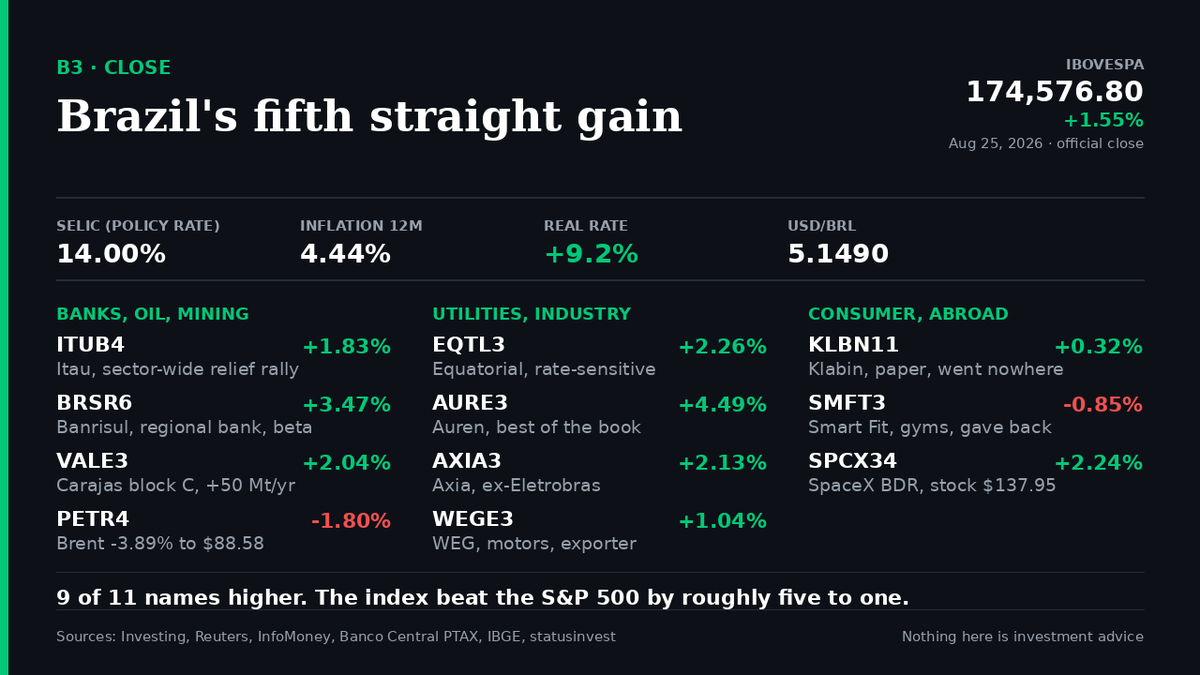
The Ibovespa, Brazil's benchmark stock index, closed Tuesday at 174,576.80, up 1.55%. Fifth straight gain. On the same day the S&P 500 added 0.3% and the Nasdaq 0.7%, so Brazil beat the US market by roughly five to one on R$28.67 billion of volume, about US$5.6 billion.
That is not the interesting part.
The interesting part is where the buying showed up. Open interest in November call options on the Ibovespa struck at 200,000 points went from 1.1 million contracts to 4.5 million in a single session, according to Bloomberg data. Traders also loaded up on call spreads on EWZ, the iShares Brazil ETF. Meanwhile the actual cash flow from foreign investors into Brazilian equities is still negative for the month: minus R$21.44 billion in August, even after a R$1.76 billion inflow on August 21.
Read that again. Positioning turned bullish. Ownership did not. Someone is renting Brazil through the options book instead of buying it outright, which tells you exactly how much conviction is behind the fifth straight up day.
WHY AN OPINION POLL MOVED AN INDEX
The trigger was a BTG/Nexus poll putting October's presidential race between Lula and Flávio Bolsonaro in a statistical tie. In Brazil, "the market-friendly candidate is closing the gap" is a tradeable event in the same way a Fed pivot is here. Nothing changed about any company's earnings today. What changed was the distribution of possible policy outcomes eighteen months out, and Brazilian equities are long-duration bets on the policy path, not on this quarter.
The sober version: this index went from about 200,000 points down to 170,000 in two months earlier this year. Today's 174,577 is still roughly 12% below the 2026 high. This is a partial recovery inside a drawdown, not a breakout.
THE GAP THAT KEEPS DRAWING MONEY BACK
The Selic, Brazil's overnight policy rate, is 14.00%, after four cuts of 0.25 point each from 15.00%. Twelve-month inflation is 4.44%. That leaves a real risk-free rate near 9.2%. Your equivalent, the 10-year Treasury, closed today at 4.6209%, down from 4.704% Monday after the Treasury expanded its buyback of long-dated paper. And the Ibovespa trades near nine times forward earnings against roughly 23 for the S&P 500.
Here is the part that gets skipped: that 9.2% real rate is why the market is cheap. It is not a bug in the valuation, it is the cause of it. Every Brazilian equity thesis has to clear a hurdle where the government pays you 9% above inflation to do nothing. What makes it interesting now is that the hurdle is falling, one 25 basis point cut at a time.
TWO NAMES WORTH UNPACKING
Vale, the world's largest iron ore producer, rose 2.04% to R$78.68 even though iron ore futures in China fell. CEO Gustavo Pimenta said the company sees room to add up to 50 million tonnes a year of capacity if it can advance block C in the Carajás region. If you own VALE in New York, that is the sentence from today that matters, not the daily percentage.
Braskem, the petrochemical producer, collapsed 13.11% after filing to restructure US$10.9 billion of debt, and B3 confirmed the shares will be removed from its indices at today's closing price. Petrobras co-controls Braskem with IG4 Capital, which is part of why PETR4 fell 1.80% on a day the index rose. The other part was Brent, down 3.89% to US$88.58 as traders read new US sanctions on Iran as an opening for negotiation rather than an escalation.
THE CURRENCY IS HALF THE TRADE
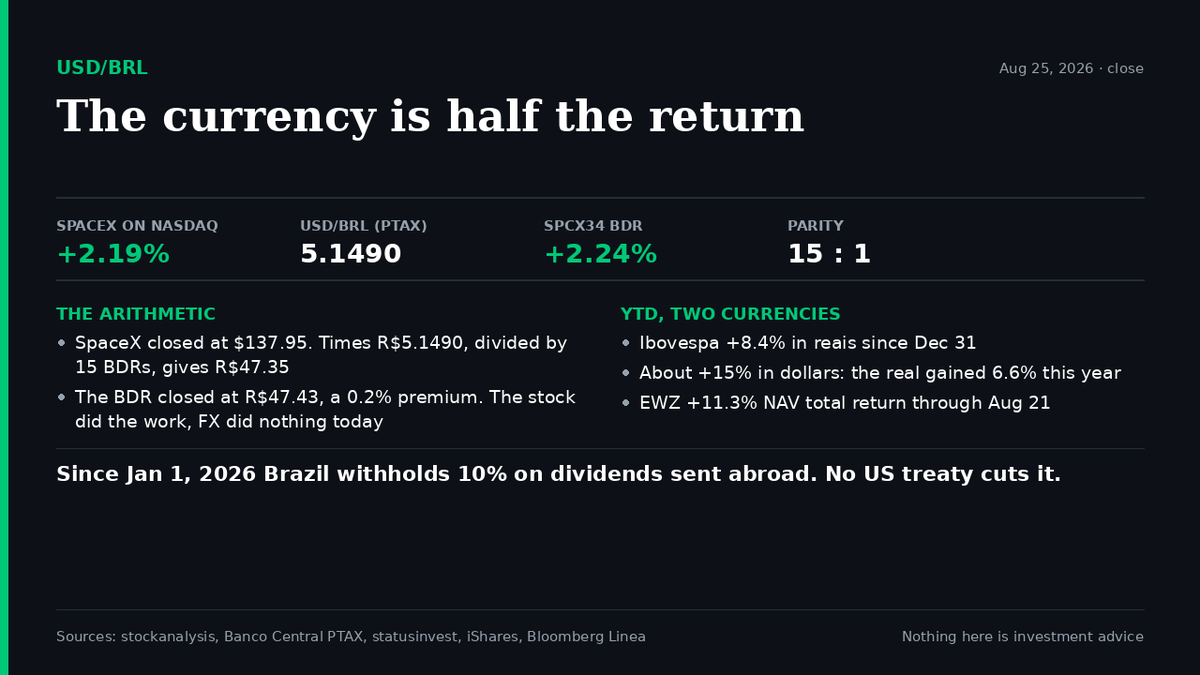
The dollar closed near flat, with the central bank's PTAX reference at R$5.1490. Year to date the Ibovespa is up 8.4% in reais. In dollars it is up about 15%, because the real has gained roughly 6.6% against the dollar this year. EWZ, the vehicle you can actually buy, is up 11.3% on NAV total return through August 21. The wedge between those numbers is the fund's 25/50 concentration cap, its 0.59% fee, and dividend withholding.
Since January 1, 2026 Brazil withholds 10% on dividends remitted abroad, under Lei 15.270/2025. There is no floor and there is no treaty relief, because Brazil and the United States have no tax treaty in force. That is a permanent drag on Brazilian dividend yield for a US holder, and almost nobody prices it in.
The cleanest illustration of currency mechanics, from my own book. SpaceX closed at US$137.95 on the Nasdaq, up 2.19%. Its Brazilian depositary receipt, SPCX34, closed up 2.24% at R$47.43. Fifteen receipts equal one share, so the theoretical price is 137.95 times 5.1490 divided by 15, or R$47.35. The receipt printed a 0.2% premium to that. Today the stock did all the work and the currency contributed nothing. On a day when the real moves 2%, that same receipt can move opposite to the stock, and holders who skip this arithmetic end up confused about what they own.
WHAT I AM WATCHING TOMORROW
Nvidia reports. The PCE inflation print lands. Brazil publishes IPCA-15, the mid-month inflation preview, at 9am local. And on Friday, Fed chair Kevin Warsh gives his first Jackson Hole speech, which matters more for Brazilian equities than anything on the Brazilian calendar, because the entire foreign flow story runs through long US yields.
HOW A US INVESTOR CAN ACTUALLY TOUCH THIS
ADRs: PBR and PBR.A for Petrobras, the state-controlled oil producer, ITUB for Itaú Unibanco, the largest private bank in Latin America, VALE for the miner, ABEV for the brewer. ETFs: EWZ and FLBR. Not recommendations, just the map.
One tax note that costs people real money. Brazilian-domiciled funds, real estate funds and ETFs are treated as PFICs by the IRS, which means Form 8621 and a genuinely unpleasant outcome. ADRs, EWZ and FLBR are not. If you hold an account in Brazil, FBAR and Form 8938 apply.
My own book closed 9 of 11 names higher. The full card is attached. The two losers were Petrobras at -1.80% and Smart Fit, the gym chain, at -0.85%.
Nothing here is investment advice.
Data as of the close on August 25, 2026. Sources: Reuters, InfoMoney, Bloomberg Línea, Investing, Banco Central (PTAX and Selic), IBGE, B3, stockanalysis, statusinvest, iShares, Siblis Research.
@OliverStuenkel The market repriced that inside a day: open interest in Ibovespa 200,000-strike November calls jumped from 1.1 million contracts to 4.5 million, per Bloomberg, and the index closed up 1.61% at 174,668, a fifth straight gain.
@judahrhodie The onshore side matches your November expiries: open interest in Ibovespa 200,000 November calls went from 1.1 million contracts to 4.5 million in one day, while foreigners pulled R$ 23.2 billion of cash out of B3 this month, so the bullish bet is in options, not stock.
@schaeffers The onshore leg explains it: open interest in Ibovespa 200,000-strike November calls jumped from 1.1 million contracts to 4.5 million in a single day, per Bloomberg, as Lula's polling lead over Flavio Bolsonaro narrowed, and the index closed up 1.61% at 174,668.
@CanarinhoFNC Tough for the index, not for the currency: foreigners pulled R$ 11.9 billion out of the B3 in the first seven sessions of August, so the ten-session streak is flow leaving, not earnings breaking.