I found I am quite interested in testing area. Thus, my next step is researching on hive (https://t.co/JsGMZvEmAb), a testing framework for better deterministic testing in Ethereum.
and here is my week2 update: https://t.co/cTc8uSuz7o
🤠update epf week2
for the last two weeks, I updated my progress daily and I found the effect was not very good. I did not dig into things deeply, so I will try to change the form.
Last week I met some issue and decided to switch to another project. I took some research on Deterministic Simulation Testing.
> Deterministic simulation testing is an advanced approach to software testing that enables developers to find and reliably reproduce complex bugs in distributed systems, such as bugs caused by concurrency, multi-threading, and timing issues.
TigerBeetle is one of the first adopter of dst in their system
1. TigerBeetle's dst is called VOPR. (see https://t.co/YqE5hbZDmj).
2. they found 30 bugs which used dst to reproduce them; if there weren't dst, they will spend whole year debugging and trying to find how did it happened.
3. dst often works with fuzzing and unit tests.
DST has some engineering limits:
1. it has to implemented from day one, including all the nondeterministic components and the dependencies.
2. the interface should be clear (i.e., TigerBeetle has `Time` type, using `TimeSim` for simulator and `TimeOs` for production use.)
I think 2. is pretty compatible with Zig and also think that was why they chose Zig as the language.
Personal news: I've joined @Morpho full-time as a solutions engineer focusing in the APAC region.
I've been public about my obsession with Morpho since the protocol showed up in 2023, and I've been building @monarchlend for more than two years. Along the way I've talked to countless teams and individuals building on top of Morpho, and it became clear to me that this immutable contract is becoming one of the most trusted pieces of code on EVM.
What I didn't see at the beginning is how much Morpho has quietly been doing to onboard the real world — a team bigger than any other in DeFi, dedicated entirely to that movement. That's some unprecedented effort, compounding for three years.
With Morpho Midnight coming, lending is about to expand fast. Midnight adds a new dimension — duration — both a challenge and something familiar to TradFi. Risk curation becomes far more than asset selection, and the best curators will push lending to a new level. This is DeFi's one shot to prove smart contracts can be a trustless layer like Ethereum, and make finance better.
If any institution wants to go onchain and manage money for users, I want them to use Morpho. Because as an immutable layer, Morpho gives end users the best protection: the cleanest isolated markets for proper risk assessments, the most trustworthy base layer to settle loans, and the most tools in the ecosystem to keep finance transparent onchain.
That's what ultimately made me join.
I'll keep working on Monarch in my own time, and slowly hand it over to other builders in the Morpho ecosystem in the next few months. I'll make sure Monarch keeps existing as an independent platform and service provider — for anyone who wants a different access point to Morpho. It'll always be here.
Before I joined, I tried to make sure everything I did was best for the Morpho protocol and $MORPHO. After joining, I'll do exactly the same.
Morpho will win.
P.S. 如果有亞太、中文區的夥伴想 connect,歡迎私訊 tg (@)antonasso 或 email [email protected]
3/ I contributed to lodestar in backfill sync for last several months, but the PR hasn't been merged and reviewed yet. I think I will also work on that feature for this week as well.
🤓 update of epf week2 D2
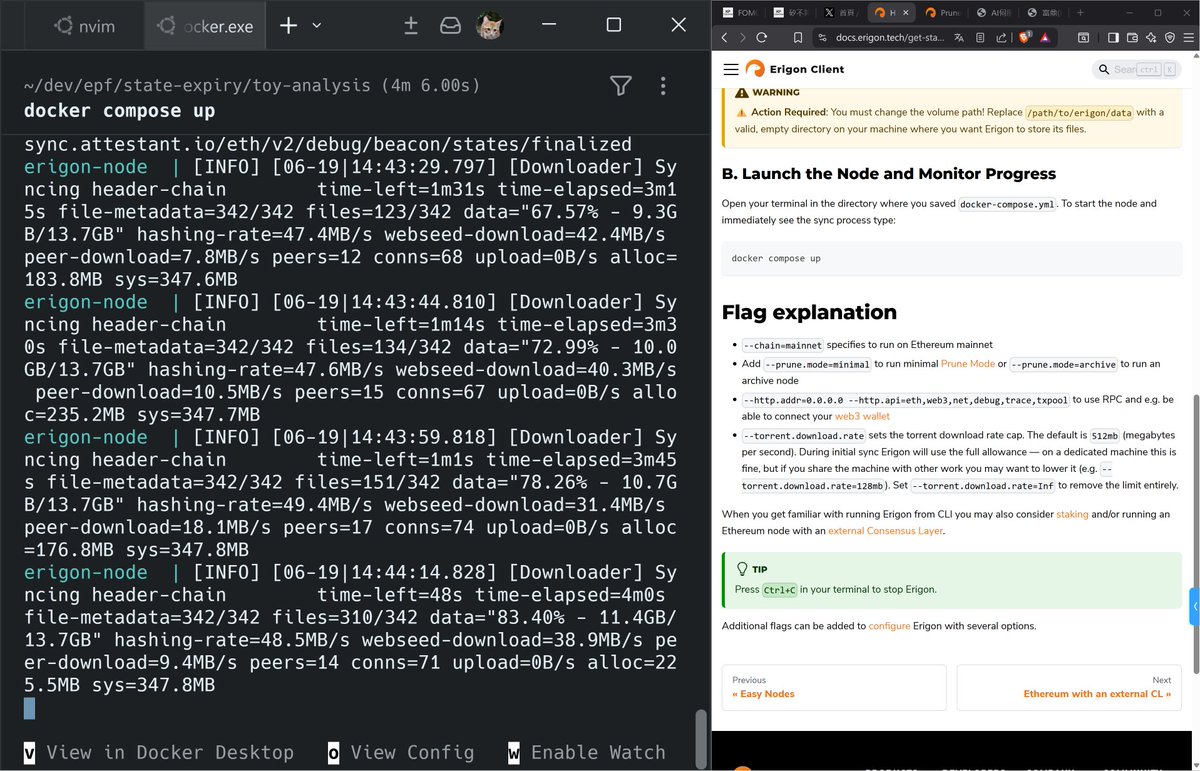
1/ Actually I had nothing too much to update today... but I set up a data pipeline, making it in the multithreaded workers to extract some data from the erigon node. It was running quite slowly; hopefully this will be done by tmr.
2/ I applied a phd position in Sweden in April. The role is about network security. I had a chance to have the interview with the professor today; however, now I have epf and I don't actually convince myself why I want to pursue a phd degree.
this is the reason I couldn't have much update today. But tmr I will be keep working on the data analysis as well.
4/ For the next goal for this week. I think I will use current data to try to extract the write-age and access-age. Currently I am extracting ~50k blocks to collect the SLOAD and SSTORE data into the dataset, and will start to do some data analysis.
I think that's it for today.
🤓 update of epf week2 D1
1/ today on EPF standup, we talked about what we did last week. And I found out that someone wants to do in the same project as me. Would be happy to collaborate!
3/ I wrote a python extractor to successfully extract the trace op codes from my local erigon node data. For example, these are the data get from the latest block:
blocks: 25374706-25374706
storage events: 10949
op
SLOAD 8557
SSTORE 2392
I also store these data into a duckdb for better future use.
This script haven't been tidied up yet, but I will upload and update the repo here.
6/ some thoughts in the first week:
I kind of enjoy the process: understanding things -> sharing here. This enforced me to understand, summarize and keep working on what I don't understand yet. I hope I could be consistently sharing these (even after EPF)!
🤓 update of epf week1 D5
Today I am still focusing on studying related Ethereum state materials, which I find very interesting. my target was to find out how to conduct a state data analysis on Ethereum.