@Lingxiao234 Really cool work! Any thoughts on how this could be extended to contact rich tasks, such as continuous tool usage (e.g. screwing in a screw)
@ArpitBahety Very cool work, will take a read. How is damage simulated? In realistic mechanical failures it’s typically exceeding a yield strength at some point of the object
@j__aehwi Very cool work! Any thoughts on whether it’s possible to generalize between different people at this scale of data? For example: different movement patterns, body types, clothing, etc?
There seems like there would be a combinatorial expansion from these various combinations.
@liu_shuo42927@DJiafei Awesome! Could I get an idea of how the key points with semantic labels are input into the VLM? Like through a prompt where you put 3d coordinates with the object label or some other way?
@DJiafei Really cool work! I see the VLM writes differentiable reward functions by itself. Would this be all in 3D point space because of P as the input being the task-relevant 3D keypoints? So essentially the VLM does guidance toward the proper object in 3D point trajectories?
How far can we push dexterous robot manipulation with human video-only supervision and minimal assumptions?
🚫 No teleop. 🚫 No wearables. 🚫 No external sensors. 🚫 No robot demos.
Introducing VIDEOMANIP: 🎥 Just monocular RGB, 🌍 in-the-wild human video → dexterous robot manipulation 🤚[1/6]
How to convey a robot’s intent and motion such that anyone can understand?
Our #CoRL2025 paper introduces CoRI, a task- and robot-agnostic pipeline that communicates any robot’s intent, given a planned physically-assistive trajectory.
https://t.co/ENrOhbPrNQ
🧵
Introducing FMVP: a method that adapts to natural arm motions during robot-assisted dressing.
Pre-trained on vision in sim, fine-tuned with limited real-world vision+force data, and tested in a 12-user, 264-trial study, FMVP is robust across garments and motions. #CoRL2025
How do we discover a robot's failure modes before deploying it in the real world? Standard benchmarks often don't capture the full picture, leaving policies vulnerable to plausible variations in object shape.
Thrilled that our work, "Geometric Red-Teaming for Robotic Manipulation," has been accepted as an oral presentation at #CoRL2025! We introduce a framework to automatically find these geometric blindspots.
https://t.co/mh84bi7Wbp
🧵
[1/7] Teaching dexterous robot hands to perform functional grasps usually needs hours of teleoperation, manual labeling, or pre-scanning object meshes.
Not anymore.
🔥We are excited to introduce Web2Grasp that learns functional multi-finger grasps straight from web images of human hand-object interactions (HOI).
No human demos. No object scans. Just web images.
👉https://t.co/lOcWgMOpu5
@CMU_Robotics@CarnegieMellon
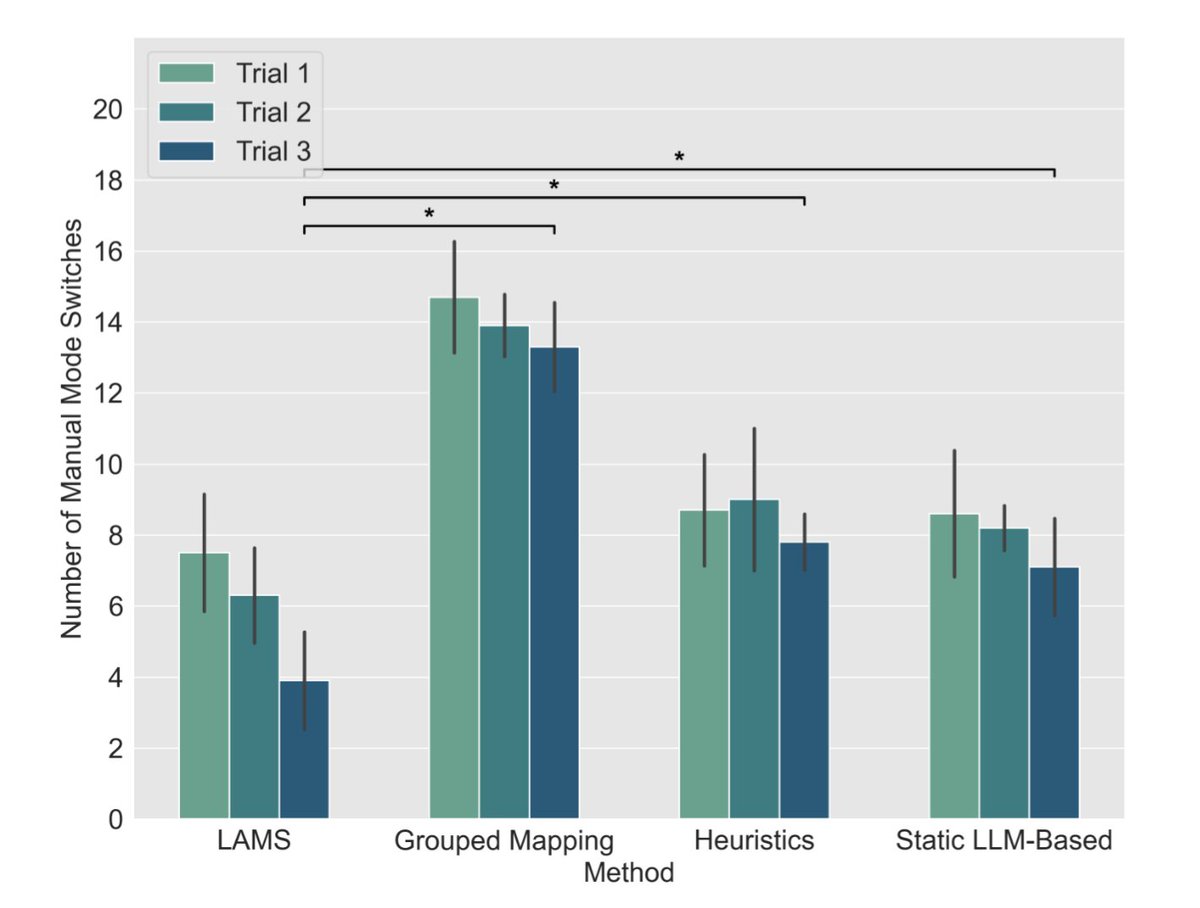
We demonstrate a strong trend toward LAMS improving based on the number of mode switches, and also find that our method is the most preferred mode switching method compared to two baselines for automatic mode switching. (4/4)
Happy to announce our paper on LAMS: LLM-Driven Automatic Mode Switching at HRI 2025!
Our research introduces the use of off-the-shelf LLMs for automatic mode switching in robot teleoperation.
📄Paper: https://t.co/ymjkQG3JWe (1/4)
LAMS leverages the strong zero-shot and few-shot prompting capabilities of LLMs. We give the LLM a single-sentence description of the task. By incorporating user-generated mode-switch examples, we show vast improvements between trials.
(3/4)
We tested some of the most common preprocessing methods and deep learning image classifiers, finding high classification performance across subjects in several datasets, especially datasets using wearable sensors.
Come chat at my poster from 4:30-7:30PM on Thursday! (3/3)
I am at NeurIPS 2024 🇨🇦! I'm presenting my paper on deep learning benchmarking of several EMG datasets across subjects and sessions, as well as few-shot fine-tuning for gesture recognition (https://t.co/fnBqC9Wttn).
EMG is the same neural technology in Meta's Orion AR demo! (1/3)
I'm personally excited to see the recent interest from tech in EMG--it's one of the most accessible ways to read brain signals for rapid, low-level control of computers, prosthetics, and robots. This is both useful for general computing control and for accessibility. (2/3)
Checkout our new NeurIPS paper on using differentiable trajectory optimization for deep RL and IL! Join our poster session at Friday 11-2.
Ziyu will present this paper (he is also applying for grad schools this cycle)